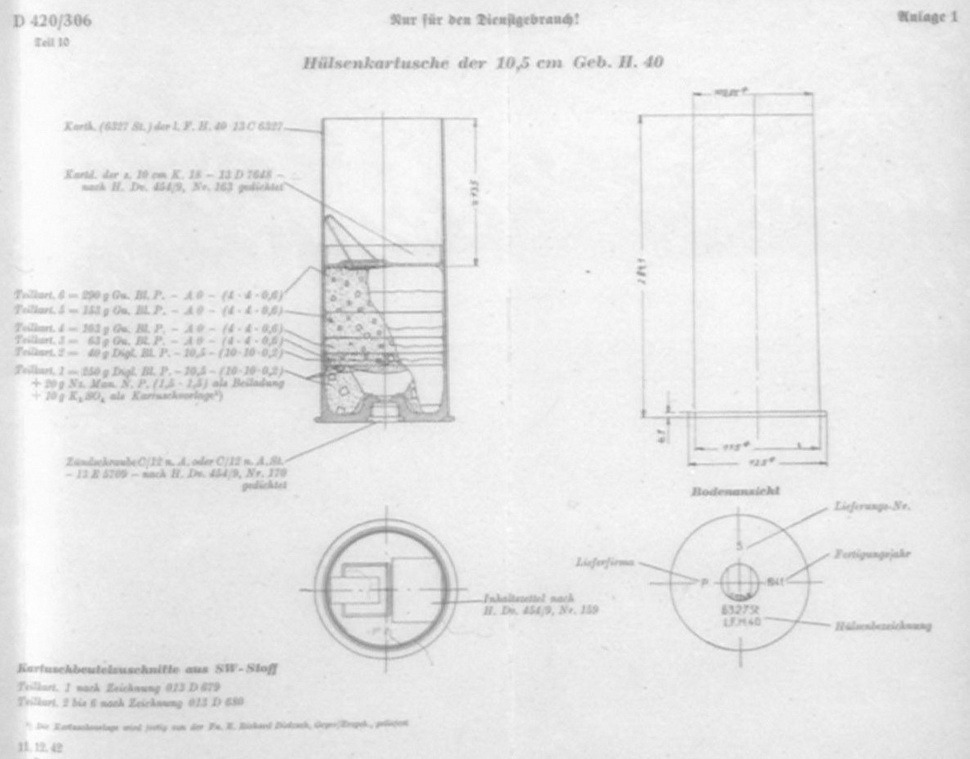
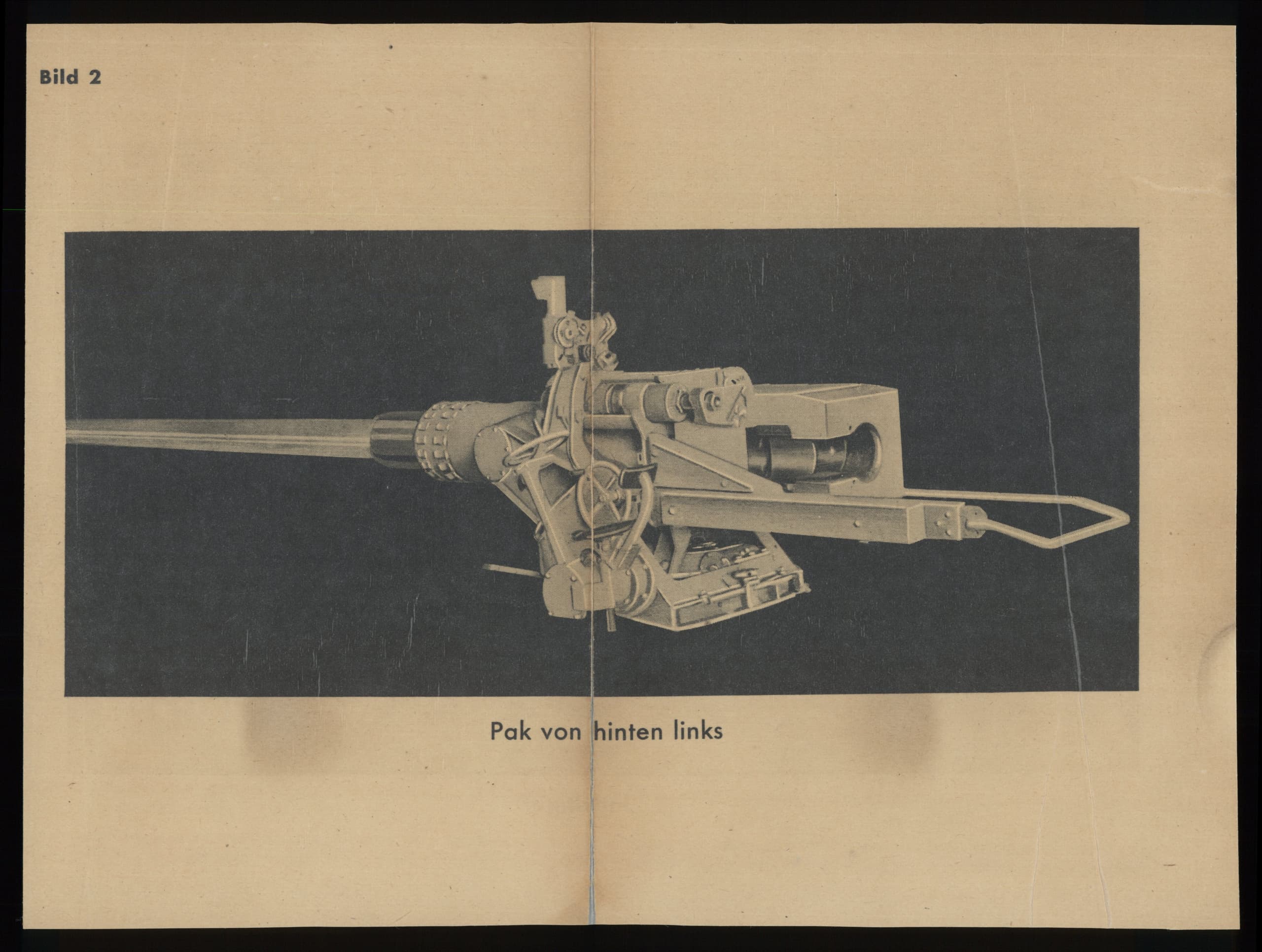
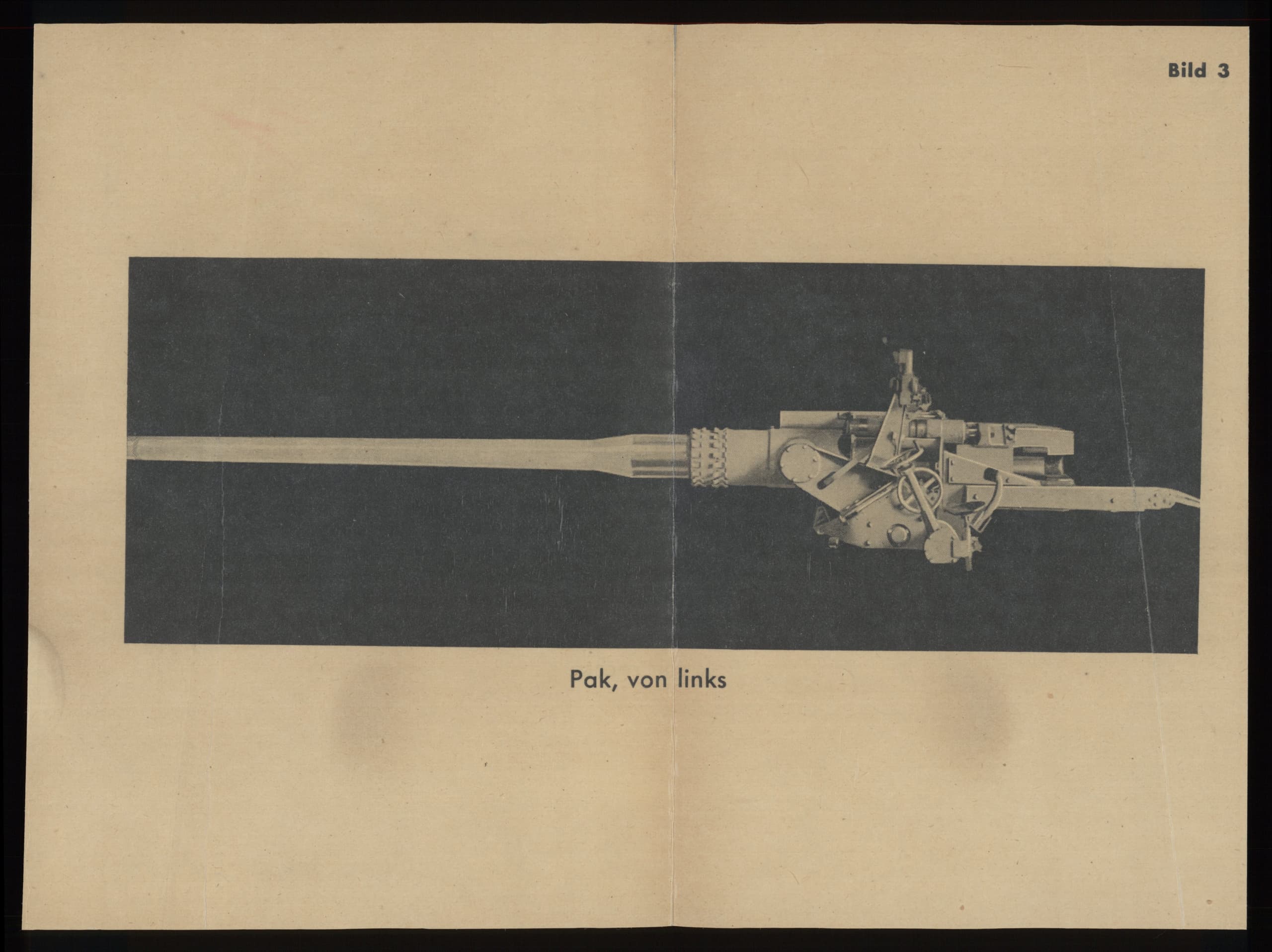
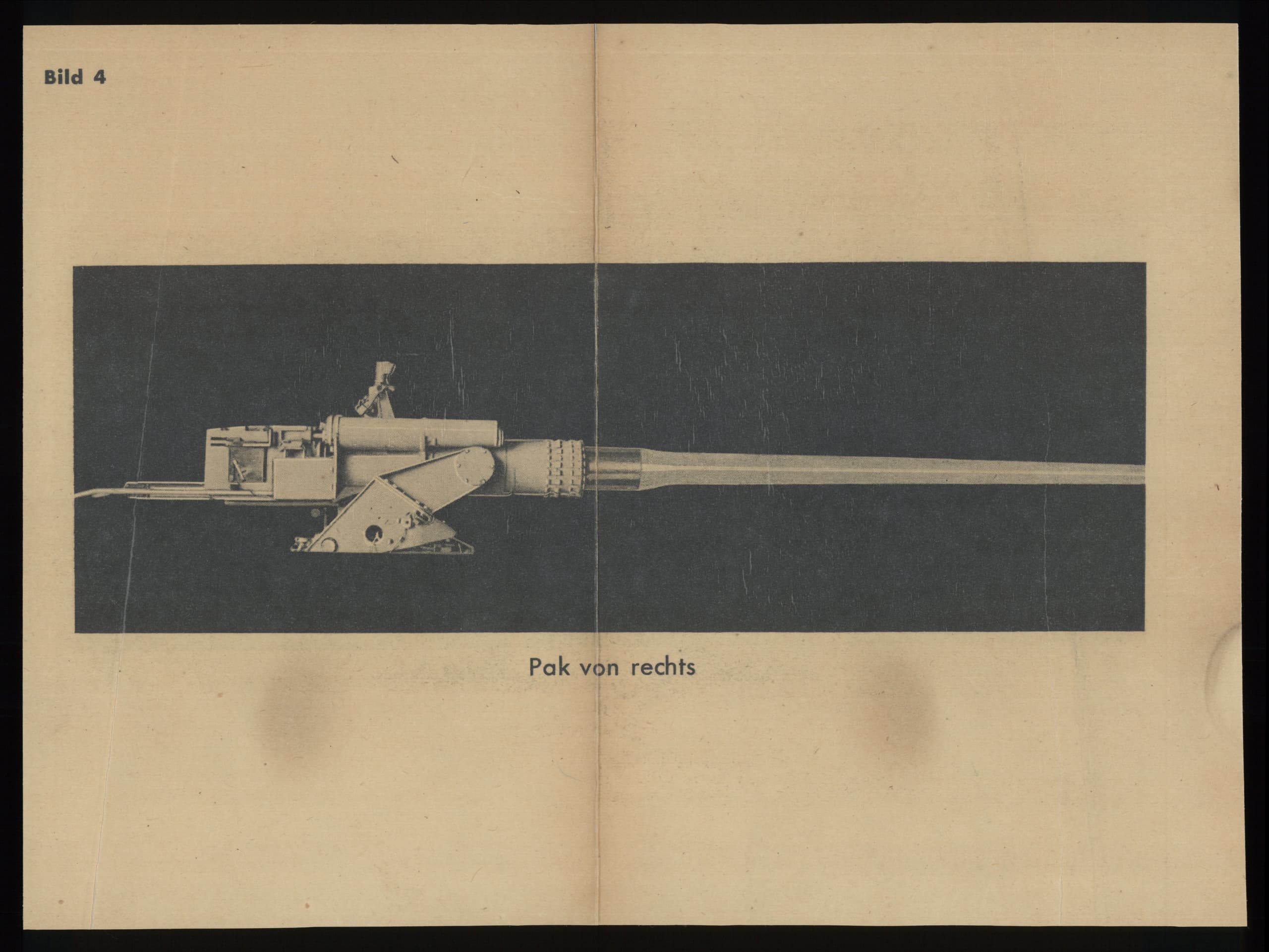
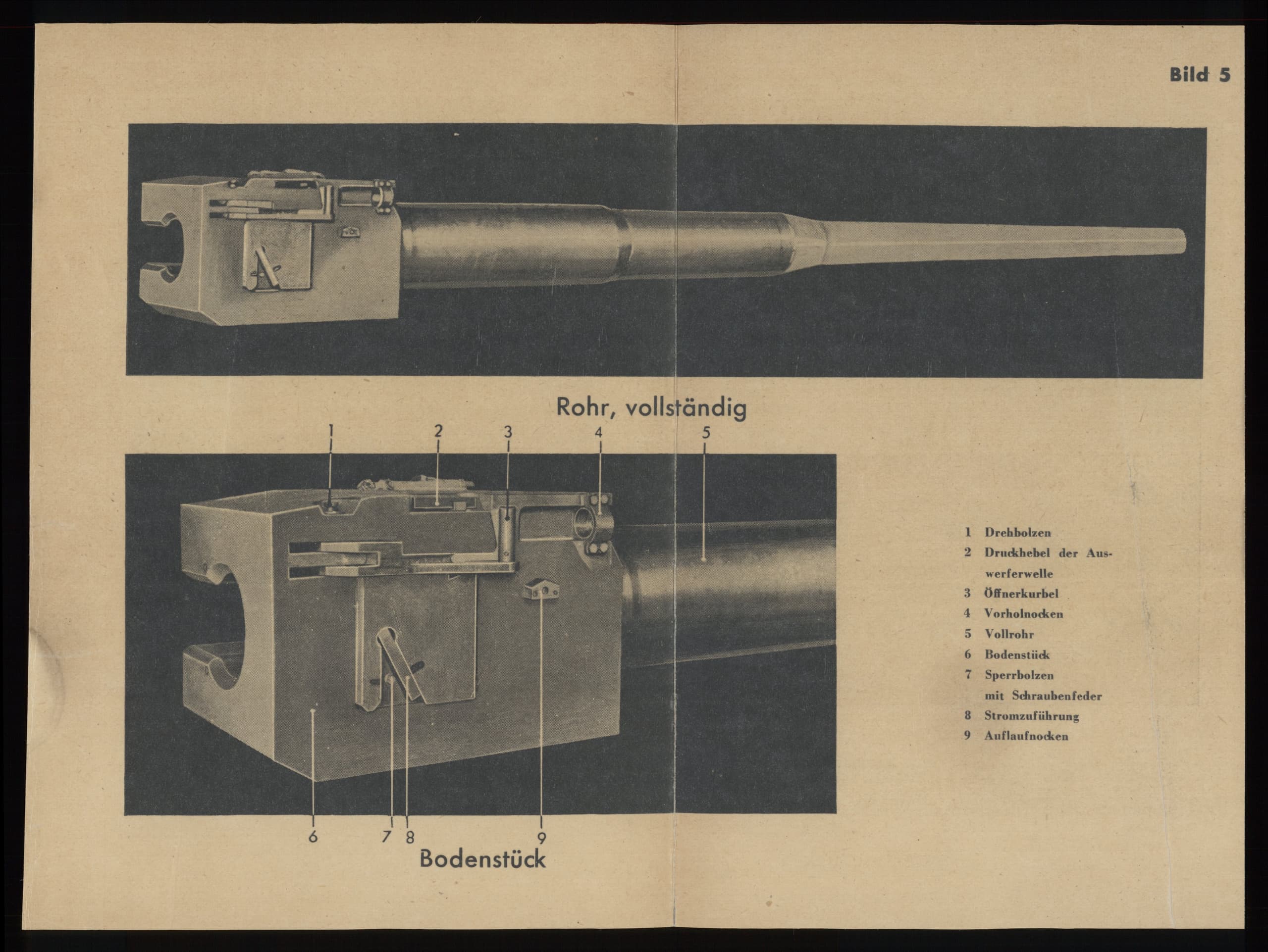
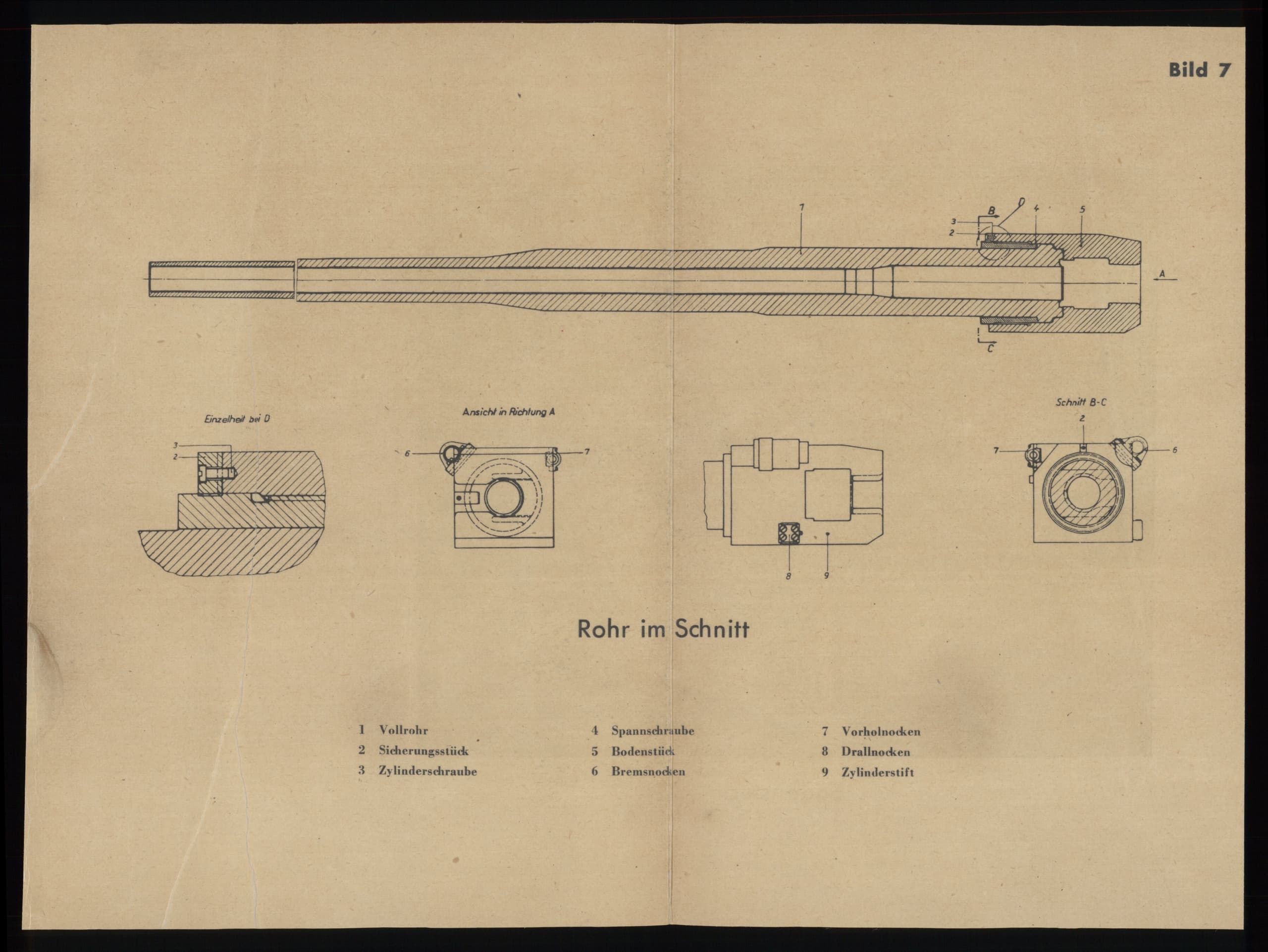
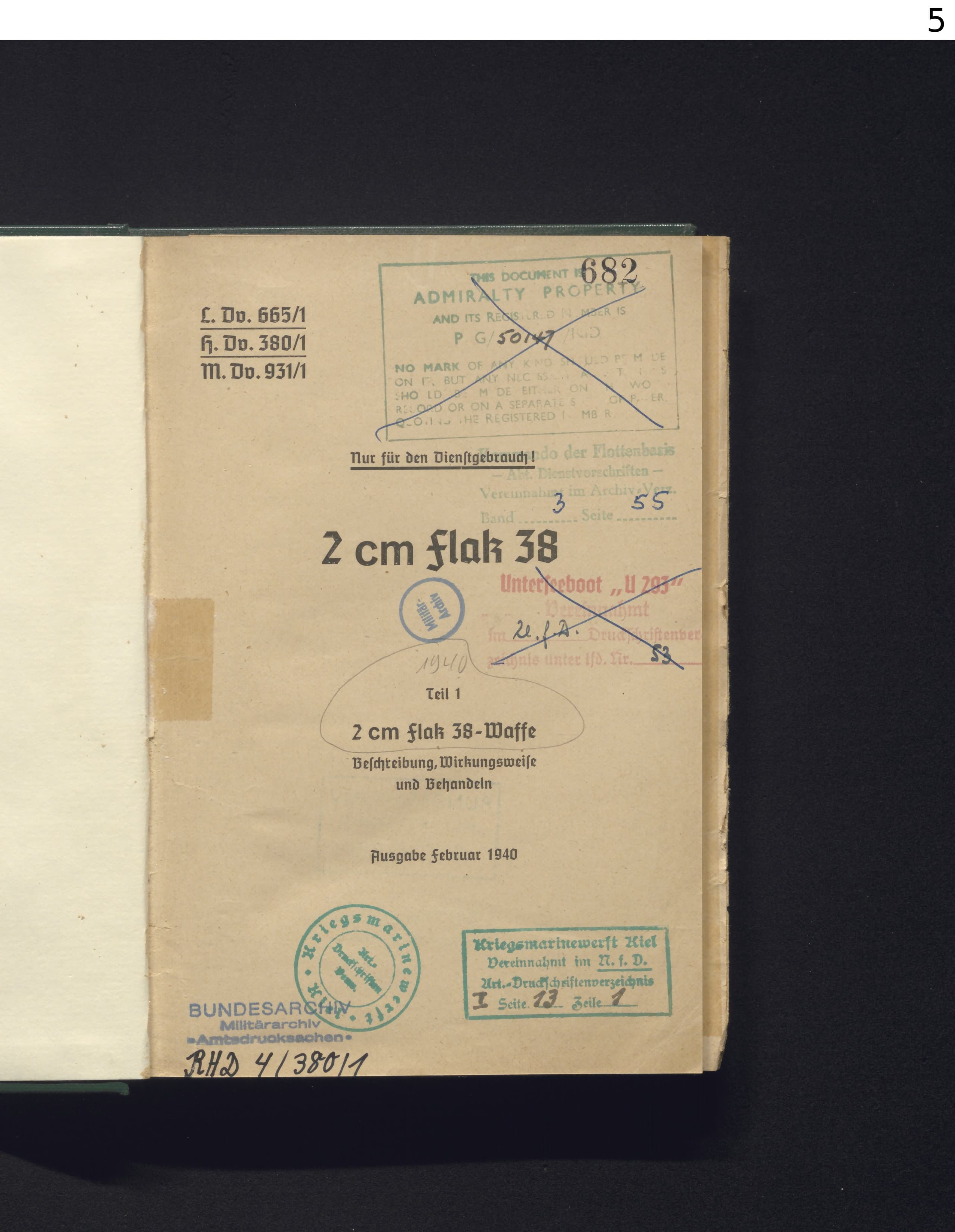
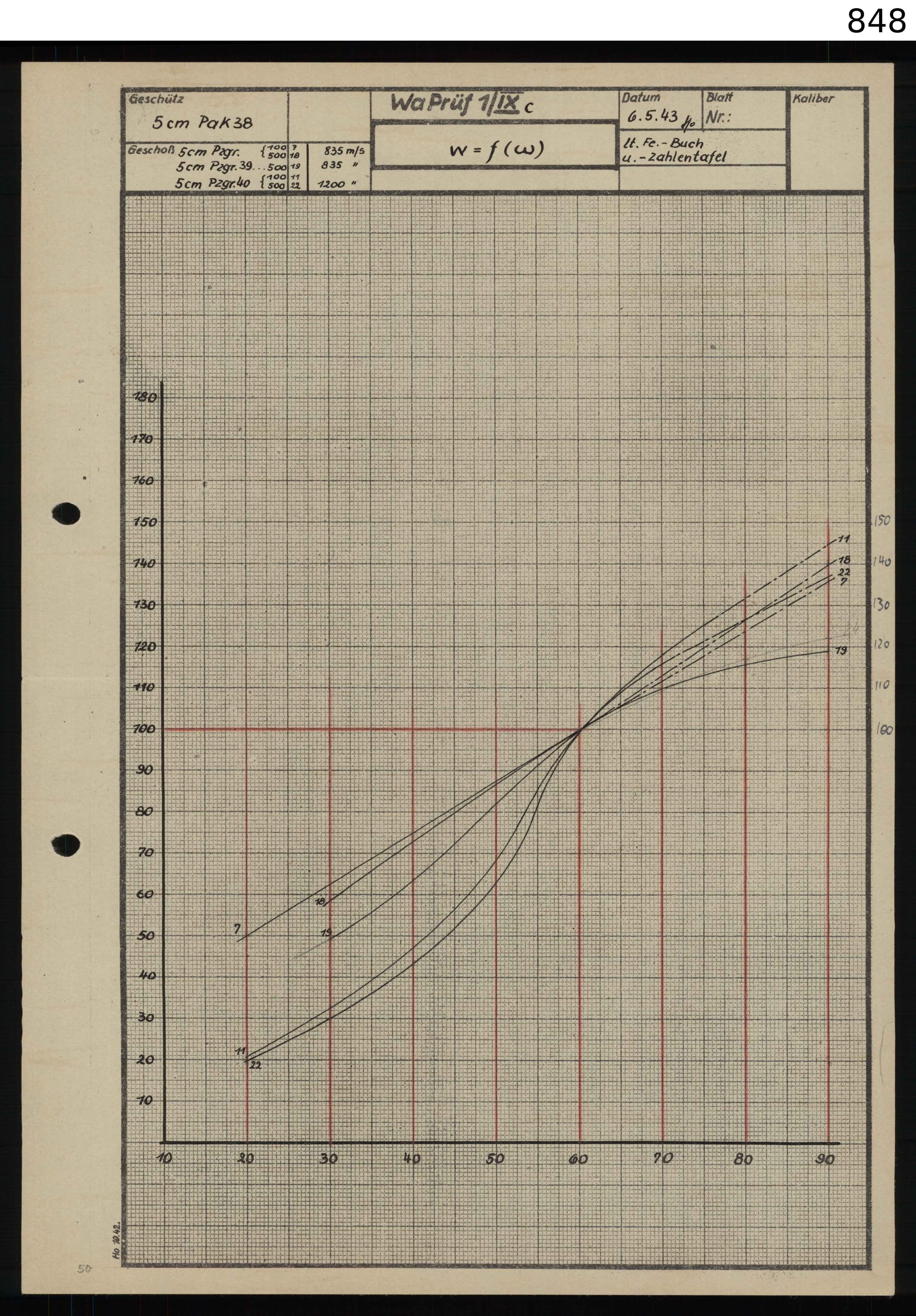
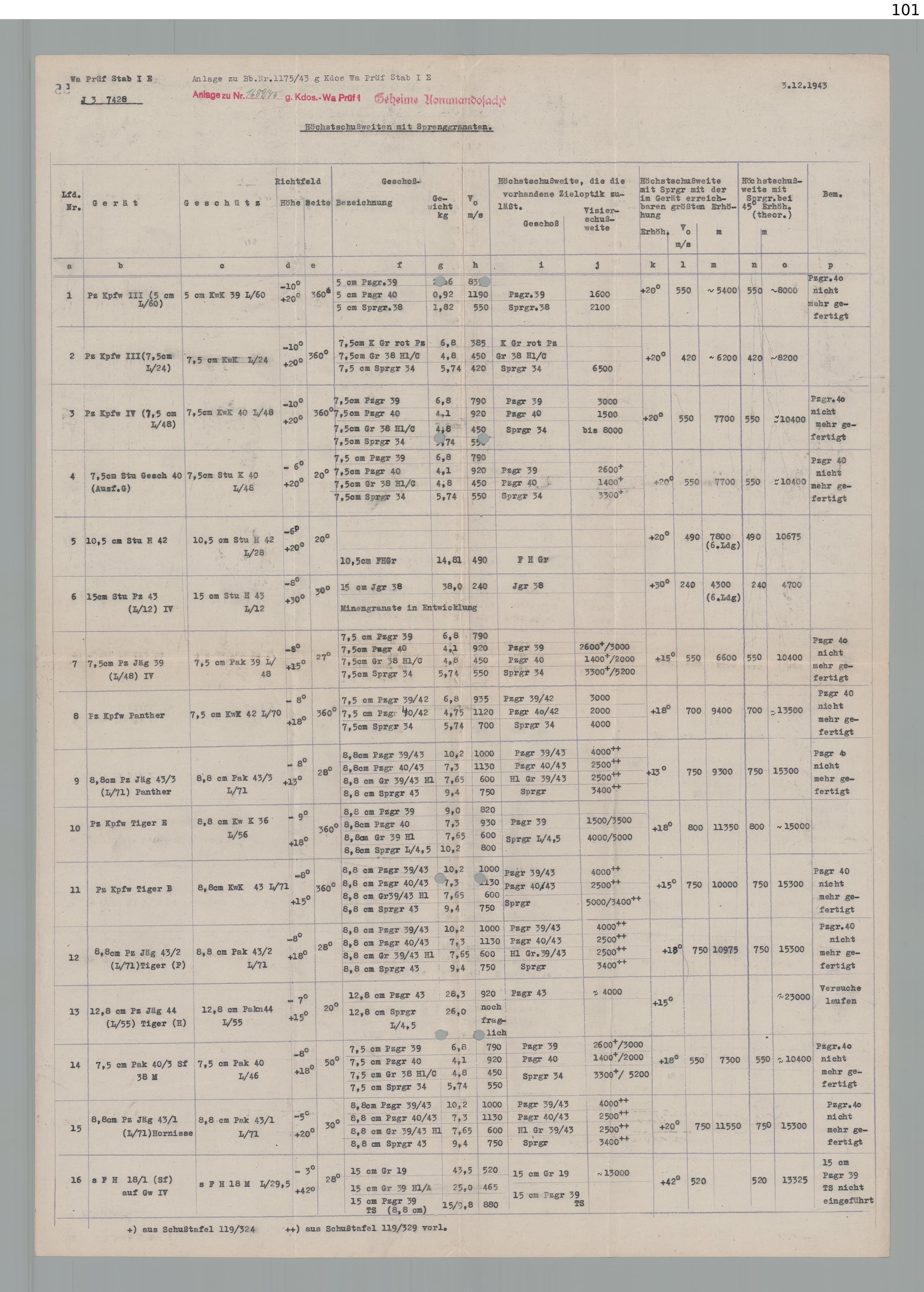
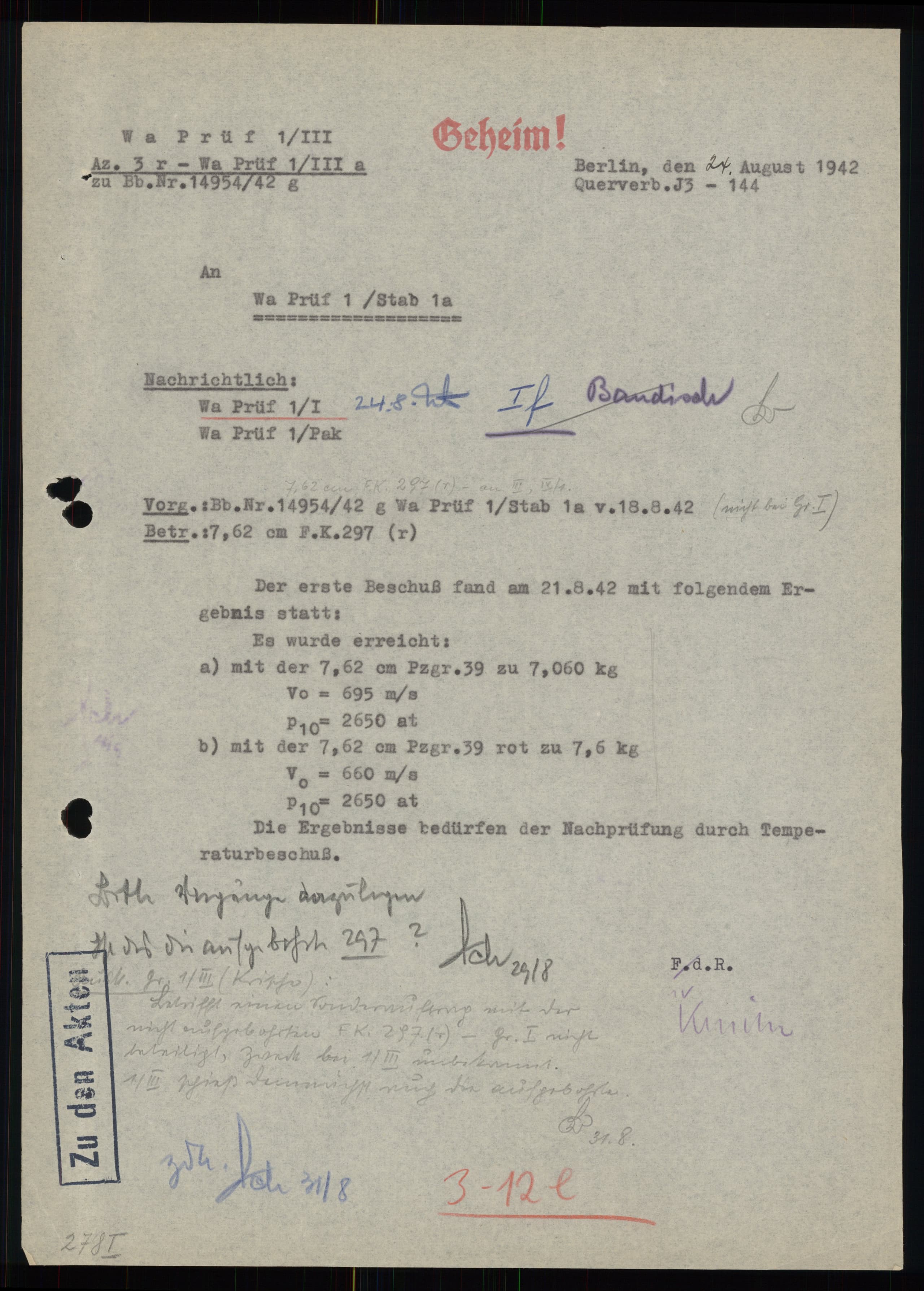
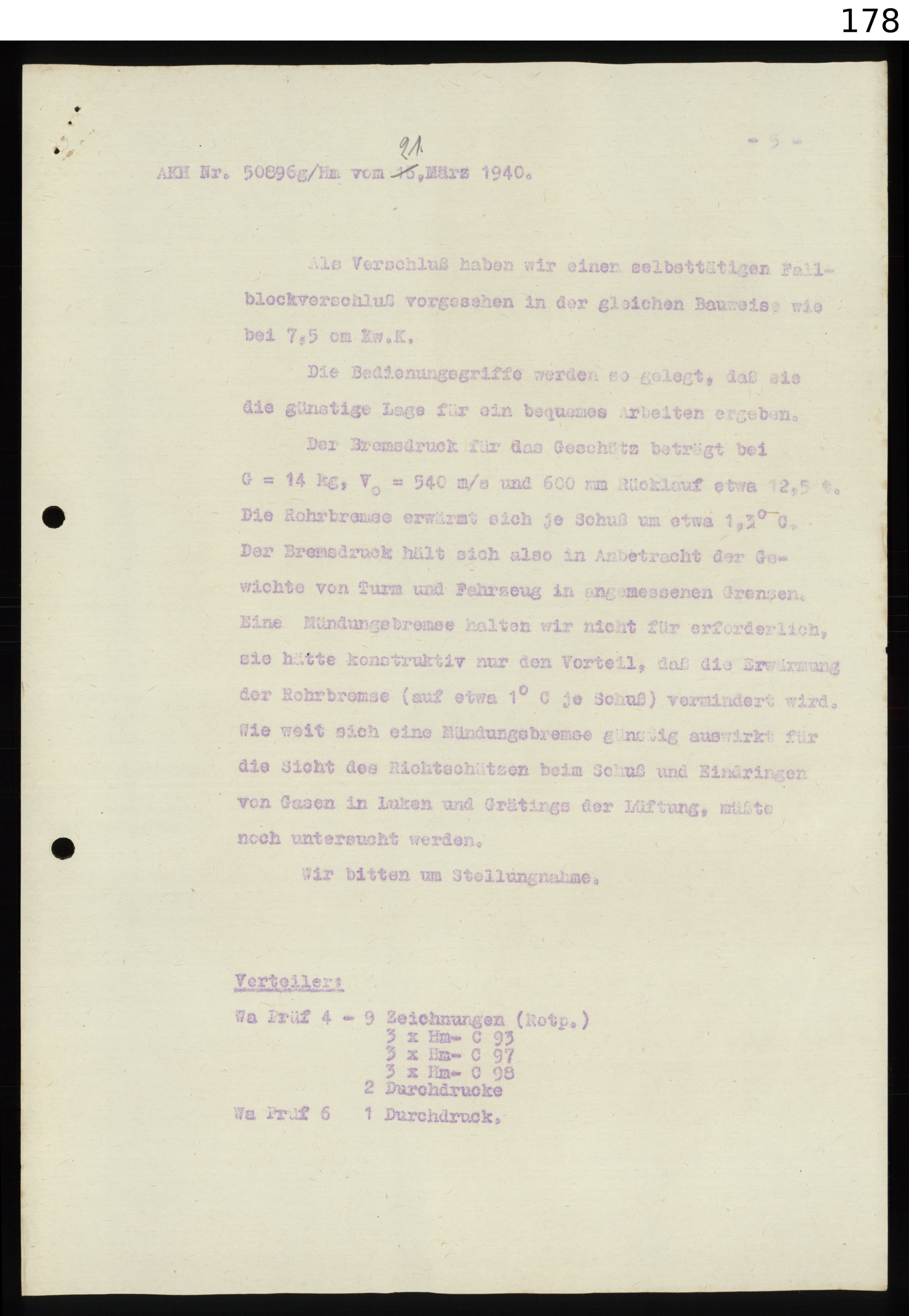
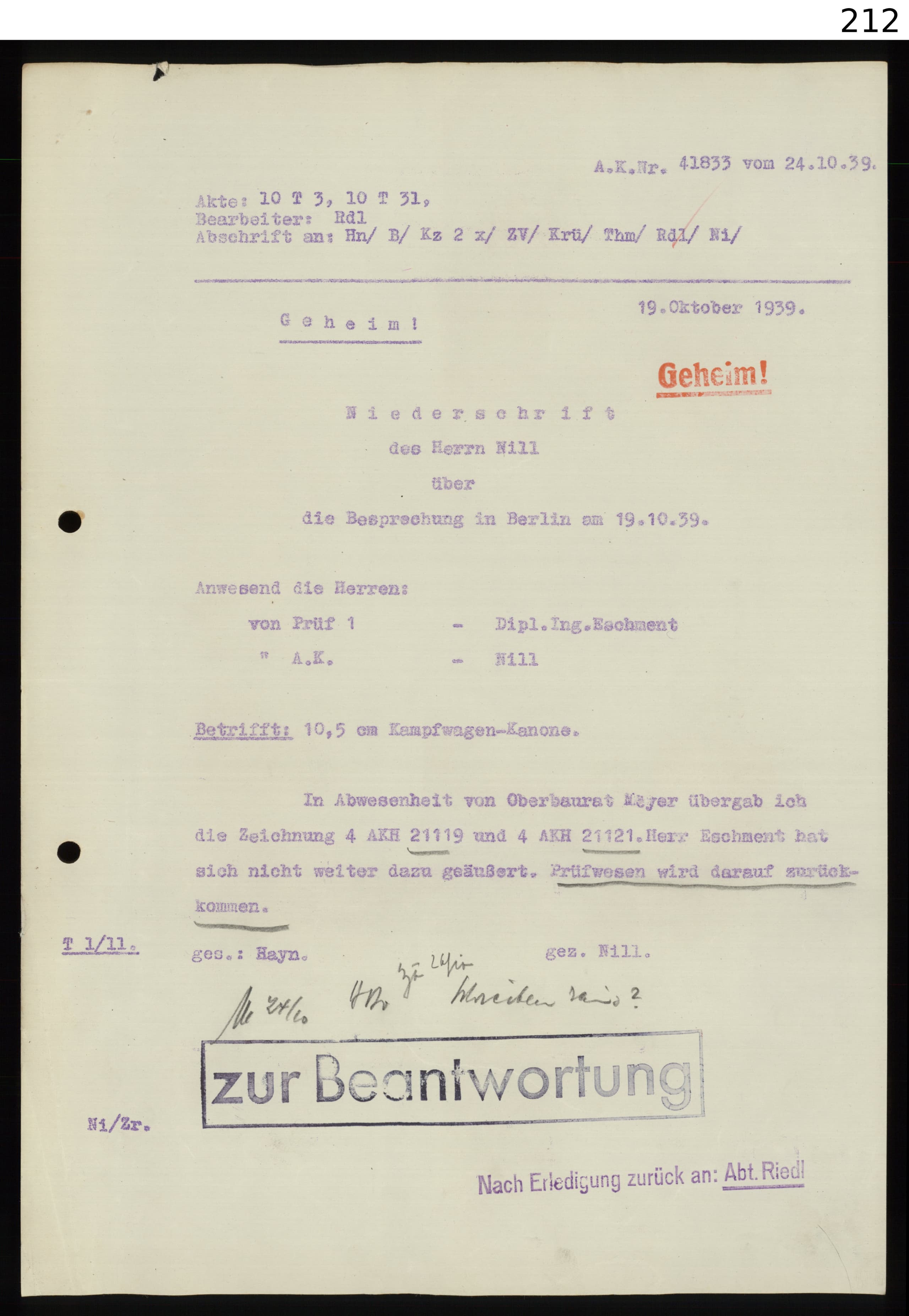
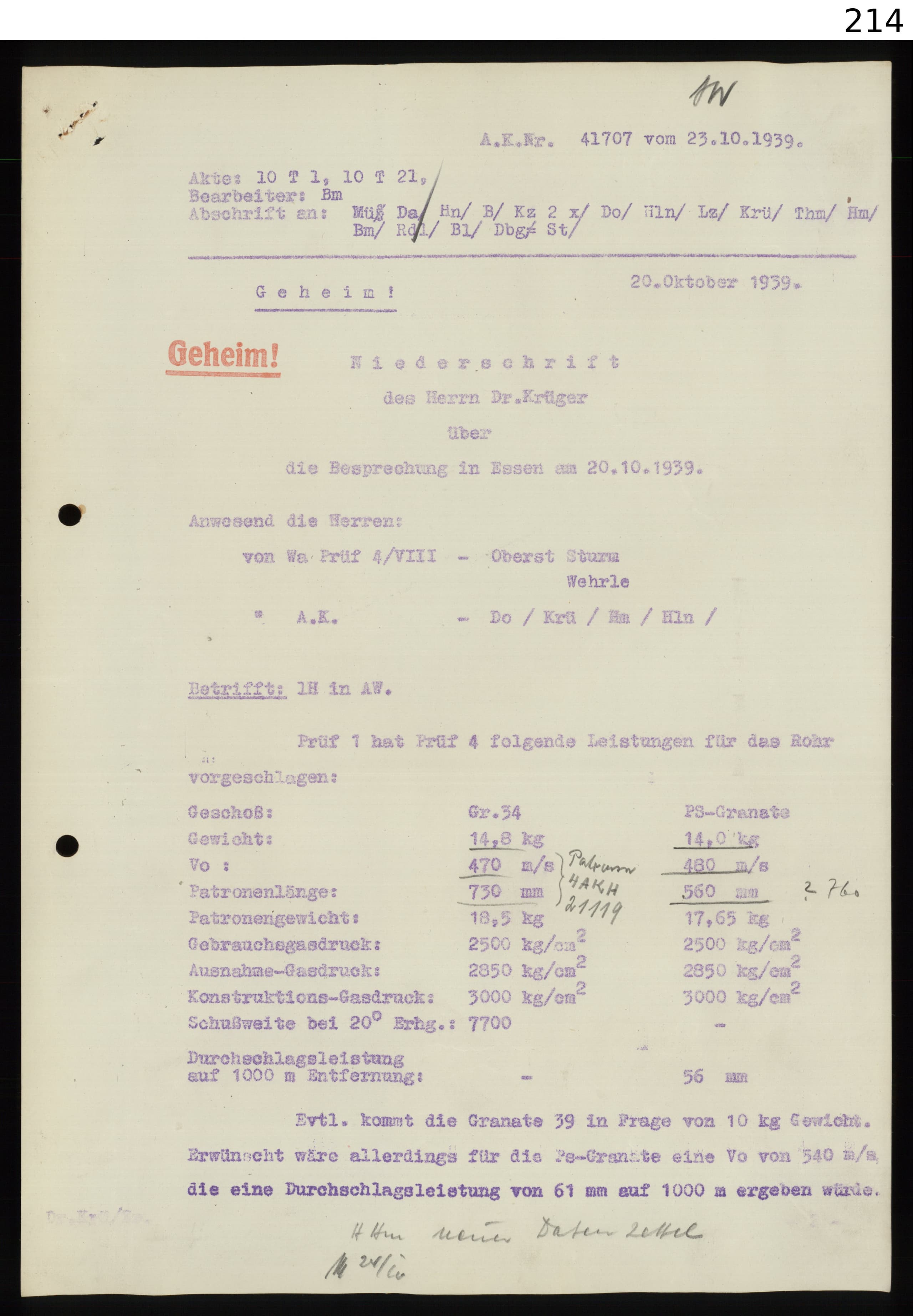
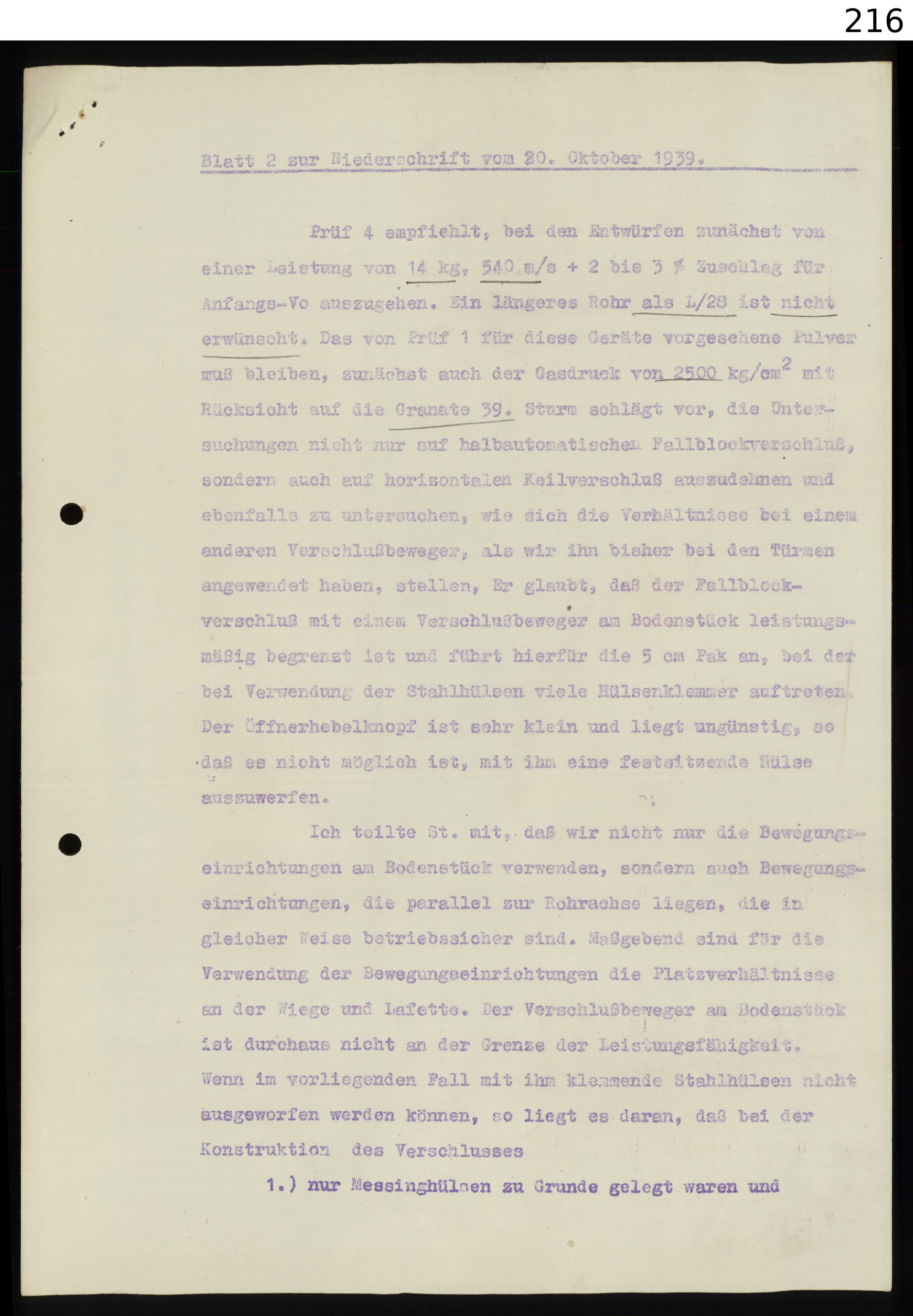
Here I created an Index of Self propelled and used german Tank, Anti Tank, AA and other guns and their ammunition. Going from small (7,92mm) to the biggest (21 cm) Howitzergun which were used in a self propelled form.
WW1 Section is in Part 2.
Also make shure to check out my other Post about Aircraft Armarments.
Ill leave Propaganda Flyer rounds, Marker rounds and most duplicate rounds (of same function) out.
Inside of the folder i will add special info about the ammo and usage (if there are dedicated ones).
If the rounds are Tracerless, ill add that to the Type as “(No Tracer)” (at ammo over 20mm).
For some guns the worn barrel (Schußtafelmäßig) and new barrel velocitys are known, ill writem them simply as xxx/xxxm/s, this is the case with Army guns, as the army was the only one to use lower tabel velocities instead of the full velocity to account for worn (end of life) barrels.
Note, on different rounds, with same casings the length may differentiate, duo to crimping on the shells with holding grooves. Best example the Pak 40s 718mm case, only beeing ~715mm on the Pak 36(r) shells.
7,92 mm
7,92mm Mg 13 K (Kurz/Short)


The Mg 13 Dreyse and the Mg 13 K (Kurz/short) are pretty much identical, however a “shorter” barrle was used, but unlike popular believe, it was just shortened to be in line with the Mg 34 down to 600mm from 718mm. Mainly used in the Pz I, but also prewar desinges of Armored Cars and Trucks, as well as even later on in the war, to simply fill the lines of Mgs as as many as possible were needed. However here i will name the K version as it was the standart use of WW2.
Caliber: 7,92mm
Ammo: 7,92x57mm
Fire Rate: 550-600 rpm
Magazin and Drumfed: 25 and 75 rpg
Muzzle velocity: 785 - 875-915 m/s
Weight: 11,4 kg
Mounting: Coaxial and AA/GP
on Nb.Fz., Pz I and Prewar desinges of Armored Cars and Trucks.
Ammo Types: Ap, Ap-T, Ap(c)
Cutaway of all:(Click to show)


Ap:
S.m.K. (Ap) 11,55g 785m/s 13mm/10m


S.m.K. L'Spur (Ap-T) 10g 810m/s 10mm/10m


S.m.K.H. (Ap(c)) 12,6g 875-915m/s 19mm/91m


Pz-Gesch. (Panzergeschoss) (Ap) 10g 810m/s 13mm/10m
It was mainly designed of 2 tasks, 1. reduce needed amount of lead and copper as the reserves ran out and 2. to increase penetration after the bullet allready passed through aircraft skin (At 100m in comparission to the S.m.K. -v- through 70° 3mm Dualiminium 8,7mm penetration instead of mere 4mm)


7,92mm Mg 34/42


Standart Infantry Mg (from Light to Heavy with Tripod) as well as GP Mg on vehicles, Coaxial and on AA/GP mount. Main Tank Mg till the end of the war duo to the barrle change system, unlike the Mg 42s which conflicted with the mounting, except open turrets and Lafetts (see Sd.Kfz.234/1 Hängelafette) some late war Turrets such as of the Sd.Kfz.234/2 and Schmalturm found on the Panther F
Caliber: 7,92mm
Ammo: 7,92x57mm
Fire Rate: 900 / 1500 rpm
Bletfed per Drum and Bag: 50 - 250/300 rpg
Muzzle velocity: 785 - 875-915 m/s
Weight: 11,5 / 10,6 kg
Mounting: Coaxial and AA/GP
on Nb.Fz., Pz I and Prewar desinges of Armored Cars and Trucks.
Ammo Types: Ap, Ap-T, Ap(c)
Cutaway of all:(Click to show)
Ap:
S.m.K. (Ap) 11,55g 785m/s 13mm/10m
S.m.K. L'Spur (Ap-T) 10g 810m/s 10mm/10m
S.m.K.H. (Ap(c)) 12,6g 875-915m/s 19mm/91m
Pz-Gesch. (Panzergeschoss) (Ap) 10g 810m/s 13mm/10m
It was mainly designed of 2 tasks, 1. reduce needed amount of lead and copper as the reserves ran out and 2. to increase penetration after the bullet allready passed through aircraft skin (At 100m in comparission to the S.m.K. -v- through 70° 3mm Dualiminium 8,7mm penetration instead of mere 4mm)
7,92mm Mg and EW 141 and Pzb.38/39

Initially designed along the Mg 131 and Mg 151, using the Patrone 318 of the Pzb. 38/39/41 it was to offer superior ballistics and penetration compared to the normal Mgs while taking up less space and weight compared to its bigger brothers. Was discontinued duo to extreme barrle wear with the 900 Rpm as well as ammo cost of the S.m.K.H. while overall not beeing as effective as envisioned.
Instead the EW 141 (Einbauwaffe) was developed from it, to be mounted into tanks (Pz I Ausf. C and R.K.9.) but only in Semi-Automatic to reduce barrle wear.
Caliber: 7,92mm
Ammo: 7,92x94mm
Fire Rate: 900 rpm (theoretical, tho only Semi-Automatic) (In game propably limited to 60 rpm)
Bletfed
Muzzle velocity: 1250 - 1450 m/s
Weight: 22,5 kg
Mounting: Main gun in Pz I Ausf. C and R.K.9 Hybrid Tank
Ammo Types: Ap, Ap-T(c) and Ap(c)


S.m.K.H. Rs L'Spur (Ap-T(c)) 14,53g 1250/1280m/s 35mm/10m

S.m.K.H (Ap(c)) 12,6g 1300m/s 35mm/10m

2 cm - 3 cm
2 cm KwK / Flak 30/38 L/65
Pictures:(Click to show)
KwK 30:(Click to show)

KwK 38:(Click to show)

L/50 barrel:
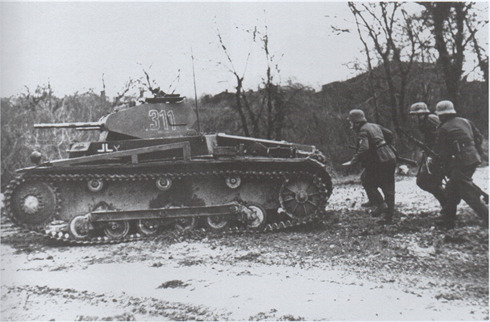
L/65 barrel:
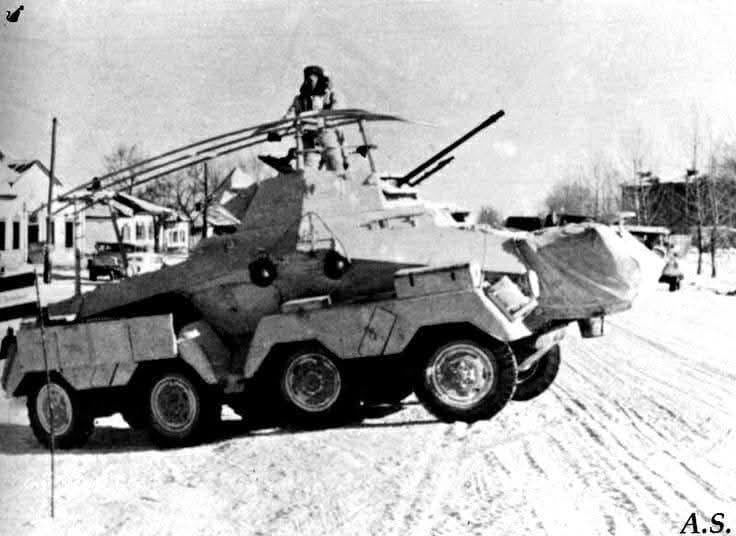
Flak 30:(Click to show)

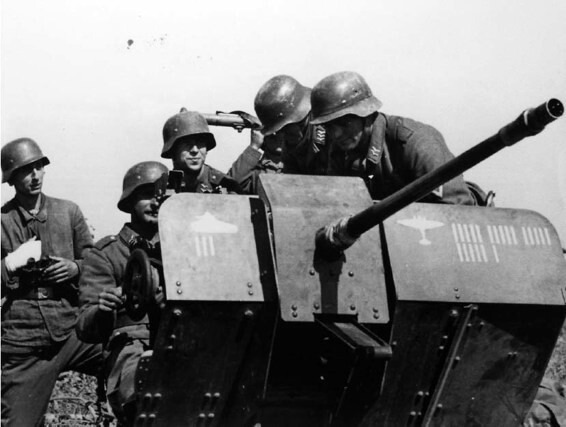

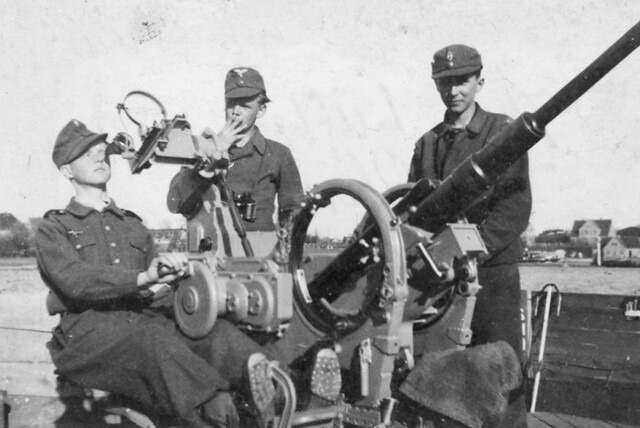
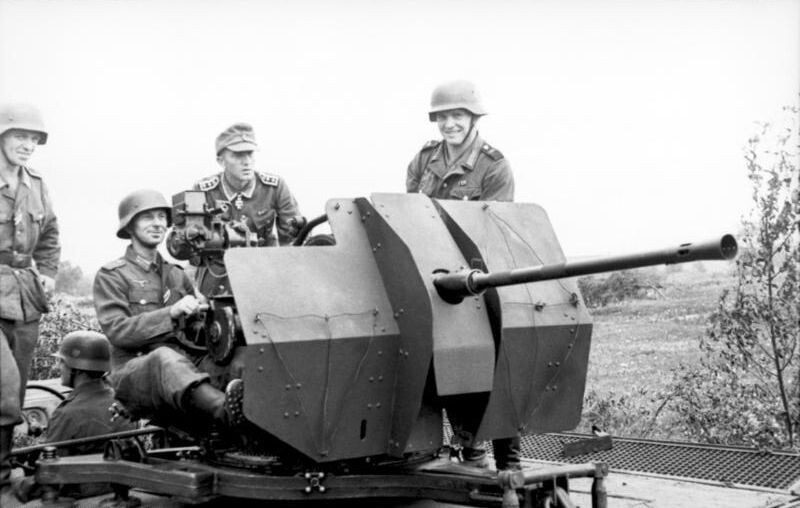
Gebirgsflak 38:(Click to show)
The Gebirgsflak 38 is a lightweight version, which can be disassebled into 3 pieces to carry it by 3 solders.
The Mounting is also lightweight and has increased vertical traverse for fighting in the mountains.

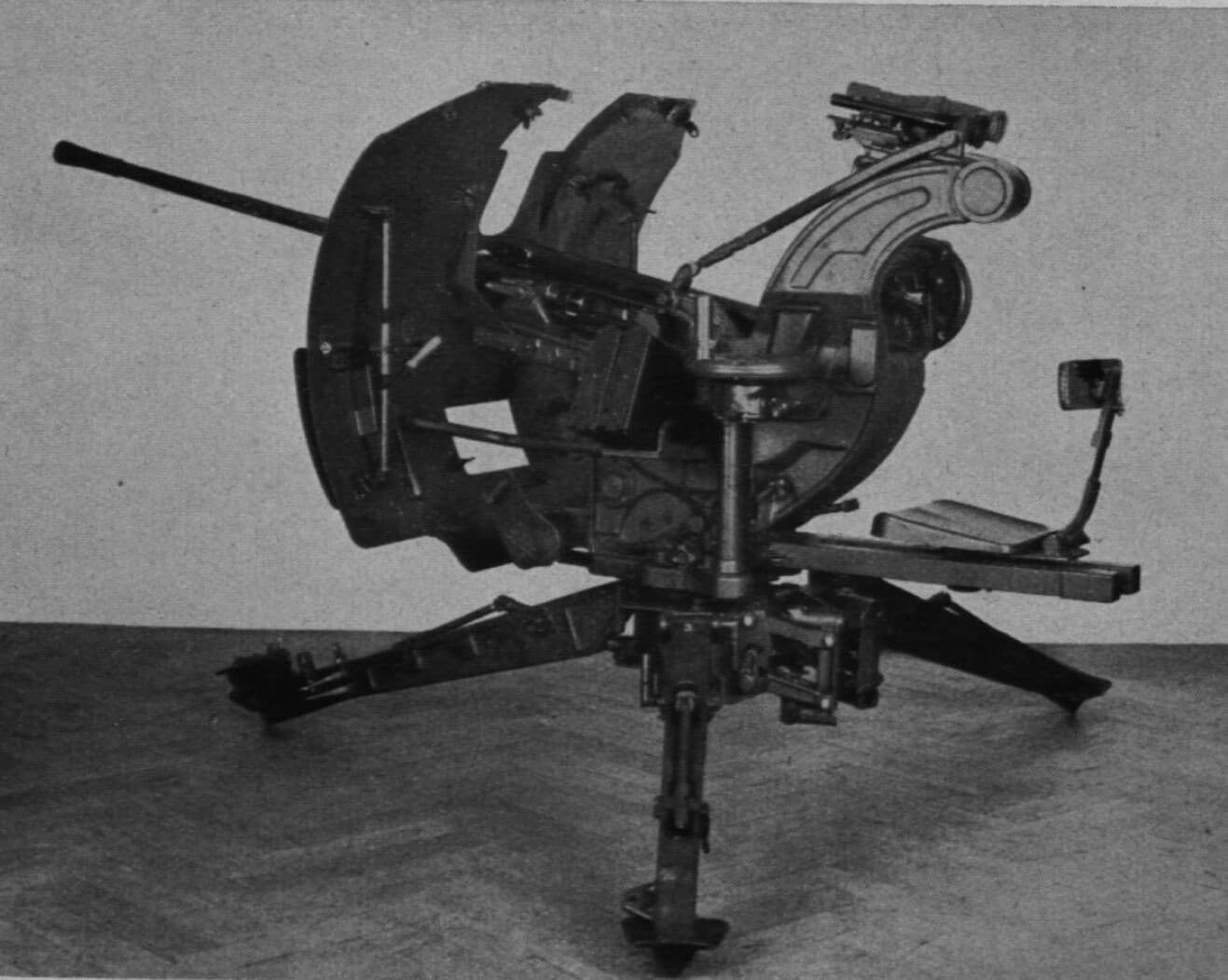
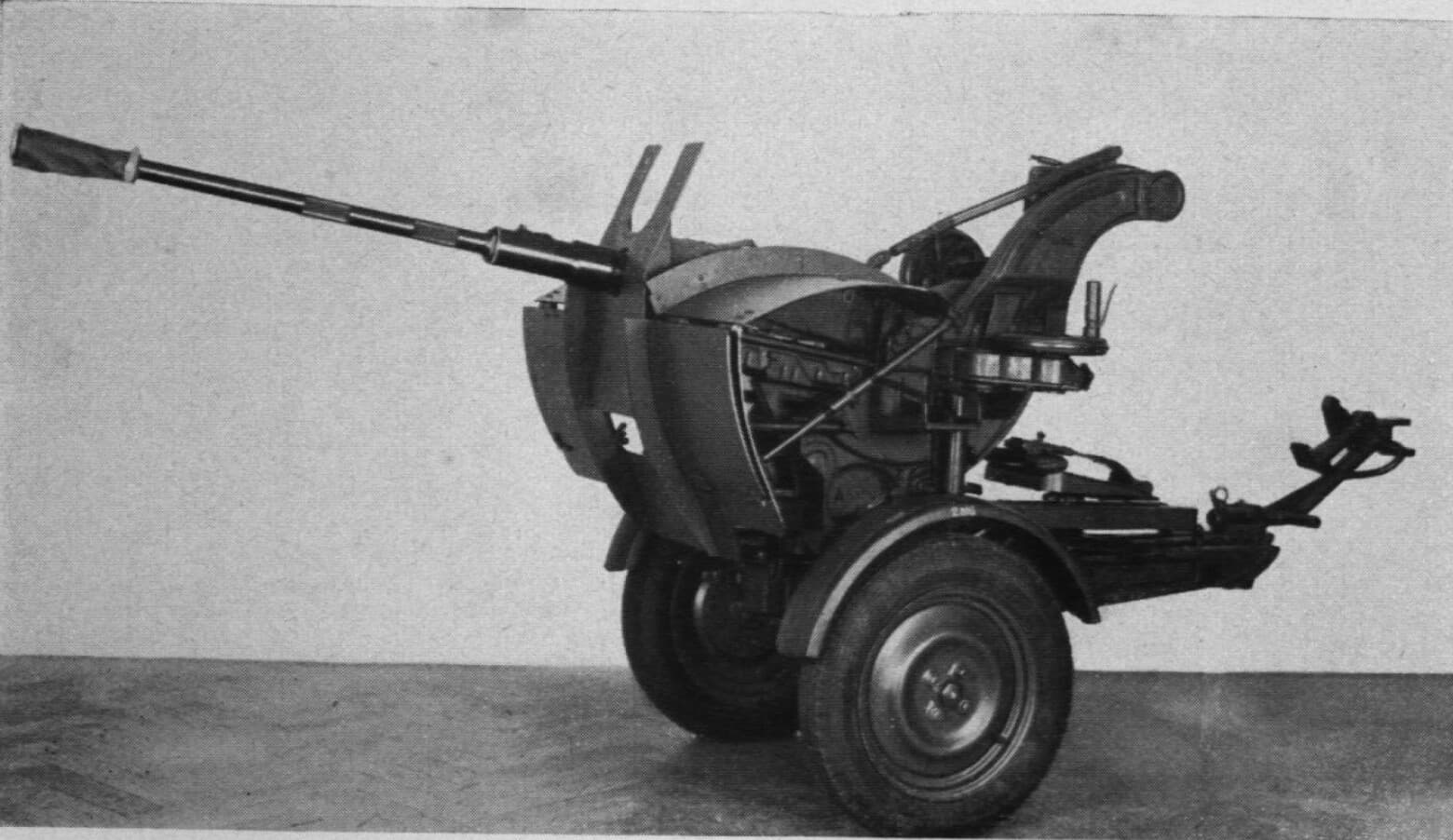
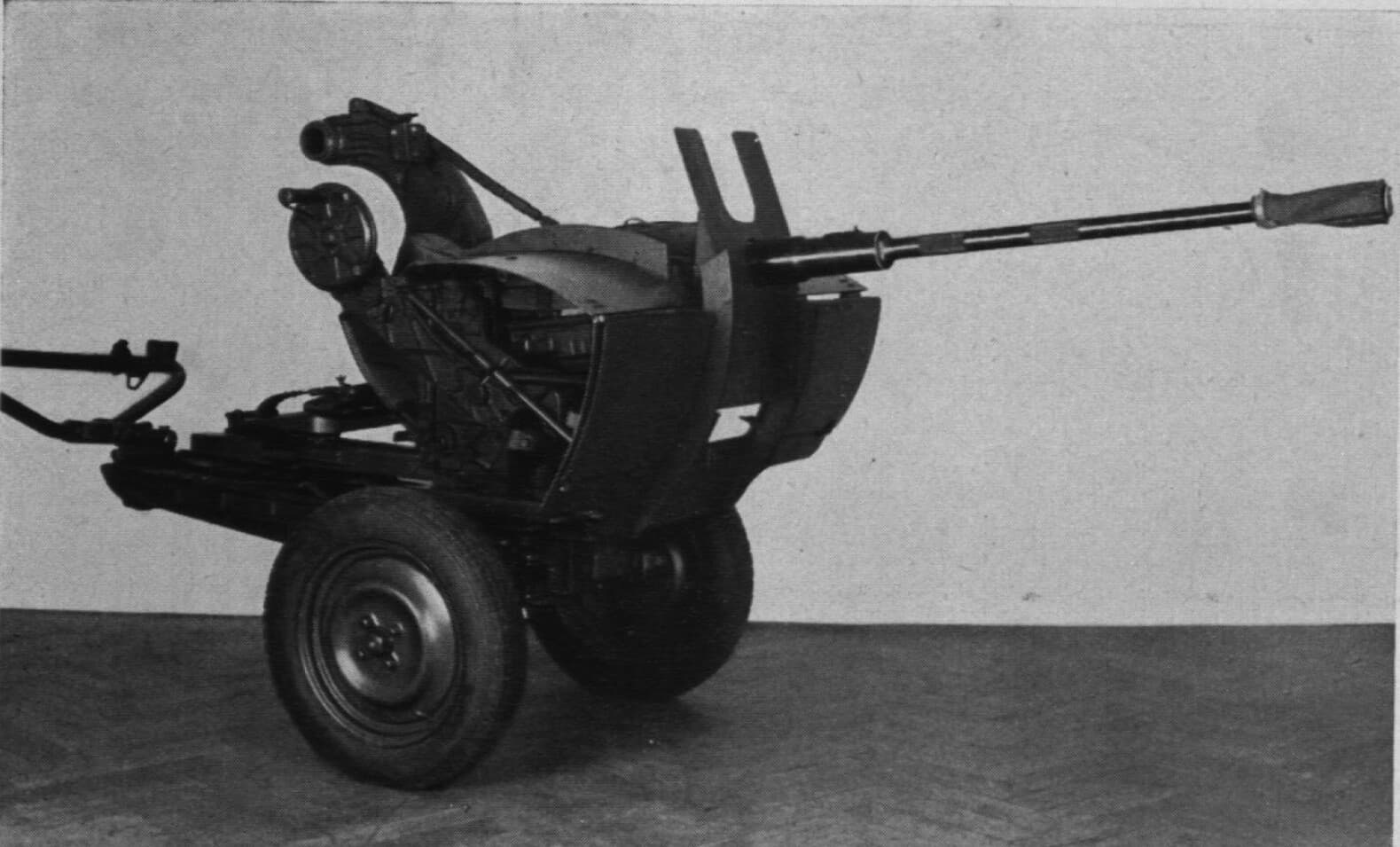
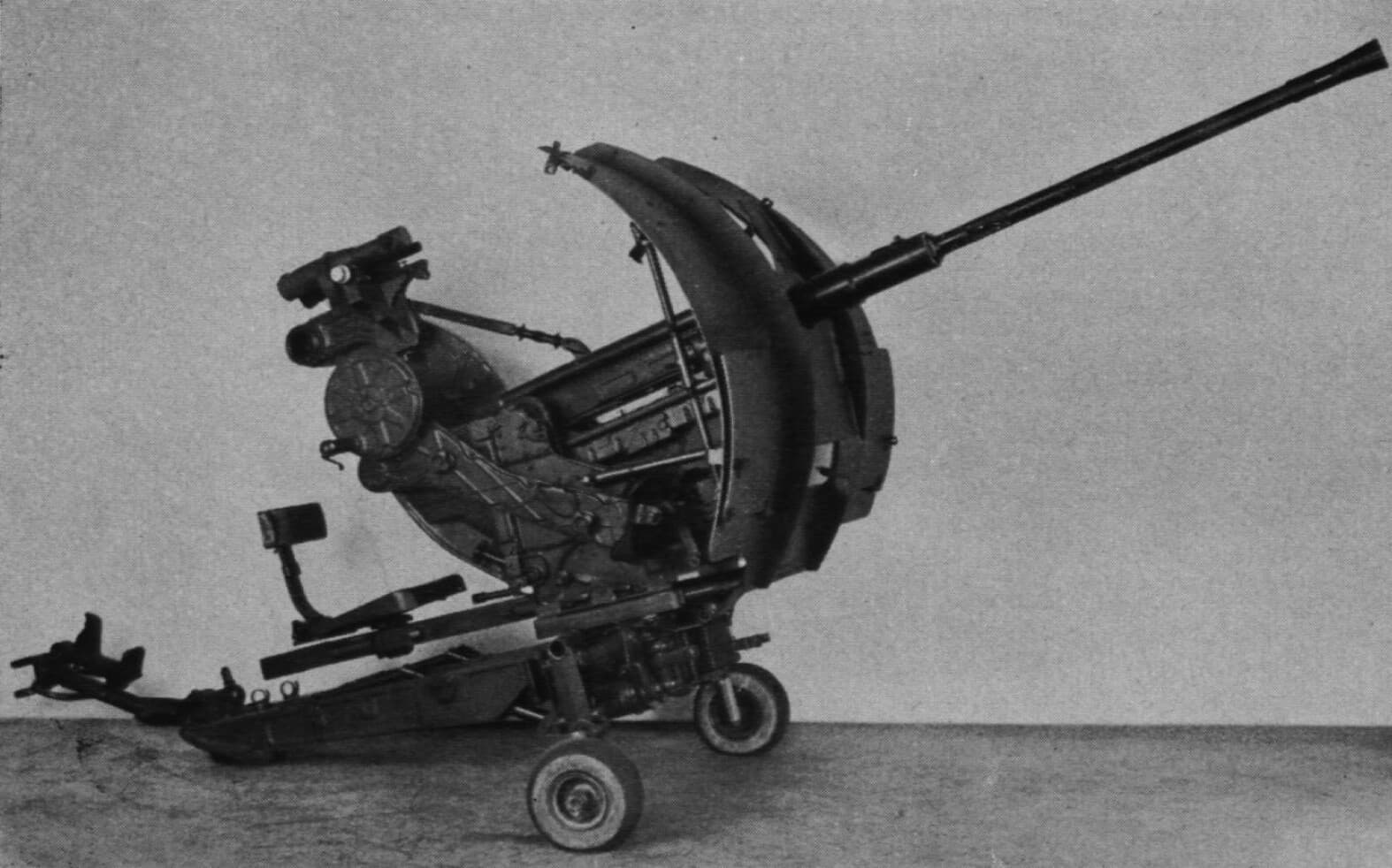
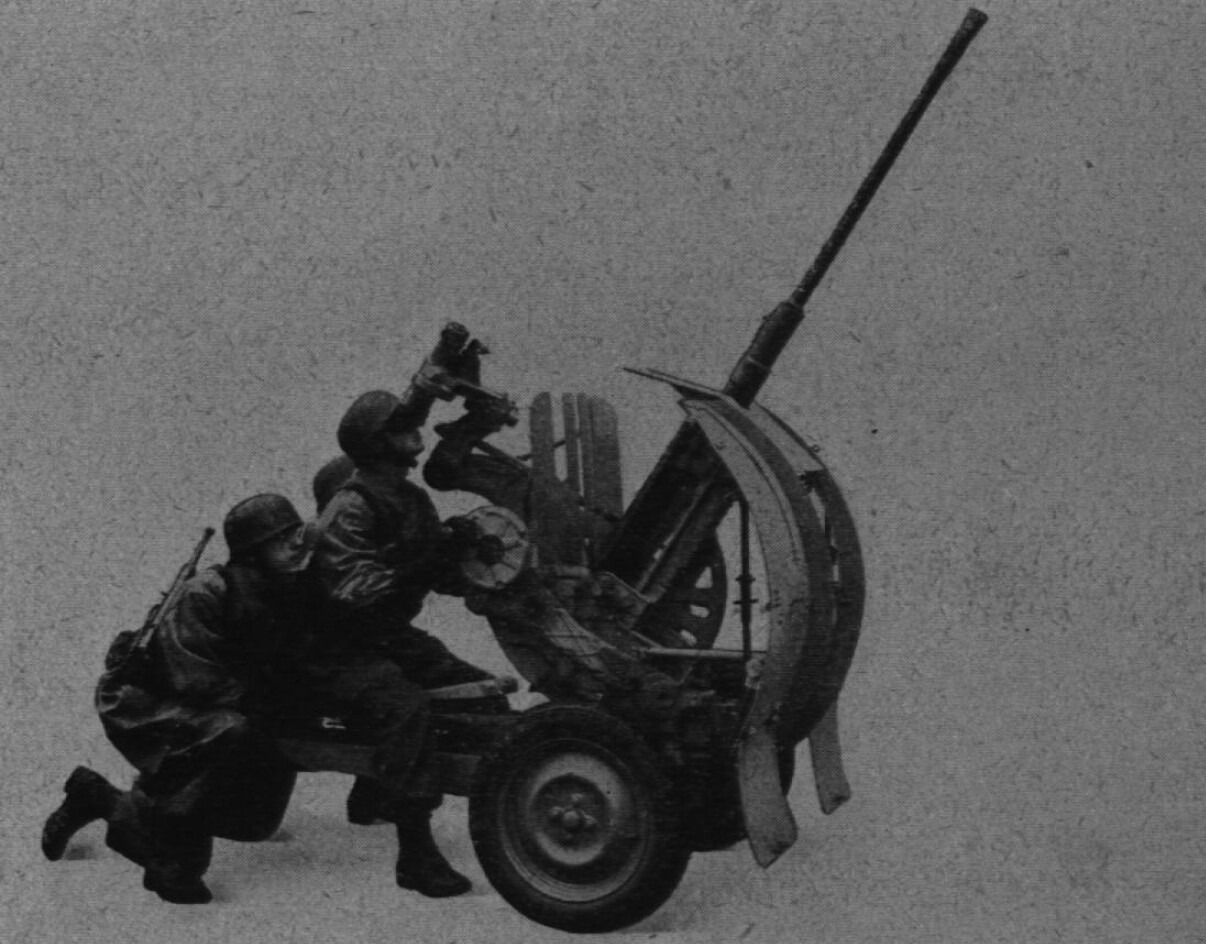
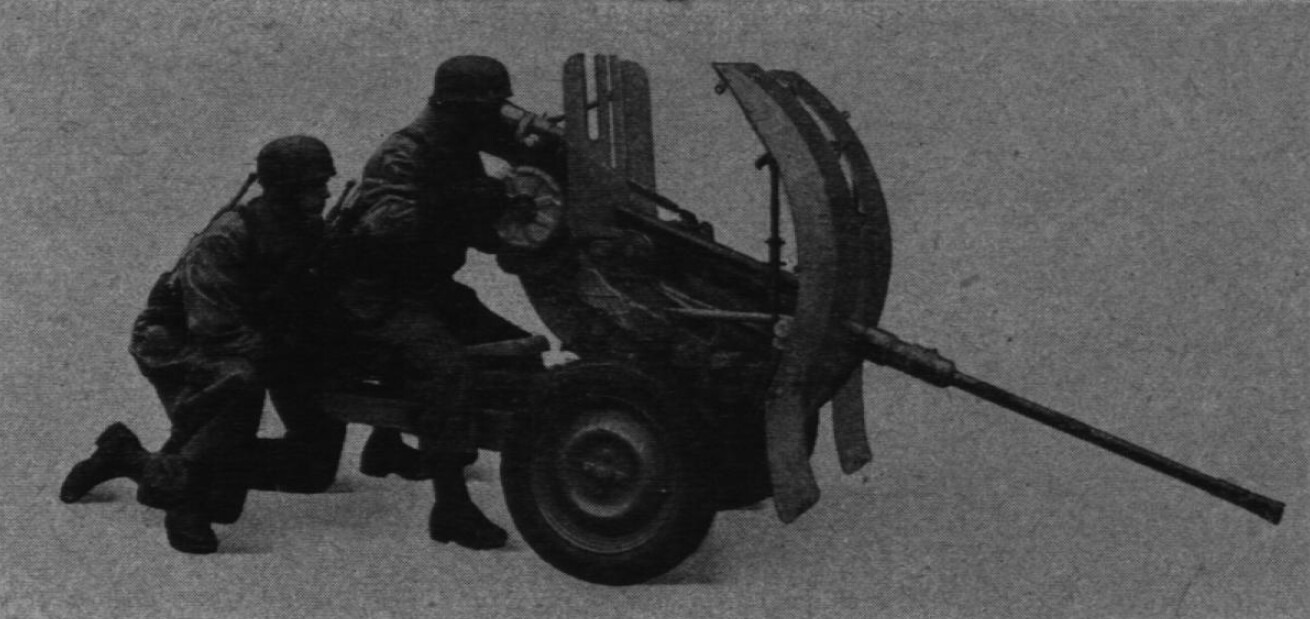

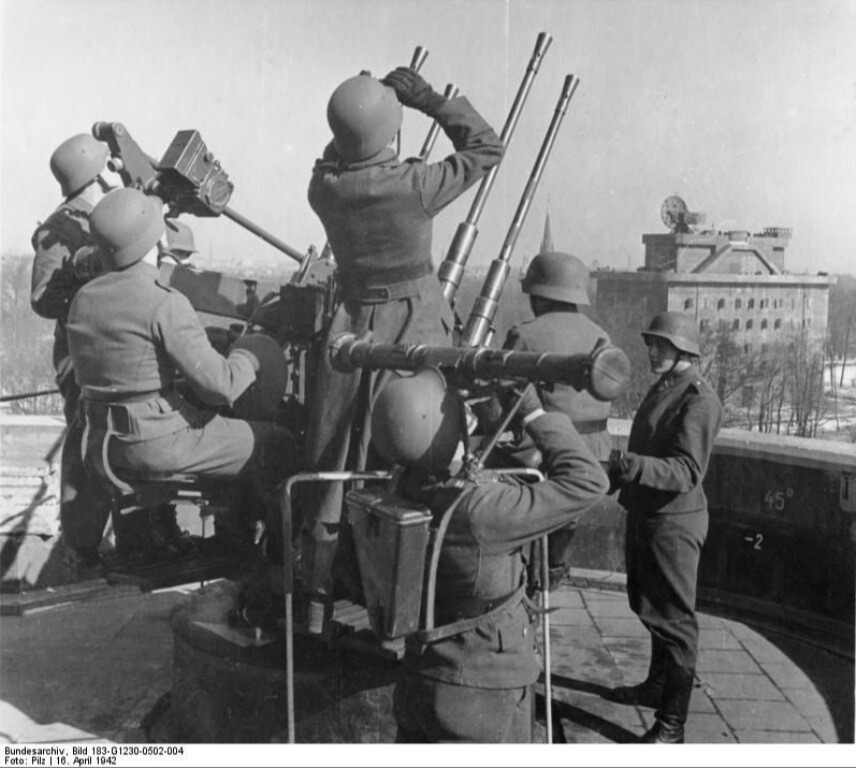
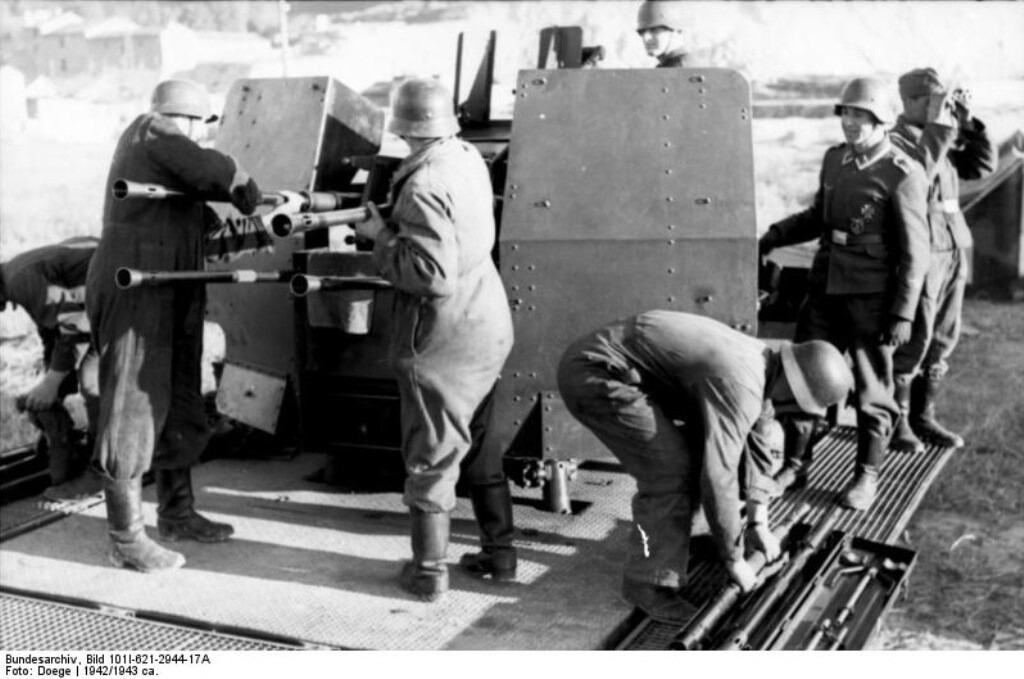
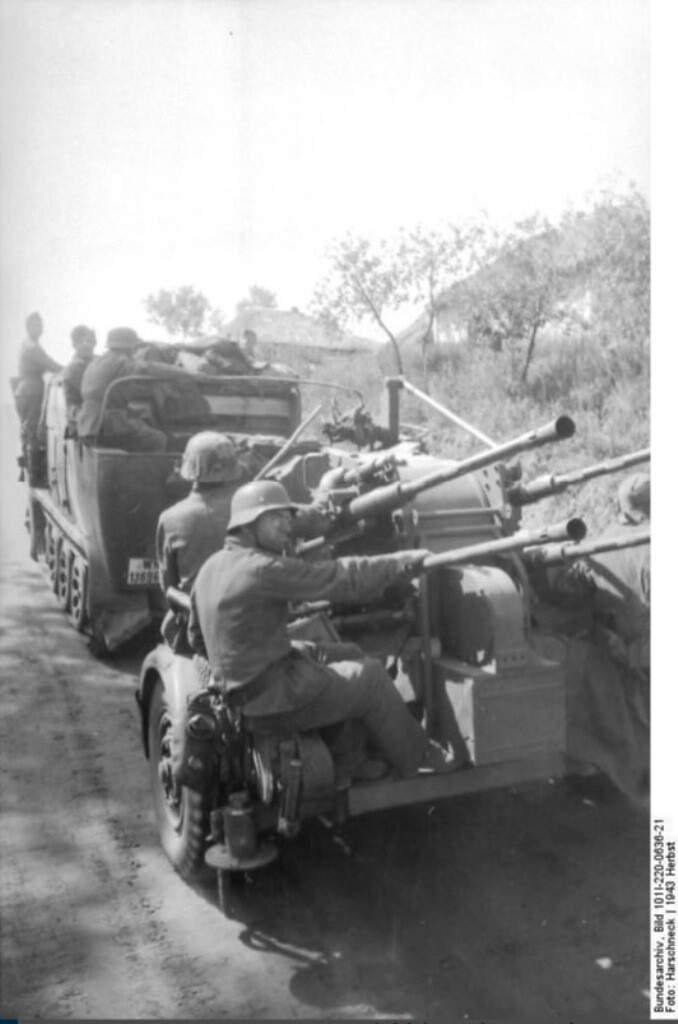
Main Light tank, Armored Car and Truck armarment, often universal rolle against Infantry, reinforced structures, light armored and unarmored vehicles as well as low flying planes.
Generally used pre war till the end of the war, while the 38 was a improved version, reducing weight, increasing reliability and firerate, beeing seen as one of the best of its class in WW2.
The KwK 30 used a L/50 barrle, while the KwK 38 recived the L/65 barrles of the Flaks to simplify production and supplies, increasing the performance to the 2 cm Flak levels. Early war, the production of L/50 barrels ceased production and after the supply was depleted, the KwK 30 was also equipped with L/65 barrels.
Caliber: 20mm
Ammo: 20x138mmB Rheinmetall
Fire Rate: 300 / 480 (450-500) rpm
Magazinfed:
KwK: 10 rounds (20 rounds sometimes also available if space allowed it, on Trucks). Upon shooting all rounds, the bolt stays open and automatically ejects the magazin, ready to directly insert a new one for high tactical fire rate.
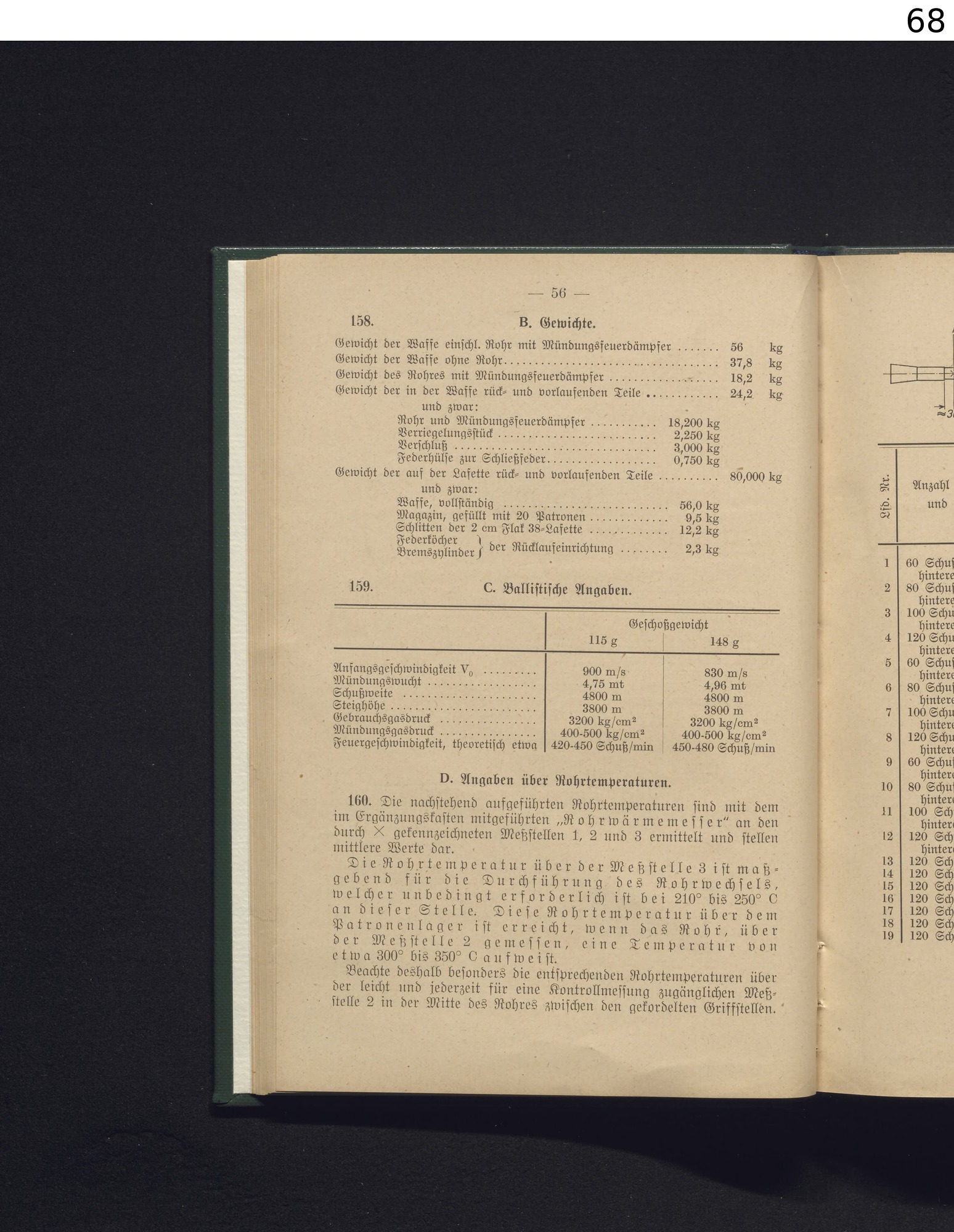
Flak: 20 rounds. In the war greater size magazins were developed, with 30 rounds, 5,3 kg and 40 rounds, 7 kg, both 20 and 40 round magazines were used by Heer and Kriegsmarine. Upon shooting all rounds, the bolt stays open and automatically ejects the magazin, ready to directly insert a new one for high tactical fire rate.
Muzzle velocity: 800 - 1050 m/s
Barrle length: KwK 30 L/50 (~1940 L/65), KwK 38 L/65, Flak generally L/65
Weight:
KwK: 64 / 58 kg
Flak: 450kg (30) 405(38)
1509kg (Vierling with trailer), Gebirgsflak 38 176kg
Mounts:
Turret mounting: usually -10° to +20°
Sockellafette: -7° to +85°
Hängelafette: -4° to +70°
Schwebelafette: -10° to +60°
Flak 30 Lafette: -12° to +90°
Flak 38 Lafette: -20° to +90°
Flakvierling 38: -10° to +100°
Geb. Lafette: -22° to +90°
Ammo Types: Ap-T, ApI-T, Aphe-T, APCR-T, He-I, HeI-T and HeI-T (m) (And self destruct)
Below characteristics are for the L/65 barrle, in the note in each ammo tap is also for the L/50.
AP:
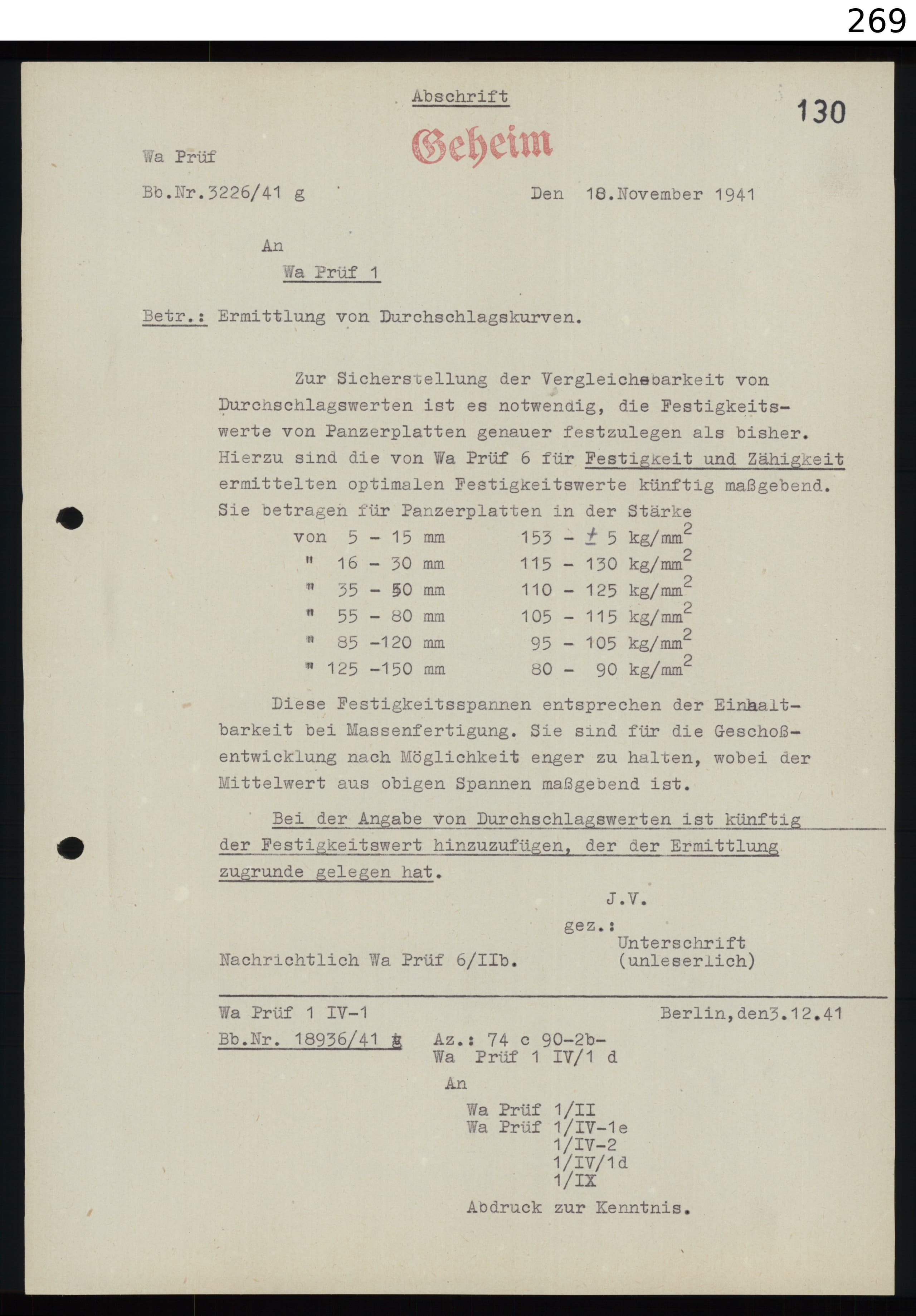
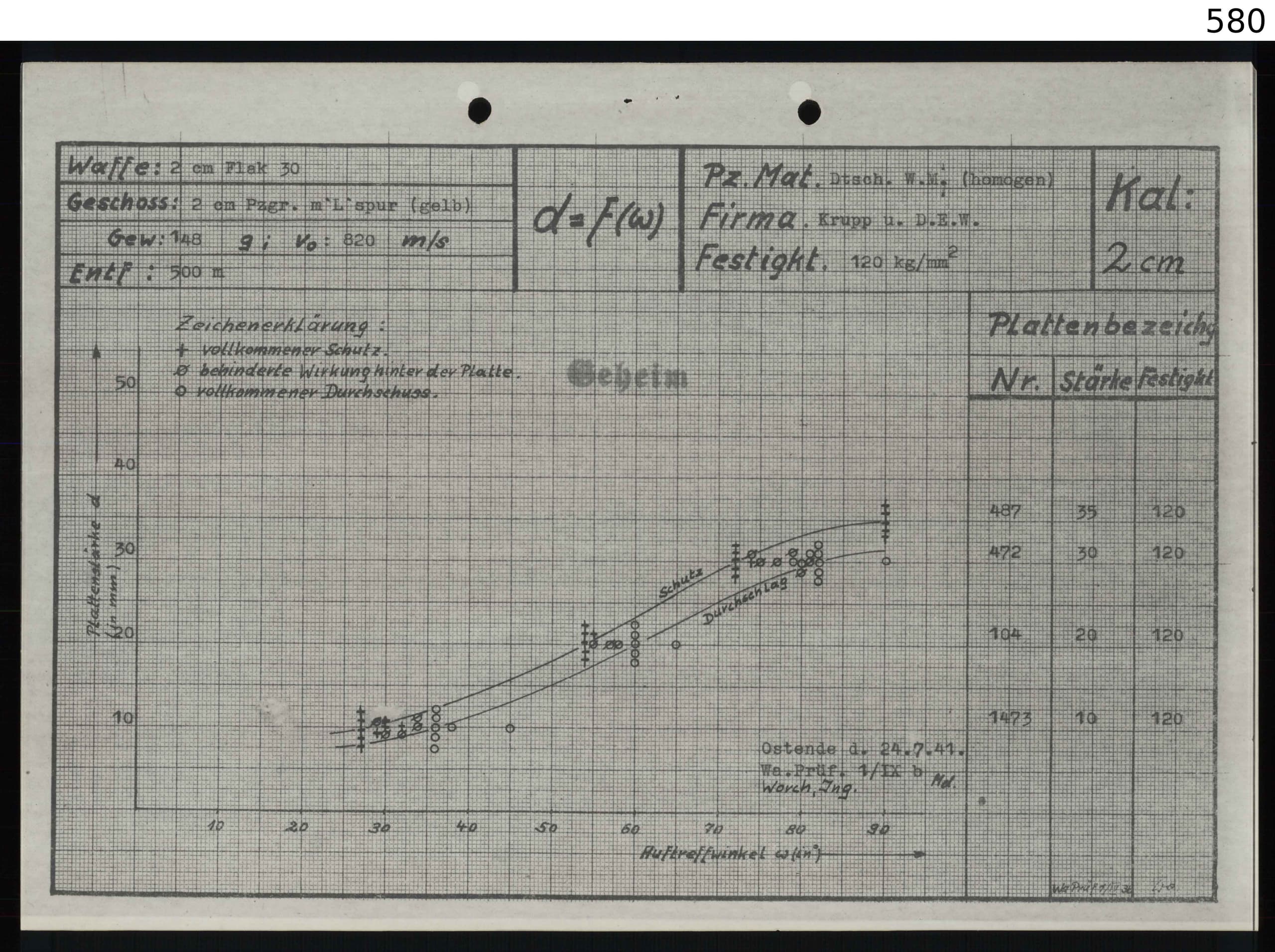
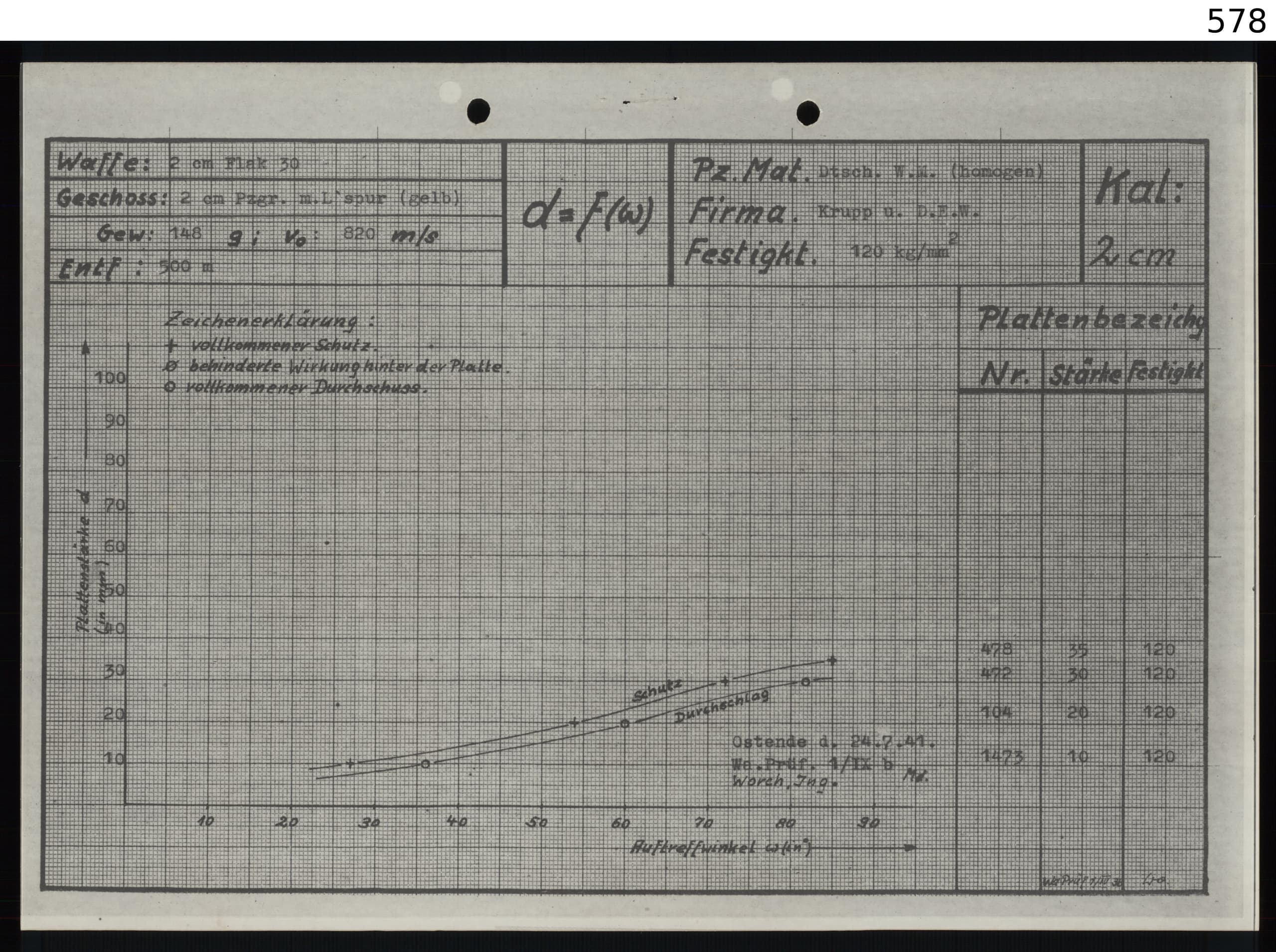
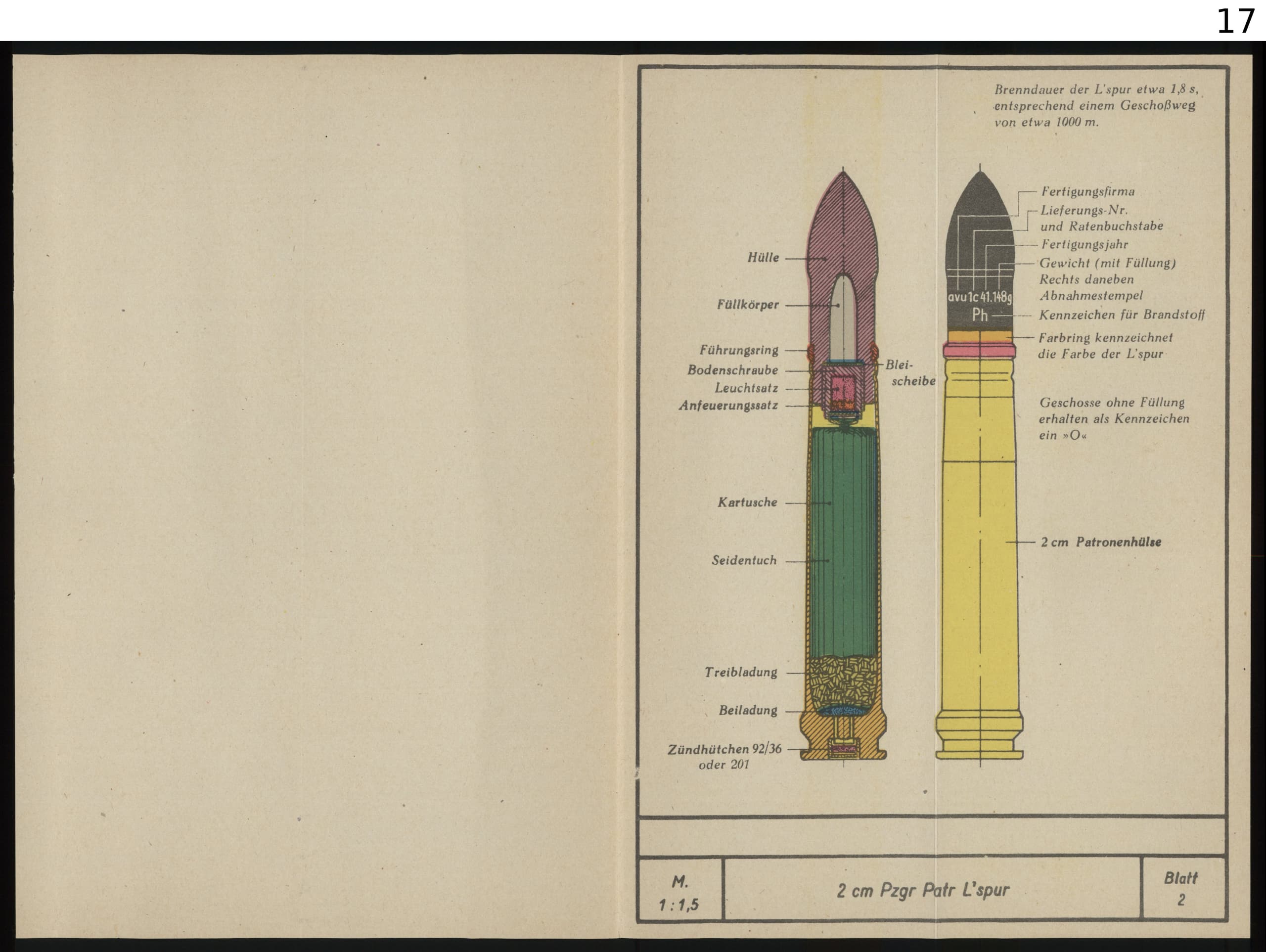
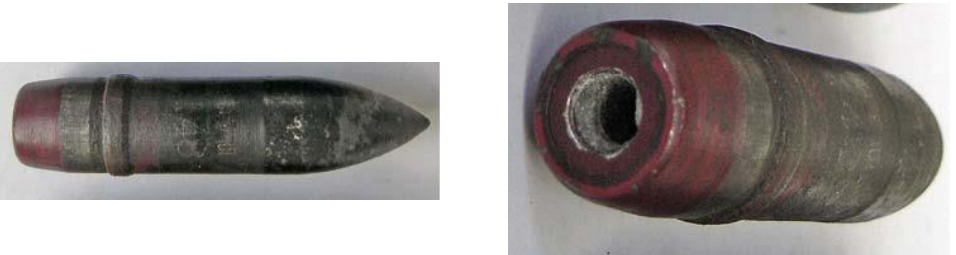
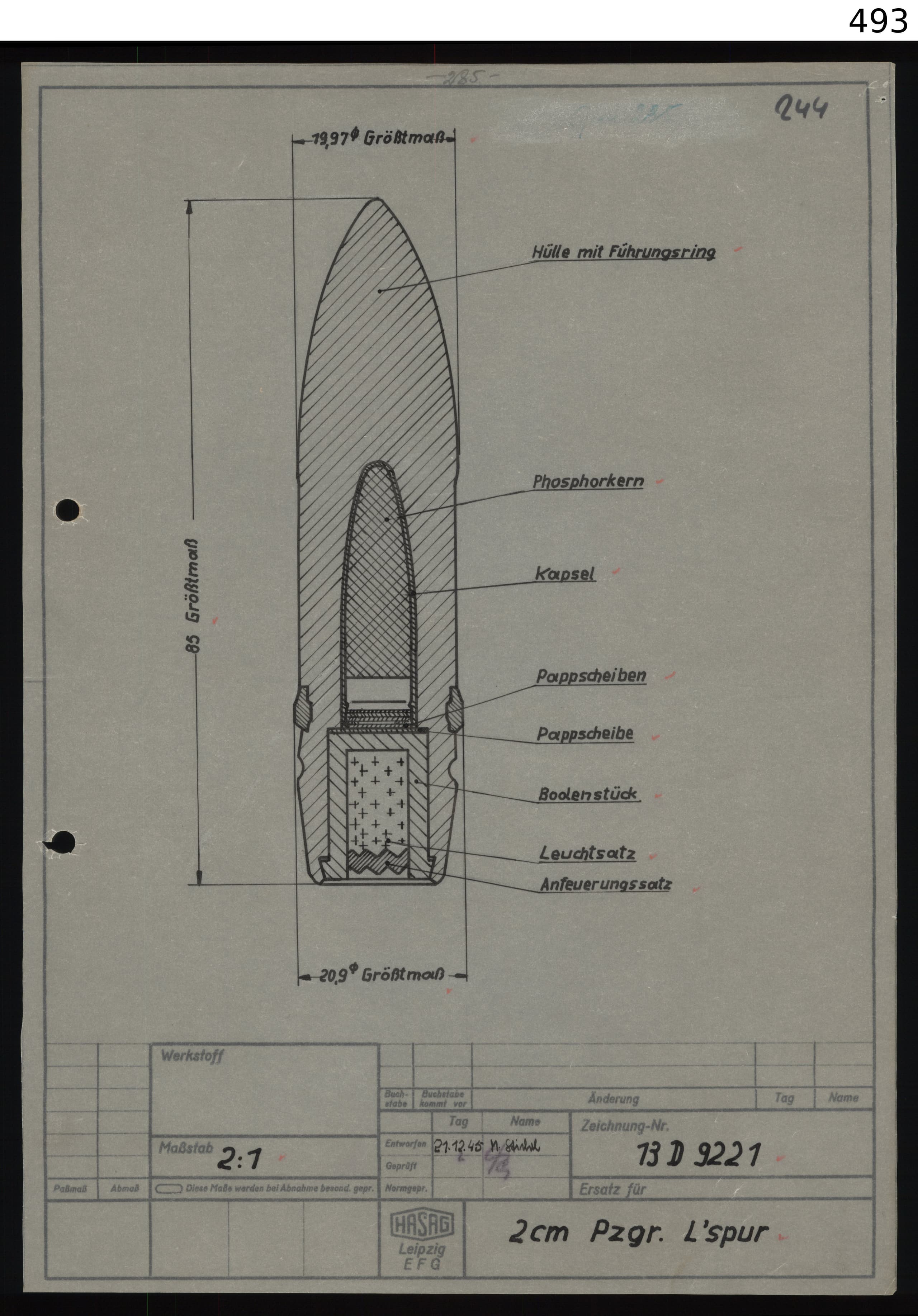
Pzgr. L'Spur. o.Zerl. (Ph.) (ApI-T) 0,148kg 830m/s 39,69mm/10m
Note: Used against ground targets. Soft and armored. 3g White Phosphor Core.
Were replaced by the empty ones and later .Zerl in the Desert and other hot places, as the Phostphor had a nasty tendicy to self ignite in hot weather.
The Ph. marked ones were standart with the filler, however they also existed with an O. which indicated they didnt have a filler and were only 143g (and 835m/s).
(Velocity for L/50 is 800m/s.)
“Alte Fertigung” (old construction) without boattail, Neuer Fertigung" has a boattail.


Pzgr. L'Spur o.Zerl. (O.) (Ap-T) 0,143kg 835m/s 39mm/10m
Note: Used against ground targets. Soft and armored. White stenciled “O” (Ohne/without) indicated empty projectiles.
(Velocity for L/50 is 815m/s.)
“Alte Fertigung” (old construction) without boattail, Neuer Fertigung" has a boattail.
Pzgr. L'Spur zerl. (Aphe-T Sd) 0,146 kg 835m/s 2,4g Pent 36,74mm/10m
NOTE: Against ground and air tragets. Soft and armored.
It does NOT have a fuze, the filler is for self destruction, in game it would also explode upon impact when shattering, like the japanese 30mm Aphe.
(Velocity for L/50 is 815m/s.)
“Alte Fertigung” (old construction) without boattail, Neuer Fertigung" has a boattail.


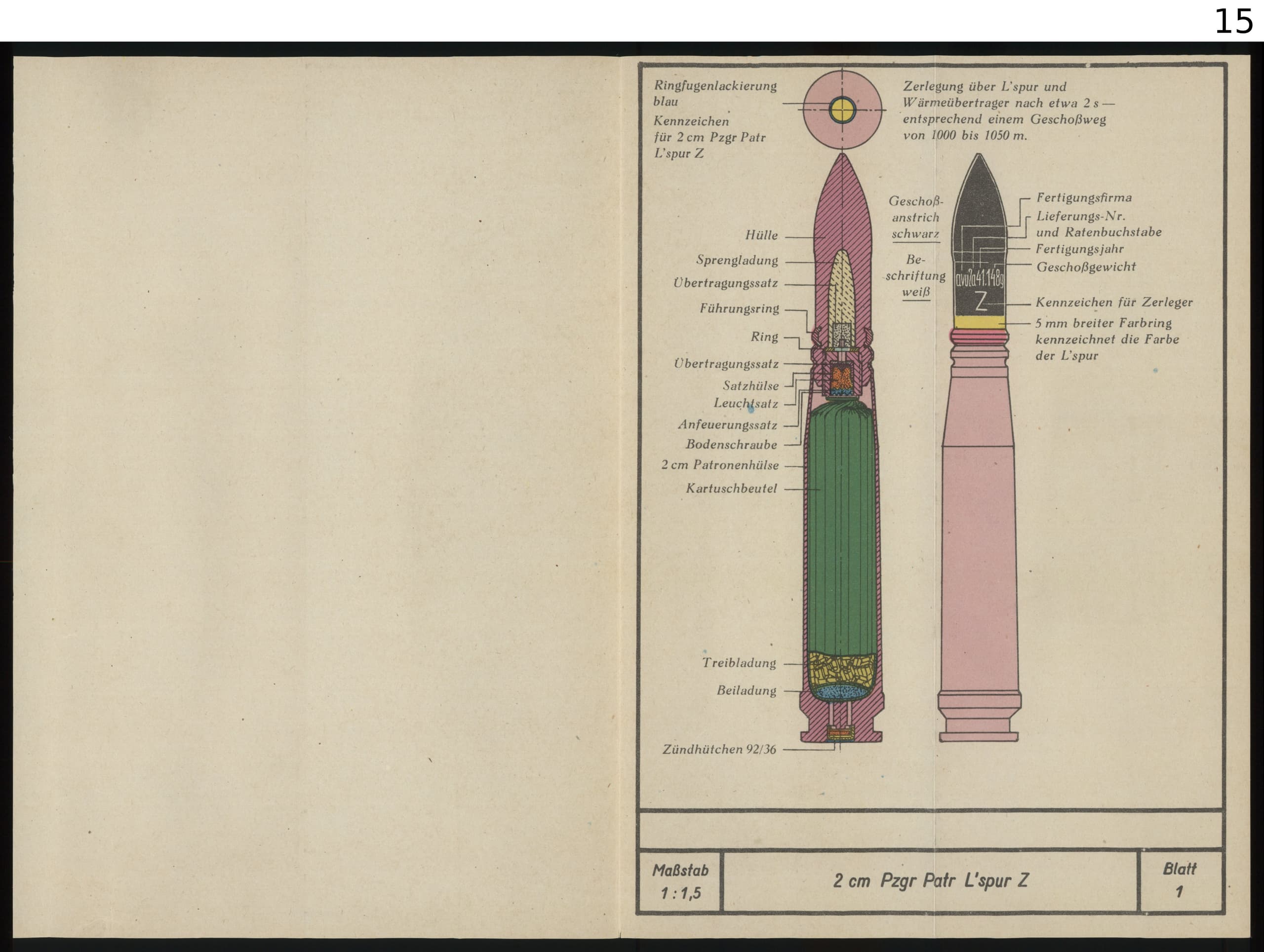
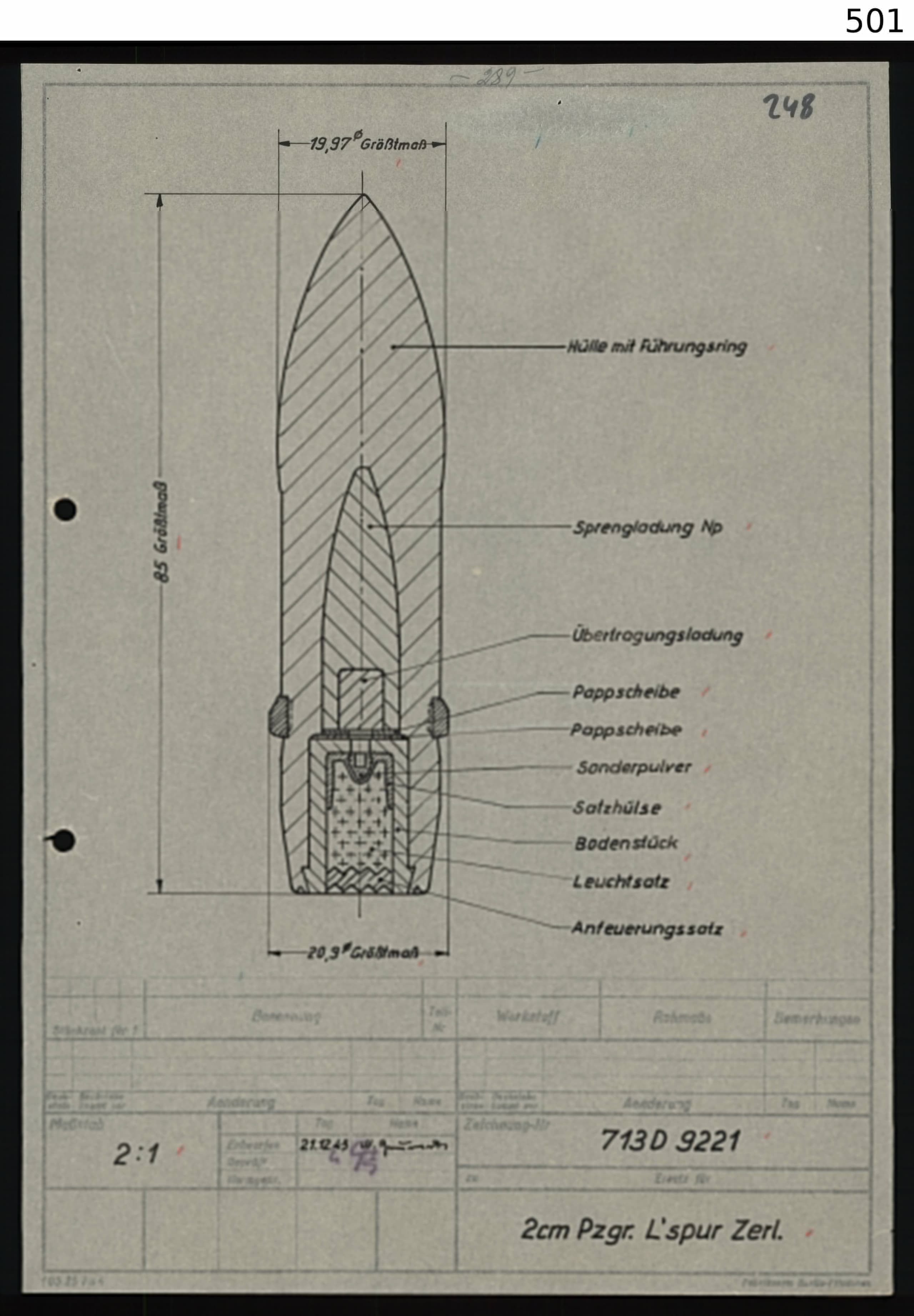
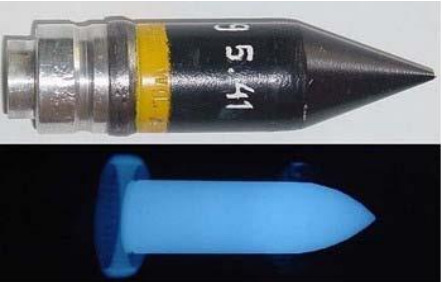
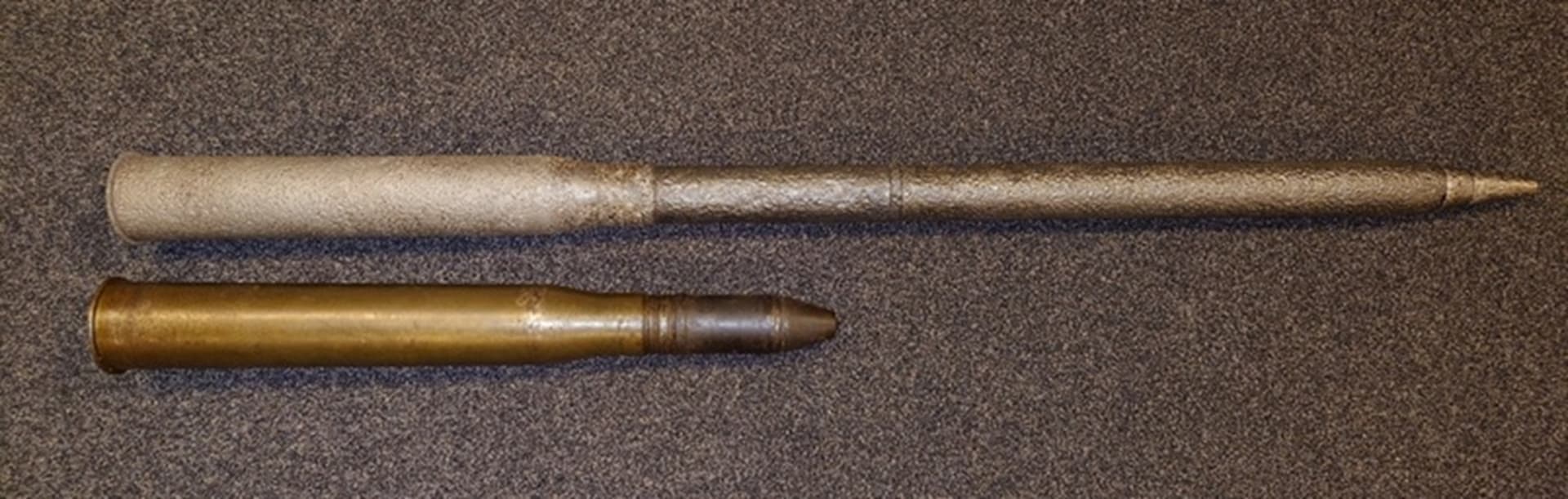
Pzgr.40 L'Spur. o.Zerl. (HVAP-T) 0,100kg 1050m/s 62g core 12x45mm 50mm/10m
Note: Only used against heavy armored targets, where the standart Ap ammo does not penetrate.
(There were 3-4 generations, with ever increasing length and slightly weight, to improve stability.)


Pzsprgr. L'Spur o.Zerl. (Aphe-T) 0,148 kg 830m/s 3,6g Pent 35mm/10m
Note: Mainly (?) used by the Navy and only against ground targets.
(Velocity for L/50 is 800m/s.)
“Alte Fertigung” (old construction) without boattail, Neuer Fertigung" has a boattail.


Pzsprgr. L'Spur m.Zerl. (Aphe-T Sd) 0,120-0,122 kg 900/920m/s 3,6g Pent 33mm/10m
Note: Mainly (?) used by the Navy and against ground and air targets.
(Velocity for L/50 is 880/900m/s.)
“Alte Fertigung” (old construction) without boattail, Neuer Fertigung" has a boattail.
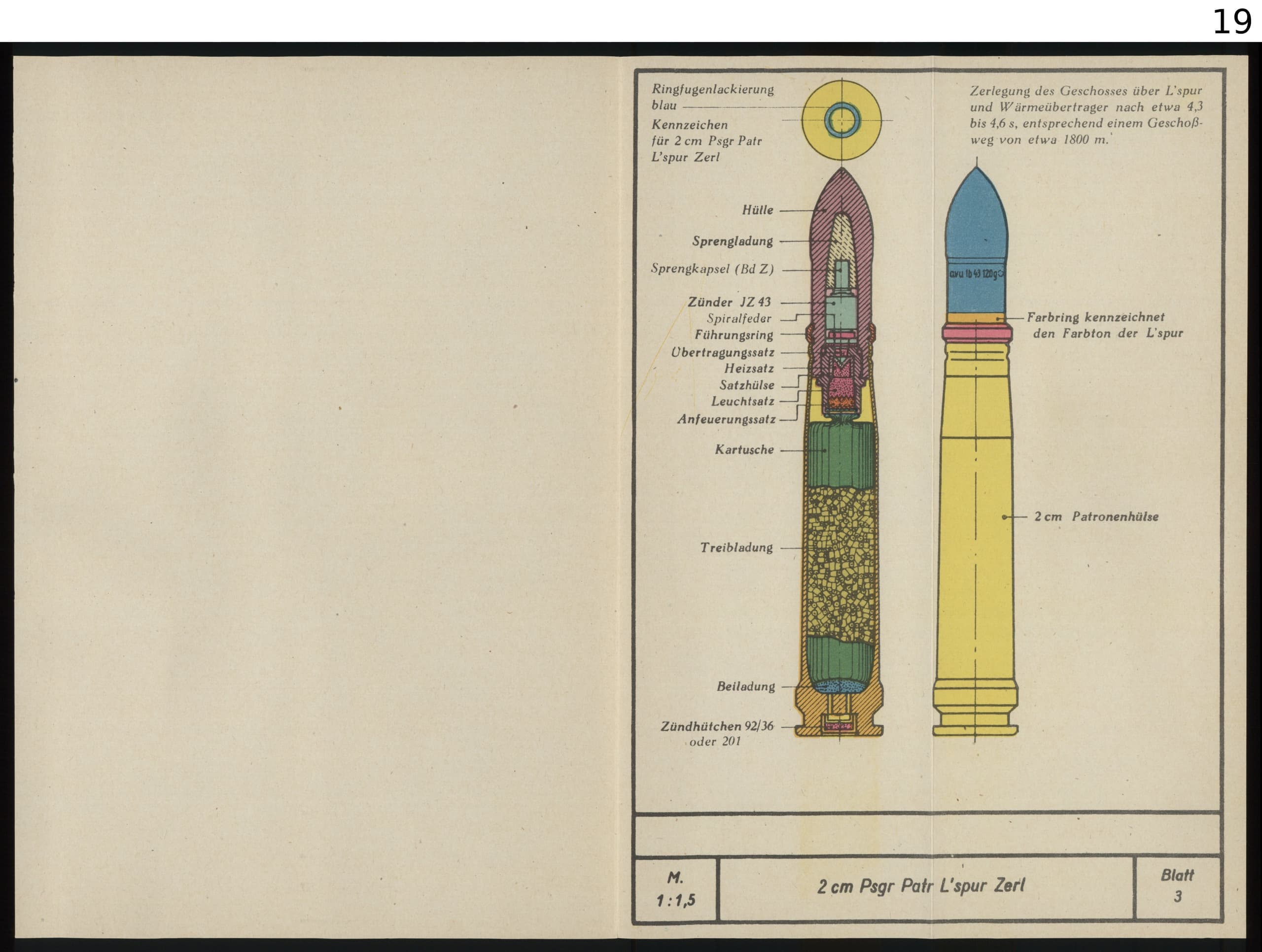


(This last picture is an adaption for the Mg151/20 and uses a different shorter tracer, which results in it beeing also a bit lighter)

He:
Sprgr. L'Spur m.Zerl. (Hef-T Sd.) 0,115 910/930m/s 6,2g Pent (10,54g) 5mm/10m
Old design without boattail, prewar replaced by Sprgr. L’Spur W, only remaining stock was used in the war.
(Velocity for L/50 is 890/910m/s.)

Sprgr. L'Spur. W m.Zerl. (Hef-T Sd.) 0,120kg 900/920m/s 6,2g Pent (10,54g) 5mm/10m
Against air and ground targets.
(Velocity for L/50 is 880/900m/s.)


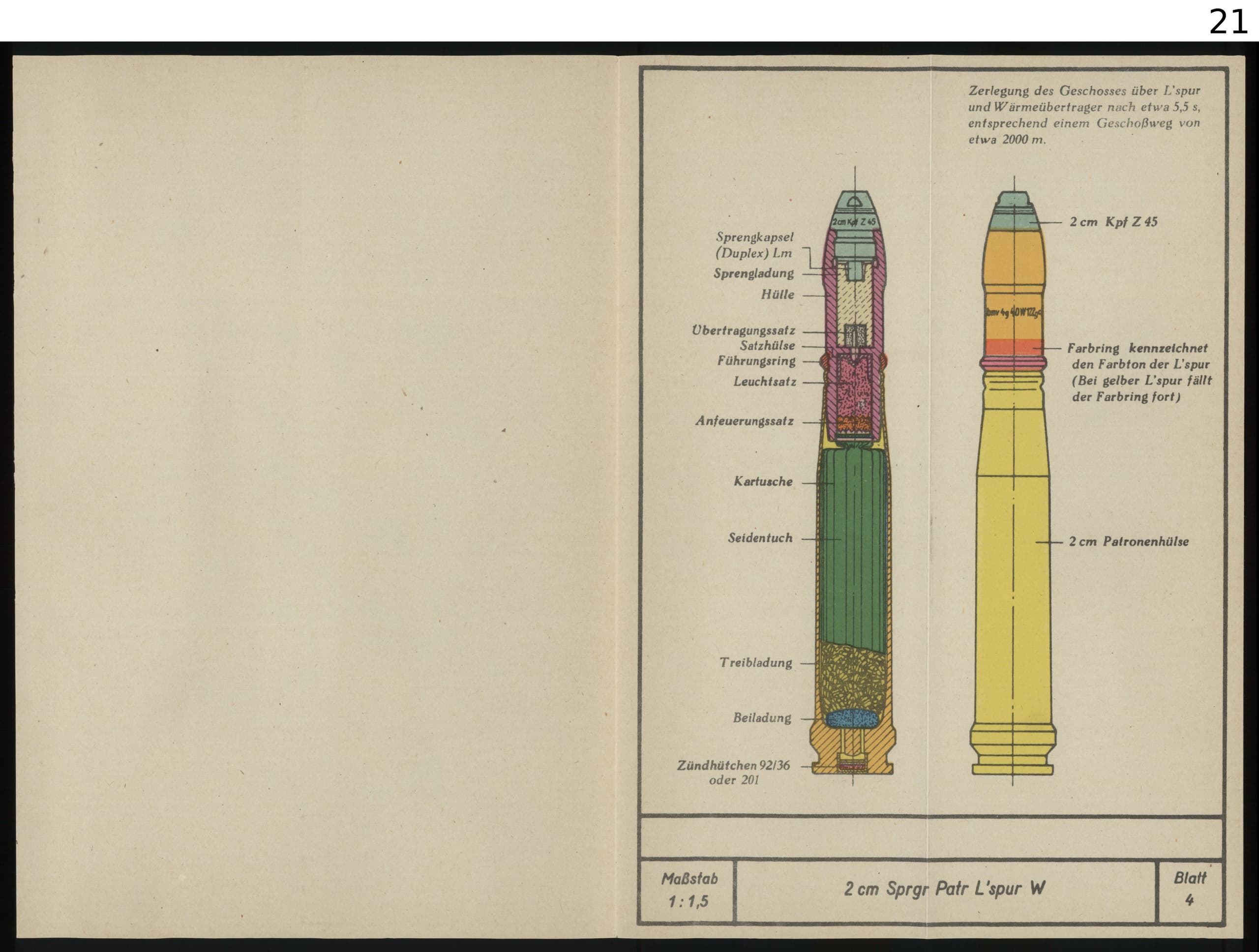
Sprgr. Erd. o.L'Spur. o.Zerl. (Hef) 0,120kg 900/920m/s 11g Pent (18,7g)
Note: Only against groundtargets. Other name is Spr.Gr.39.
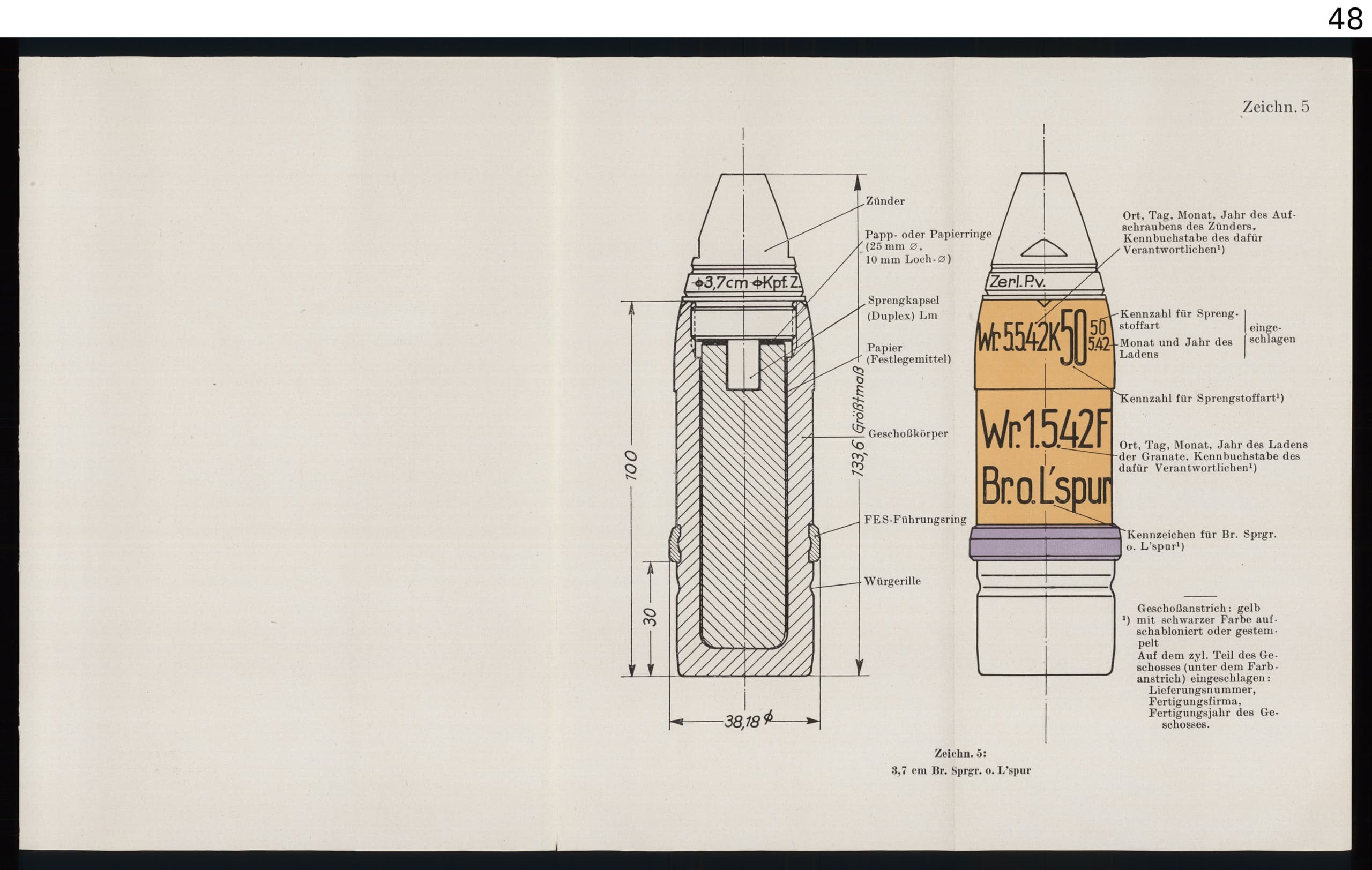
(Couldnt find the correct drawing, the Br.Sprgr. o.L’Spur is basically the same, just different filler with Zink.)
(Velocity for L/50 is 880/900m/s.)


Brsprgr. L'Spur m.Zerl. (Hefi-T Sd.) 0,120kg 900/920m/s 6,6g H.5 and Aluminium
(Velocity for L/50 is 880/900m/s.)

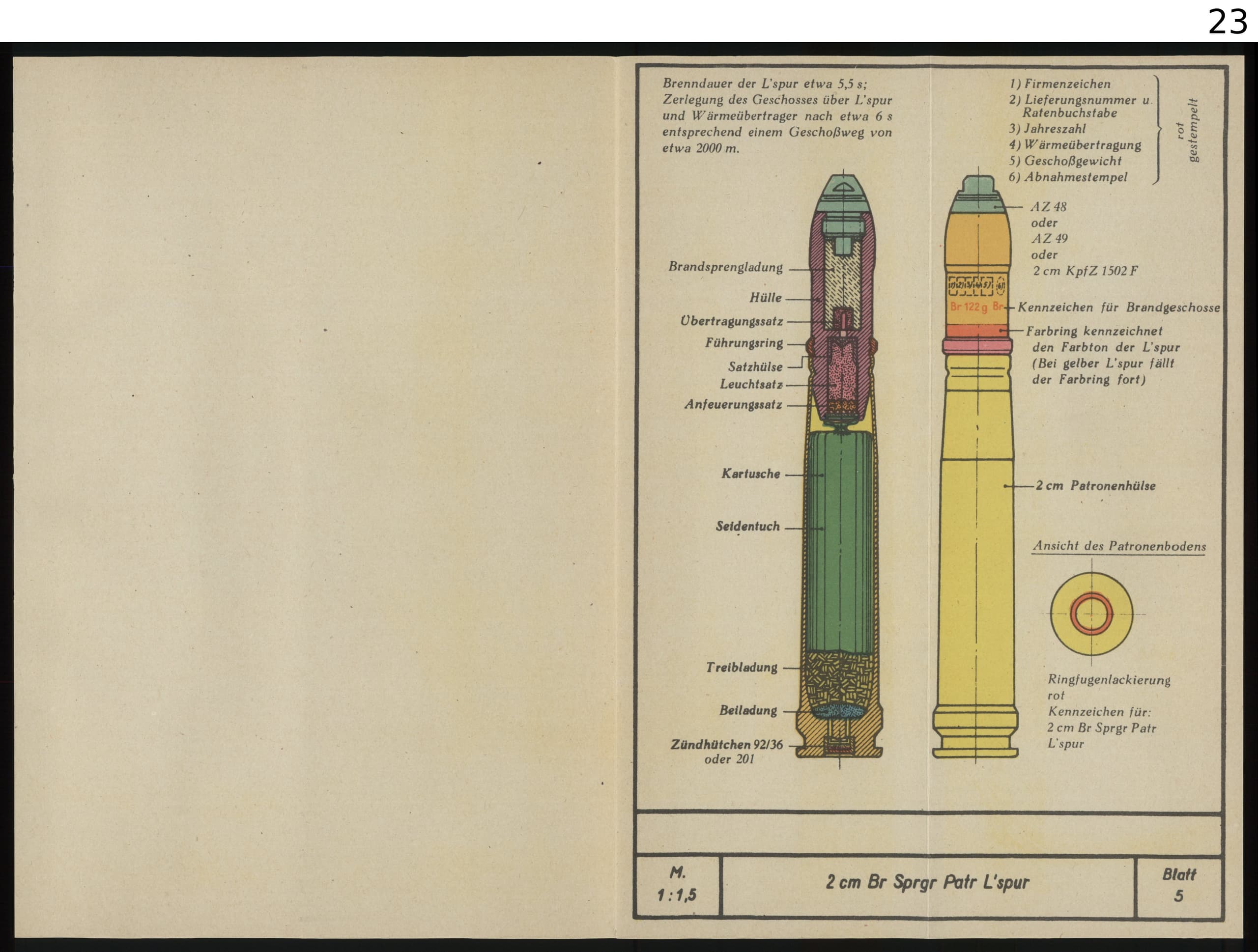
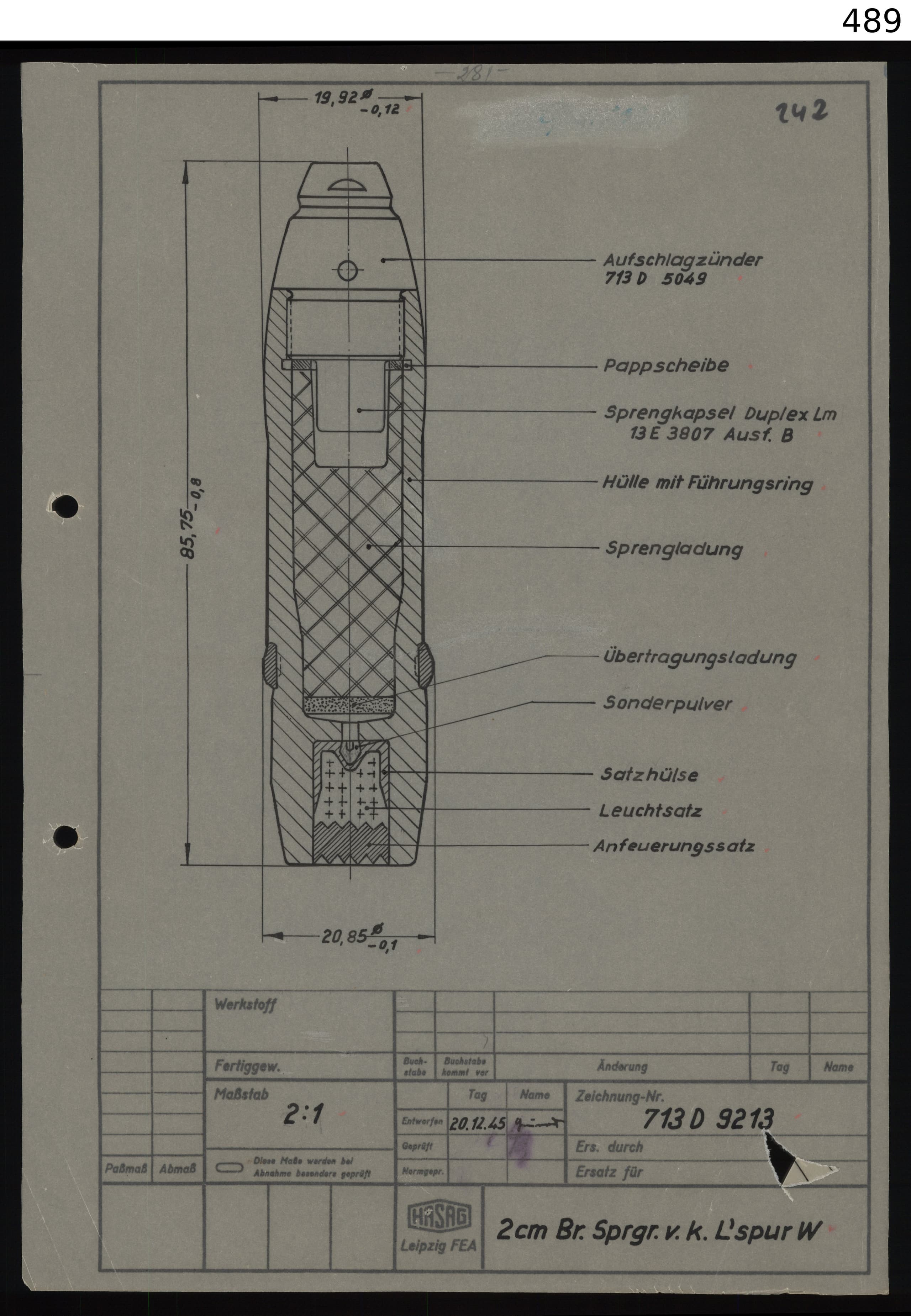
Brsprgr. vk. L'Spur m.Zerl (Hefi-T Sd.) 0,120kg 900/920m/s 19g H.5 and Zink
Note: Against Air and Ground targets, reduced tracer length for increased filler. The full feight of the H.5 and Zink mixture is 19g, not the pure He filler.
(Velocity for L/50 is 880/900m/s.)
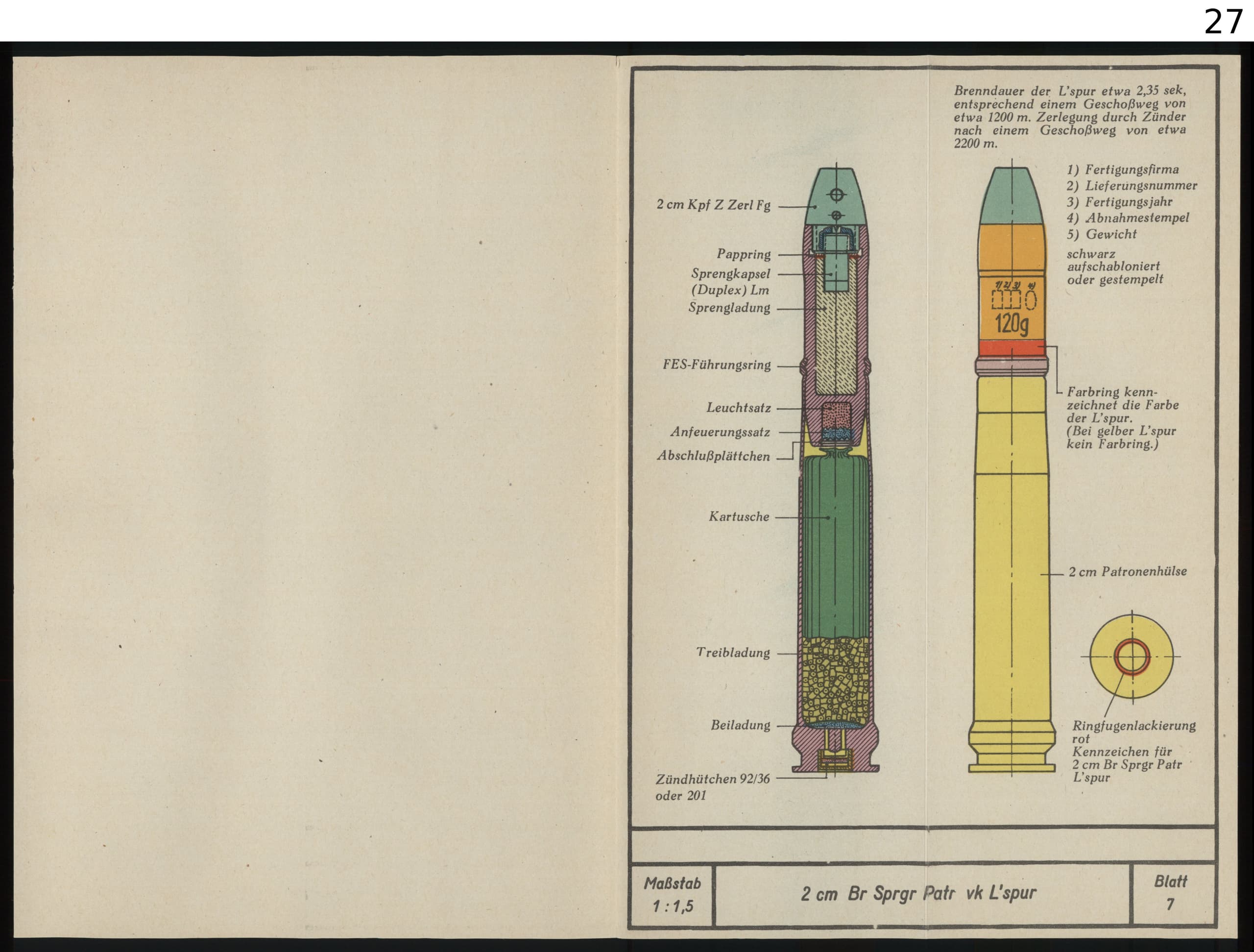

Brsprgr. o.L'Spur. m.Zerl. (Hef-I Sd.) 0,120kg 900/920m/s 20g H.5 and Zink
Note: Against ground and air targets. No tracer at all to have a fully capacity He (H.5) and Incendary (Zink) mix. (Weight calculated by Killakiwi 7g H.5 13g Zink)
(Velocity for L/50 is 880/900m/s.)

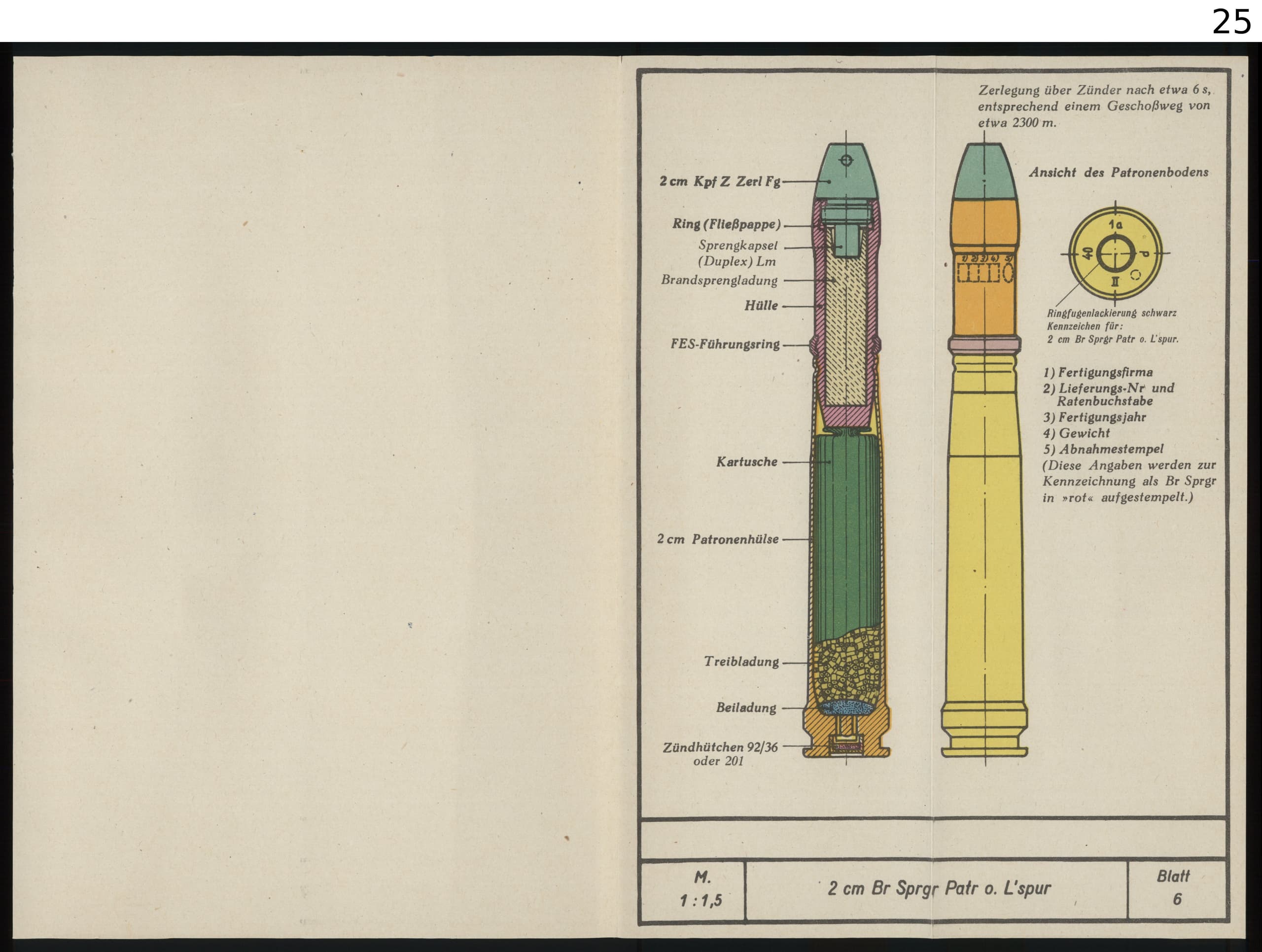
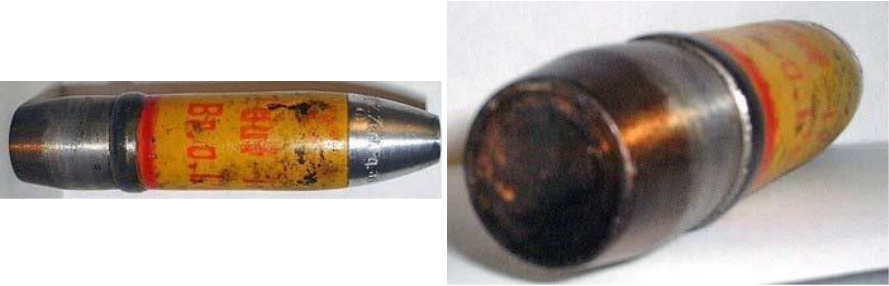
Minengeschoss:
M-Gesch. X m.Zerl (He-I (m) Sd.) 0,104kg 950m/s 25g HA 41 (40g)

M-Gesch. X L'Spur m.Zerl (HeI-T (m) Sd.) 0,109kg 950m/s 24g HTA (38,4g)

Vehicles:
Flakpanzer I, Flakpanzer 38, Wibelwind, Möbelwagen
Panzer II, Sd.Kfz.231 6 and 8 Rad, Sd.Kfz.222 and 234/1
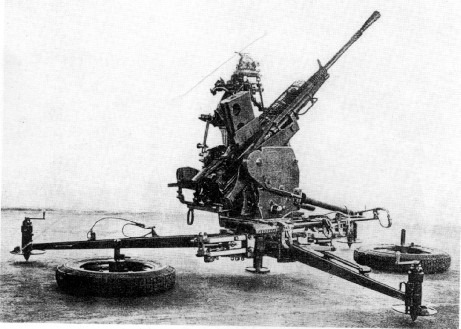
2,5 cm Flak Hotchkiss (f) L/60


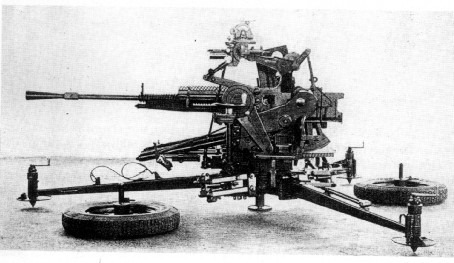
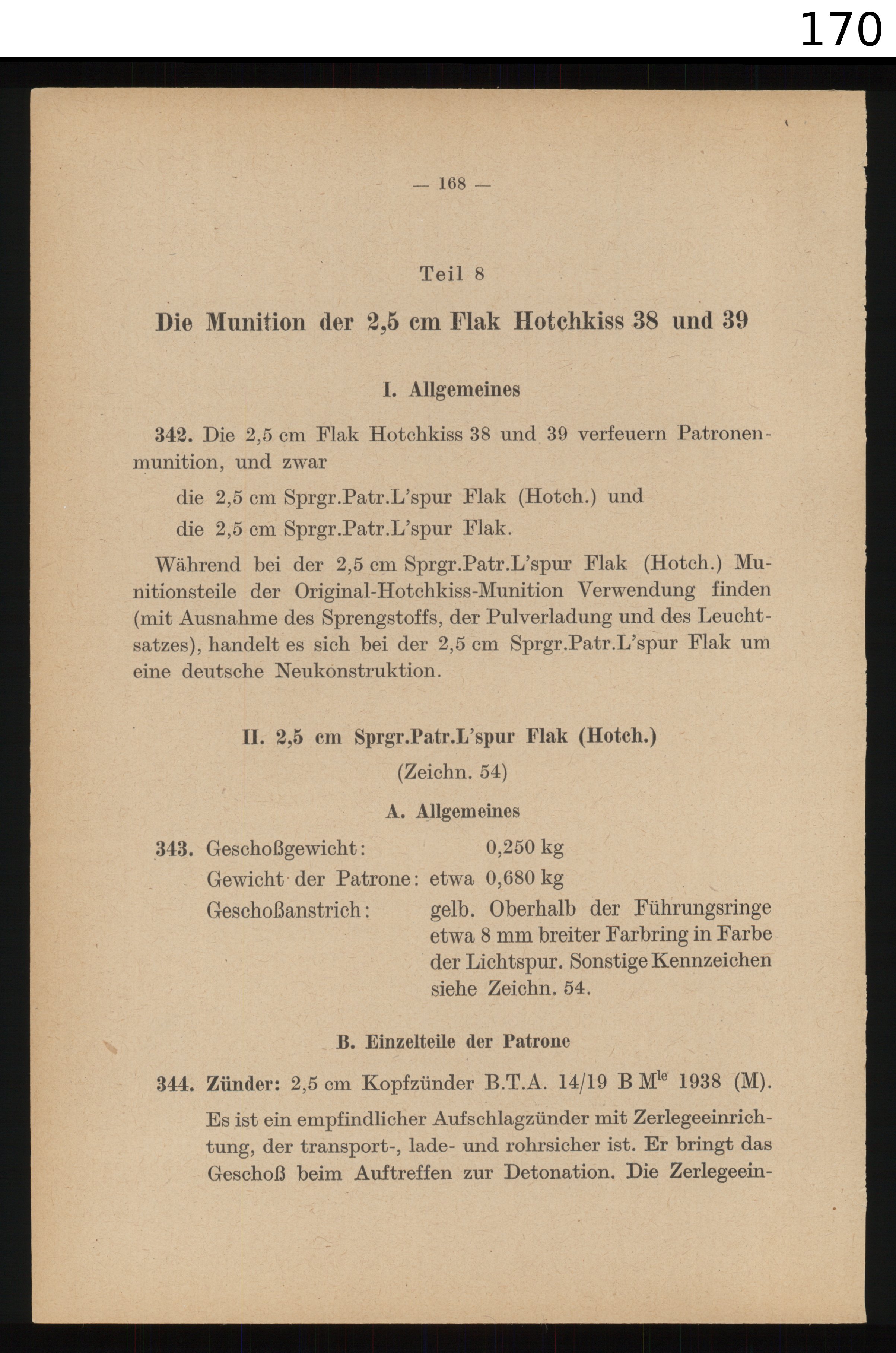
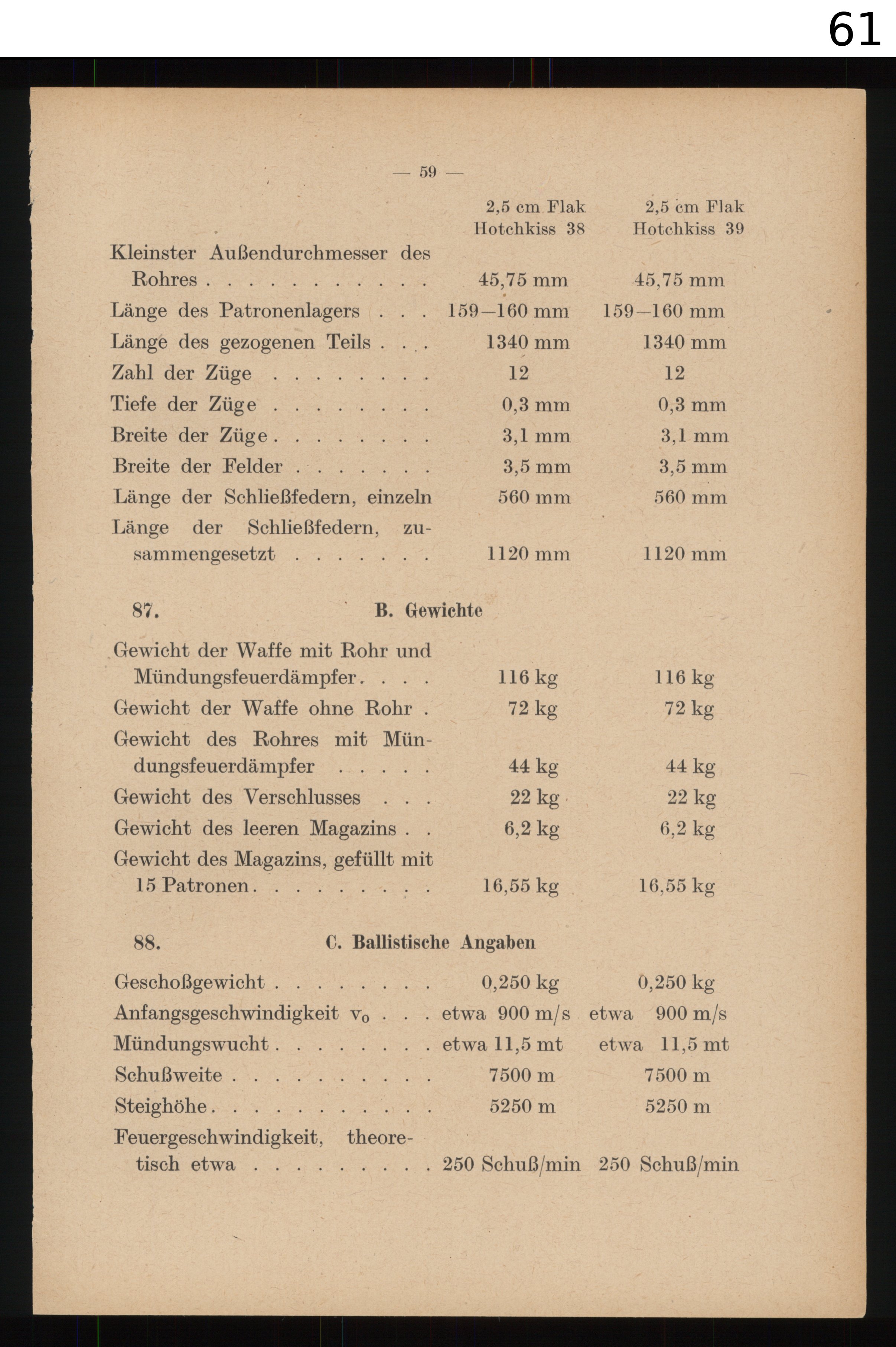
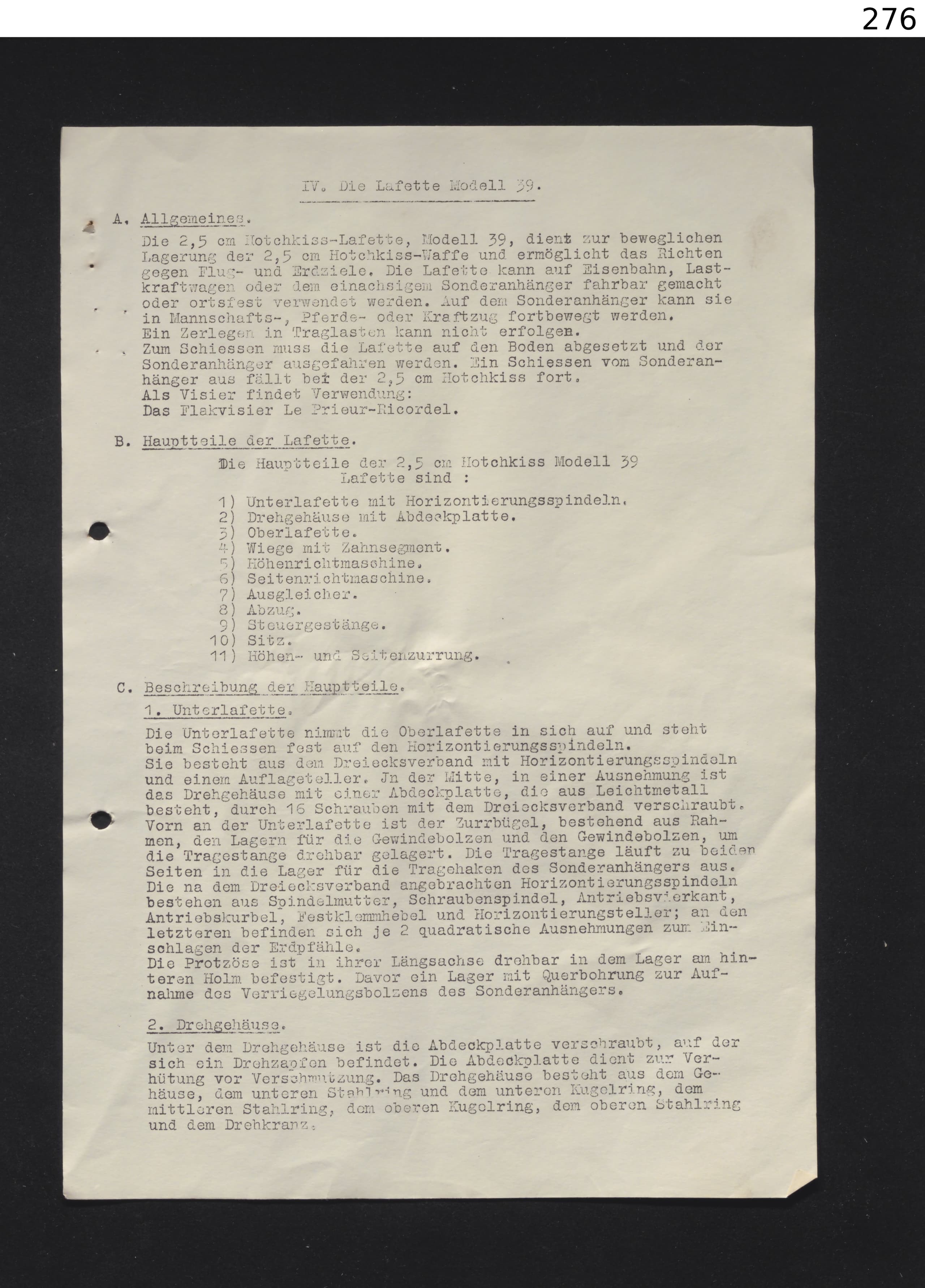
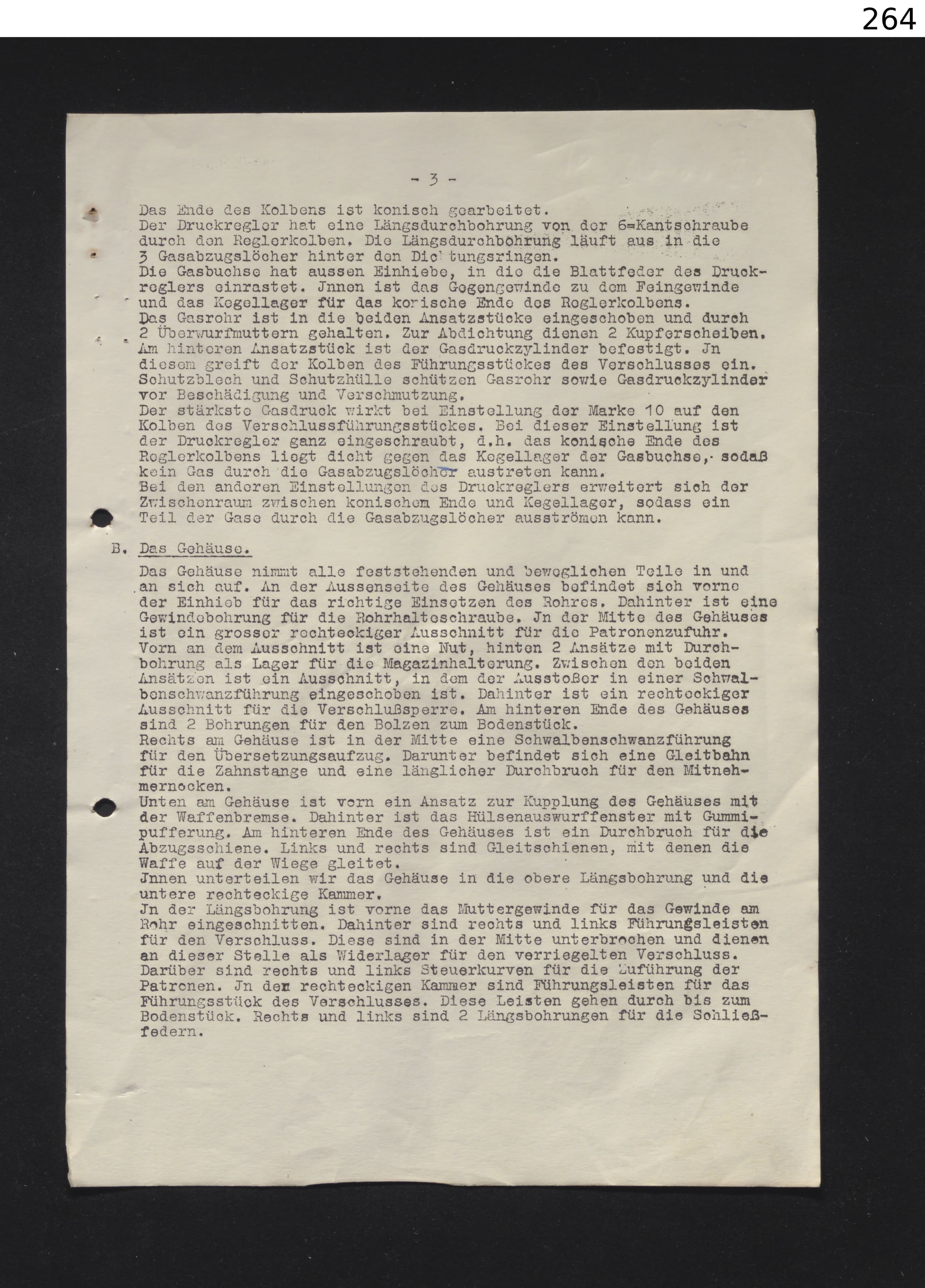
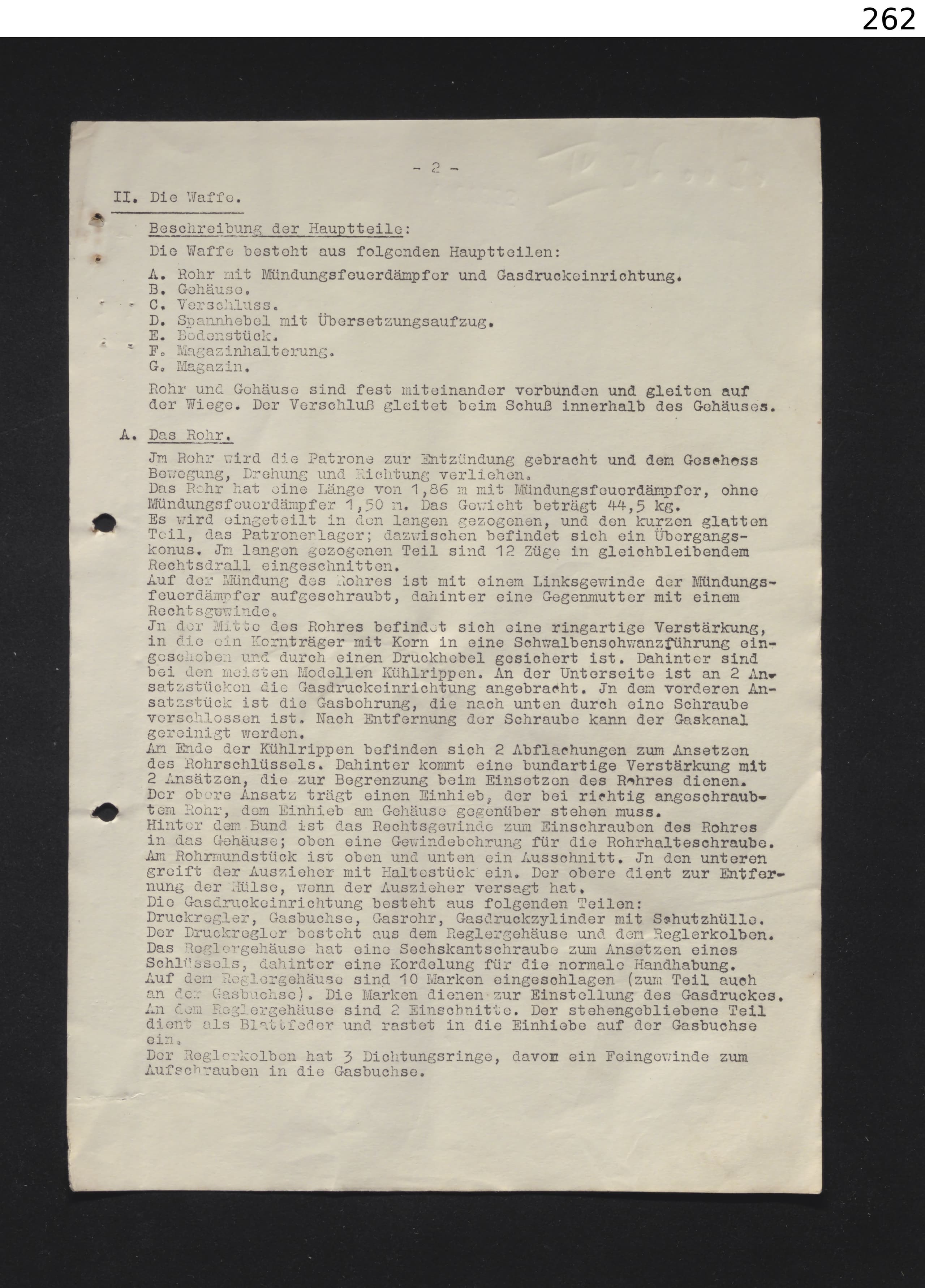
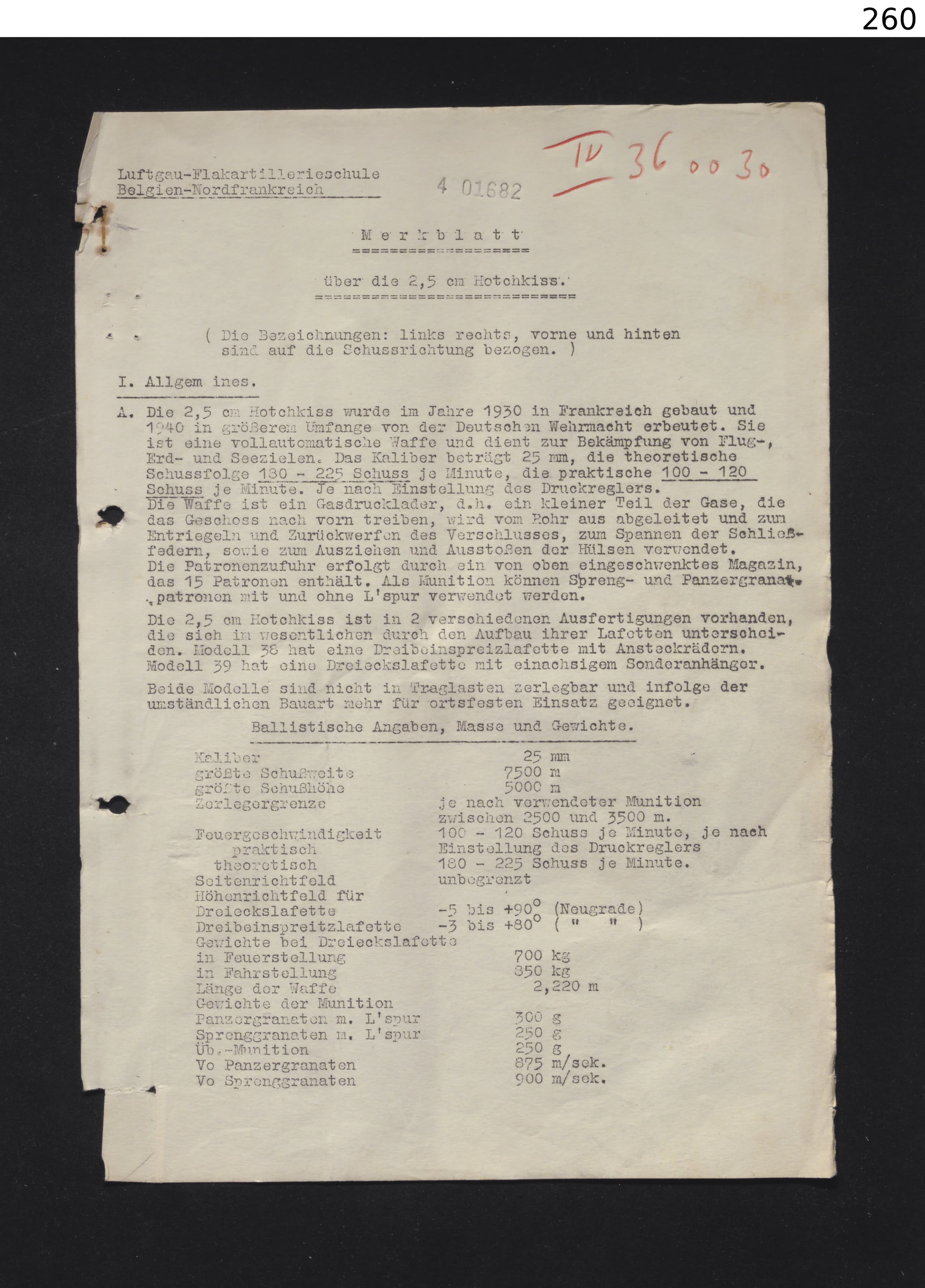
Caliber: 25mm
Ammo: 25x163mm
Fire Rate: 130(180)-225, 250 rpm (choosable by tuneing the pressure controle.)
Magazin Fed: 15 Rounds
Muzzle velocity: 875-900 m/s
Weight: 700 kg in fire position, 850 kg in travel, 115kg the gun alone.
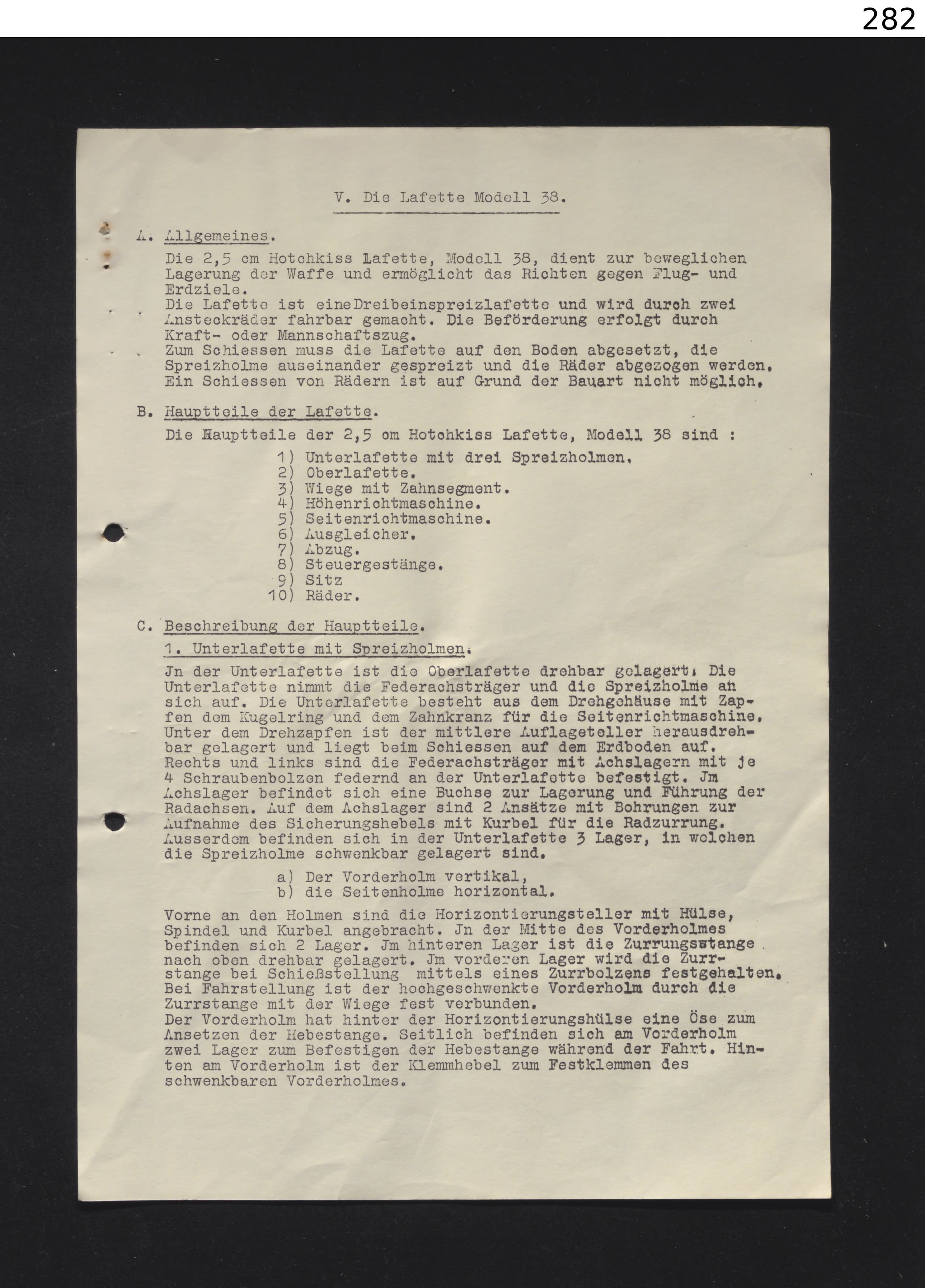
Mountings:
38, 39 and 40 see pictures
Triangular lafett -5° to 90°
3 Legged Spreading lfett -3° to +80°
Ammo Types: AP-T, HVAP-T, HE-T
AP:
Pzgr. L'Spur (Ap-T) 300g solid shot 875m/s 55,67mm/10m
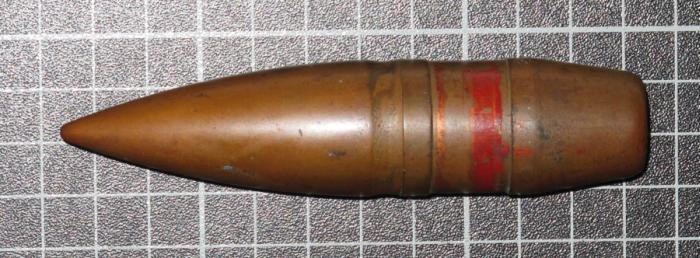
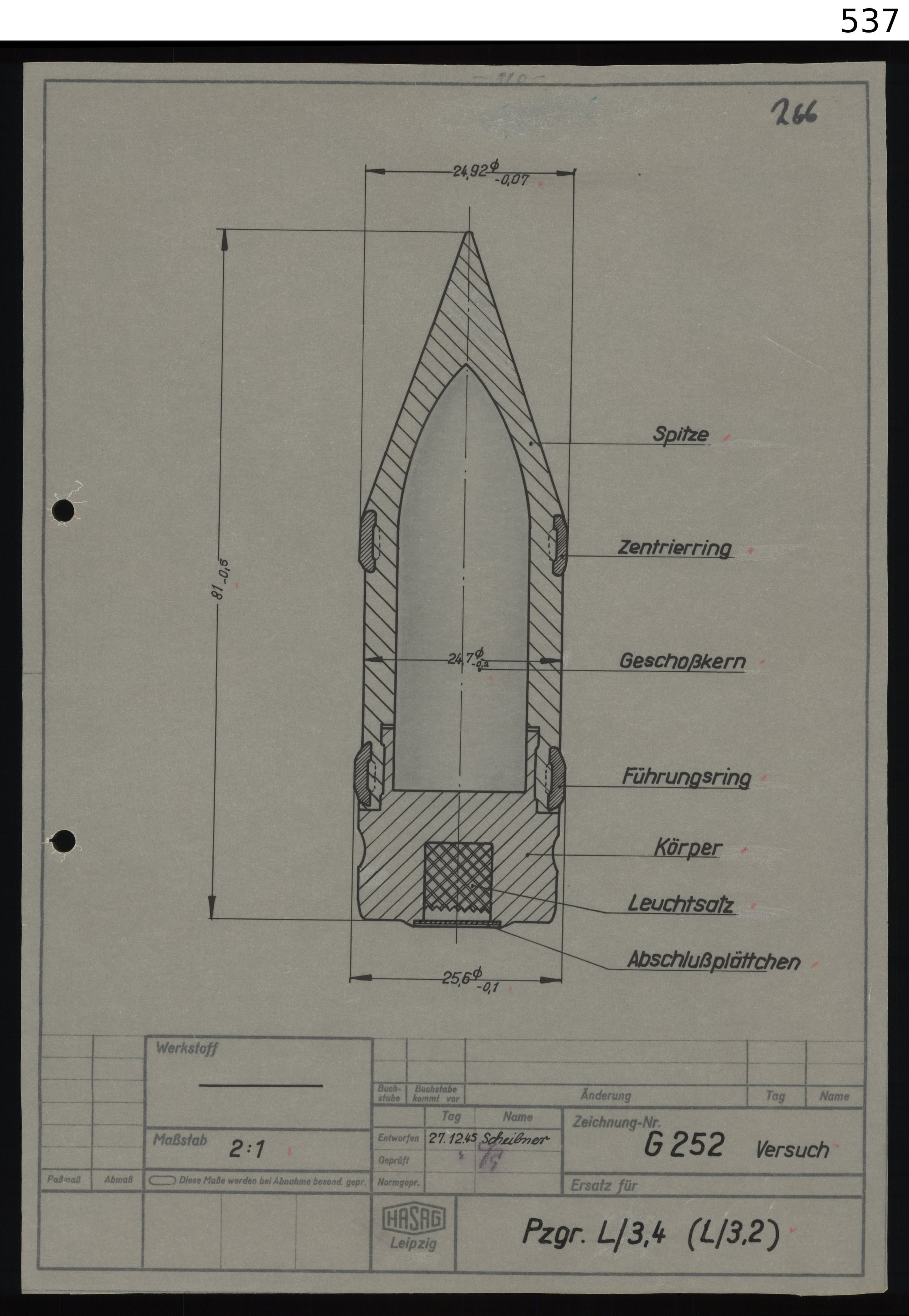
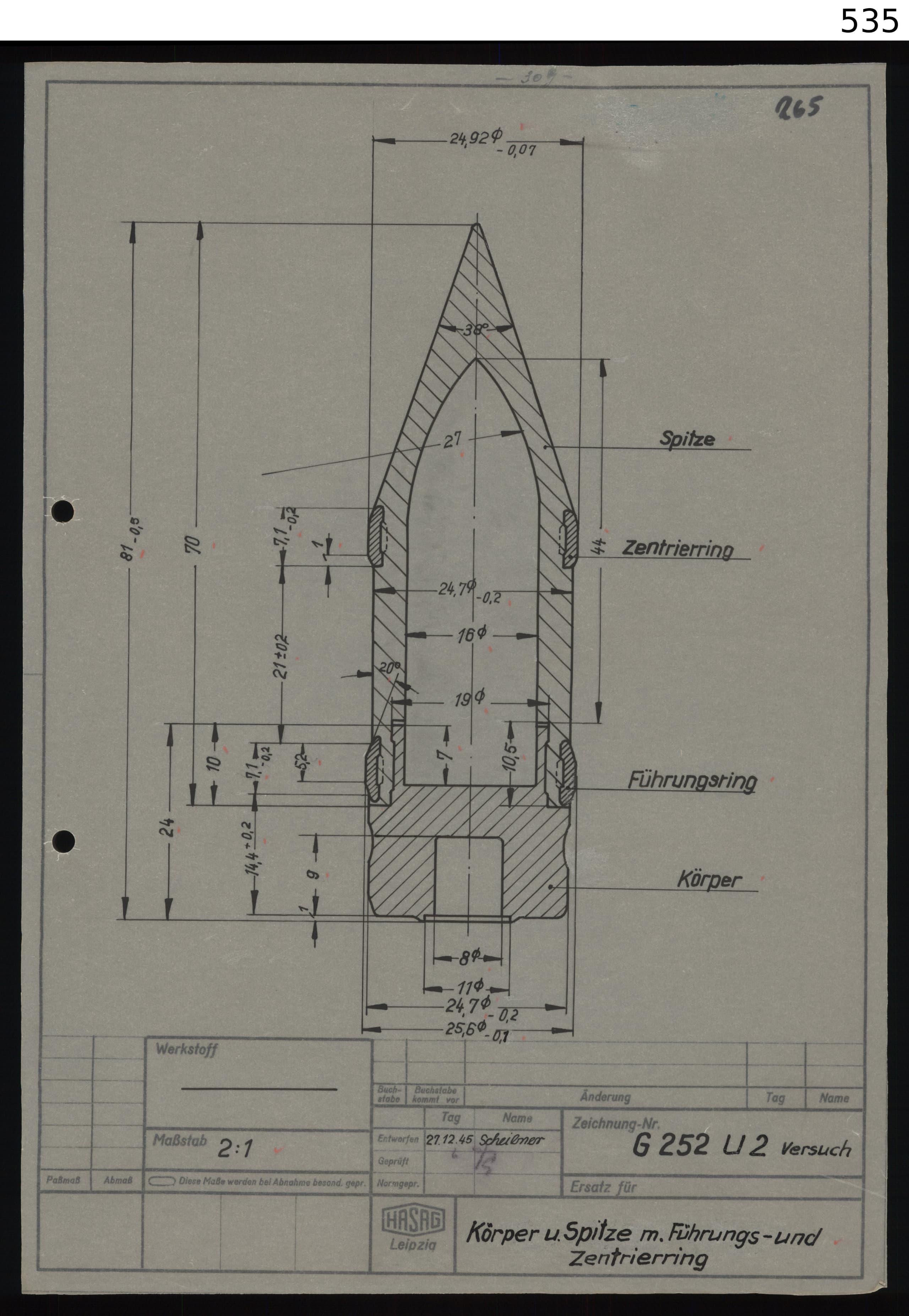
Pzgr.40 (Pzgr. L/3,4 (L3,2)) (Hvap-T) 200g 16x51,5mm ~125-130g Core 900m/s ~48mm/10m
~48mm by gaijins base calculator, which is for the smaller rounds rather underperforming.
HE:
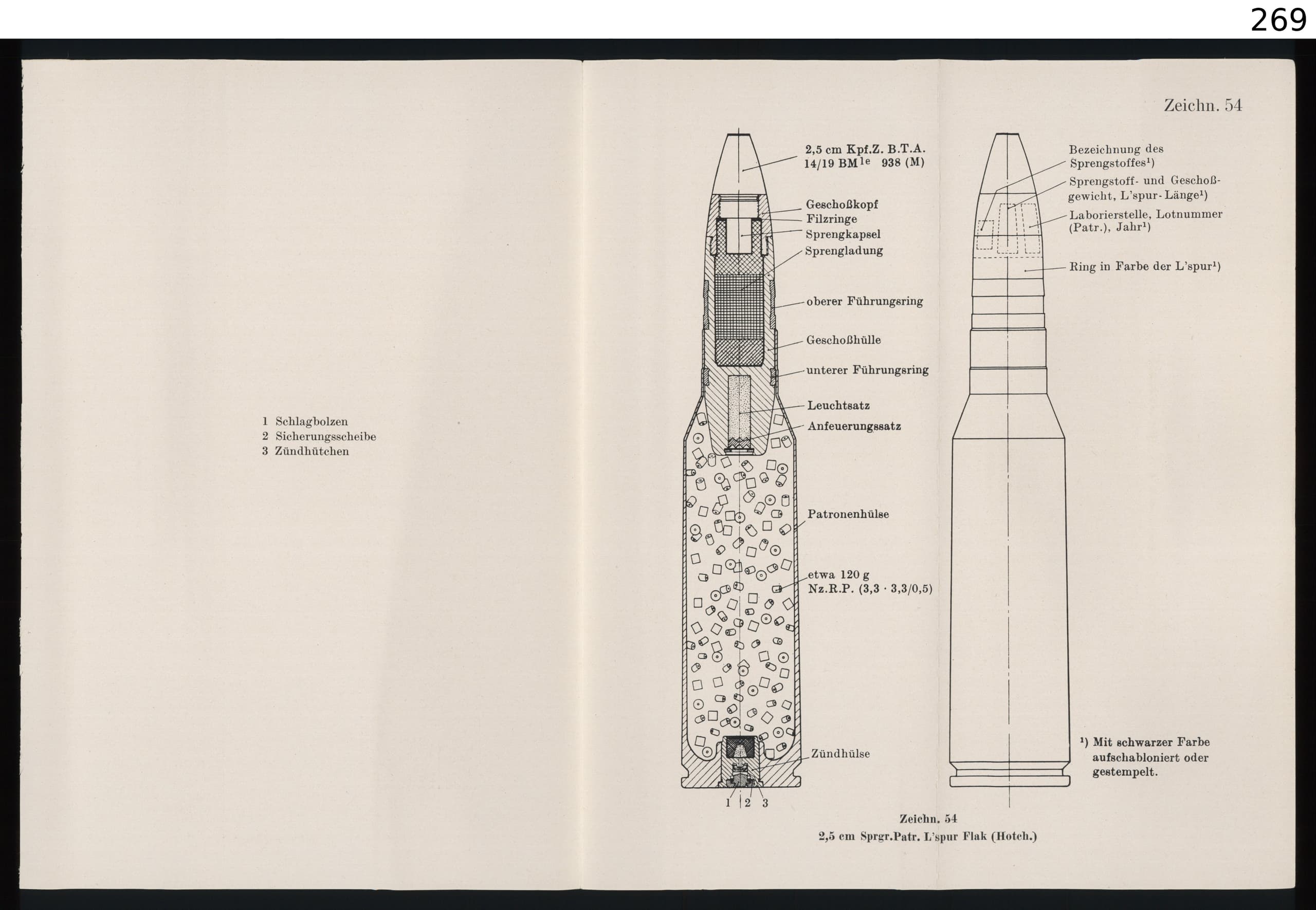
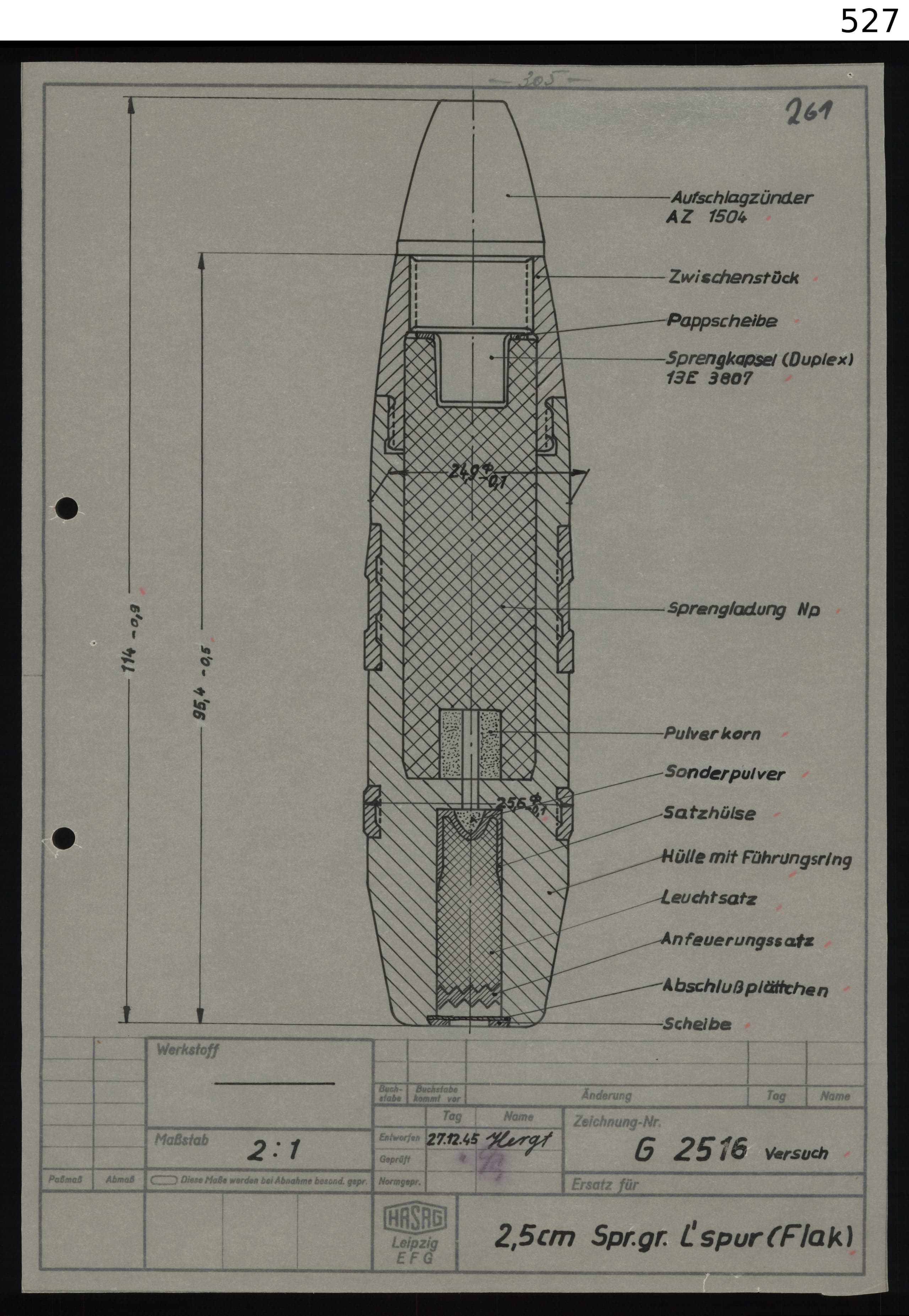
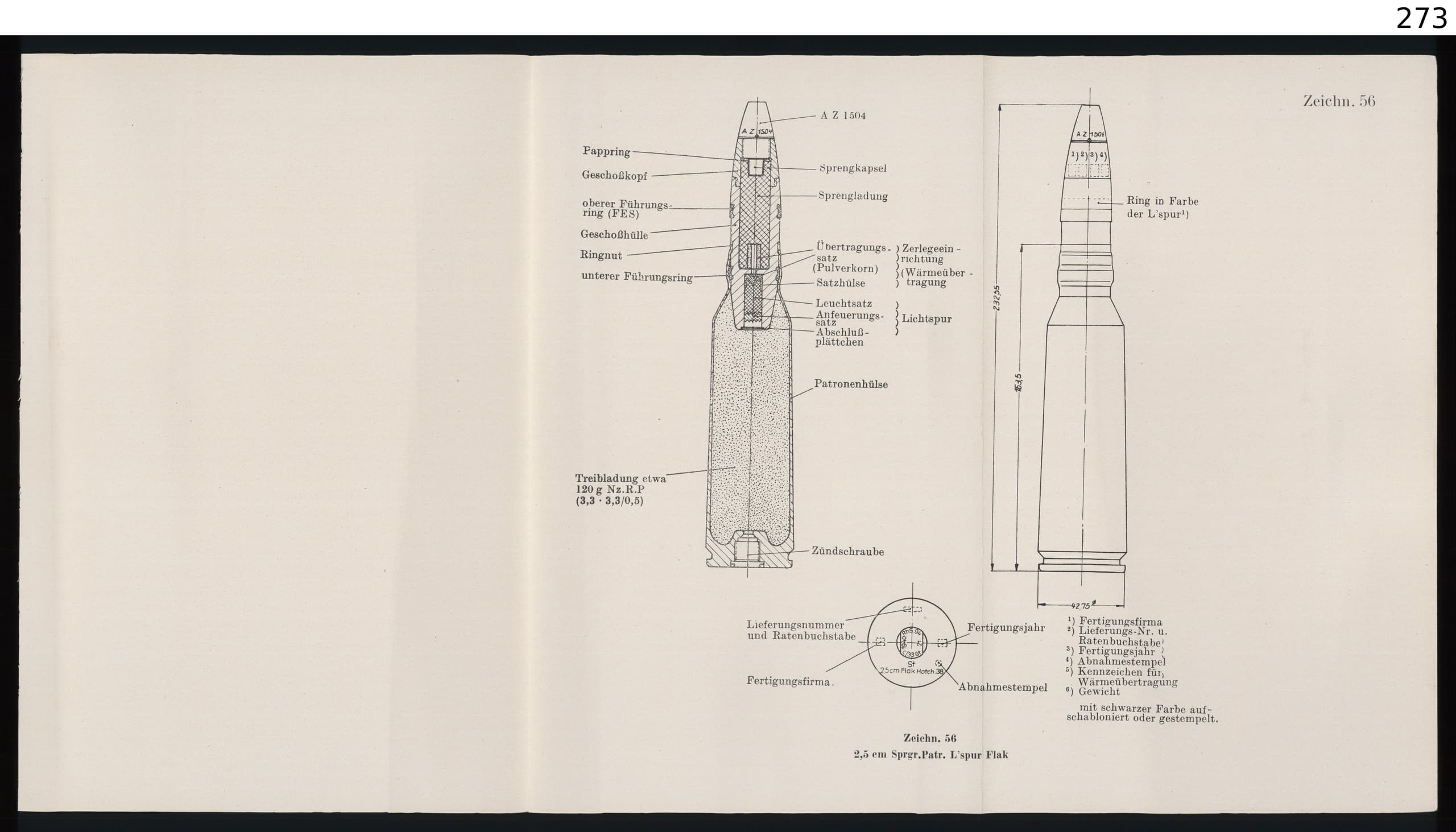
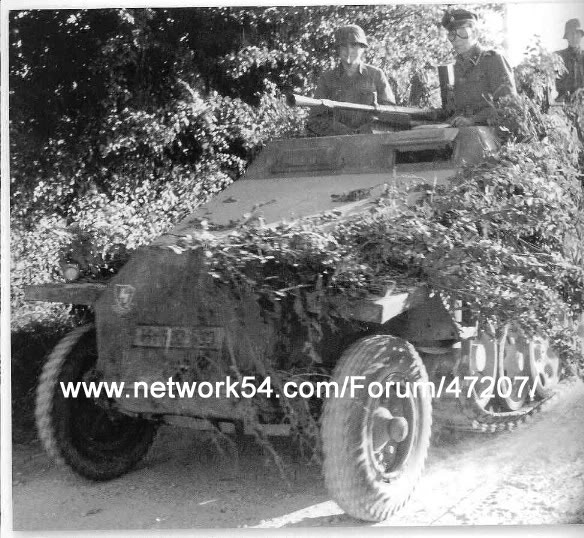
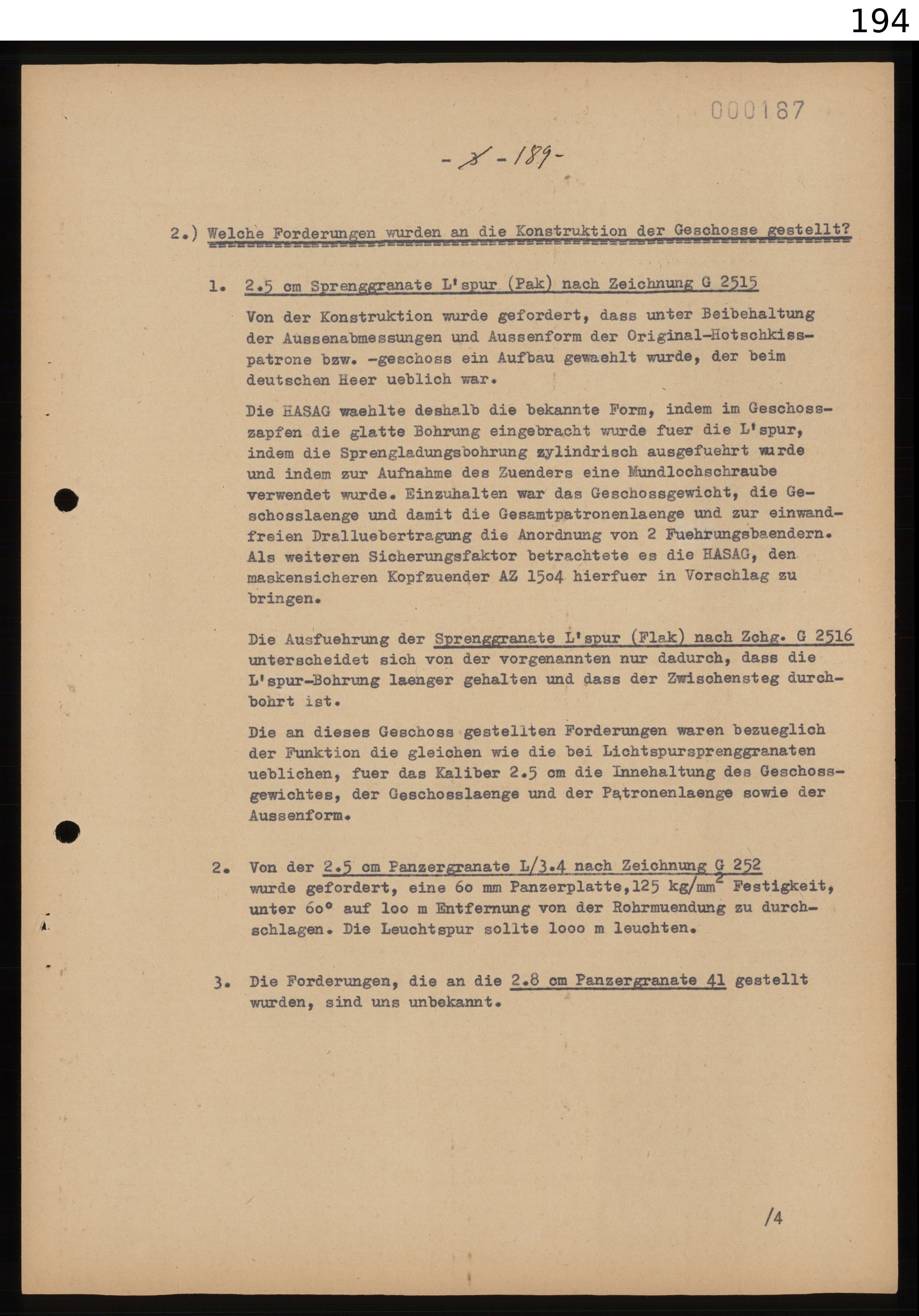
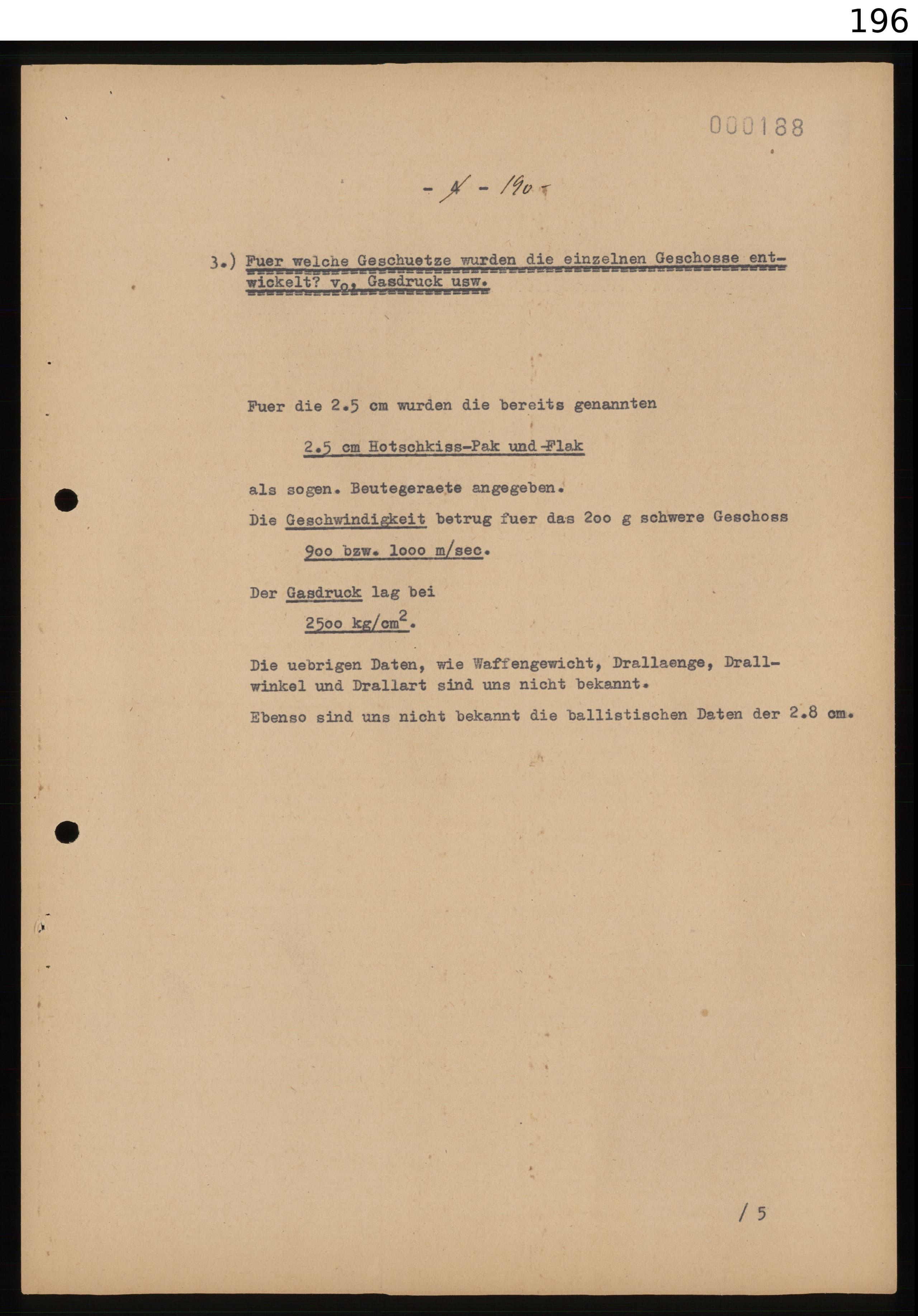
A document (see pictures) writes that it is intended for fixed emplacements, per trailer, train or on Truck flatbets. 1 Picture is known where it is mounted on a Sd.Kfz.251.
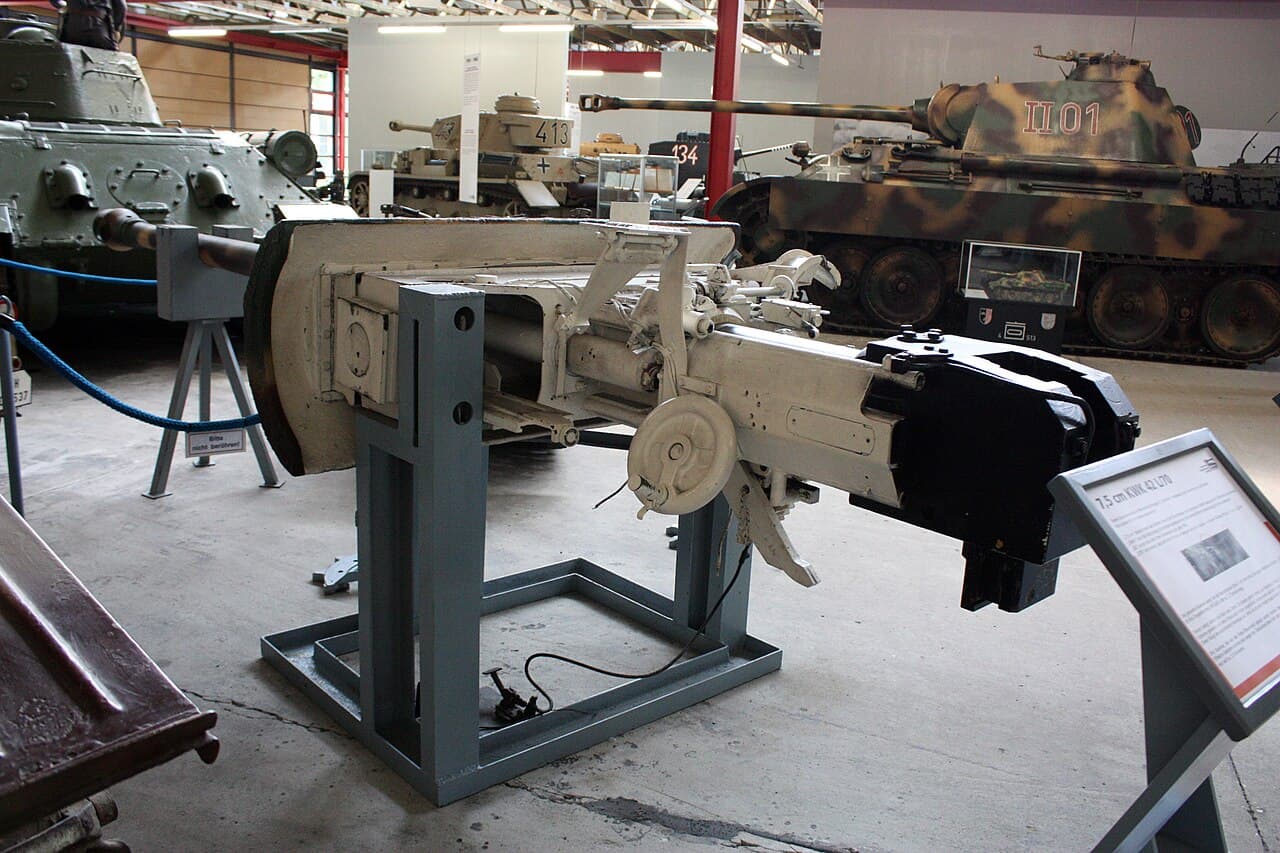
2,8/2 cm S.Pz.B.41 / KwK 42


Development upon the Gelrich Principal and the smallest of the 3 guns which entered production.
Envisioned as a lightweight high power Anti Tank rifle/cannon for the Paratroopers, it was used on all fronts from East to west and South. Based on the 28/20 mm round also a Full automatic Aircraft gun was in development, but cancelled duo to price, wear and better alternatives.
However along the single shot S.Pz.B.41, the 2,8/2 cm KwK 42 (see last pic abov was developed and put into 50 Vk.9.03 Turrets. Beeing well liked for its Power to weight ratio and High velocity with Ap and He ammo available, it was used as is by infantry as well as mounted on lots of German and captured vehicles.
Caliber: 28/20mm
Ammo: 28x187mmR / 28x210mmB
Fire Rate: 30 rpm (60 and more rpm KwK 42)
Single Shot, Horizontal Breechblock (KwK 42 belt fed)
Muzzle velocity: 1430 - 1500 m/s
Weight: 229 kg (Full gun and mounting)
Ammo Types: He, Apcr
Ap:
Pzgr.41 (APCR (no tracer)) 0,12kg (12x45mm 62g Core?) 1400/1415/1460m/s 90mm/10m
1400m/s is worn barrel, 1415 new barrel, 1460 m/s is early higher charge.


He:
Sprgr.41 (He (no tracer)) 0,086/0,1kg 5,3g Np.10 (8,84g TnTe) 1500m/s


3 cm Flak 103/38 L/45


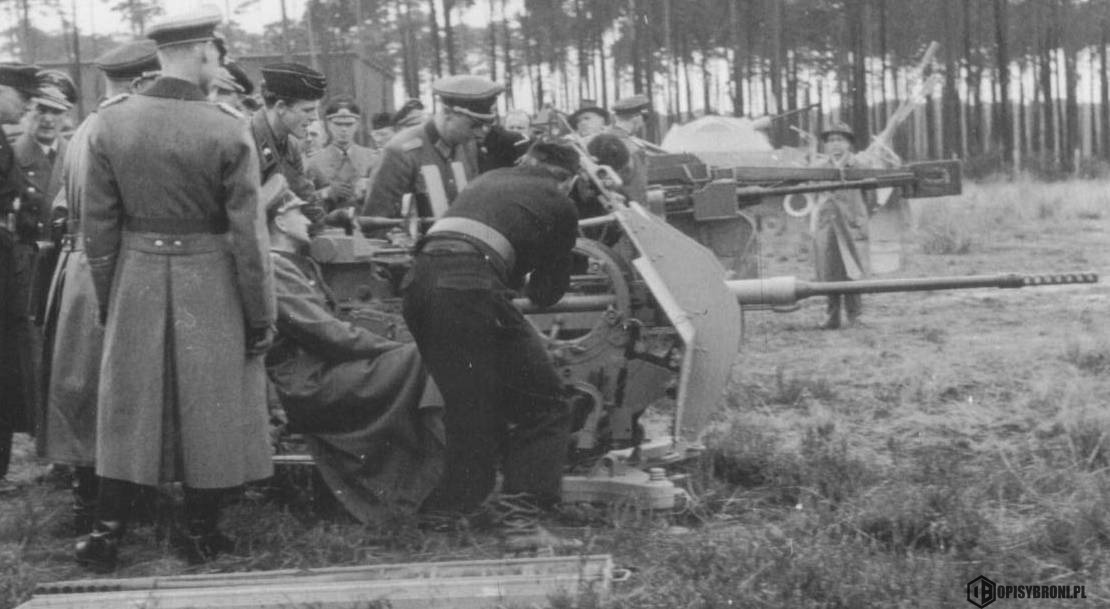
Caliber: 30mm
Ammo: 30x184mmB Rheinmetall
Fire Rate: 450 rpm (Syncronized)
Beltfed 50-60 rpg box
Muzzle velocity: (700) 800-960 m/s
Weight: 105kg
Mountings:


Baumaffe (Treemonkey) and Sockellafette


Ammo Types: Ap-I, Aphe-T, Apihecbc-T, HVAP-T, He-T, He
Similar principal to the Mg 151/20
AP:
Pzbrgr. (E.) o.Zerl. (Ap-I) 0,5kg 725m/s 50mm/10m
Note: Used against Trading ships and other light War Vehicles/Vessels. Contains a 9g Thermite filling.
After penetrating 6mm of Ship construction steel, over a path of 2m it ejects the Thermite (Elektron) filling, multiple penetrations create a permament fire source.


Pzsprgr. L`Spur. o.Zerl. (Aphe-T) 0,5kg 725m/s 14g Pent (23,8g) 50mm/10m
43mm/10m, by calculator with filler, however is the same shell as the AP-I with same penetration.
Note: Primary against Iron/Steel protected or armored Ground targets.
5mm Fuze Sensitivity and 0,75m (+/-0,25m) Fuze Delay.
2 Versions existed with different Bottum Fuzes (BdZ. 1583 and BdZ. 1584) with 500g or 530g weight (resulting also in a 25m/s velocity difference)
Was later replaced by the Pzbrsprgr. L’Spur as it was ligher (reducing wear), offered increased penetration and double effect of HE and Incendary instead of only He.)
(Like the ammo of the Mg 151/20 this is build like the Pzbrgr but with Pent filling and a Bottomfuze instead of Thermite filling.)


Pzbrsprgr. L`Spur. o.Zerl. (ApI-T / ApheIcbc-T) 0,455kg 800m/s 5,2g Pent (8,84g) 58mm/10m
Note: Against Iron/Steel protected and Armored ground targets. Against Locomotives and heavily armored Planes. Was to replace the Pzsprgr. L’Spur.
Apcbc round. 5mm Fuze sensitivity and 0,75m +/- 0,25m Fuze Delay.


H-Pzgr. L`Spur. o.Zerl. (HVAP-T) 0,356kg 960m/s 16,1x85mm 231g core 81mm/10m
Note: Only against Heavily armored Tanks. The Al-Mg-Cu Alloy Carrier has an incendary effect upon melting on impact.


He:
Sprgr. L`Spur. o.Zerl. (He-T) 0,44kg 800m/s 27g Pent (45,9g)
Note: Against Air and Ground Targets. Fully replaced by the M-Geschoss L’Spur o.Zerl.
(Later also with reduced charge of 750m/s to increase gun life.)


Minengeschoss:
M-Gesch. Ausf.C L`Spur. o.Zerl. (Hei-T (m)) 0,33kg 900m/s 70g HTA 5g Pent (92,5g)
Note: Against Air and Ground Targets. Fully replaced the Sprgr. L’Spur.
(Also with reduced wear charge of 860m/s.)
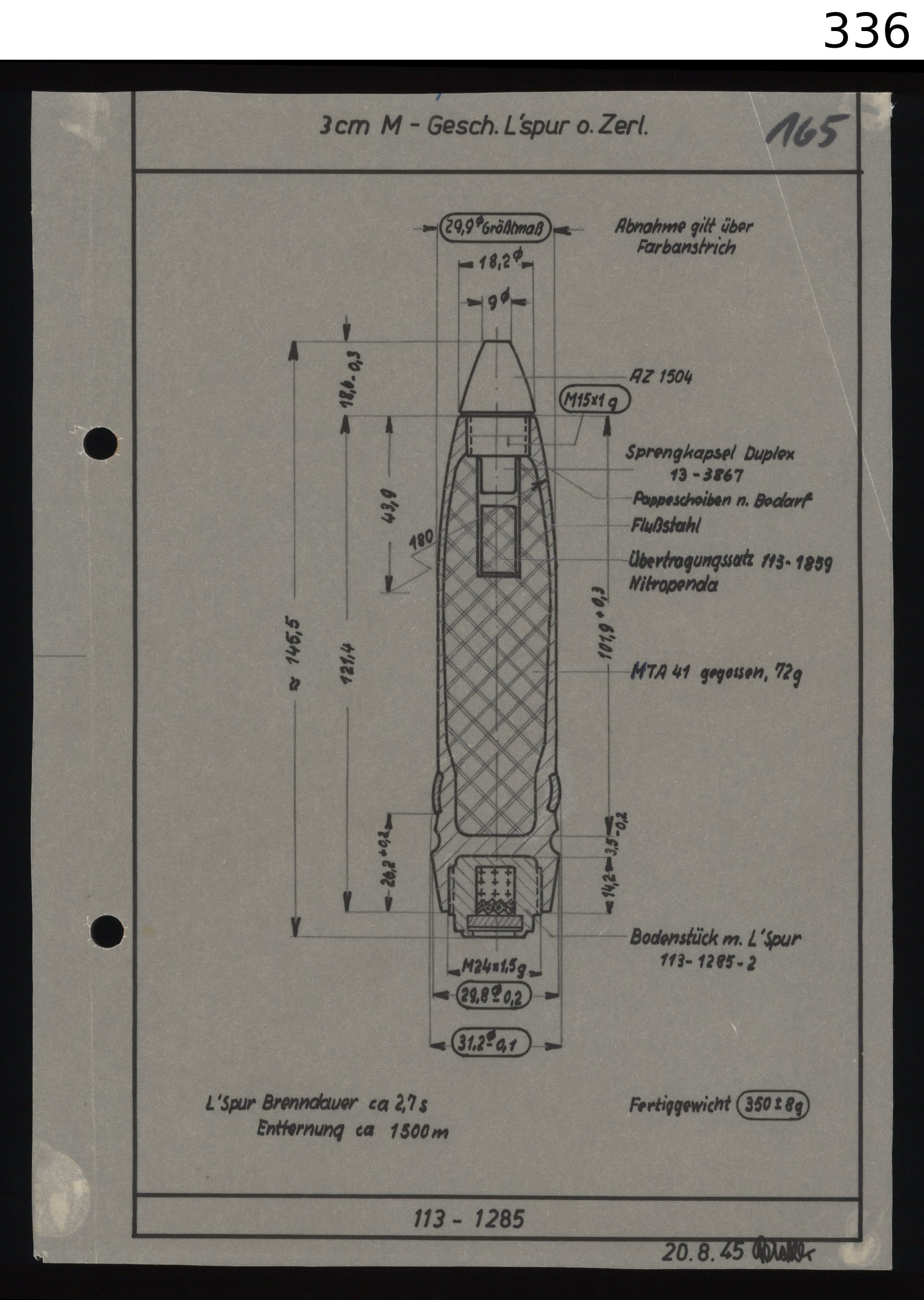

M-Gesch. Ausf.A o.Zerl. (Hei (m)) 0,33kg 900m/s 85g HTA (102g)
Note: Against Air and Ground Targets. Fully replaced the Sprgr. L’Spur.
(Also with reduced wear charge of 860m/s.)


Incendary:
Brgr. o.L'Spur o.Zerl (I) 0,33kg 900m/s 140g Incendary mix & 0,6g Pent (1,02g)


3,7 cm
3,7 cm KwK/Pak L/45


The 3,7 cm KwK and Pak L/45 was a prewar designe form after WW1 and overall still in use as a light infantry gun in 1945, especially with over time 3 life extentions in form of Sprgr.40 and Pzgr.40 and Stielgranate 41. Beein a capable, simple and light AT and Tank gun at the beginning of the war.
Development started after WW1, after the development in WW1 of the 3,7 cm TAK 1918 L/21, it was allready seen that the caliber of 3,7 cm was ideal in archiving great power, effect while keeping the weight and size down. After the war a further development with increased firepower and modernized resulted in the Pak L/45, which also found its way in the Pz III as it was capable enove, produced in great numers until more powerfull armarments were available.
The addition of 36 in the name is a after war addition and most likely because of the name switch from TaK to PaK in 1936, the gun was only named 3,7 cm TaK/PaK L/45 pre and inner war.
And was even taken as basis for the American 37mm gun and copied by the Japanese as Type 97 and taken as basis for later 3,7 cm gun development of the Japanese.
Caliber: 37mm
Ammo: 37x250mmR


Fire Rate: 22-30 rpm
Single Shot, Horizontal Breechblock
Muzzle velocity: (110m/s) 740 - 1020 m/s
Weight: 327 kg (Pak Combat ready)
Mounting: On Tanks (Pz III and Nb.Fz.) and LOTS of different vehicles both by factory and field mod.
Ammo Sheet: (Click to show)
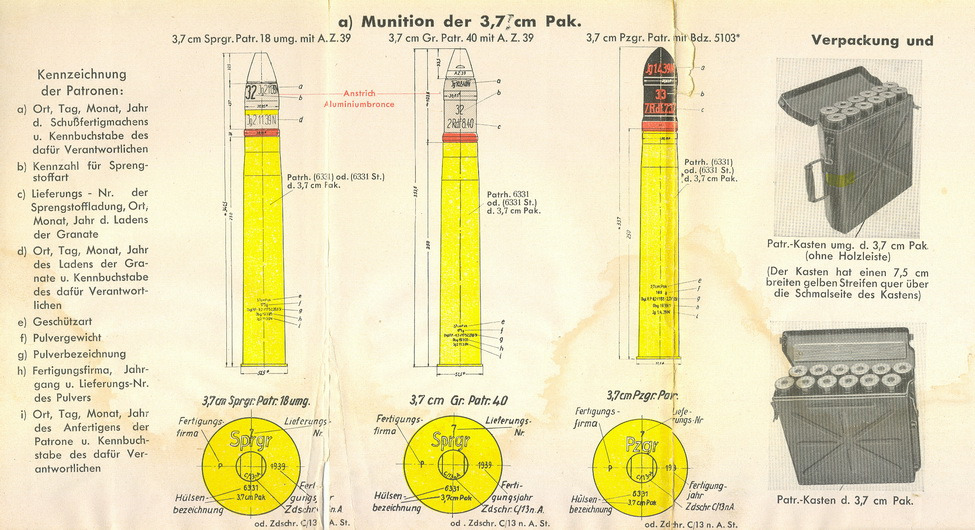
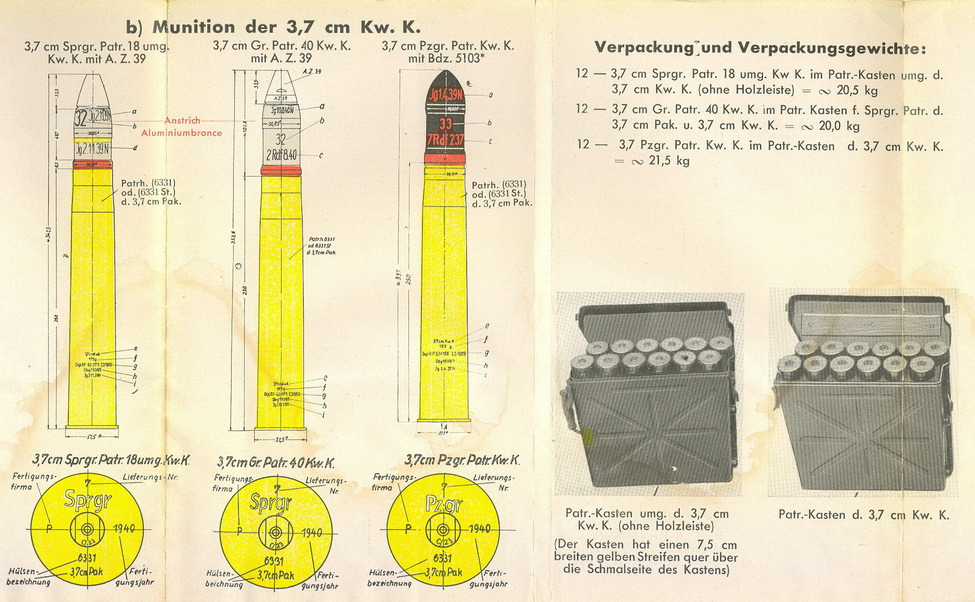
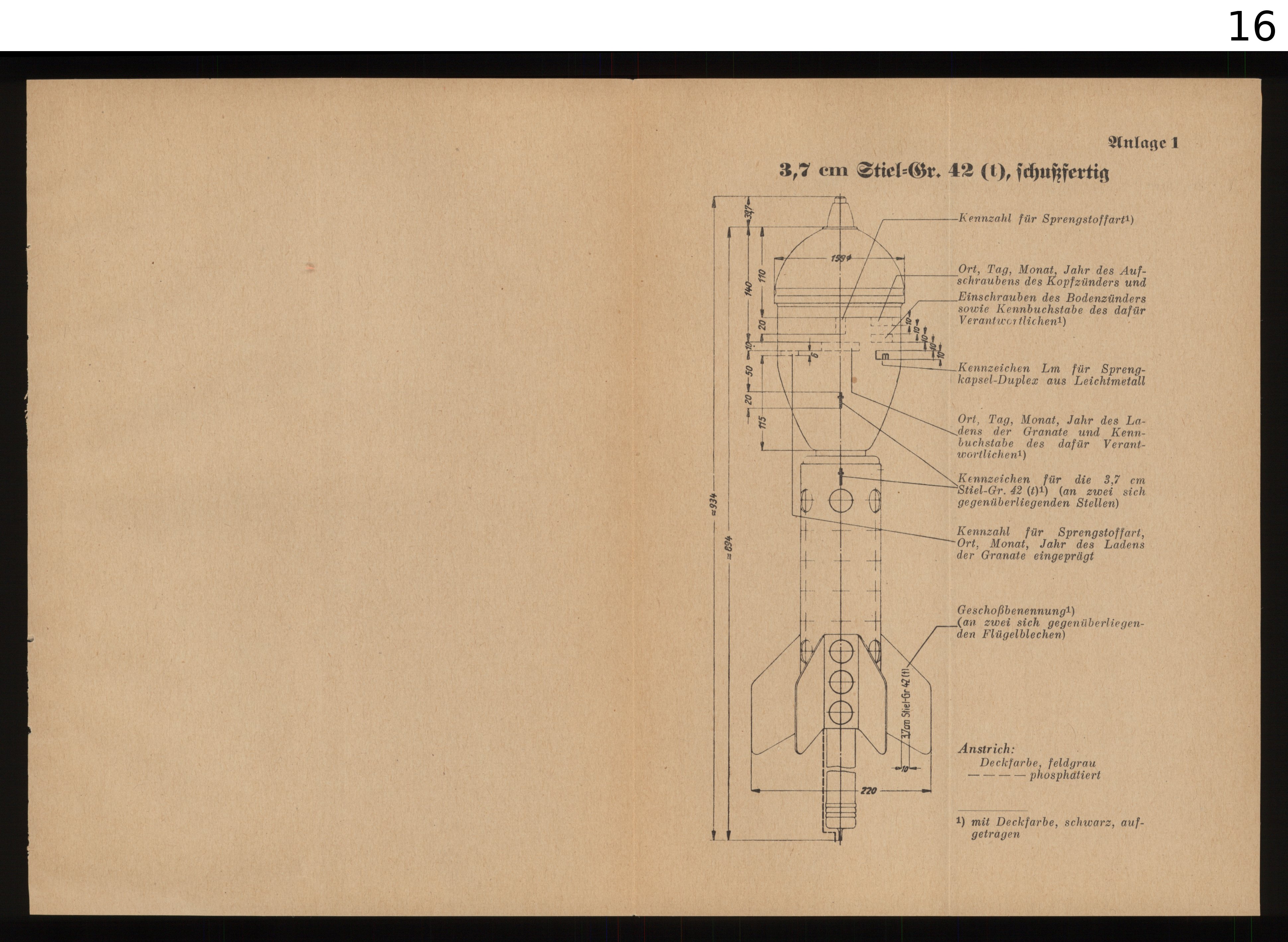
Ammo Types: Aphe, Hefi, Apcr, Supersize Heat-FS (only open compartment Pak)
Ap:
Pzgr. (A) (Aphe) 0,67 kg 800m/s 10g Pent (17g) 53,43mm/10m

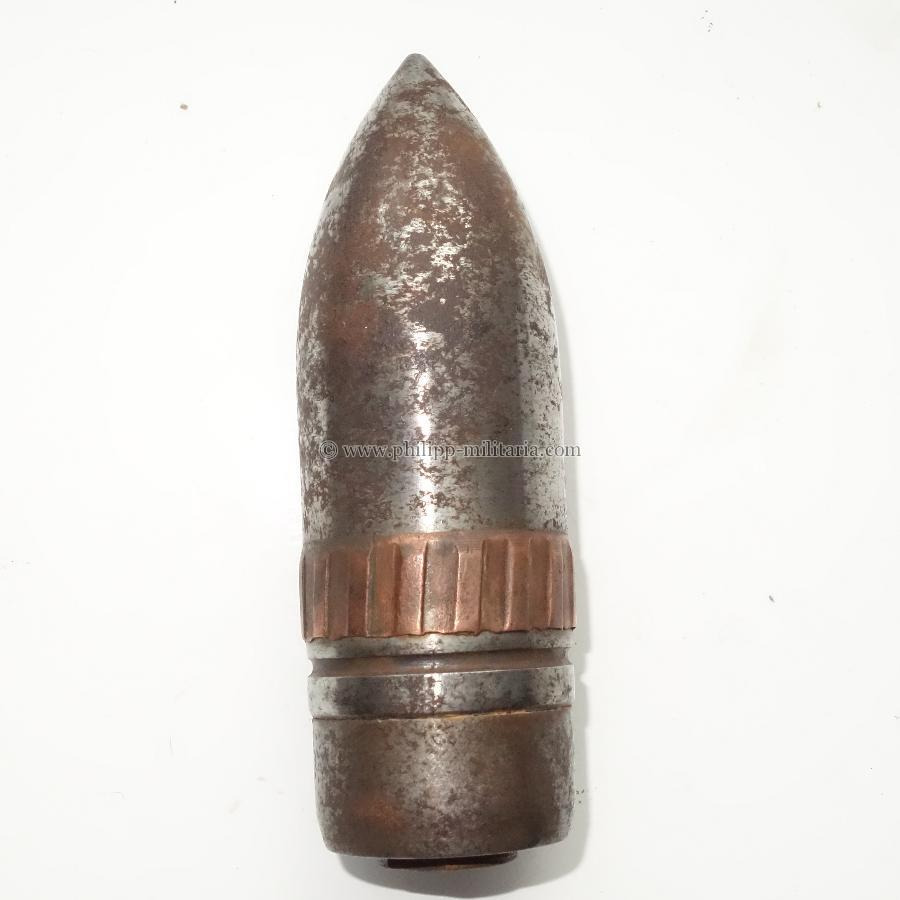
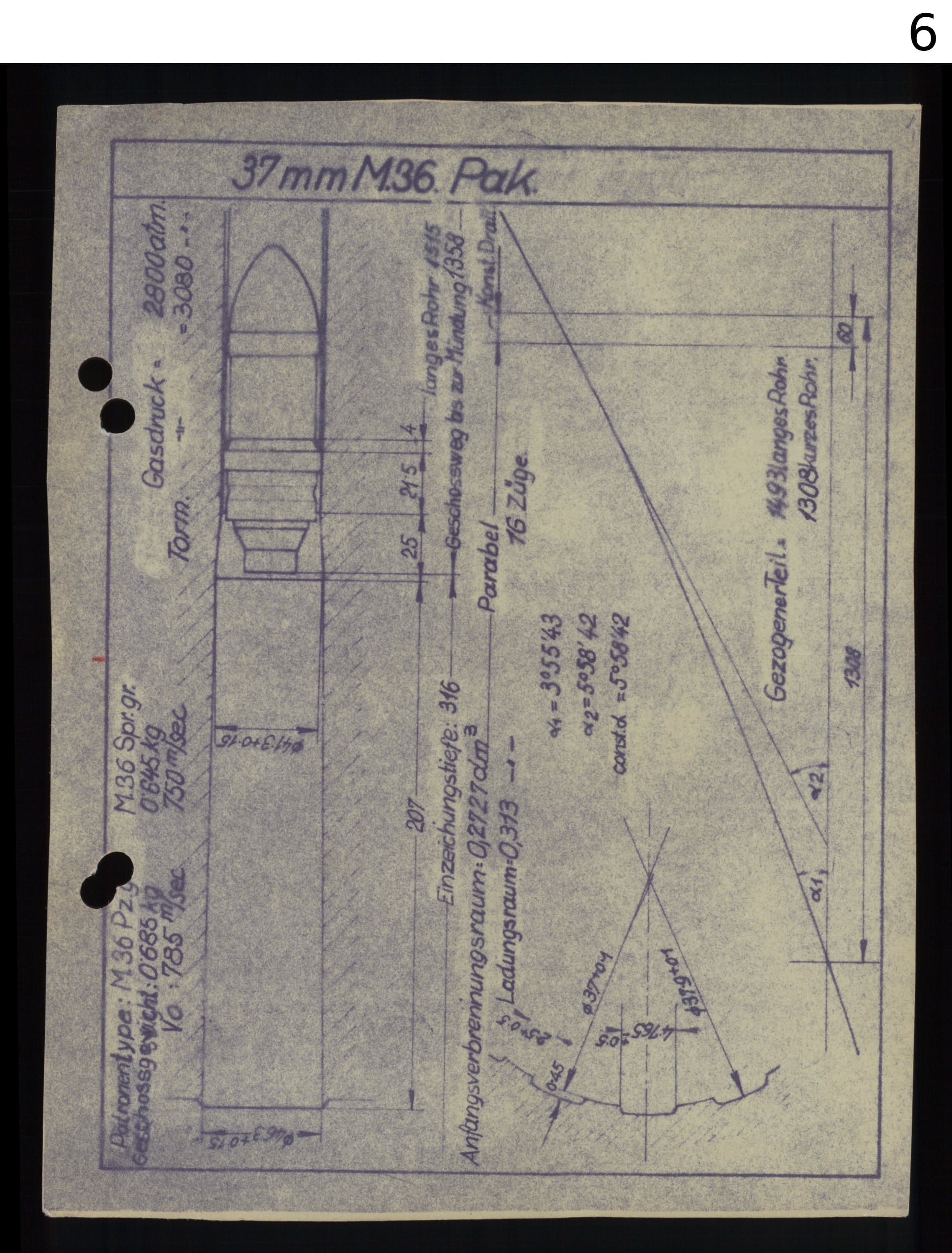
Pzgr. (Aphe) 0,695 kg 740/760/780m/s 13g Pent (22,1g) 47,87-49,73-51,29mm/10m
The round existed both as 685g and 695g, its propably production differences.
At 685g the velocity is 745/765/785m/s




Pzgr.40 (Apcr) 0,37 kg 1020m/s 15x58mm Core 135-139g 86mm/10m


He:
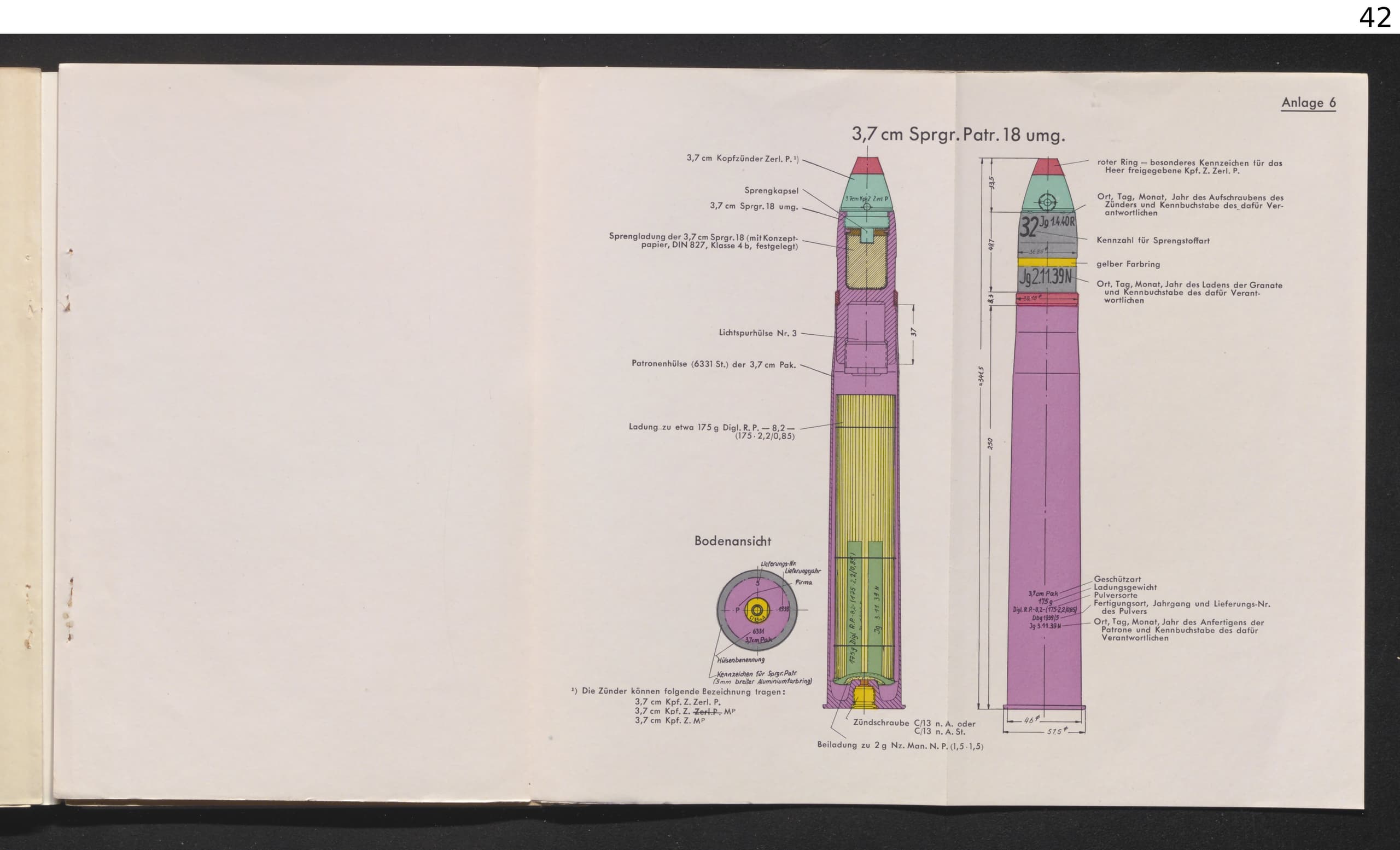
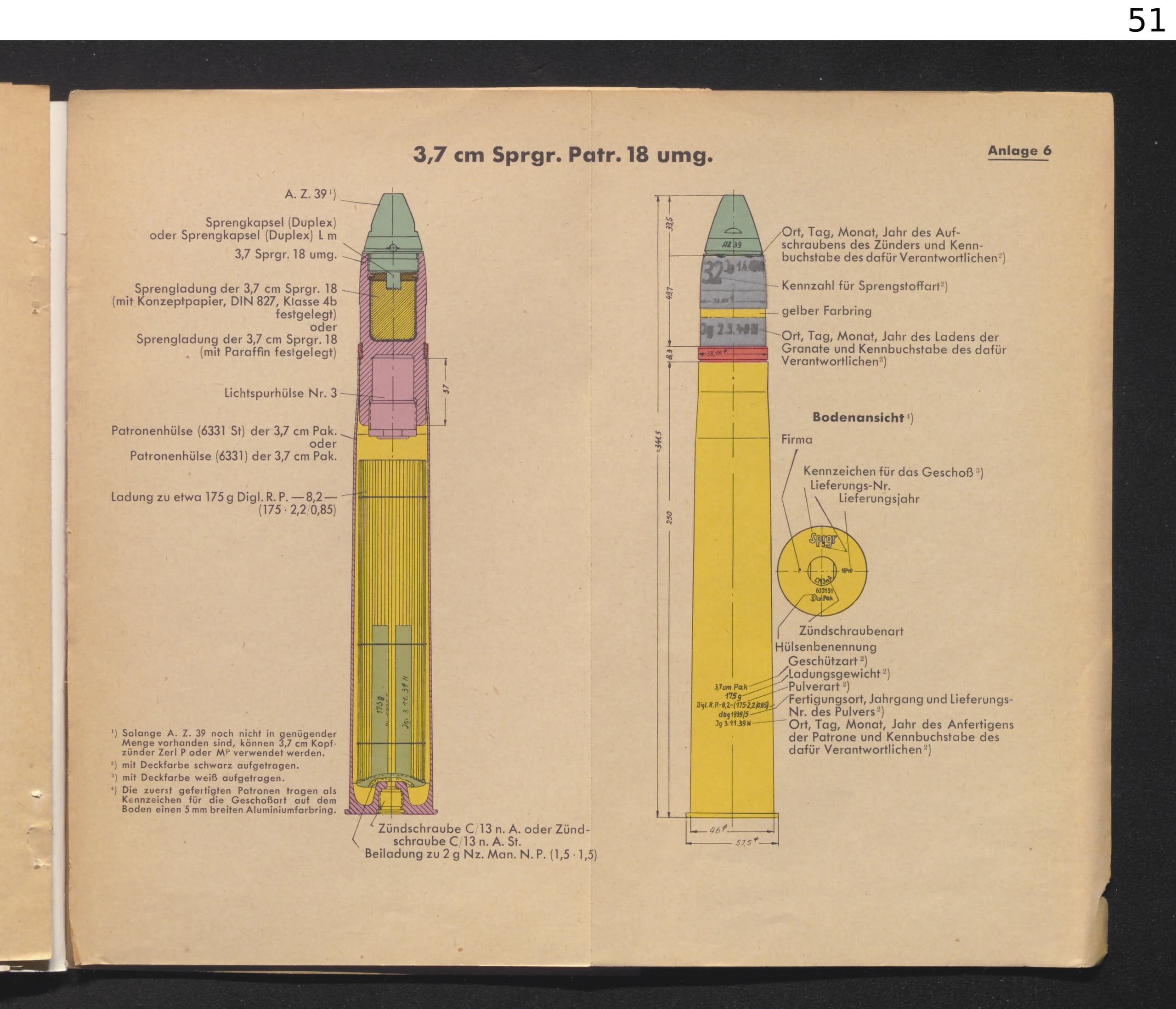
Sprgr.18 umg. (He) 0,615/0,645kg 780/770m/s 26 g Np.10 (44,2g TNTe)
(umg. (umgebaut/modified) they took the older 2 copper driving band Sprgr.18 and turned the lower part down also removing the 2nd lower driving band and new production.)




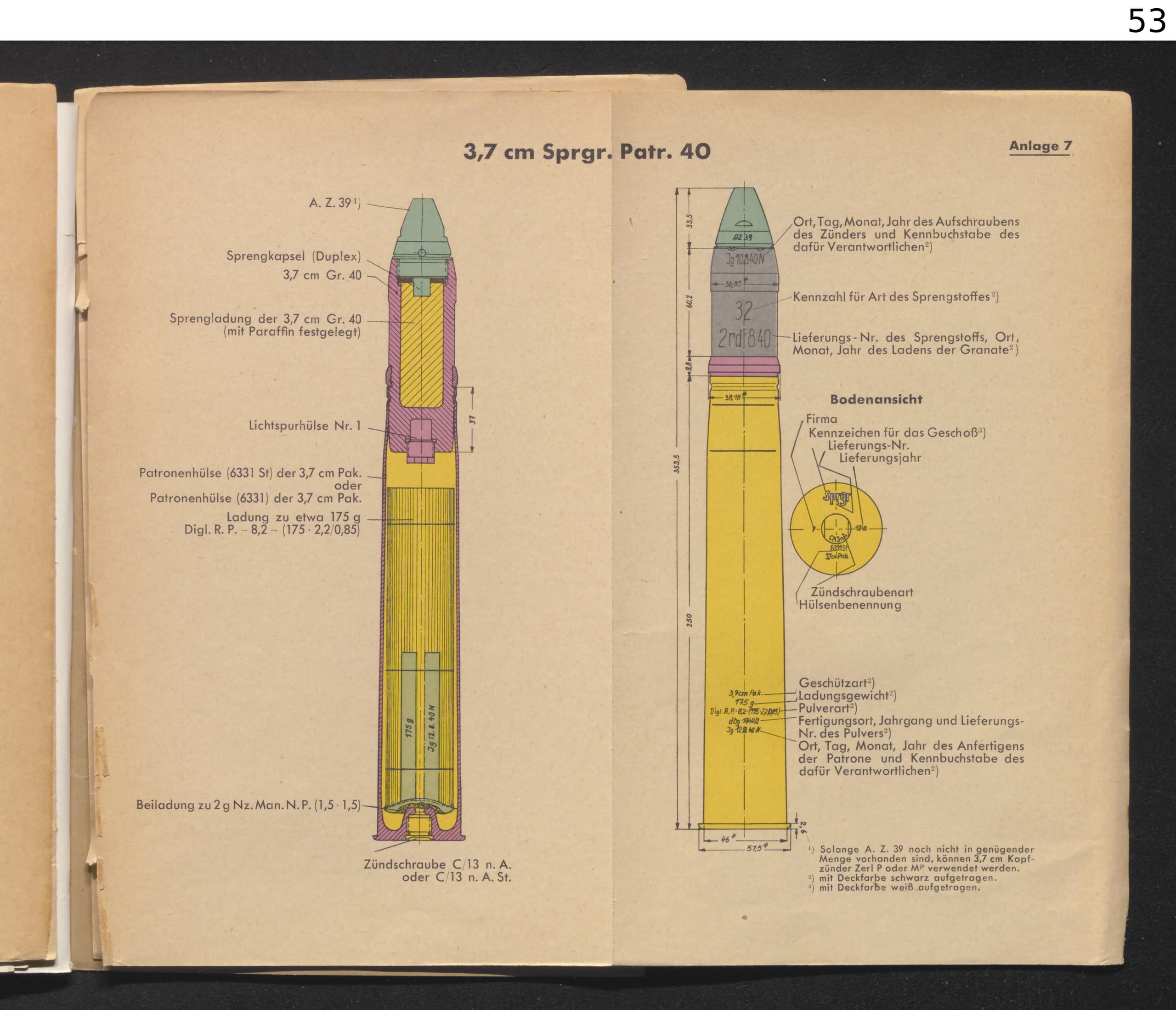
(Only for open compartment Paks)
15 cm Stielgranate 41 (Supercaliber Heat-FS) 8,5 kg 2,42 kg Füller 95 (Hexagon/TnT 60/40) Filler 110 m/s 180mm/30°/all distances effective range up to 300m, max range 700m


Developmental:


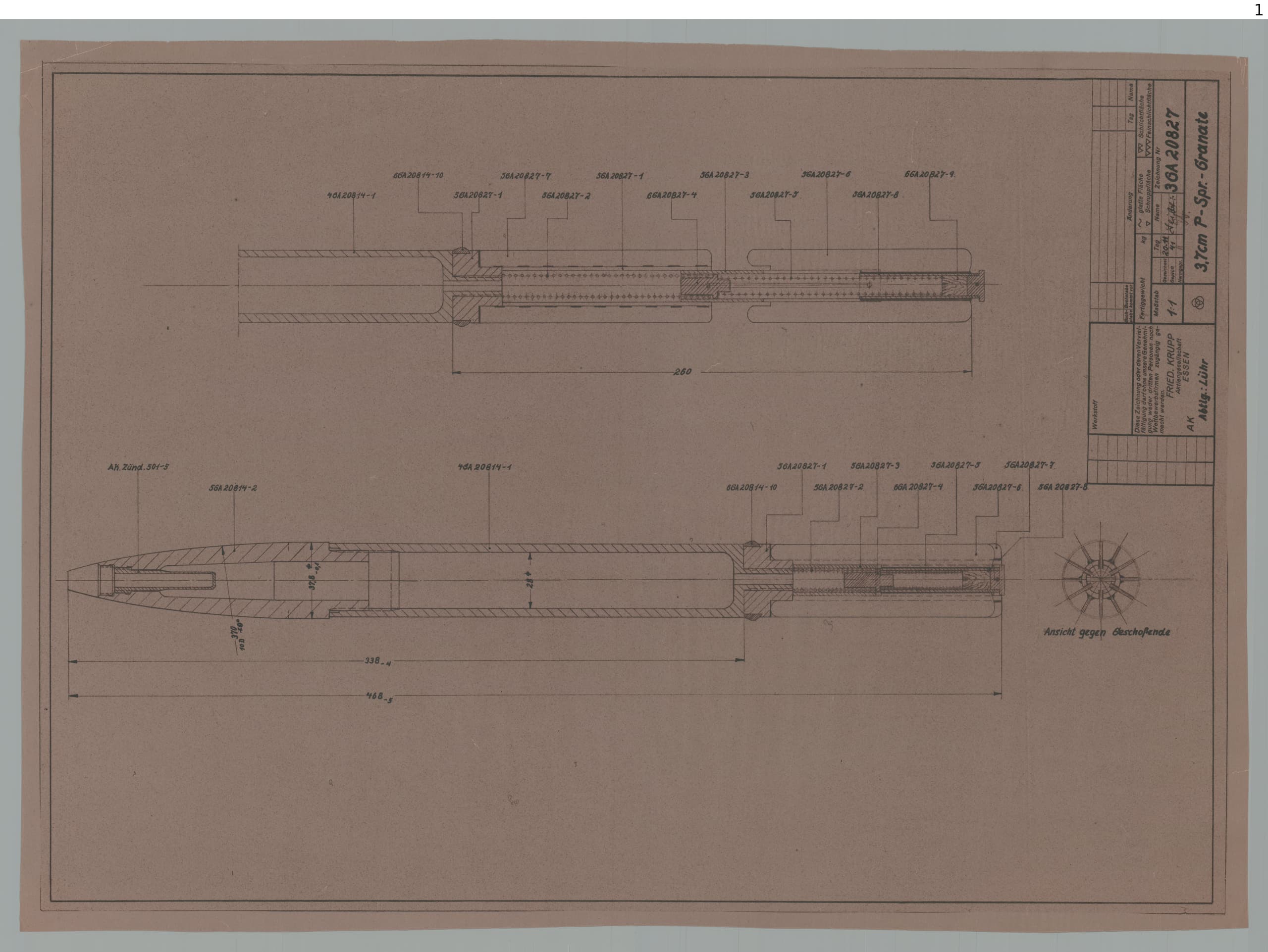
3,7 cm KwK 38(t) L/48
A Czech gun, both used as a field AT gun and the main armarment of the Pz.38 (t) tanks.
Actual barrel length is L/47,8 germany rounded it up in the name to L/48. Germany produced both the original and own type ammo for it, while a light tank, it had a stronger armarment than german light tanks of the time (different doctrin, the 2 cm automatic guns were powerfull enough for equal tanks, overall effective against a range of targets including low flying aircraft up to 1800m with the 115 and 120g HE rounds.
Caliber: 37mm
Ammo: 37x268mmR
Fire Rate: 22 rpm
Single Shot, Horizontal Breechblock
Muzzle velocity: (110m/s) 750 - 1040 m/s
Weight: 275 kg
Mounting: On Tanks and field mounts
Ammo Types: Aphe, Hefi, Apcr, Supersize Heat-FS (only open compartment Pak)
The Ap rounds are both with and without tracer available.
Ap:
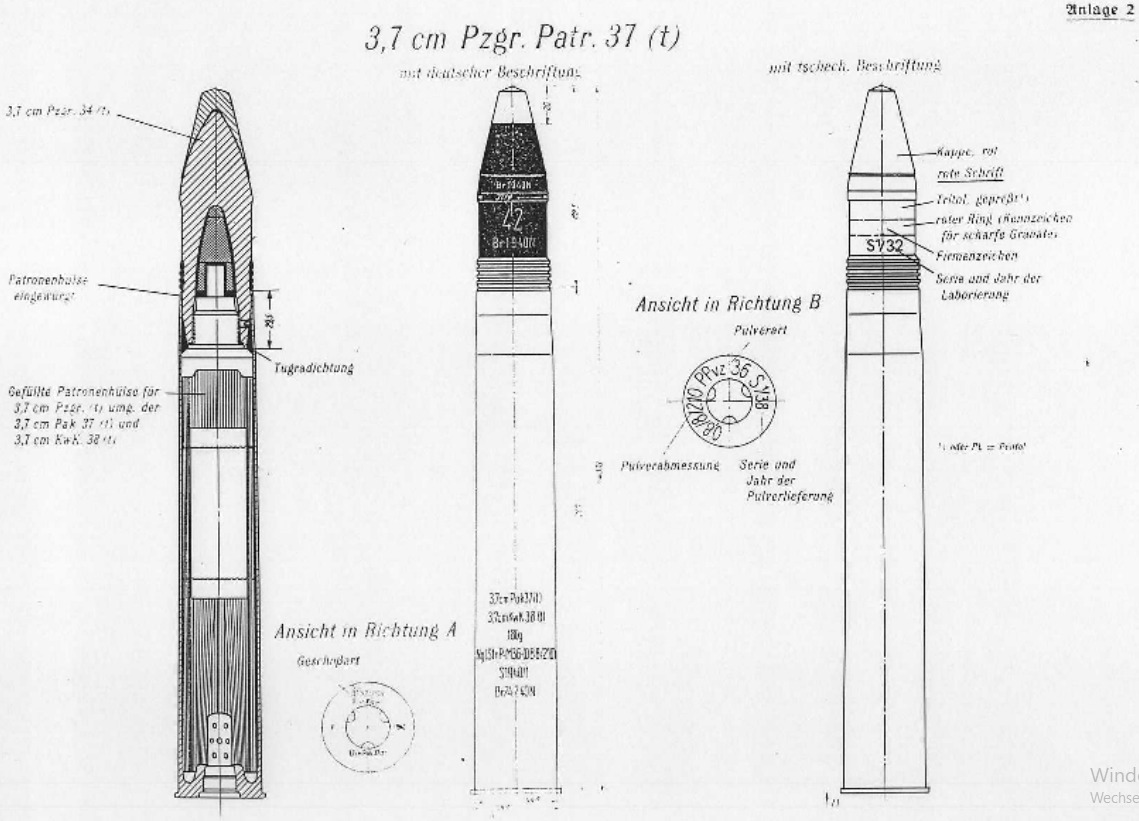
Pzgr.(t) umg. (Apc) 0,815 kg 750m/s 13g Pent (22,1g) 61mm/10m

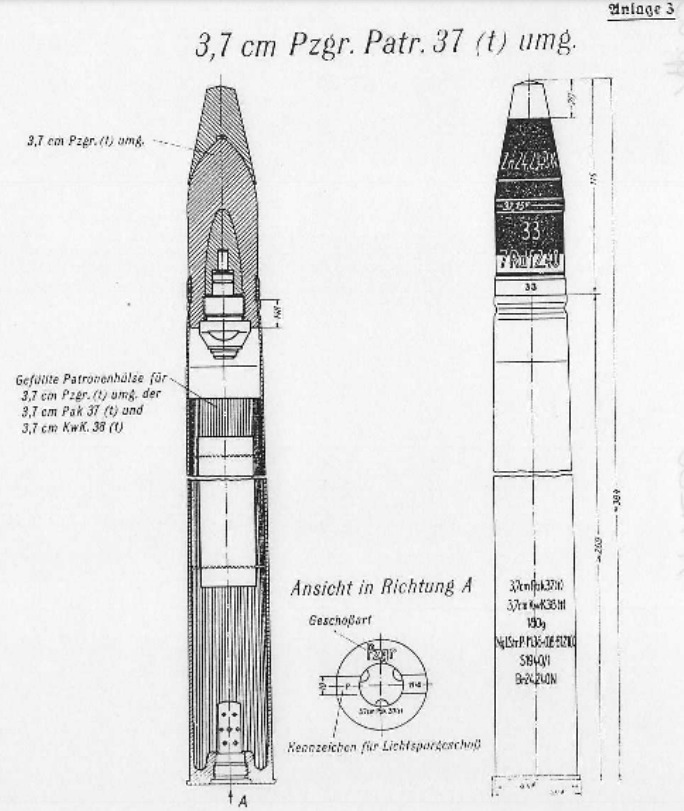
Pzgr.40 (t) (Apcr) 0,37 kg 1040m/s 15x58mm Core 135-139g 87mm/10m
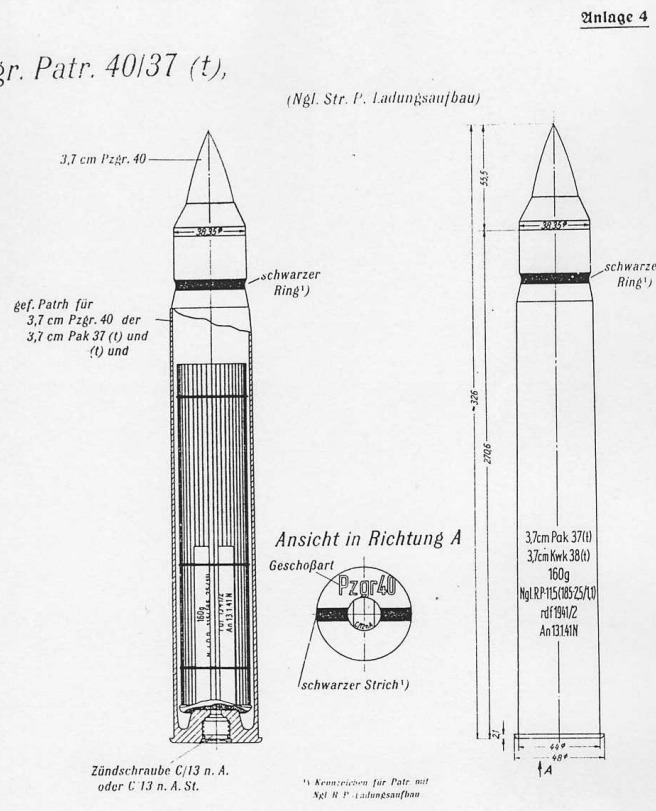

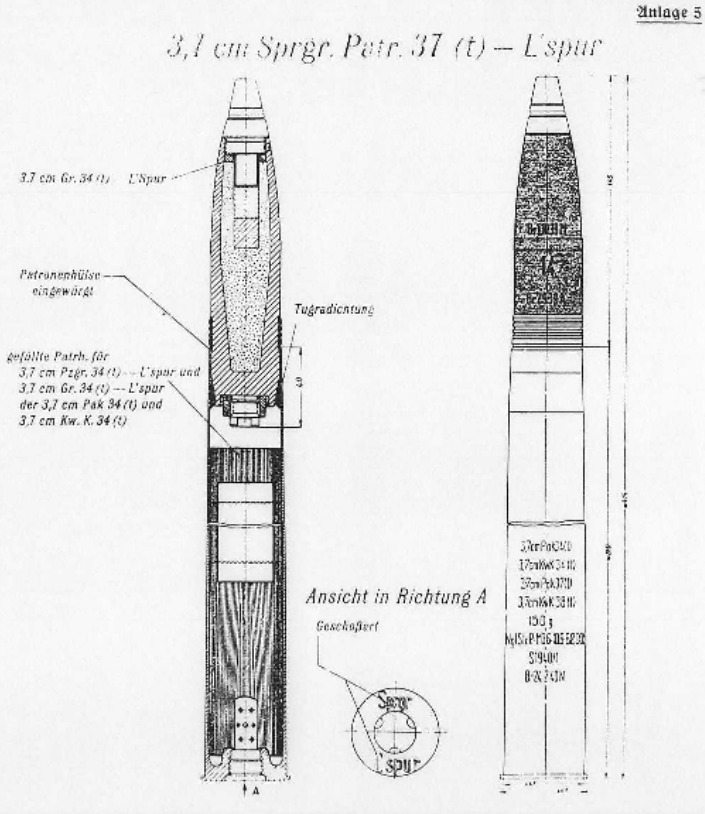
HE:
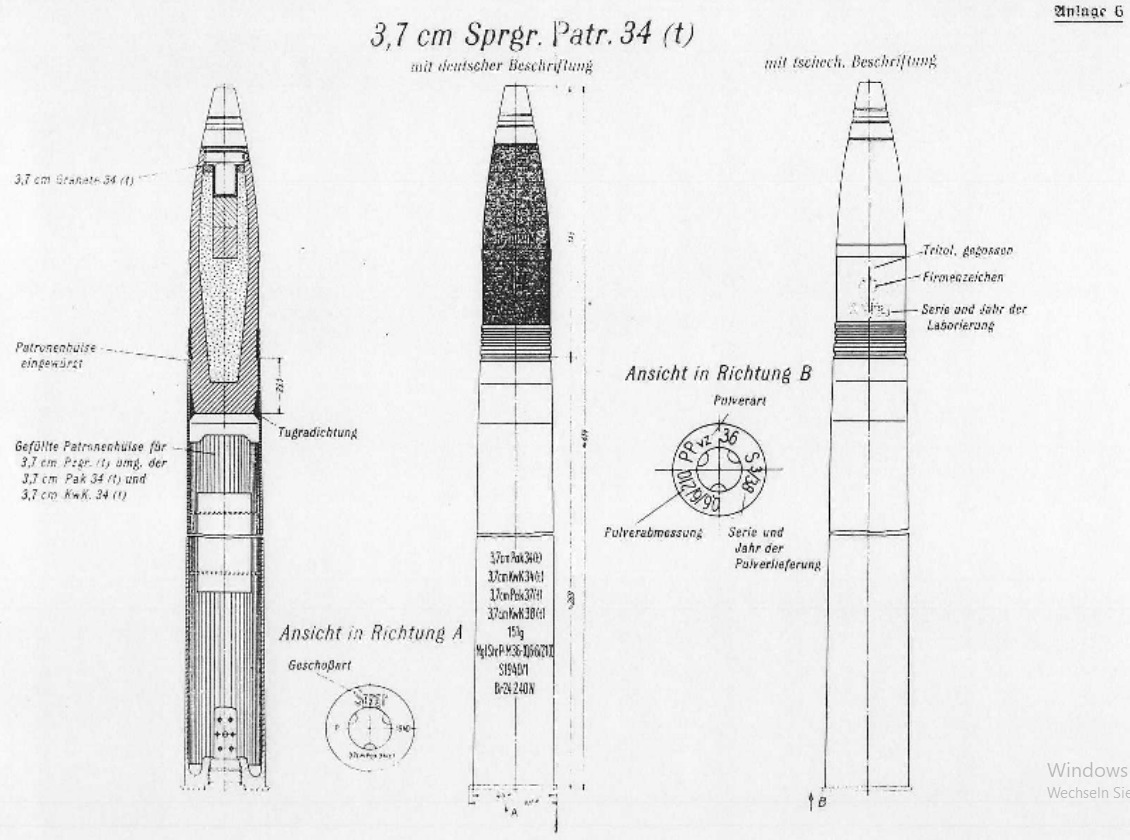
Sprgr.34(t) L'Spur (HE (Tracer) 0,825 kgl 750 m/s 77g Trytol
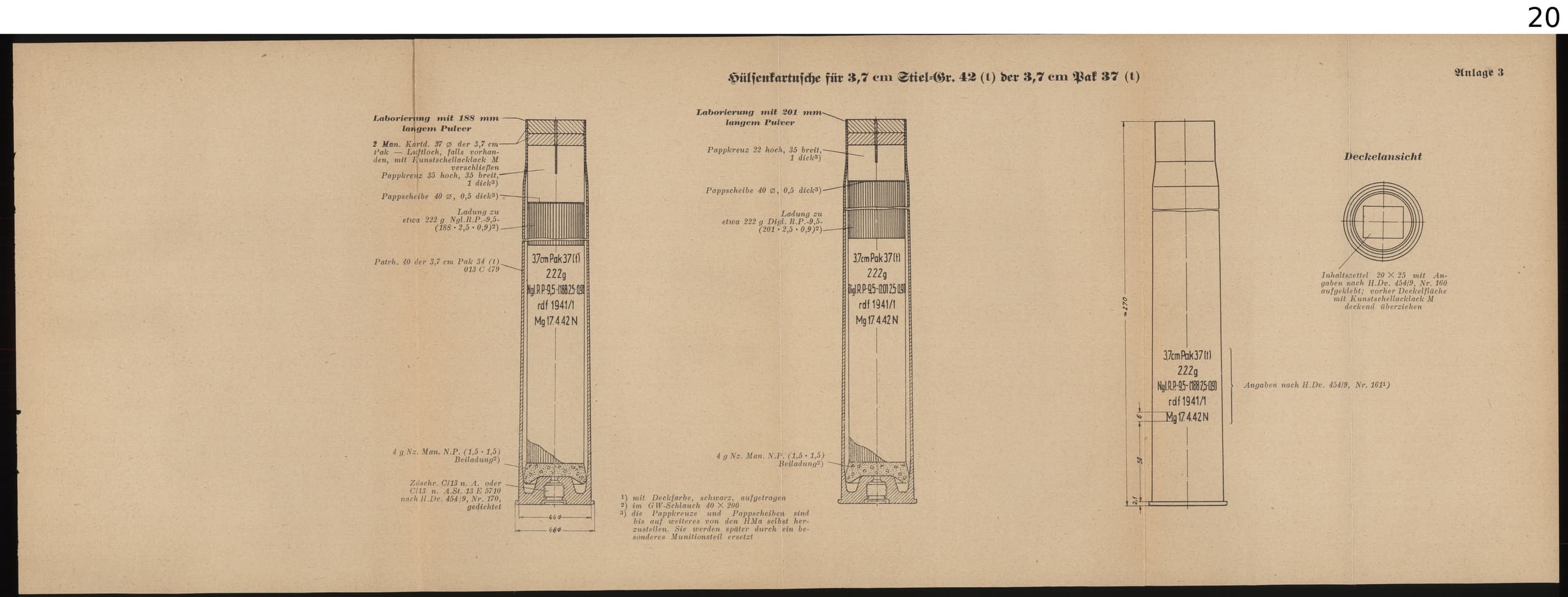
3,7 cm Flak 18/36/37/43 L/57
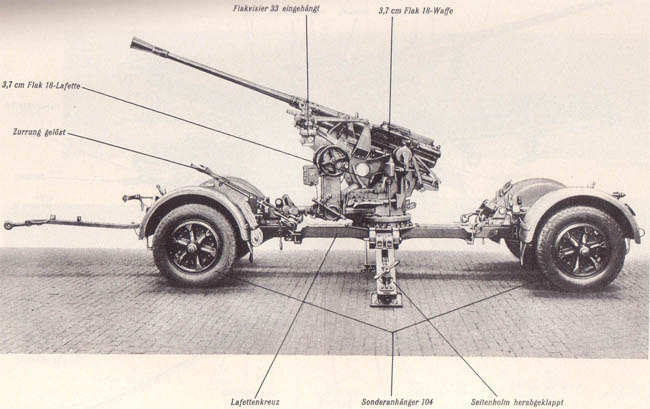
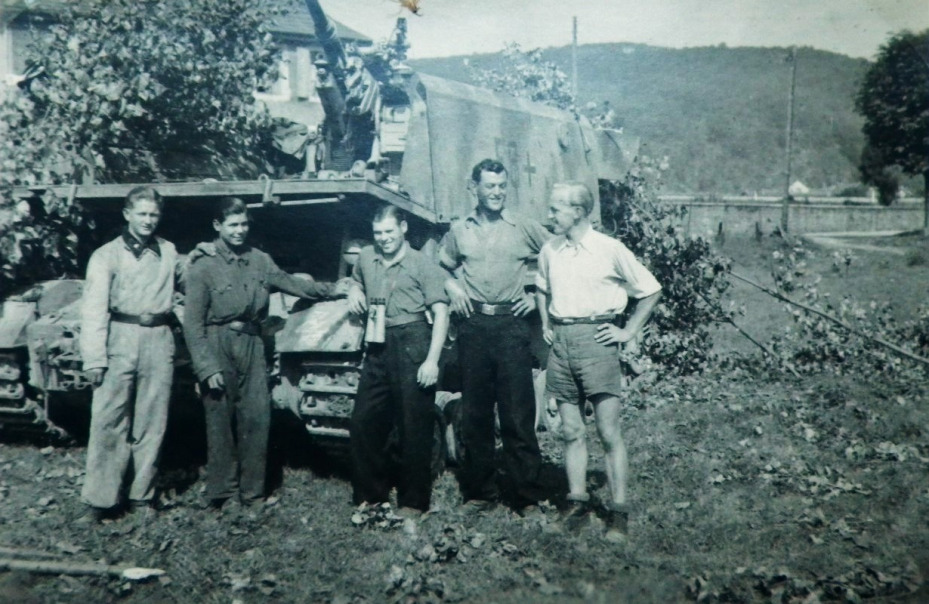
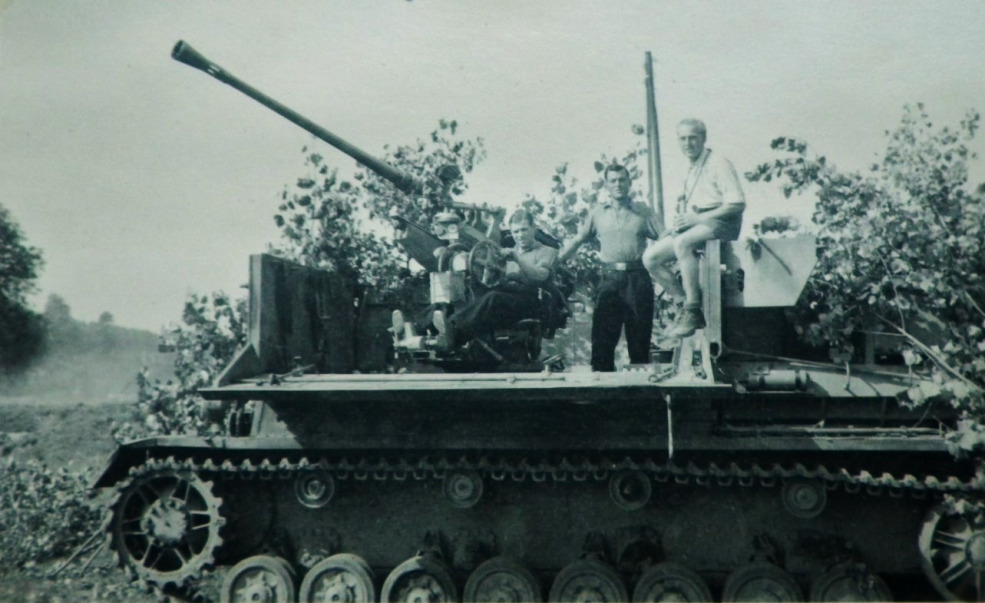
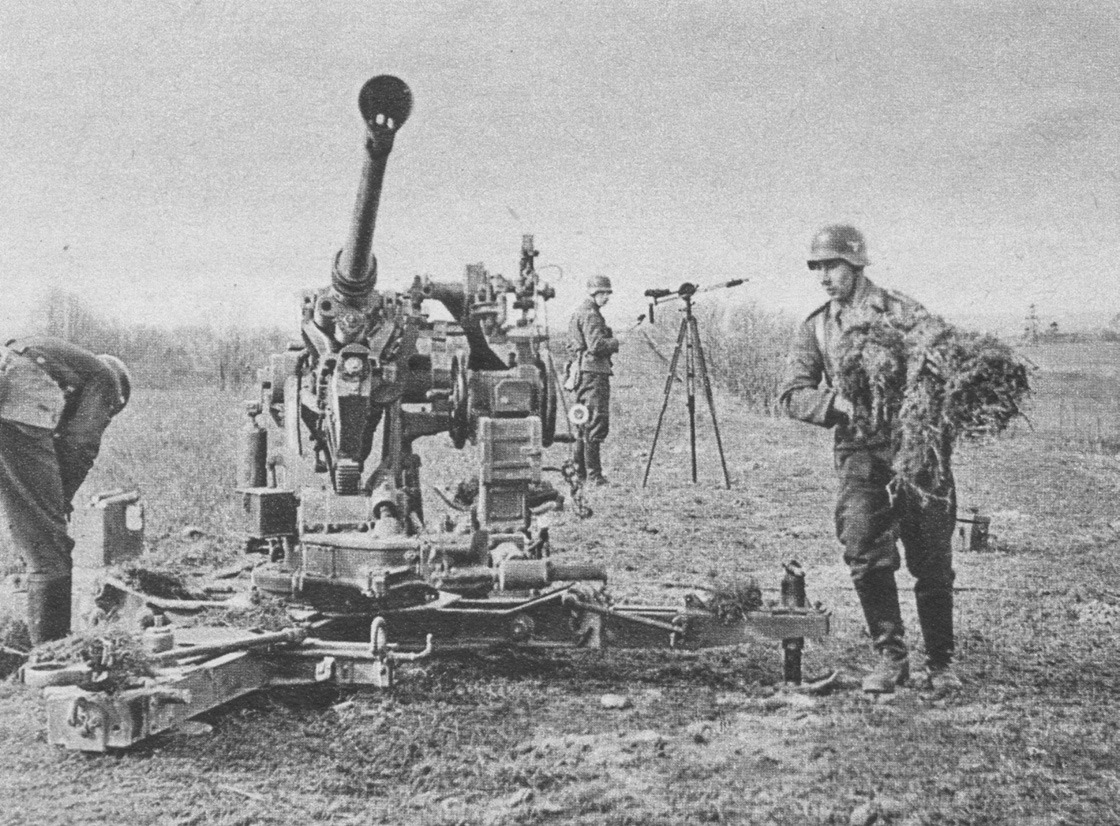
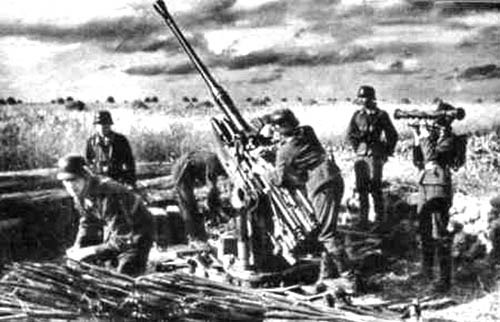
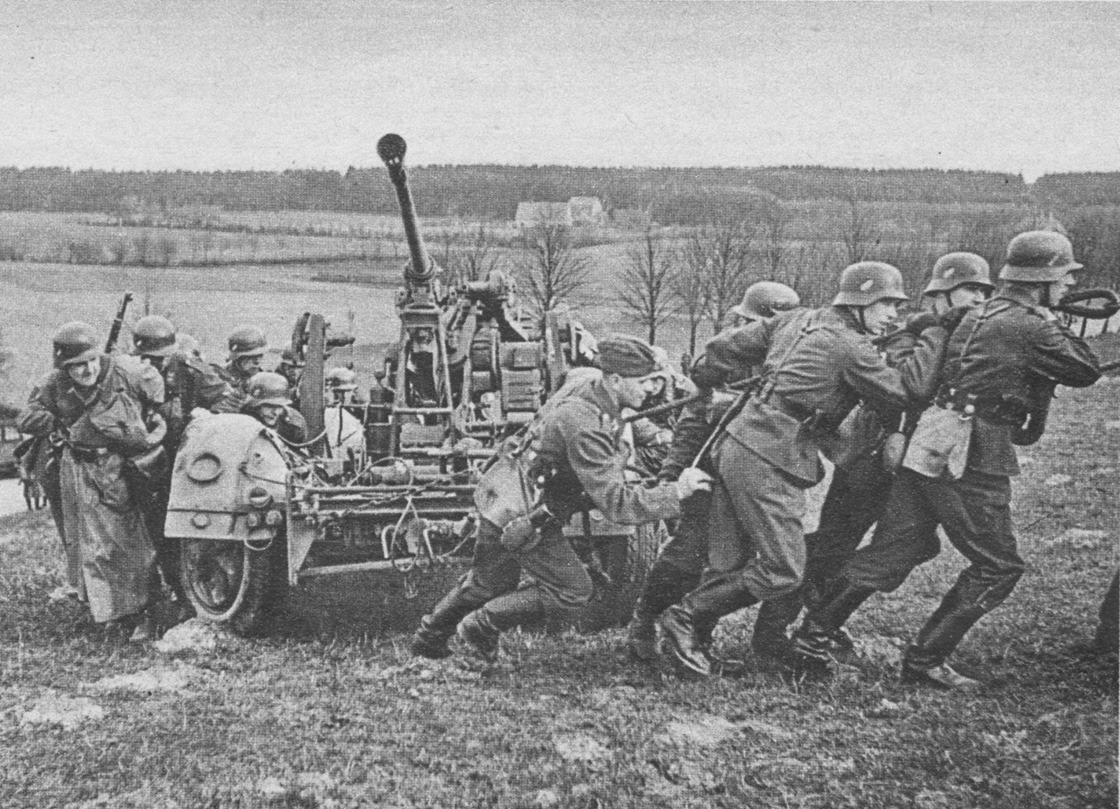
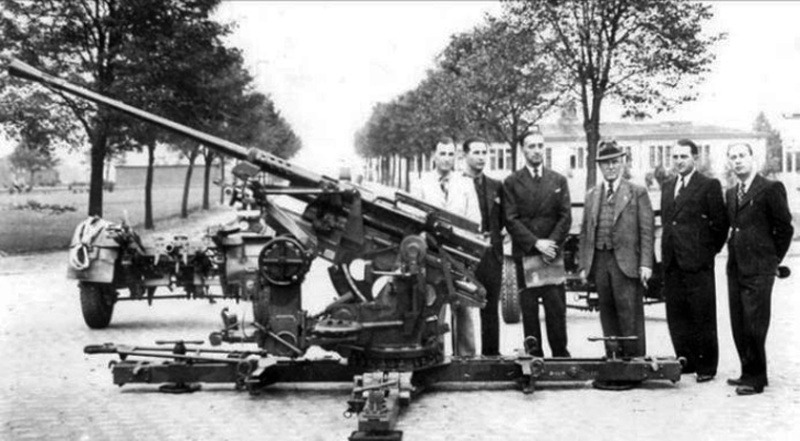

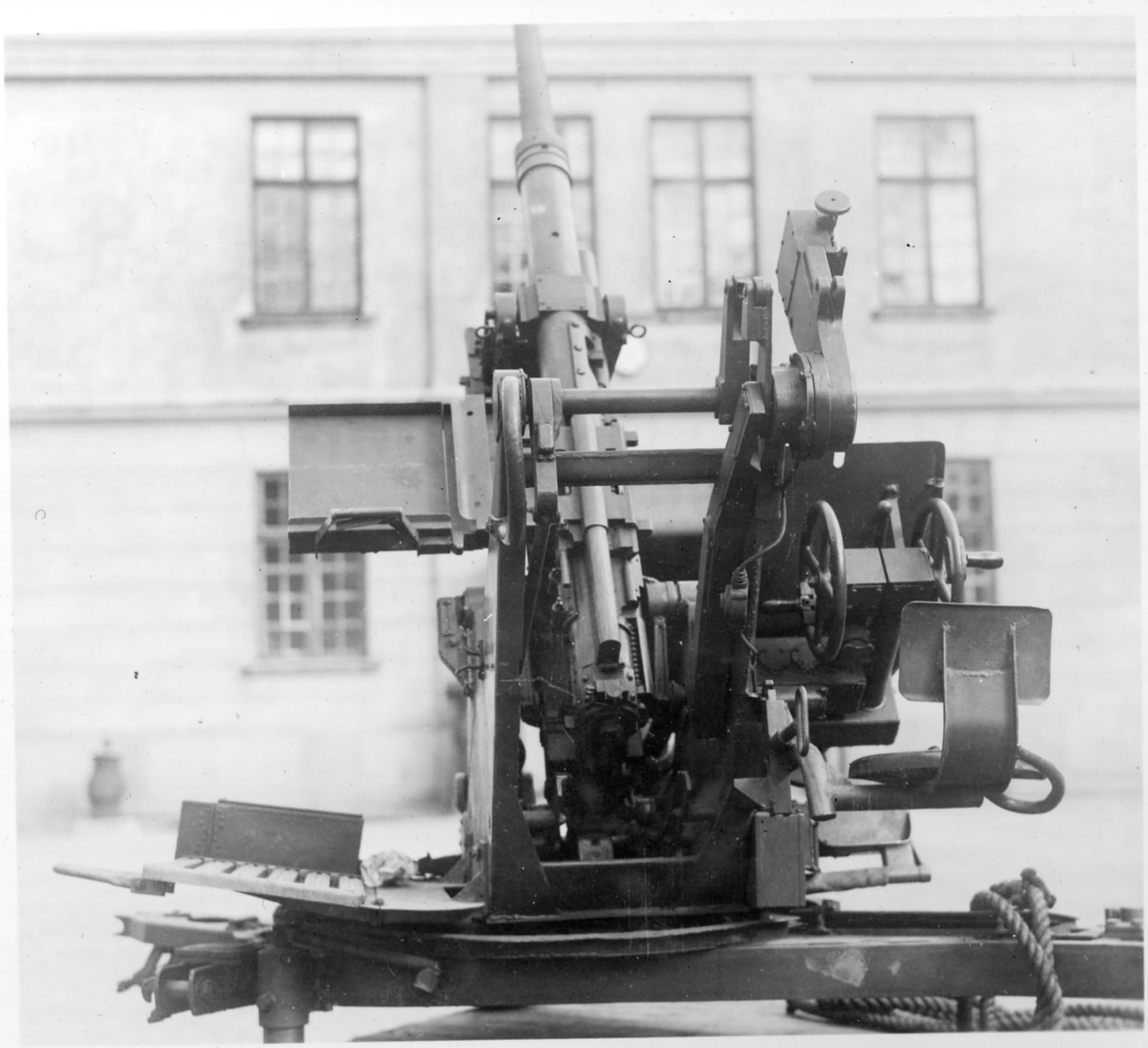
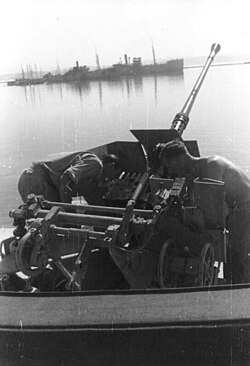
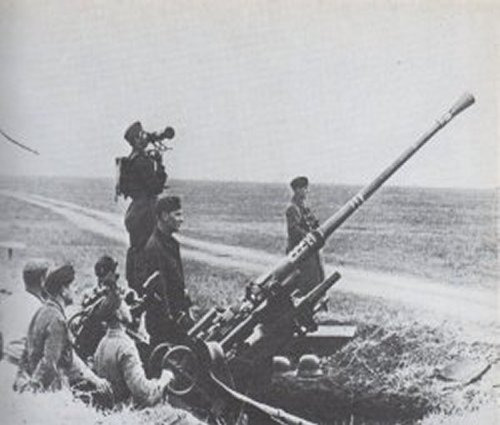

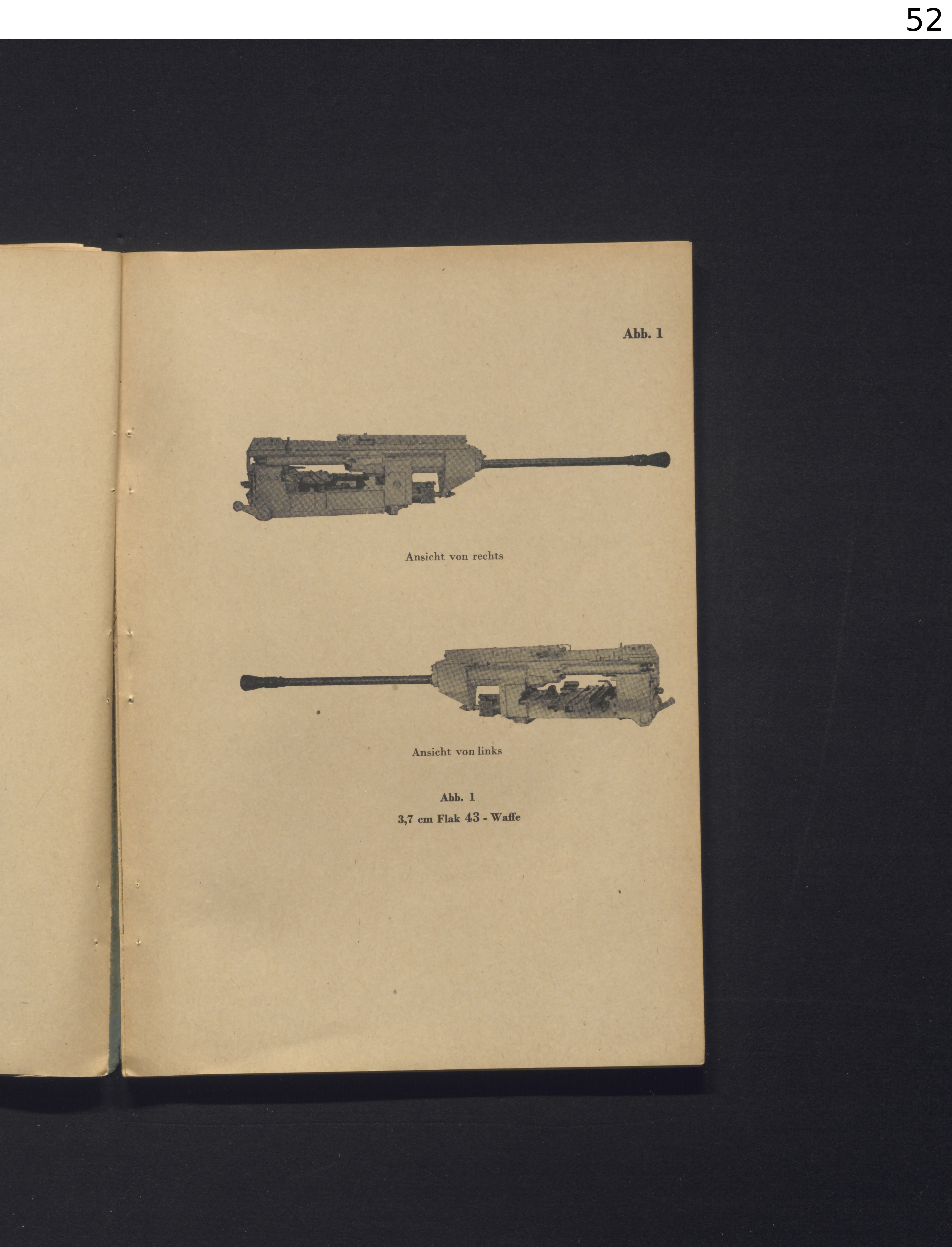
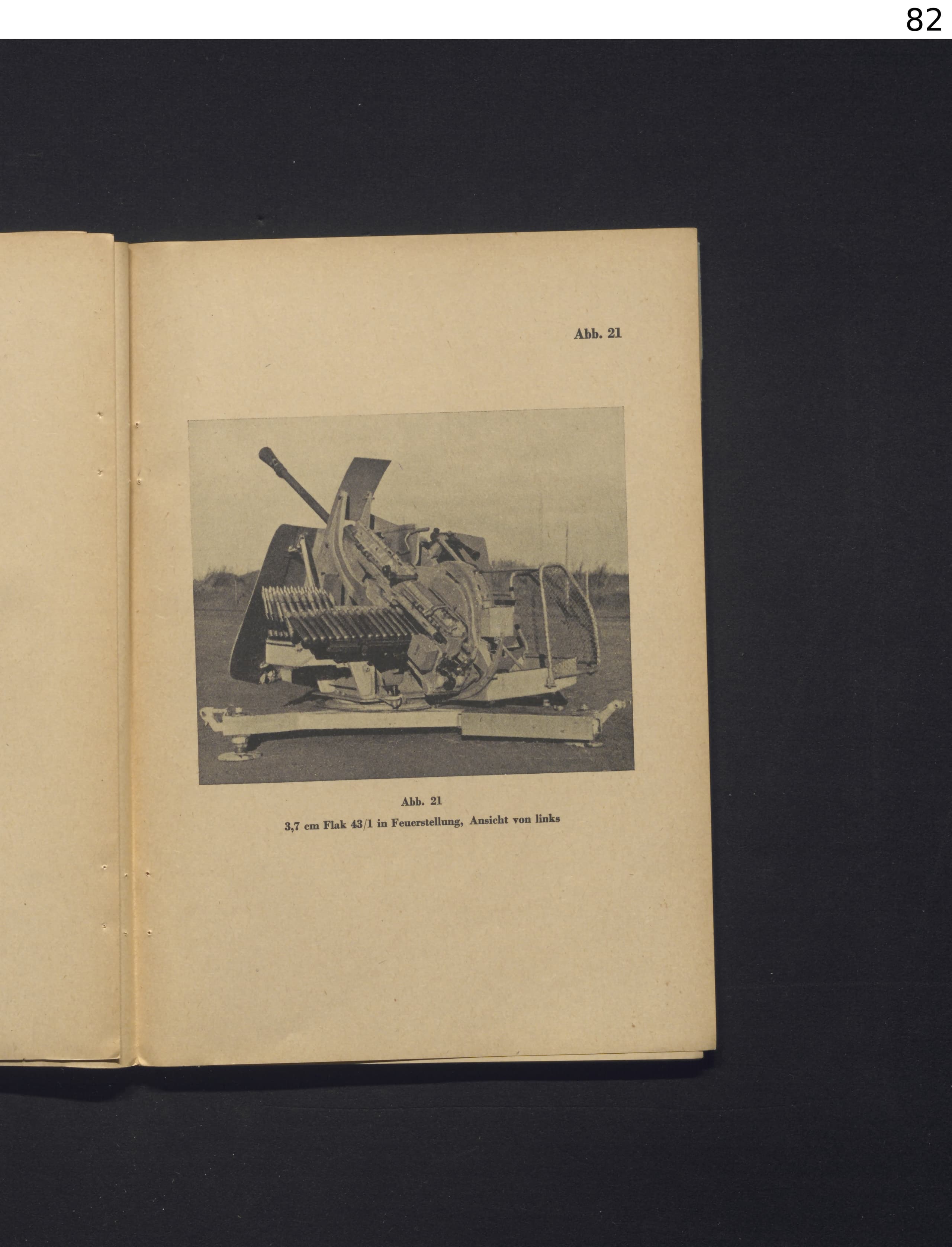

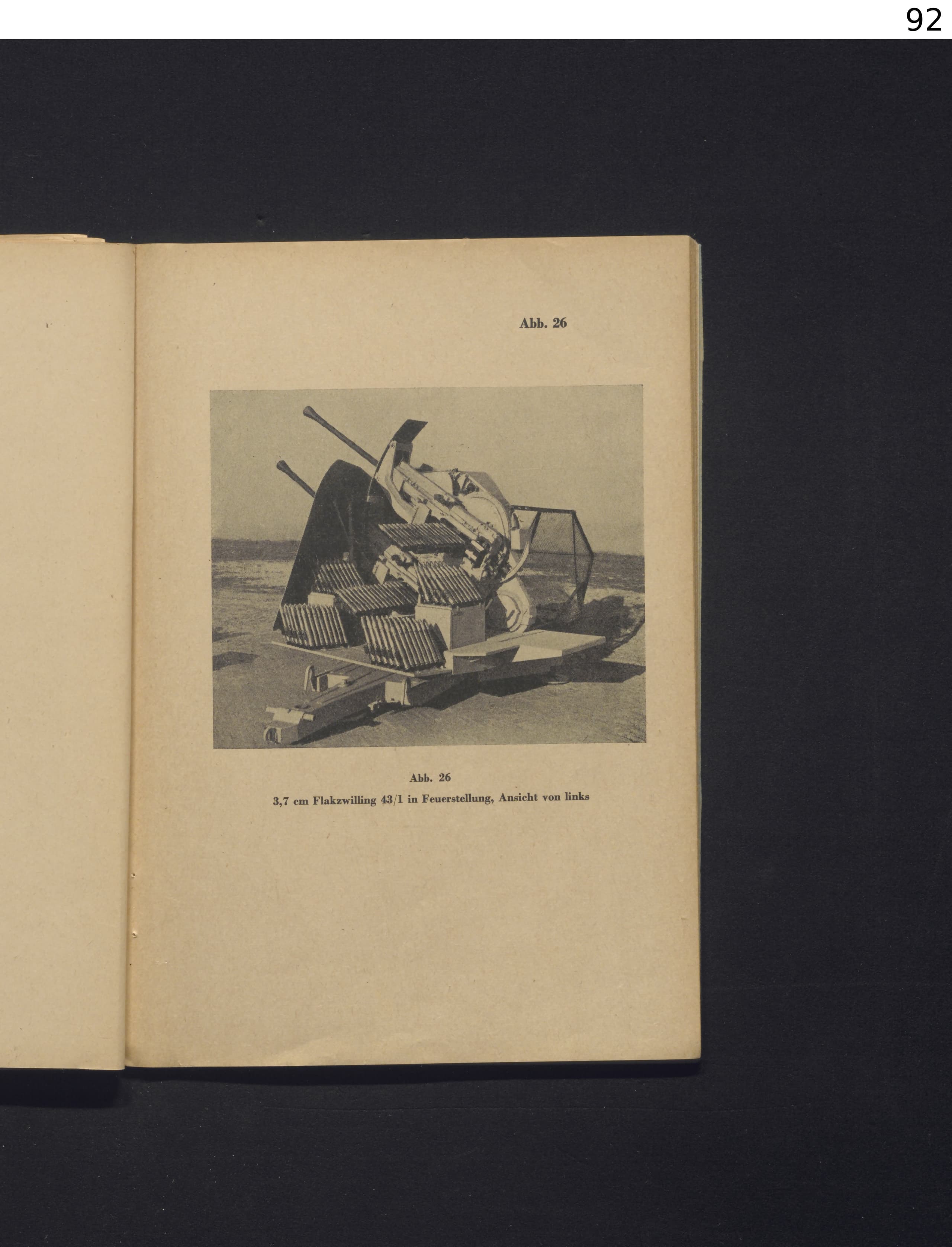
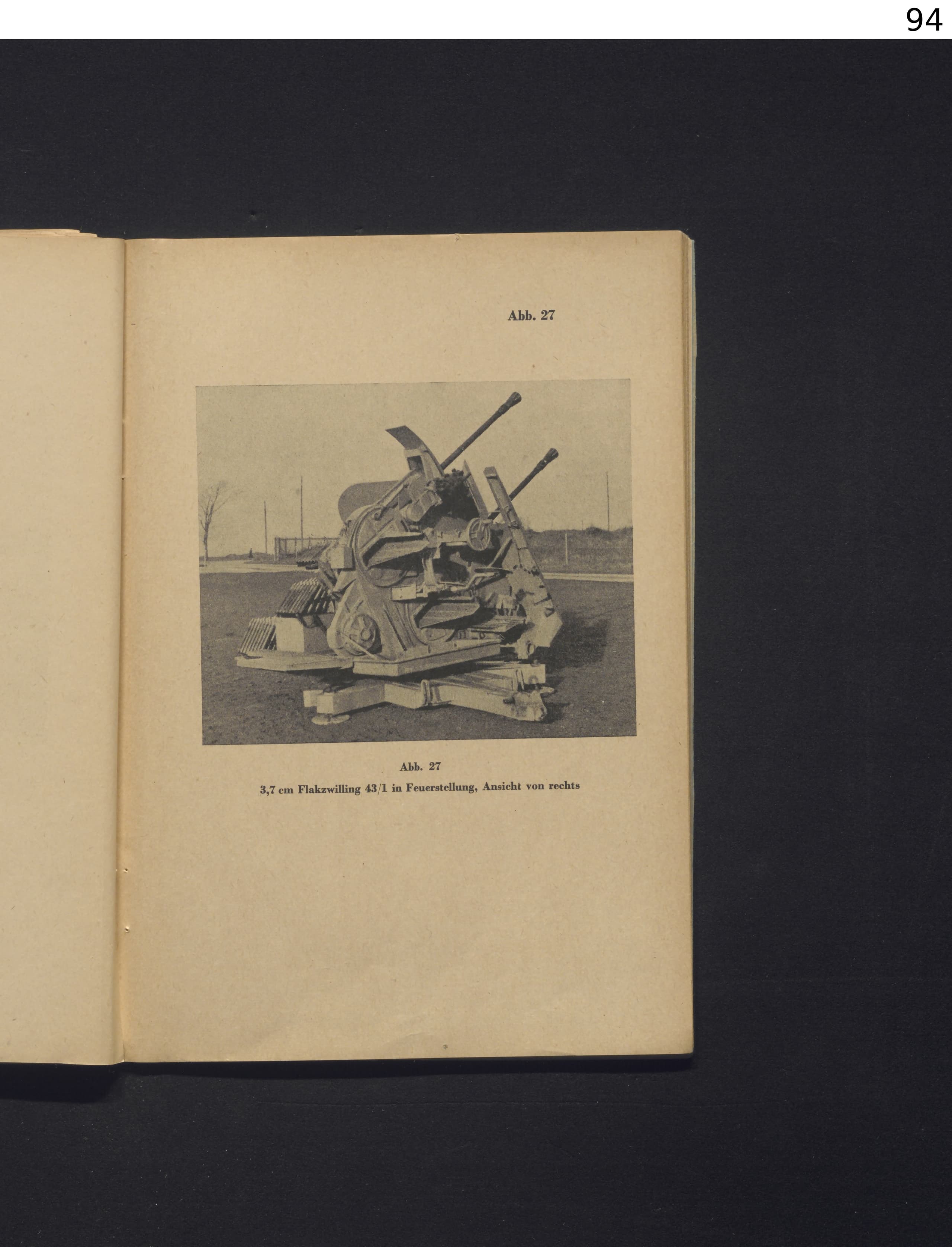

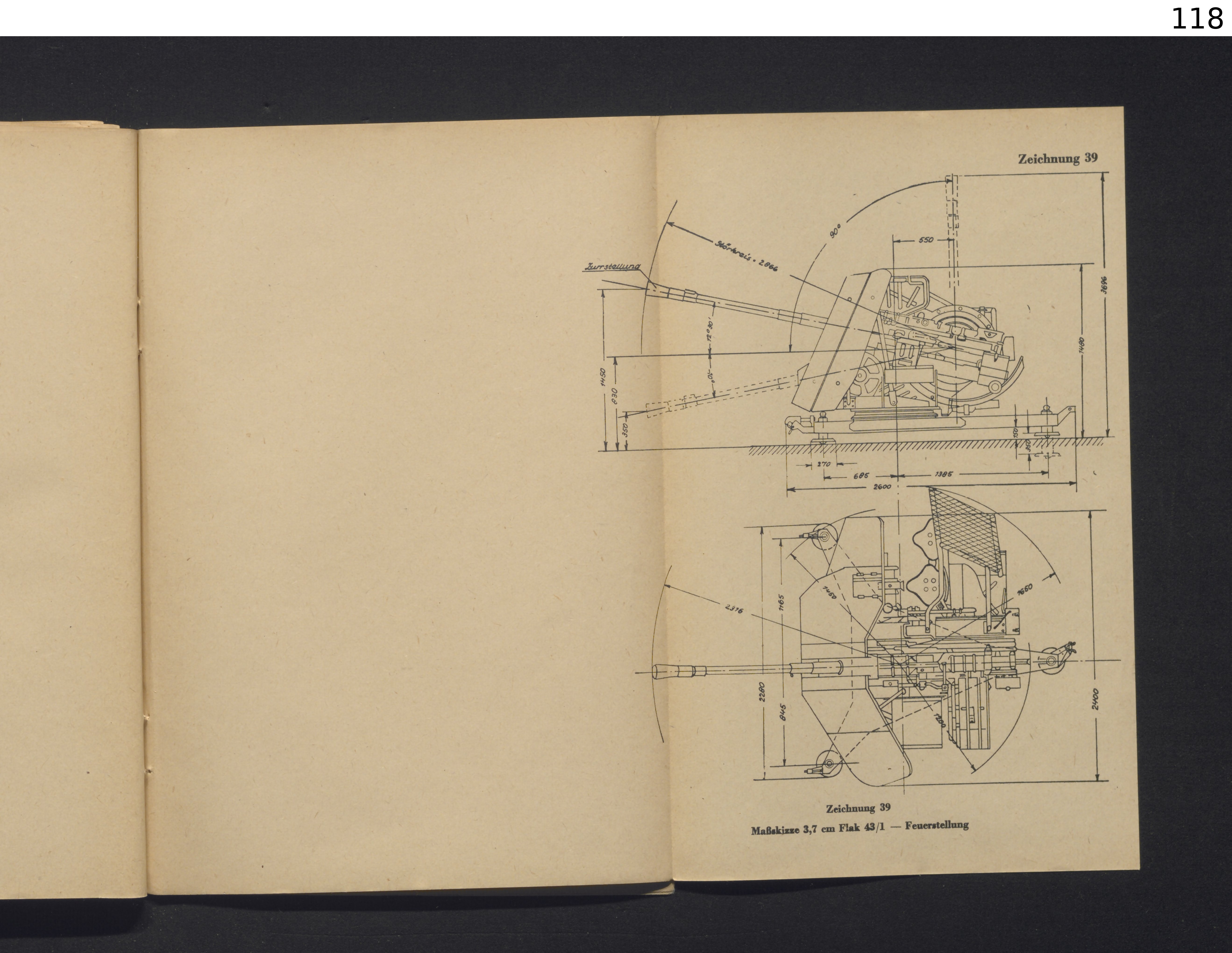
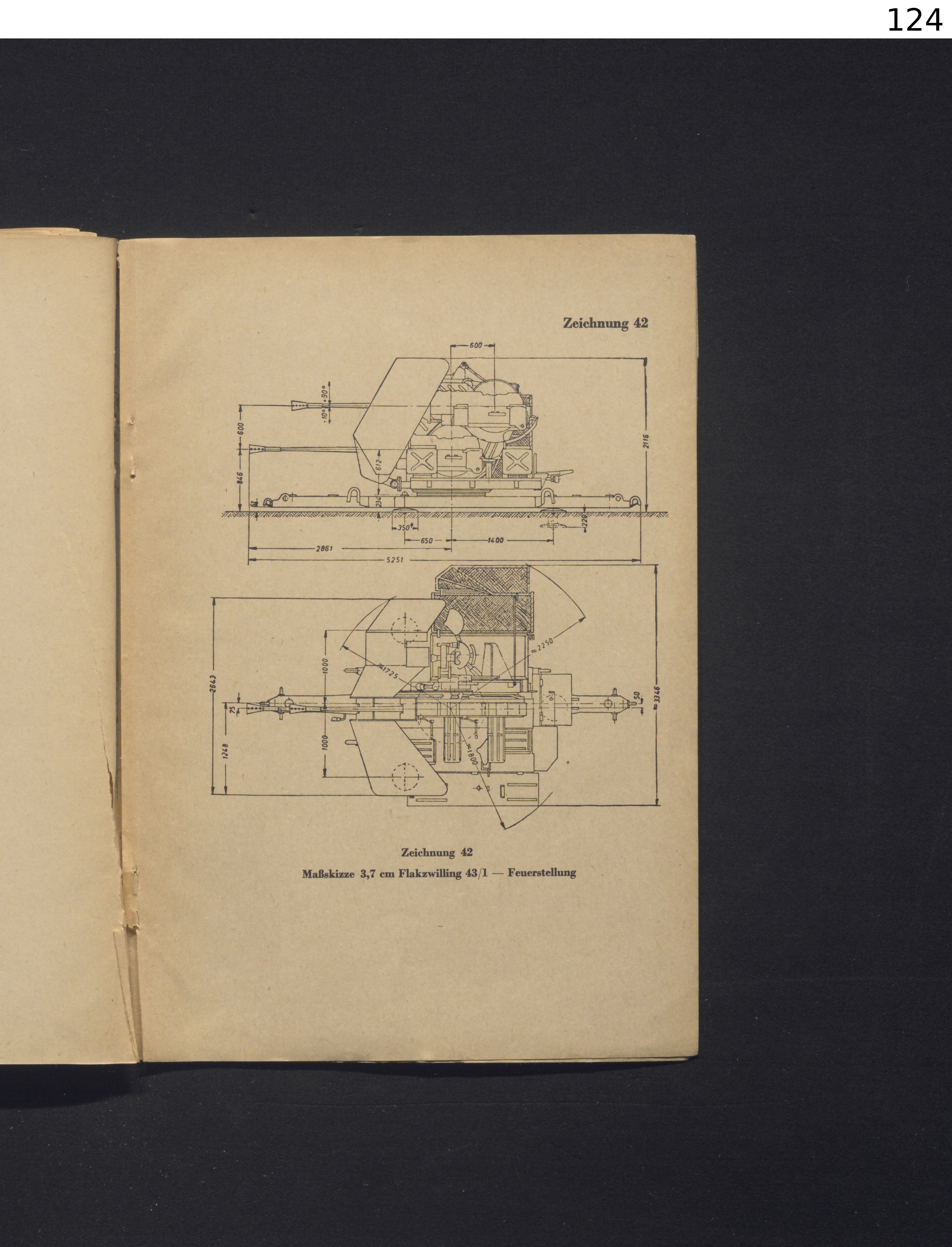


The 3,7 cm Flak 18/36/37 are identical guns mounted on different platforms. Originally developed in 1930 by Rheinmetall, it was an upscaled version of the same action as was already used on the 2 cm guns. Originally early on Krupp developed a 40mm Automatic gun, which would be sold to Bofors (of wich Krupp had 1/3) and continued development to become the 40mm Bofors L/60. The Reichswehr however was not satisfied with the Krupp gun, while it offered great firepower, due to its relatively big shells, it was also heavy, required 2 gunners and big. Rheinmetalls new 3,7 cm Flak 18 was already lighter with 1750 kg compared to the 1981kg of the Bofors. The 3,7 cm Flak 18 wasnt long in service, production started in 1935 and already in 1936 after only 80-200 produced with 360 licensed copies by Romania. The new Flak 36 recived a longer loading tray, fitting 2 6 round frames as well as had a 3 point lafett instead of the crosslafett as well as a new 1 axle trailer, which further reduced the weight to 1550 kg. With a new simplefied sight being developed in 1937 for the otherwise identical Flak 37. While still reaching 4200m after which the round self detonates. The guns were intended for “short” range close defence, while the 5-5,7 cm class was for Medium range inbetween the 3,7 and 8,8 cm guns. While the 5 cm Flak 41 L/67 was quite powerfull, it was only produced in relatively low amount, until late war the project was started again, with mainly 5,5-6 cm guns for both AA and Aircraft mounting, it was however also considdered to use 5,7 cm as vast amounts of 6 pdr ammo was captured, to “just” design the gun around that ammo and take it also in own service as it was also already powerfull enough.
The Flak 43 was a new take on the gun, while retaining the barrel and ammo for simplicity, it was based on the 3 cm Mk 103 action and made mostly from stamped parts, without any special alloy steels, this aided in reduced weight, increased fire rate and production speed as well as simplicity, rather important for the war effort.
Caliber: 37mm
Ammo: 37x265mmB
Fire Rate: 180 rpm (160-200 rpm) / 250 rpm (Flak 43) (500 rpm for Flakzwilling 43)
Loading Tray 6 round Rahmen (Frame) / 8 round Rahmen (Flak 43)
Muzzle velocity: 770-1170m/s
Weight: 274 kg (Flak 18) / 1.250 kg in Fire position (Flak 43)
Ammo Types: Aphe-T, Hvap-T, Hef-T, Hefi-T, Hef-I, HeI-T(m)
Ap:
Pzgr.18 L'Spur (Aphe-T) 0,7 kg 770/790m/s 13g Pent (22,1g) 50,67/52,56mm/10m
Its mostly written as 700g, however some sources as 685g, they are completly identical and its propably production differences.
For the 685g Pzgr.18 its 780/800m/s and 50,62/52,52mm/10m.
Note: Against Ground and Air Targets.
Bottum Fuze after 7mm active.

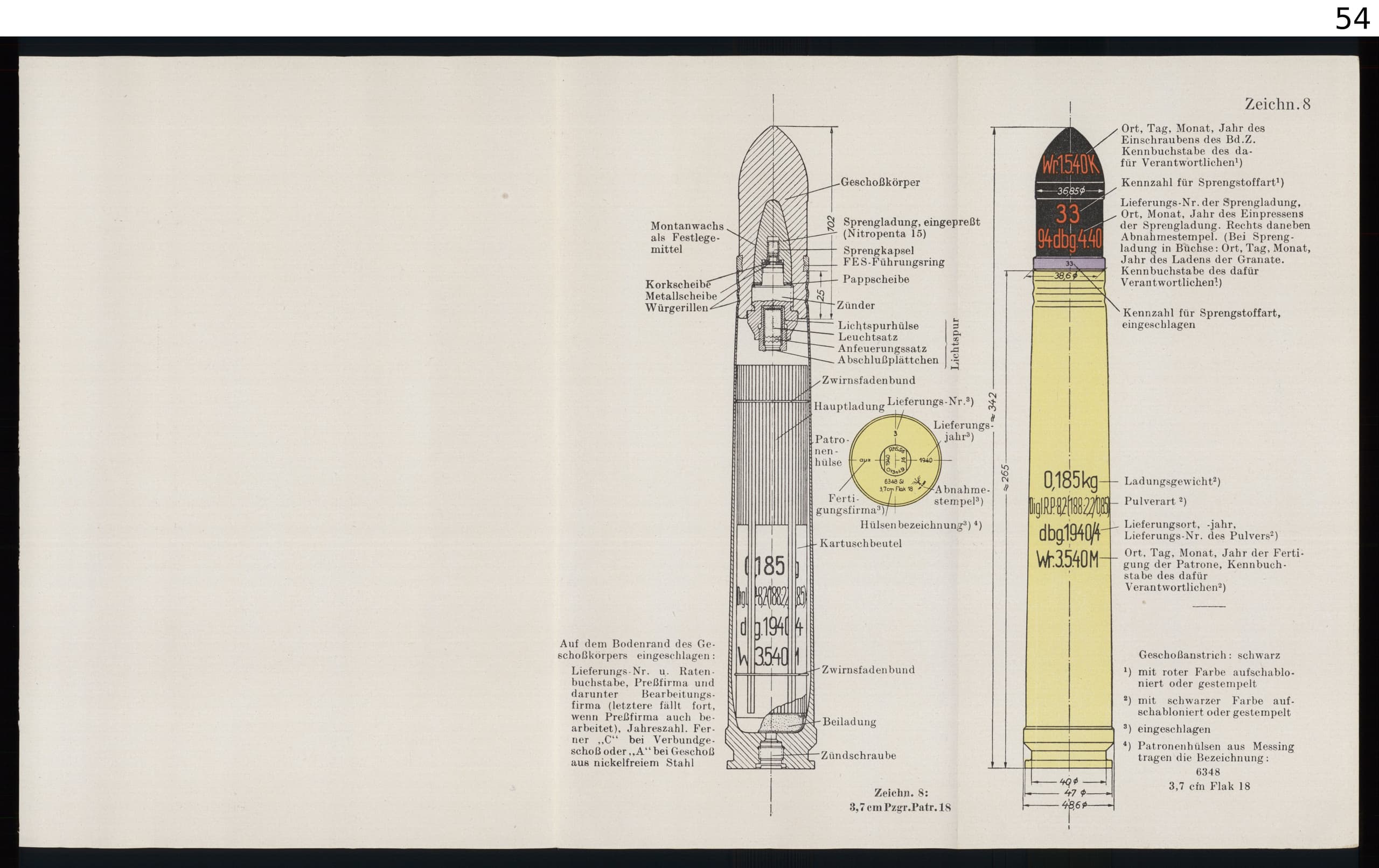

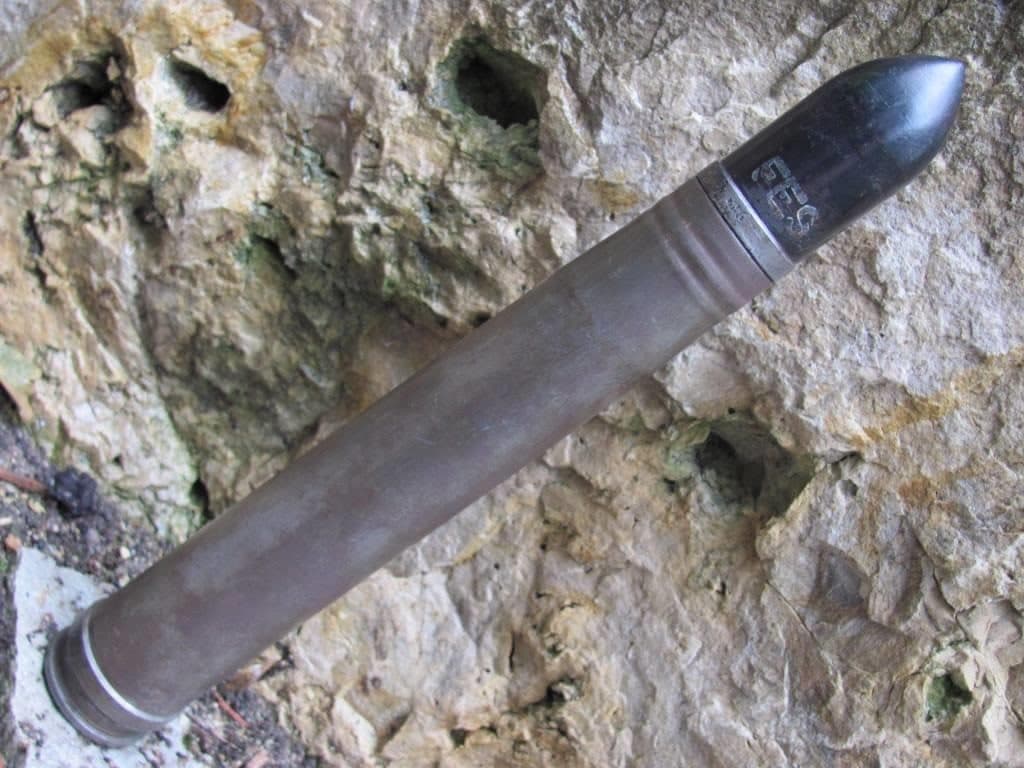
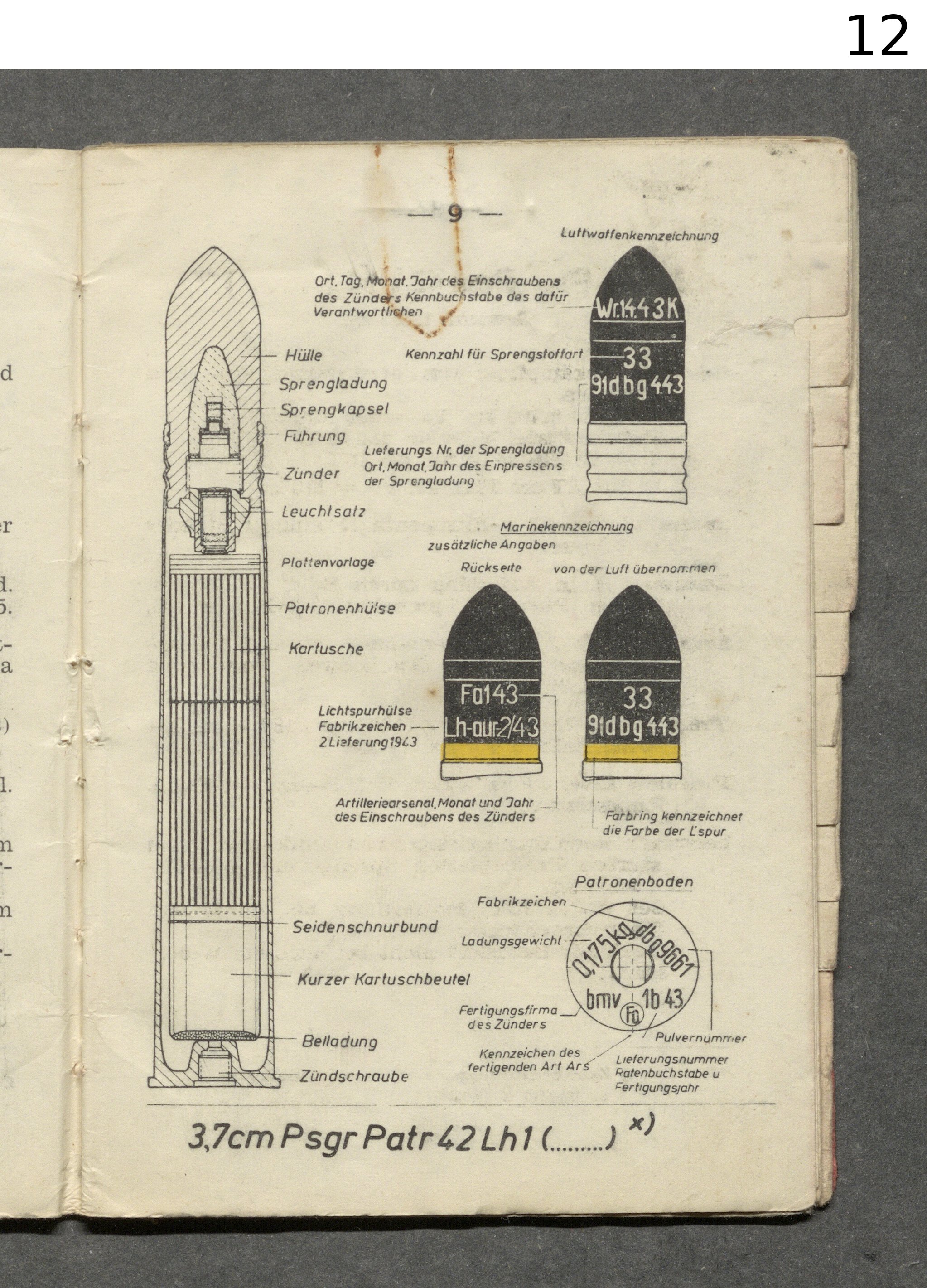
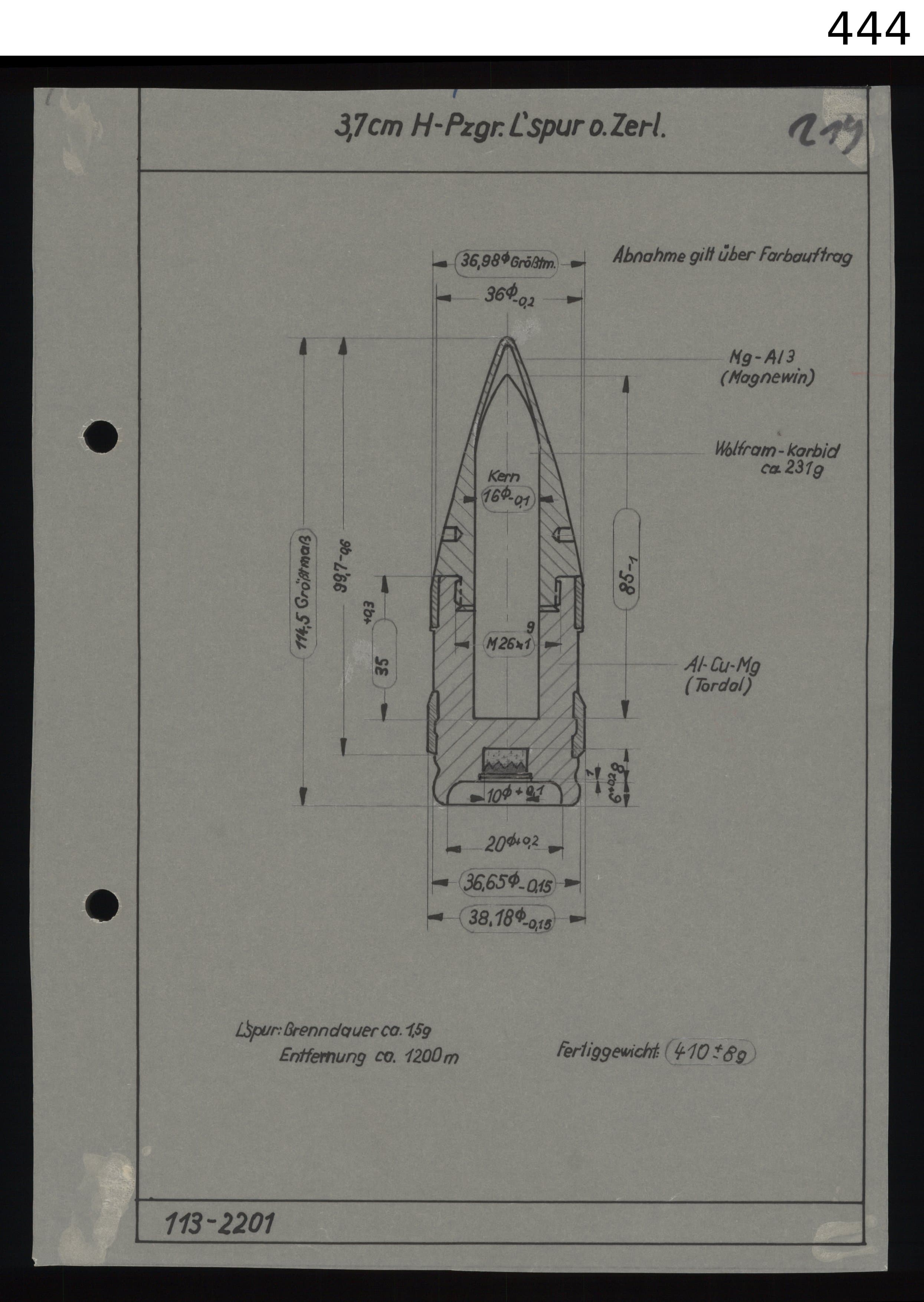
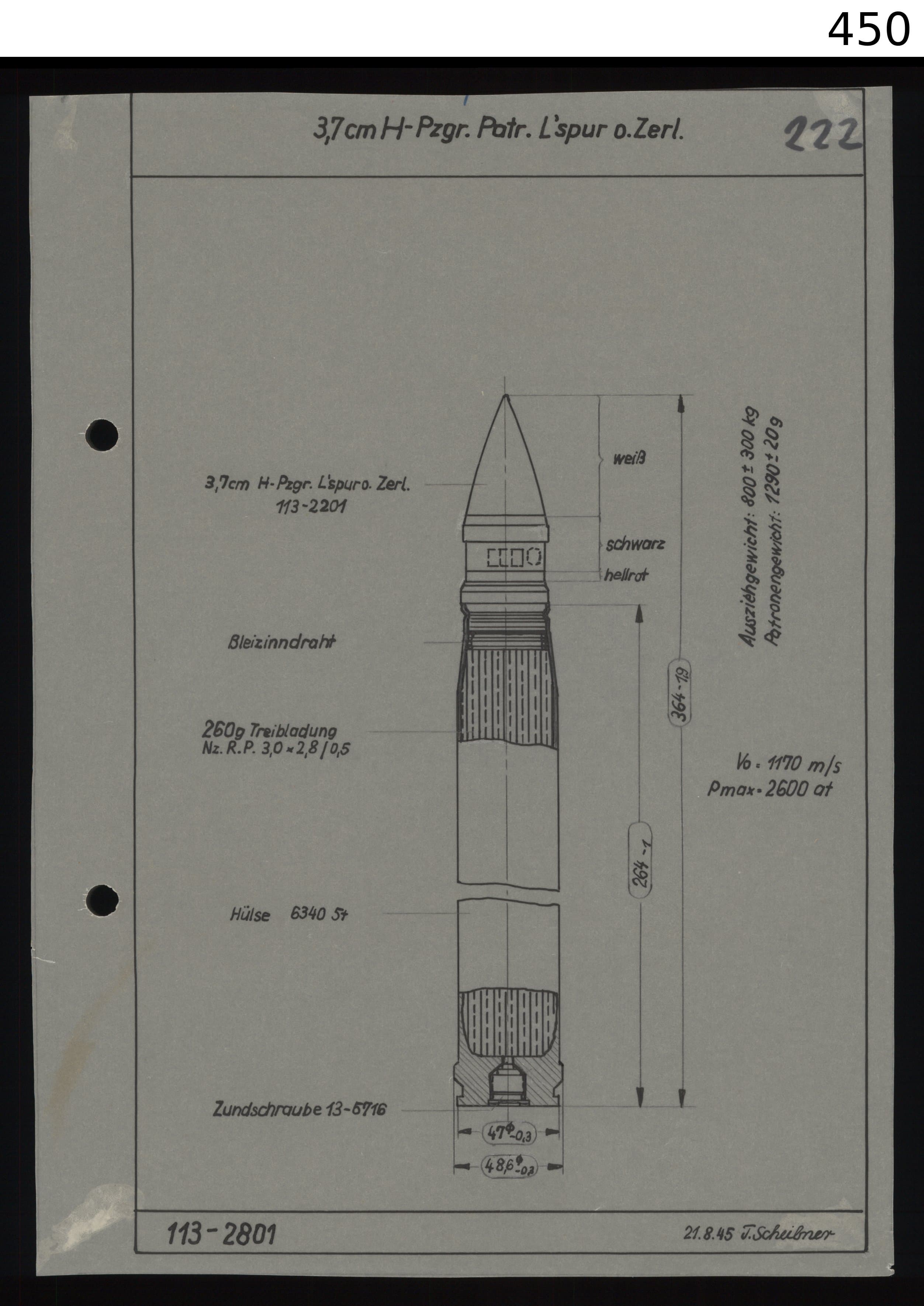
H-Pzgr. L'Spur. o.Zerl. (HVAP-T (I)) 0,405/0,410 kg 1170/1150m/s 16,1x85mm 231g core 110-112mm/10m
Note: Only against Tanks, where other Ap rounds cant penetrate. The Carrier has an Incendary effect when melting upon impact.
The Shell first 405g at 1170m/s then later on 410-418g at 1146-1150m/s. This could be a slight design change or a general allowed production variation, which increased later on.


He:
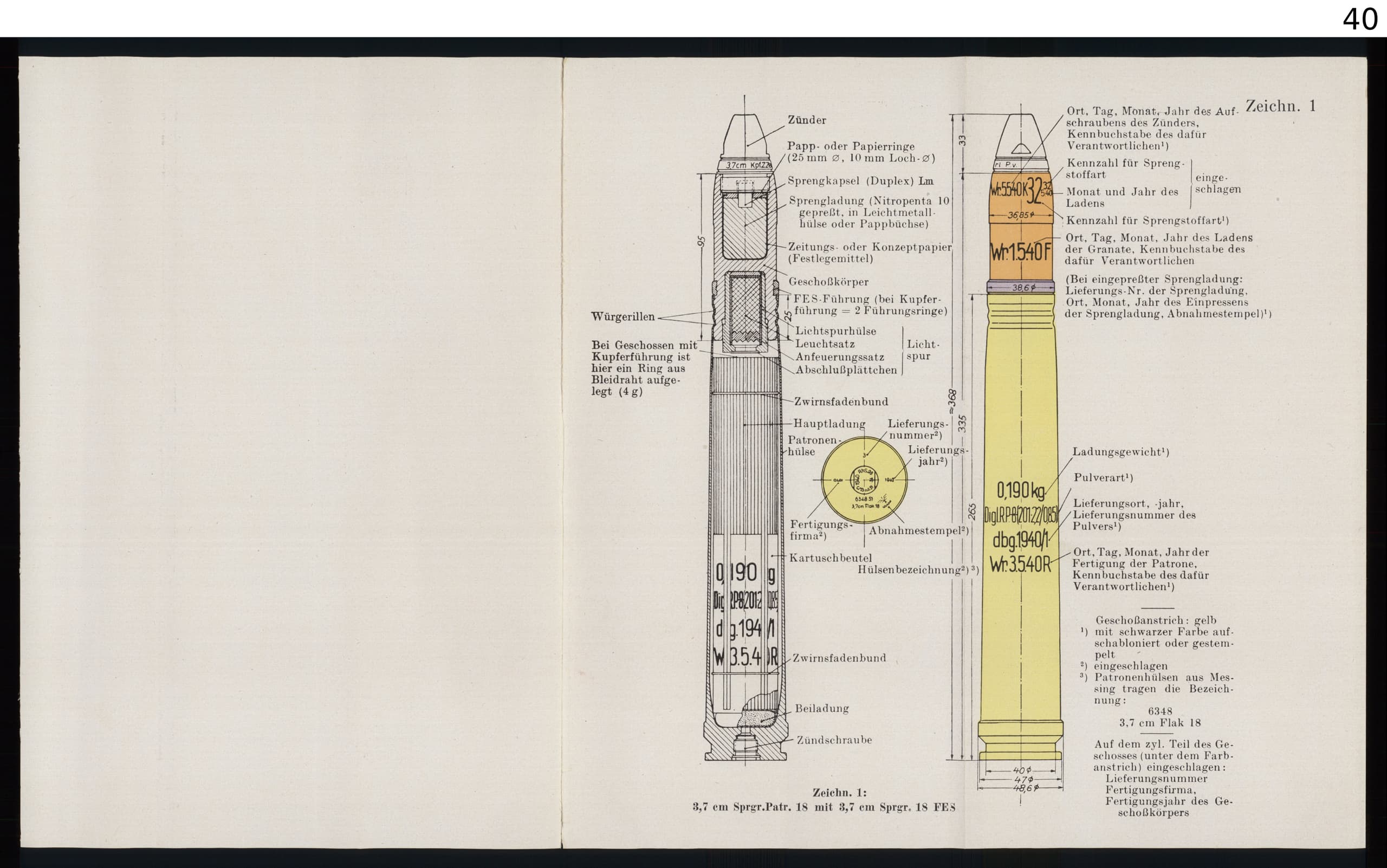
Sprgr.18 L'Spur. (Hef-T) 0,612/0,623 kg 840/835m/s 26g Np.10 (44,2g) 7mm/10m
612g is the FE driving band with 840m/s, 623g is the Cu driving band with 835m/s.
Depending on Fuze it could also be 635g and 830/850m/s.


Brsprgr. L'Spur (Hefi-T) 0,612/0,623kg 840/835m/s 26-30g H.5 and Aluminium
612g is the FE driving band with 840m/s, 623g is the Cu driving band with 835m/s.
Note: Against Air and Ground targets.
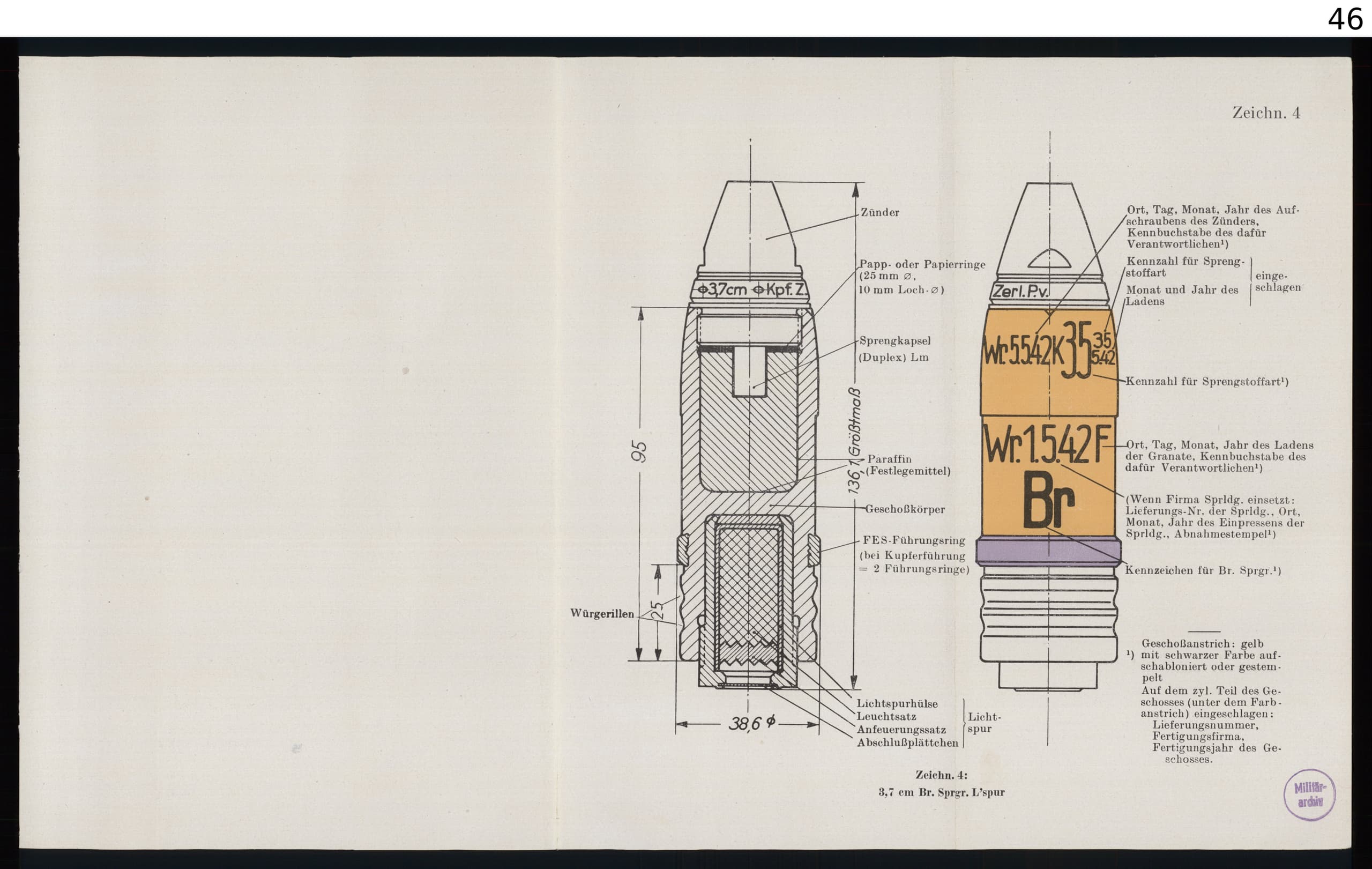
Brsprgr. vk L'Spur. (Hefi-T) 0,644 kg 820m/s 48g H.5 and Aluminium
Note: Against Air and Ground targets, shortened Tracer for increased He and Incendary effect.
The luftwaffe drawing perhaps isnt the most accurate and the Navy drawing may be more closer to reality.

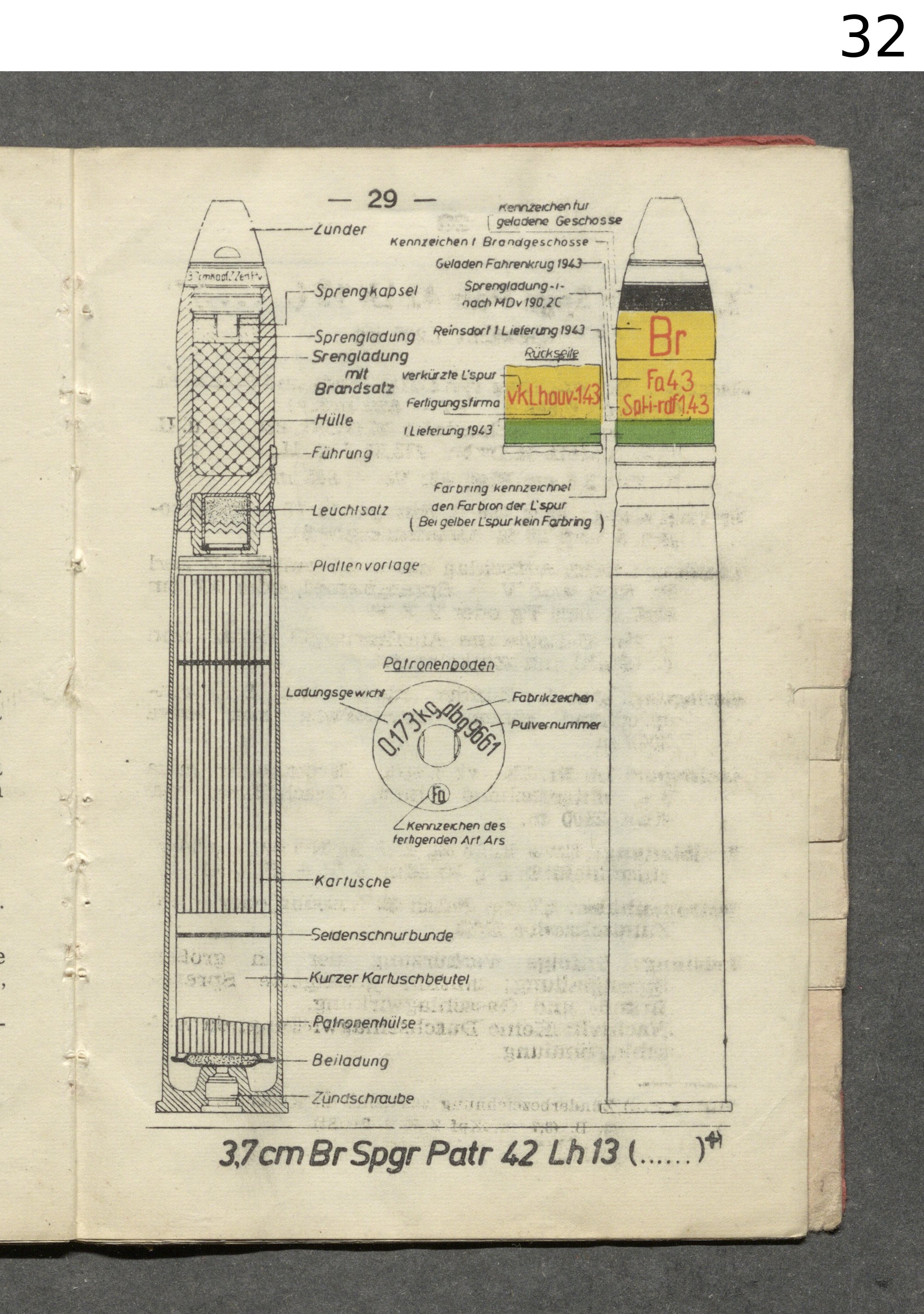
Brsprgr. o.L'Spur (Hefi) 0,620 kg 835m/s 90g H.5 und Zink
Note: Against Air and ground targets.
(Filler of 35,5g H.5 and 54,5g Zink, calculated by Killakiwi)
Minengeschoss:
M-Gr.18 L'Spur. o.Zerl. (Hei-T (m)) 0,55-0,565kg 900-914m/s 90g HTA (108g) 7mm/10m

Mountings:
Flaklafette 36
Flaklafette 43
Flaklafette 44 (Zwilling, modified for side by side feeding.)
Vehicles:
Sd.Kfz 6/2 (5t)
Sd.Kfz 7/2 (8t)
Pz I Ausf. B mit 3,7 cm Flak 37
Ostwind
Ostwind II (Flakzwilling)
3,7 cm Flak 43 auf s.W.S

3,7 cm KwK L/70
Pictures:(Click to show)


Along with the earlyer L/65 (later used as 3,7 cm Pak.K. L/65 in 29P8 Panzerkasematte) were prototype and small series guns, intended to replace the L/45 gun as a more powerfull gun with (propably) the same breech, just a longer barrle and new high velocity ammo. And the L/70 beeing mounted on the Pz.Sfl… But abandond in favour of the 5 cm Pak 37 L/42 and KwK 38 L/42.
Caliber: 37mm
Ammo: 37x355mmR

Fire Rate: 22 rpm
Single Shot, Horizontal Breechblock
Muzzle velocity: 900 - 1000 m/s (different source or differentiation of L/65 and L/70)
Weight:
Mounting: Bunkers and Pz.Sfl.
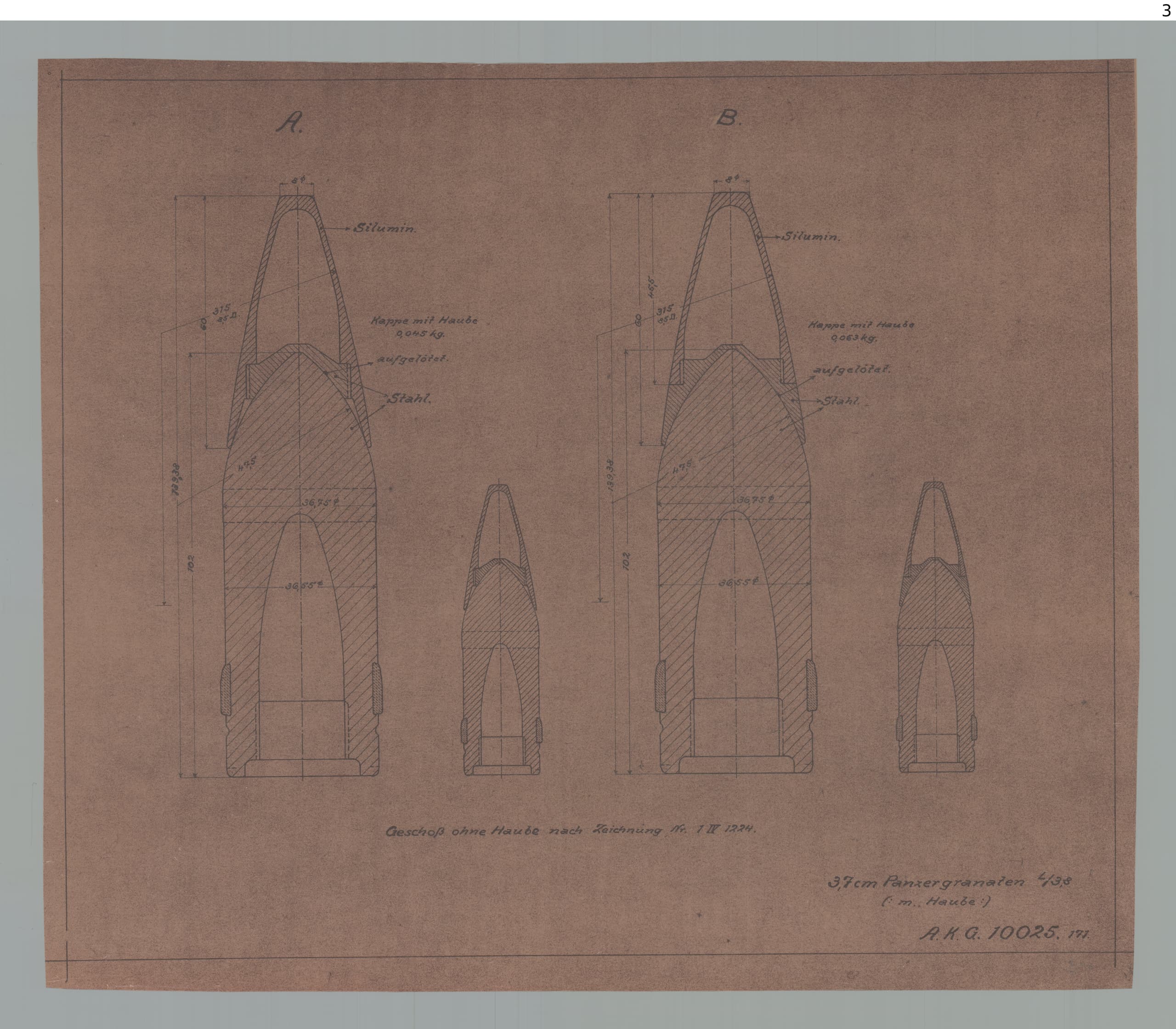
Ammo Types: Apcbc, Hefi
Ap:
He:
Sprgr.18 (He) 0,62kg 900m/s 29 g Np.10 (49,3g TNTe)
Sprgr.40 (He) 0,665 kg 900m/s 45 g Np.10 (76,5g TNTe)

3,7 cm Flak 341 L/77


Intended as a improvement for the Flak 43, based mostly on it, it increased the firepower enormusly, with an new L/77 barrel and new 37x280mmB casings with 400g prpellant, intended for mounting on the Flakpanzer V (Flakpanzer 341) 4 were produced, 2 for tests and 2 for reference.
Caliber: 37mm
Ammo: 37x280mm
Fire Rate: 250 rpm
Loading Tray 10 round Rahmen (Frame)
Muzzle velocity: 1000-1040m/s
Weight: 470 kg
Ammo Types: Apcbc, HefI-T
For an increase in perfromance with this gun the main focus went away from the Heeres Geschoss of ~130mm length to the Marine Geschoss of 152mm (L/4,1) shared with the Heer and Marine and was already in service with the C/30 and russian captured 61-K guns.
Ap:
Pzgr. L'Spur (Apcbc) 0,82kg 1000m/s 22g Pent (37,4g TnTa) 87mm/10m
Unlike the uncapped Pzgr.18 L’Spur, this Panzersprenggranate (Psgr. L’Spur) is adapted to a velocity of 1000m/s in its original gun.

He:
Brsprgr. Vk.L'Spur L/4,1 (Hefi-T) 0,725kg 0,065kg 1040m/s Np.10 AlGrieß (104-110,5g TnTa)
While this round is 730g heavy and only has 30g Np.10 or H.5 AlGrieß (51g TnTa), an adapted variant with smaller tracer was most likely what is described on the datasheet.


Mounting of Flakpanzer V envisioned
Also for Navy on ships and on a ground mountings
4,2 cm - 5 cm
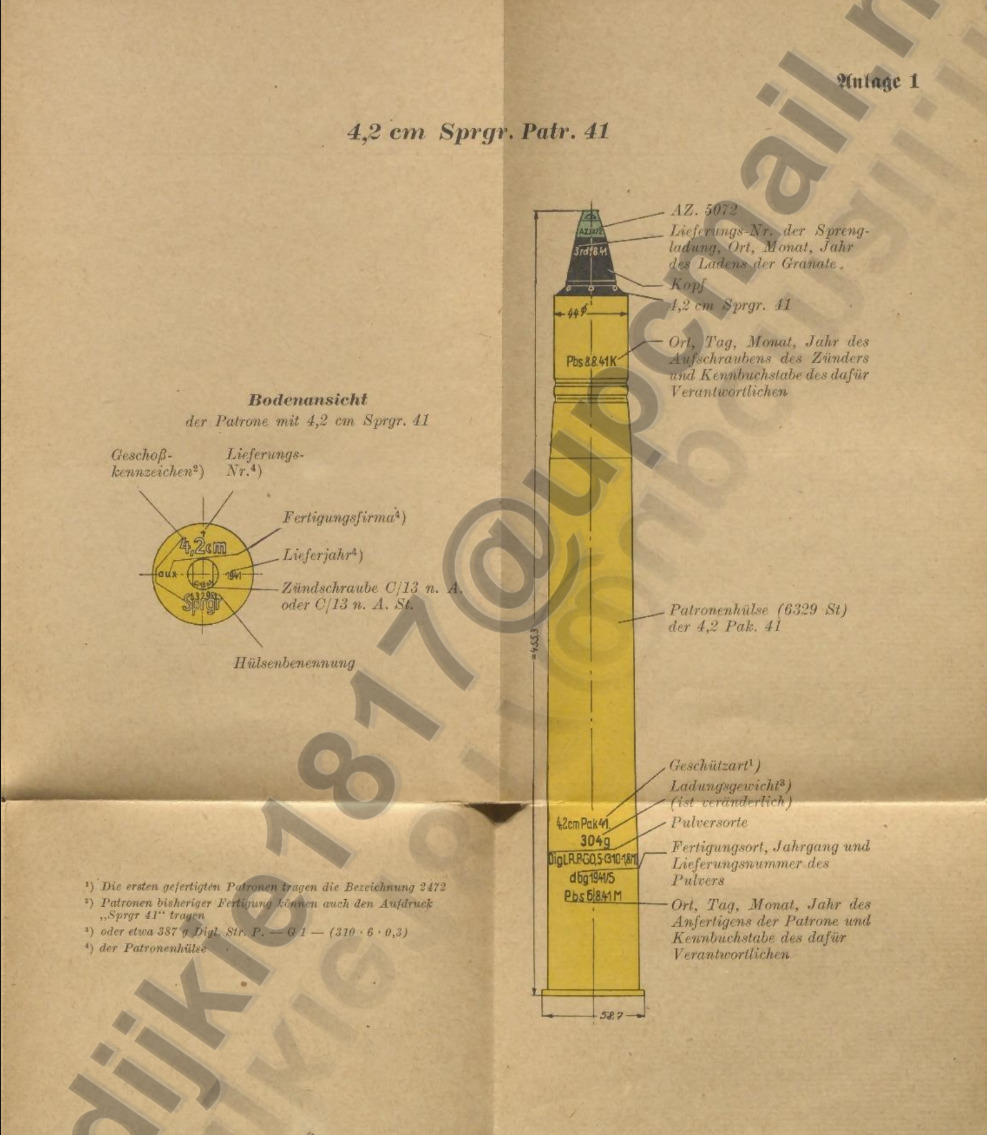
4,2/2,9 cm Pak 41 L/55
Pictures:(Click to show)


Designed as the 2nd Size of Gelrich Principal and designed as a lightweight gun for paratroopers using the same mount as the 3,7 cm Pak L/45, but with more penetration. Build in relatively small numbers, but used till the end of the war. Used as is, but also mounted by paratroopers on captured and own vehicles. Example (under Picture a Captured Bedford MW).
Caliber: 42/29mm
Ammo: 42x406mmR

Fire Rate: 22-30 rpm
Single Shot, Horizontal Breechblock
Muzzle velocity: 900 - 1500 m/s
Weight: 506 kg
Mounting: Pak 36 Mount (slightly improved)
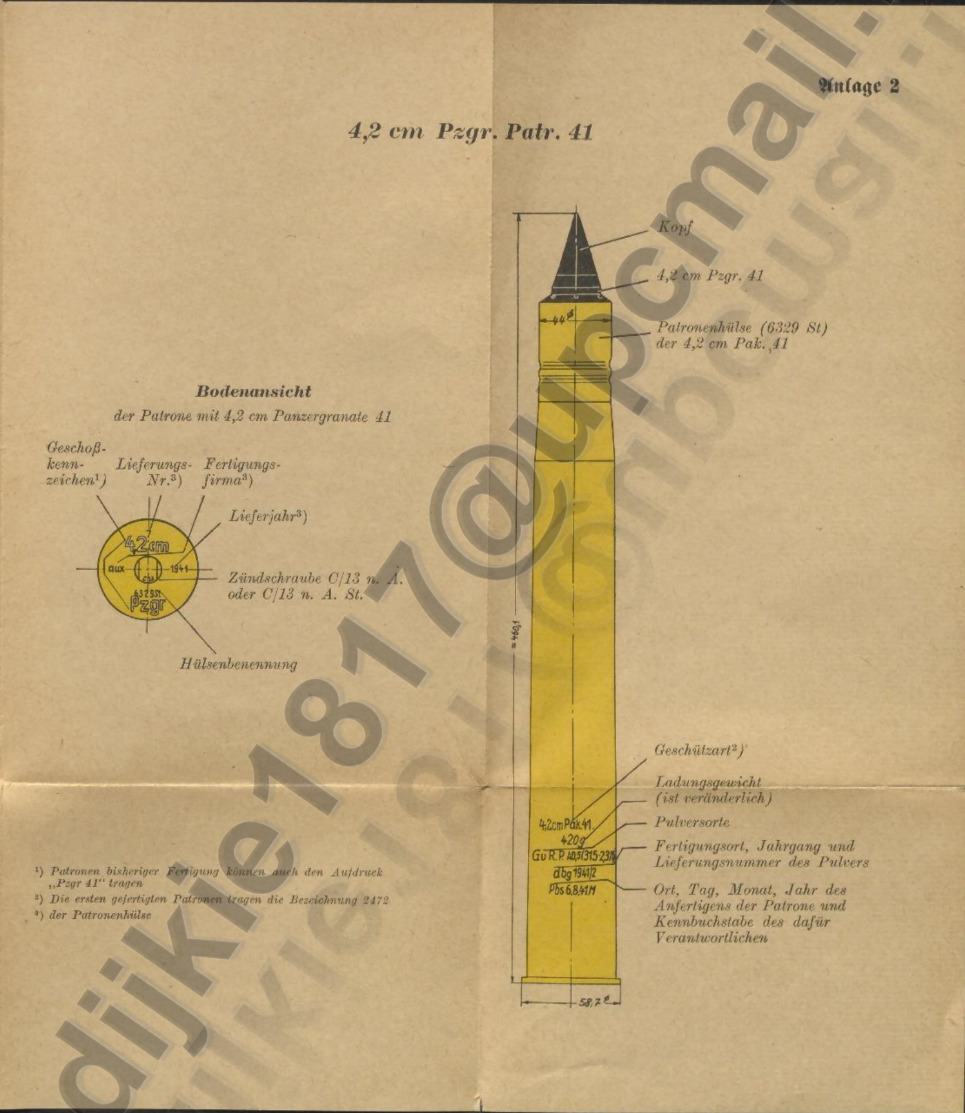
Ammo Types: APCR, HE
Datasheet:

Ap:


He:


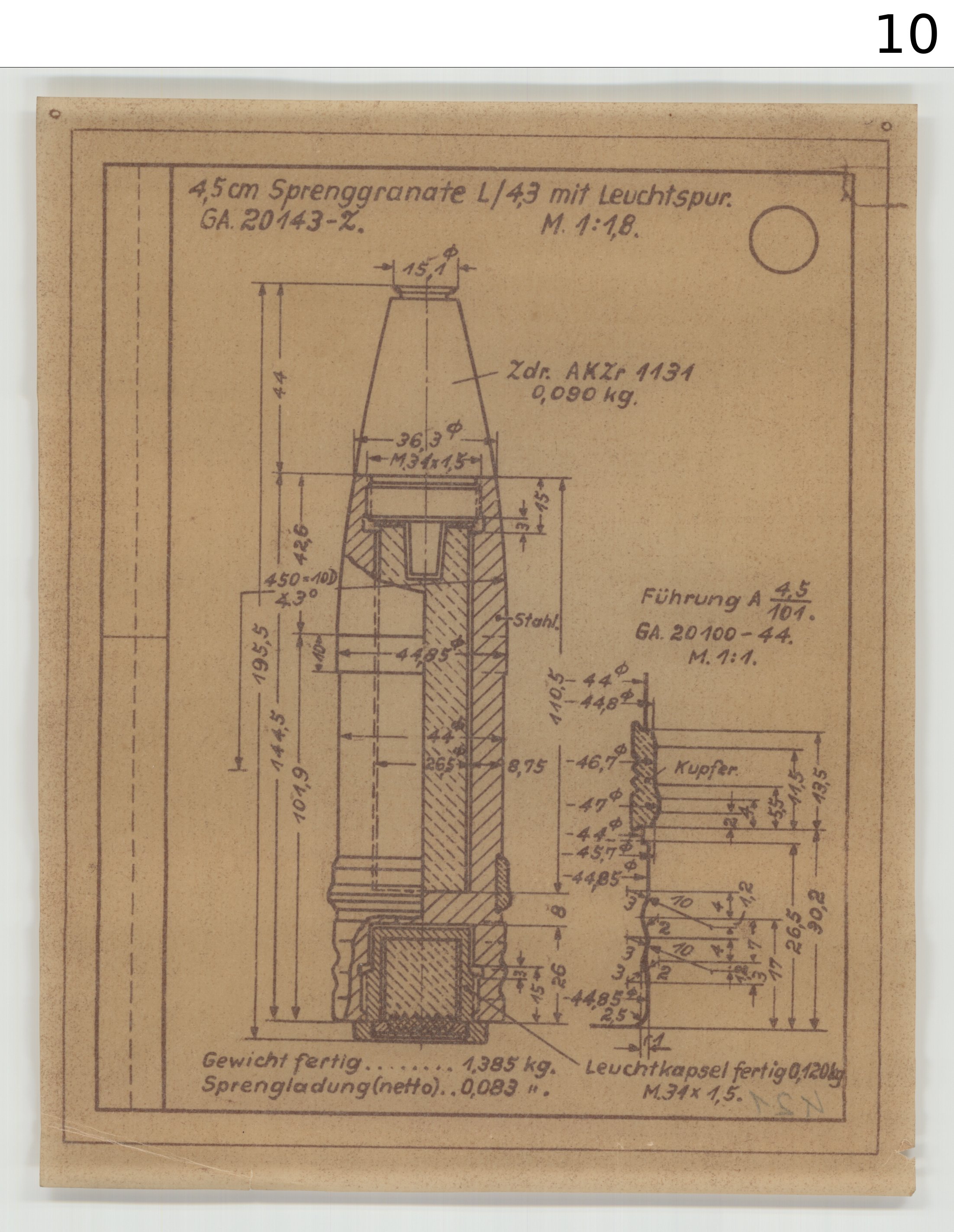
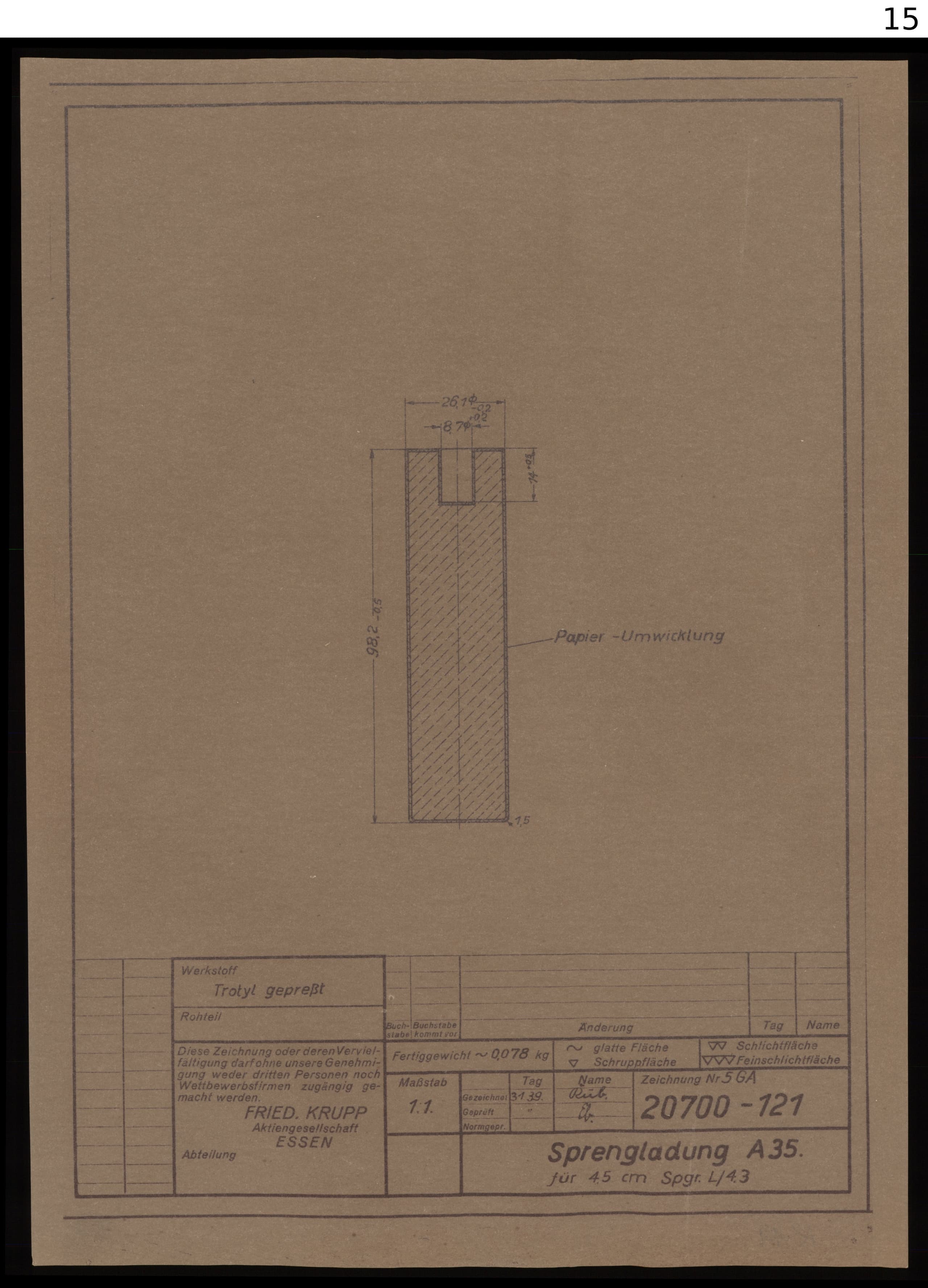
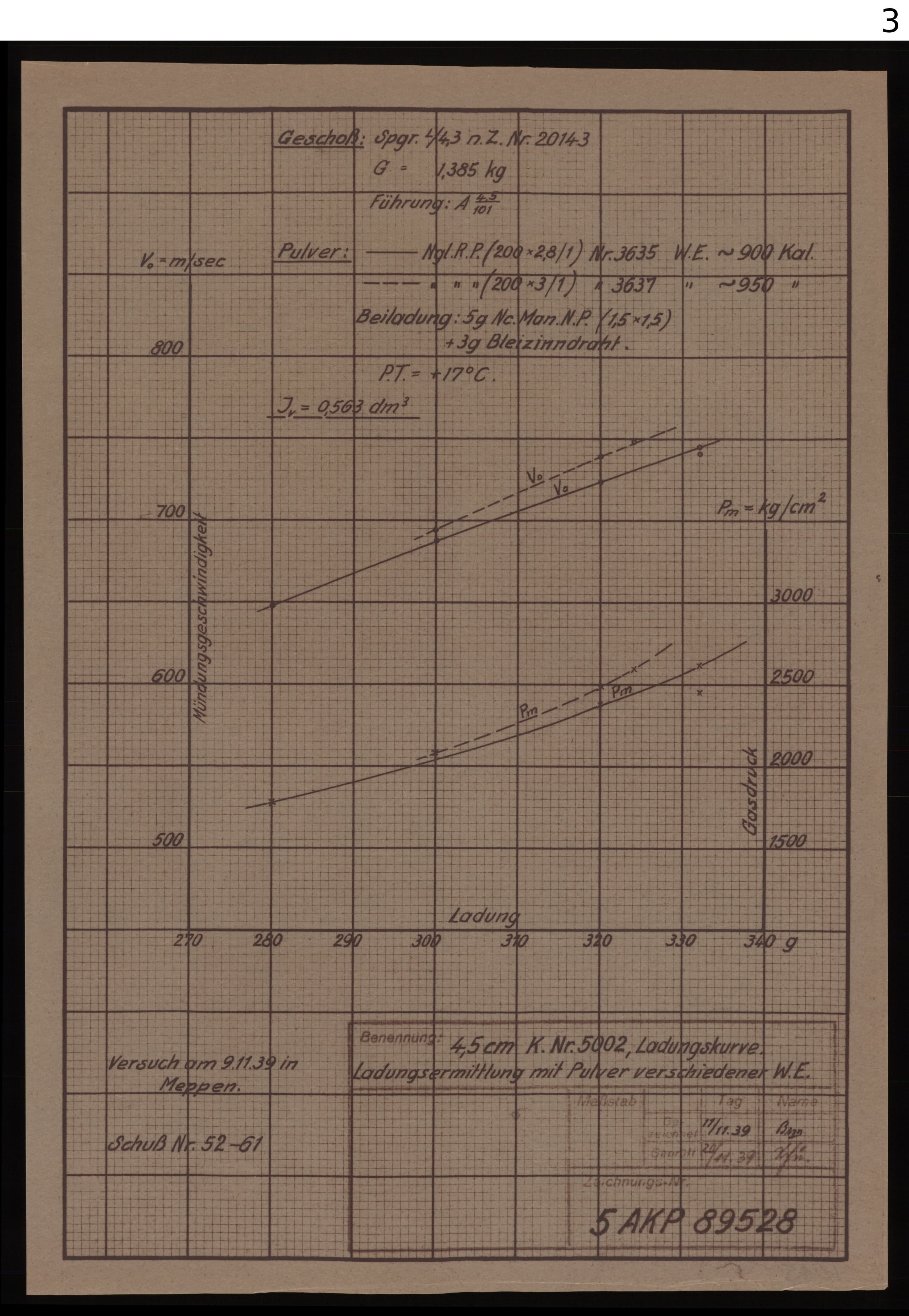
4,5 cm PaK/KwK L/50 Krupp
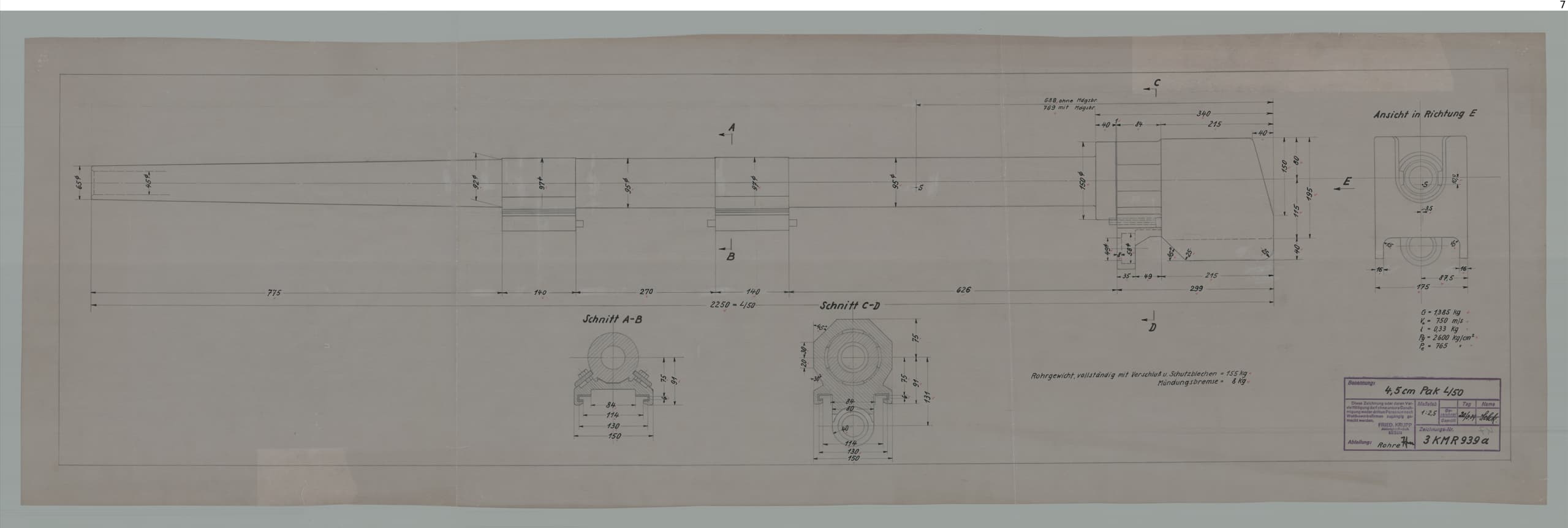
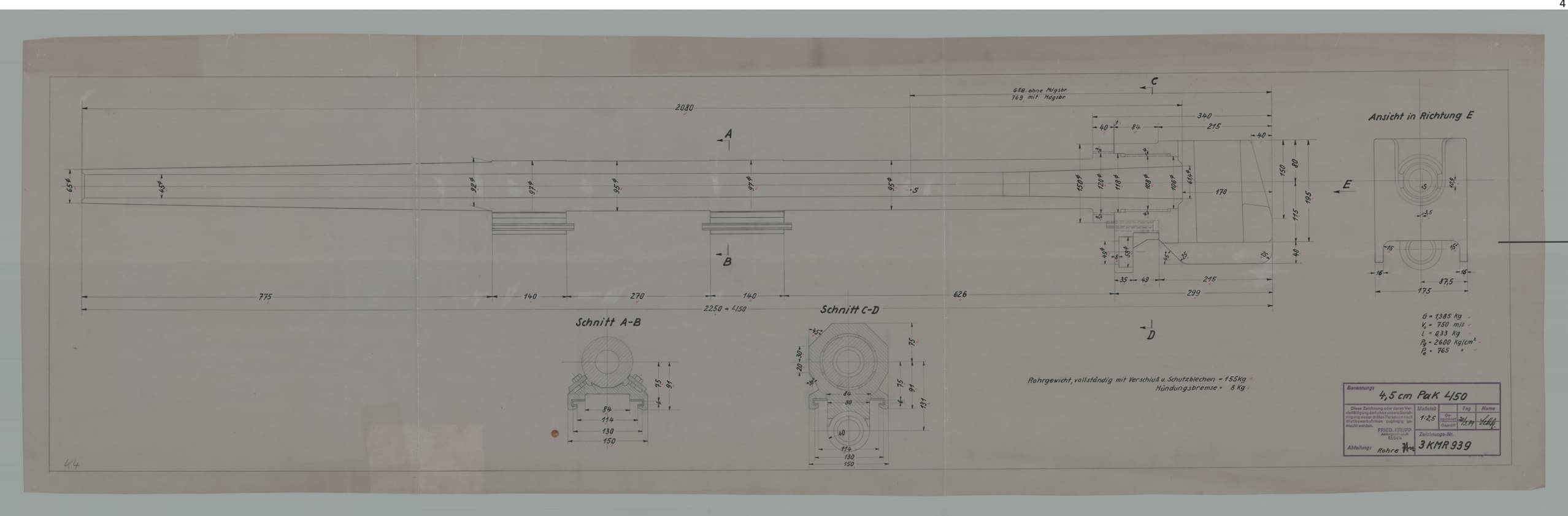

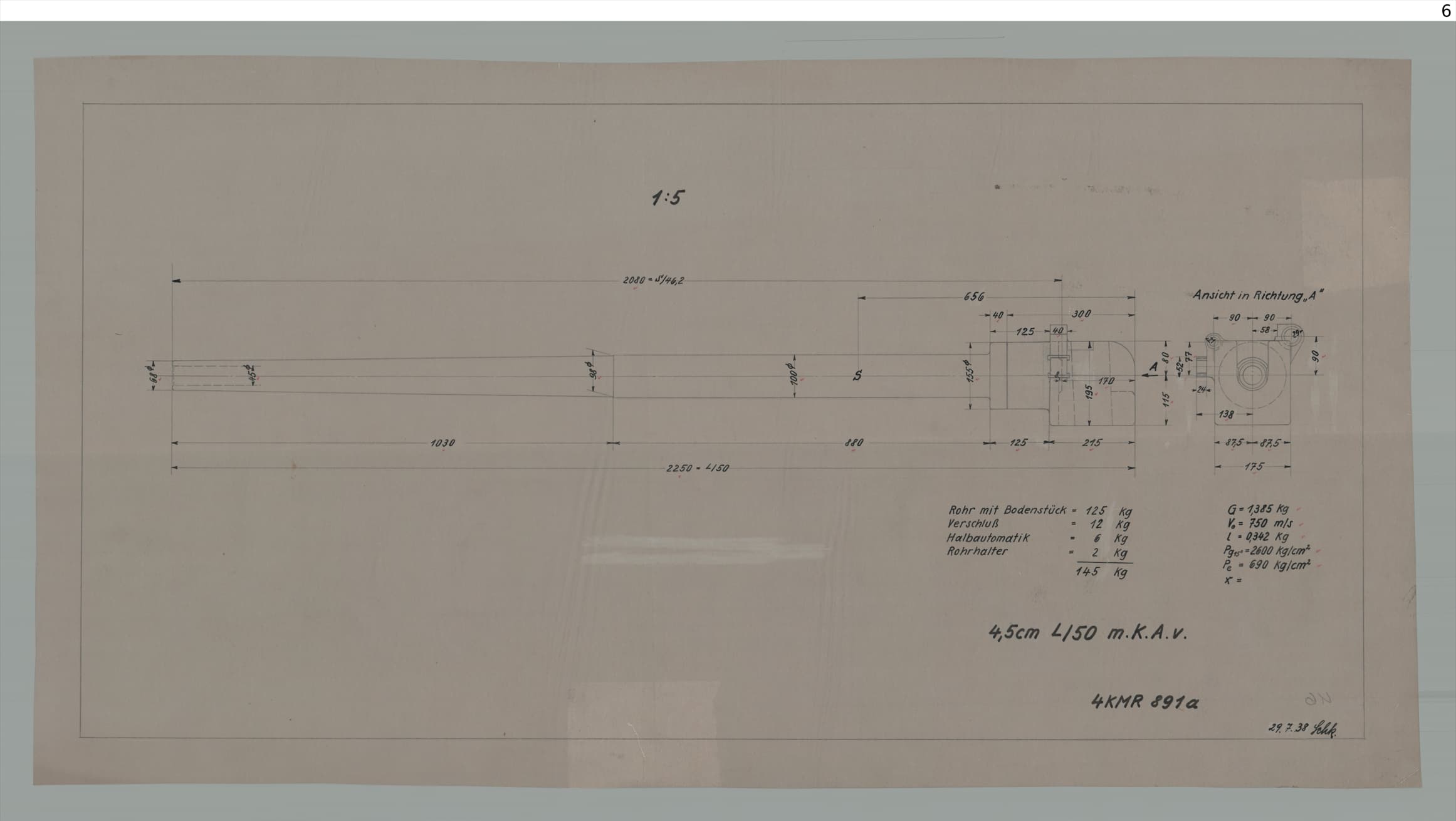
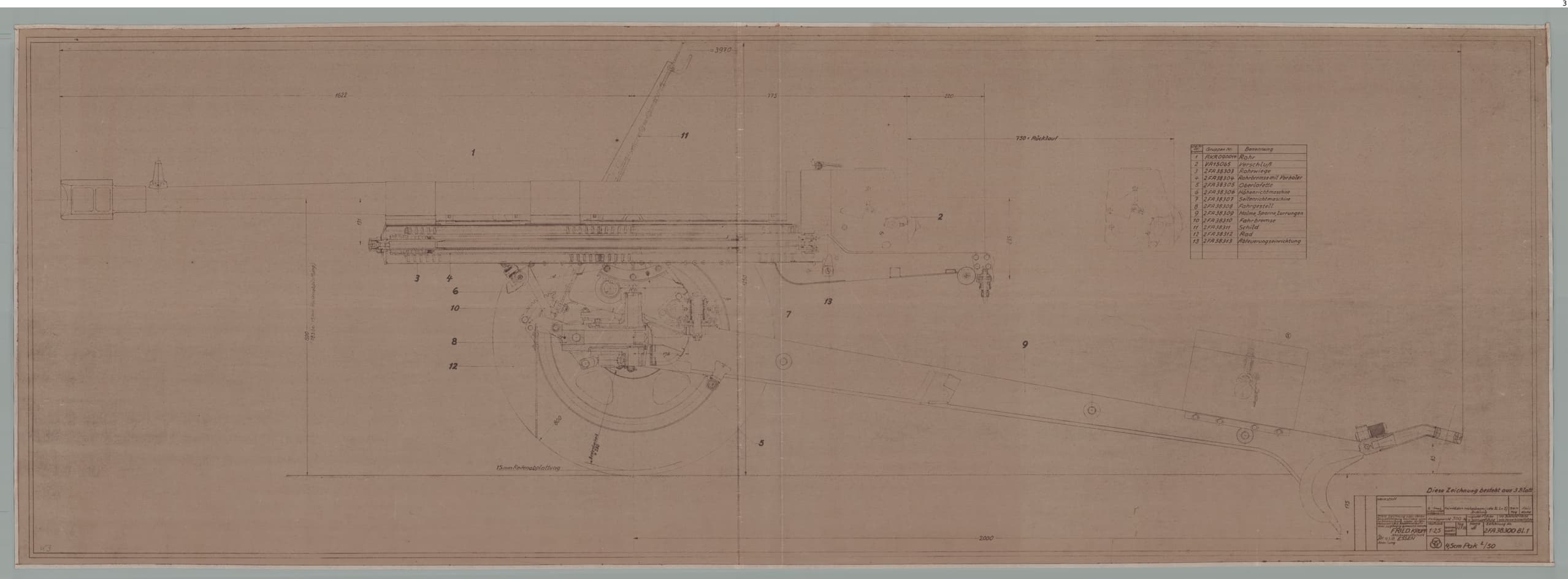
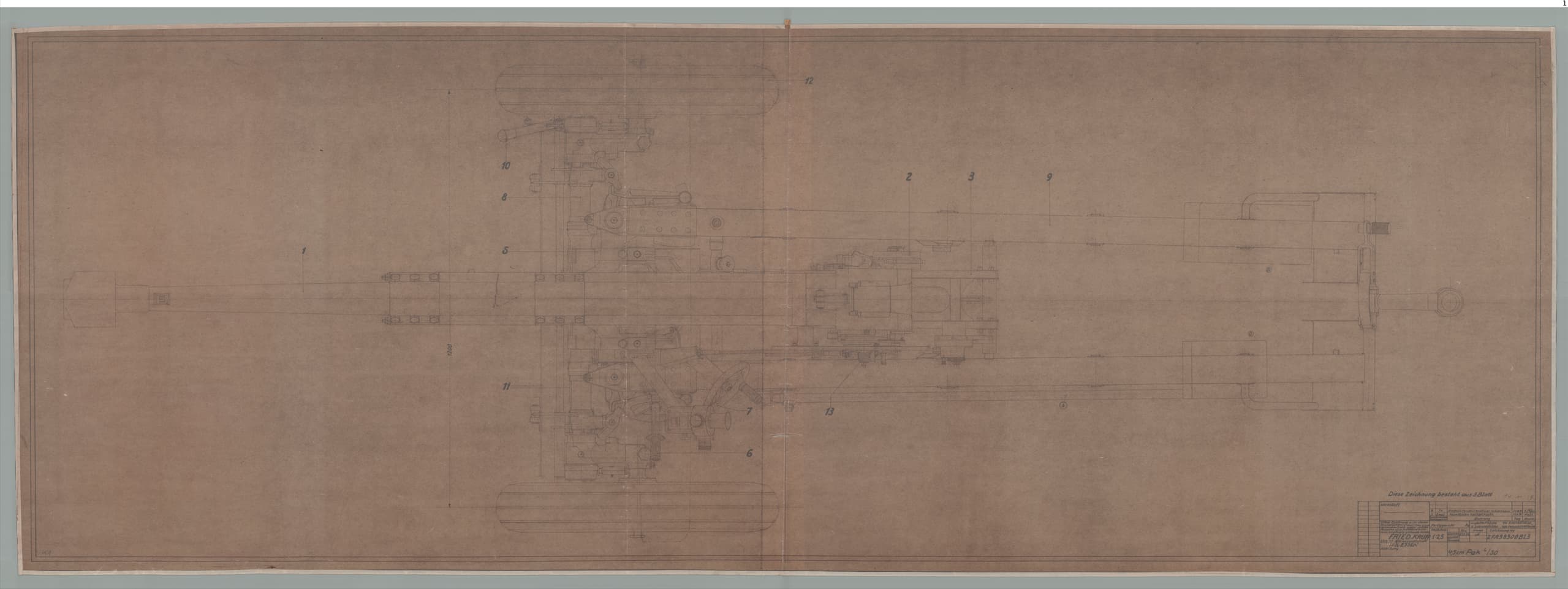
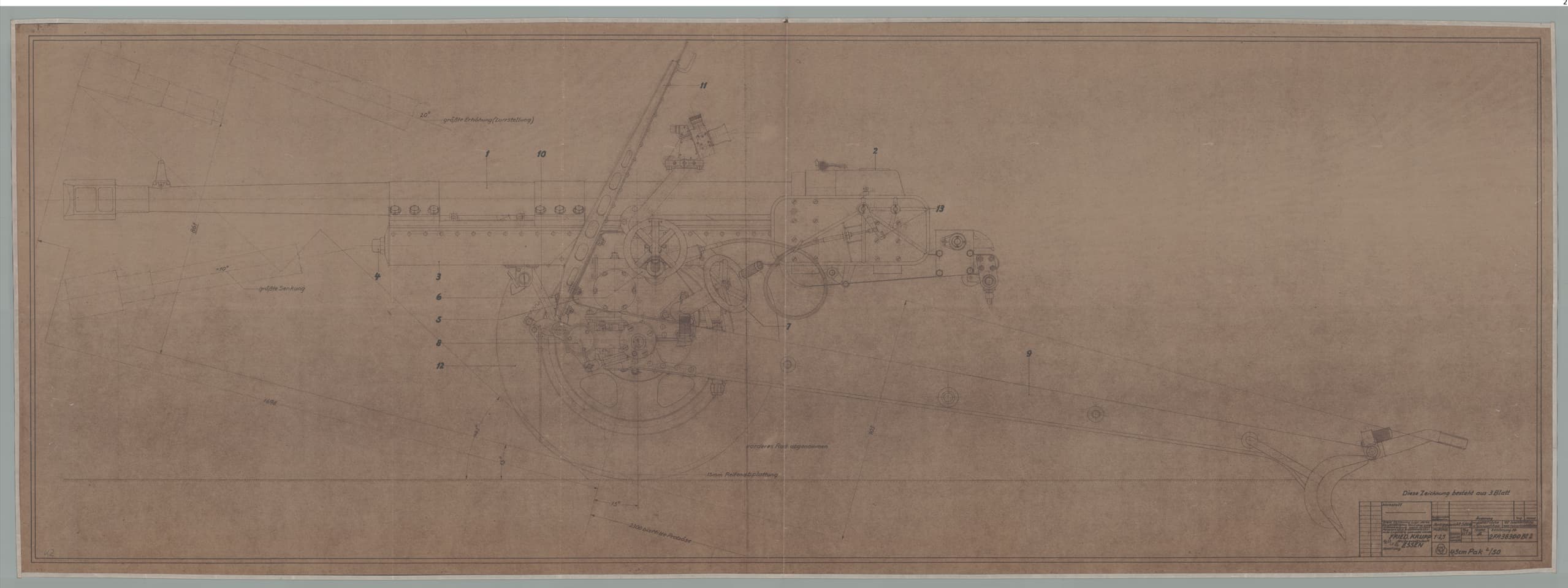
A light 45mm tank and anti tank gun, mainly designt for export as an AT gun as well as main armarment of the M.K.A. (Mittlerer Kampfwagen für Ausland (Medium Tank for Abroad/Export)) which was also produced, and would have been one of the best, however with the outbreak of WW2 the whole project was abandond, overall the gun was slightly weaker than the russian 45mm gun.
With lots of different round models developed, i will only show here the 6 most interesting, as the rest are only minor changes.
Caliber: 45mm
Ammo: Unknown
Fire Rate: 20 rpm
Single Shot, Vertical Breech Block
Muzzle velocity: 750 m/s
Weight: PaK: 155 kg (Gun without carriage) KwK: 145 kg
Mounting: Tank Maingun, AT gun
Ammo Types: APCBC, APCBC (No Tracer), APHE, HE
AP:
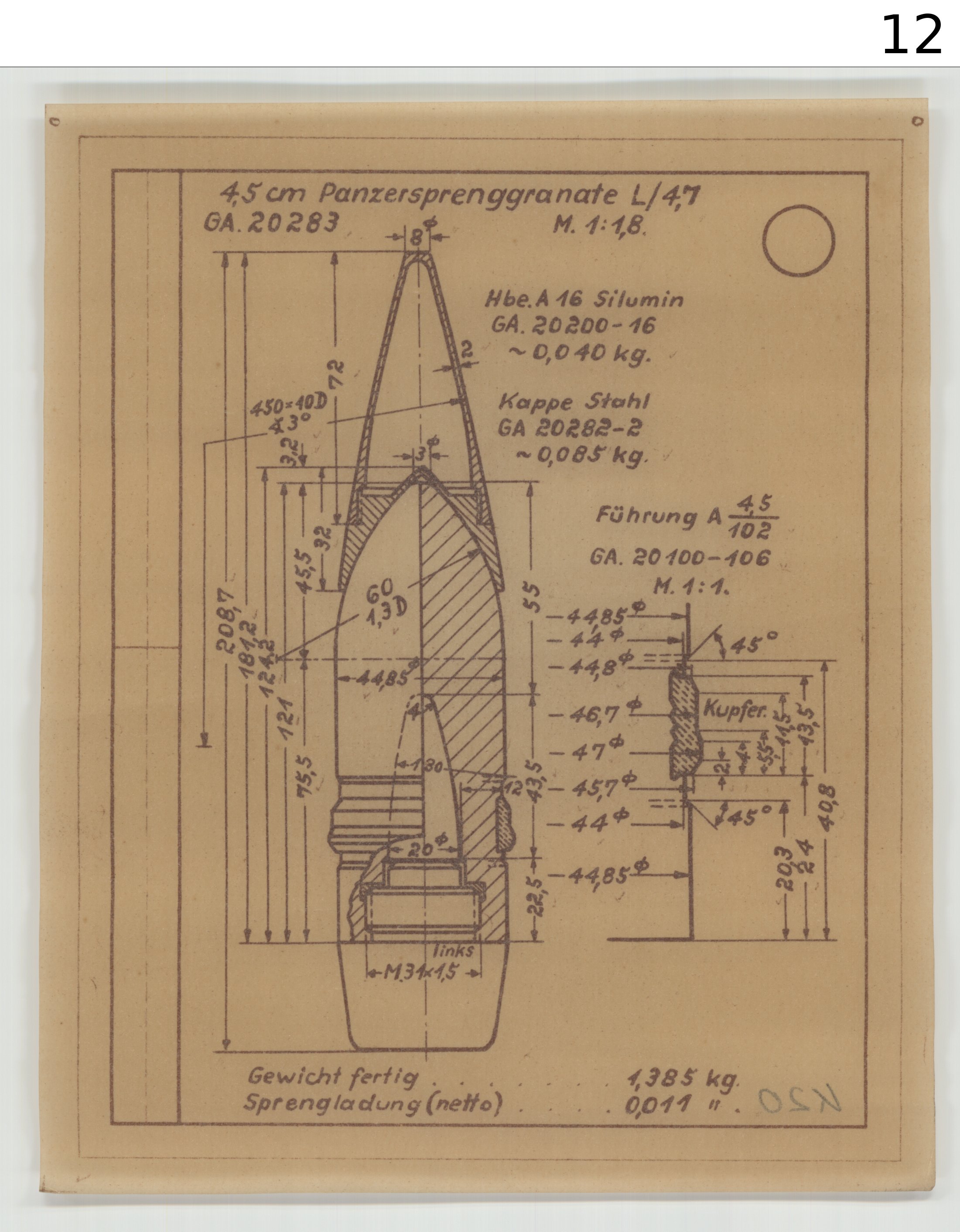
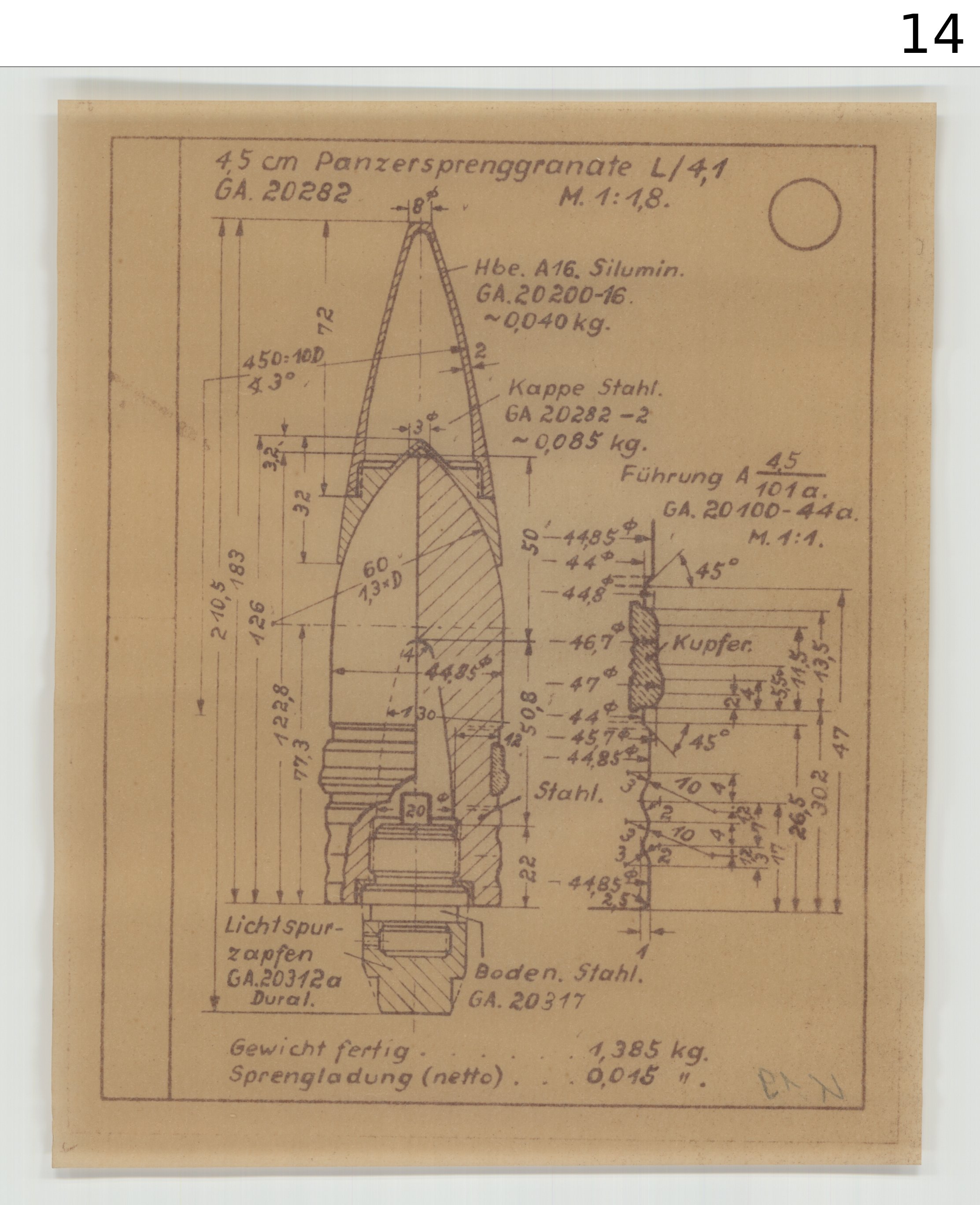
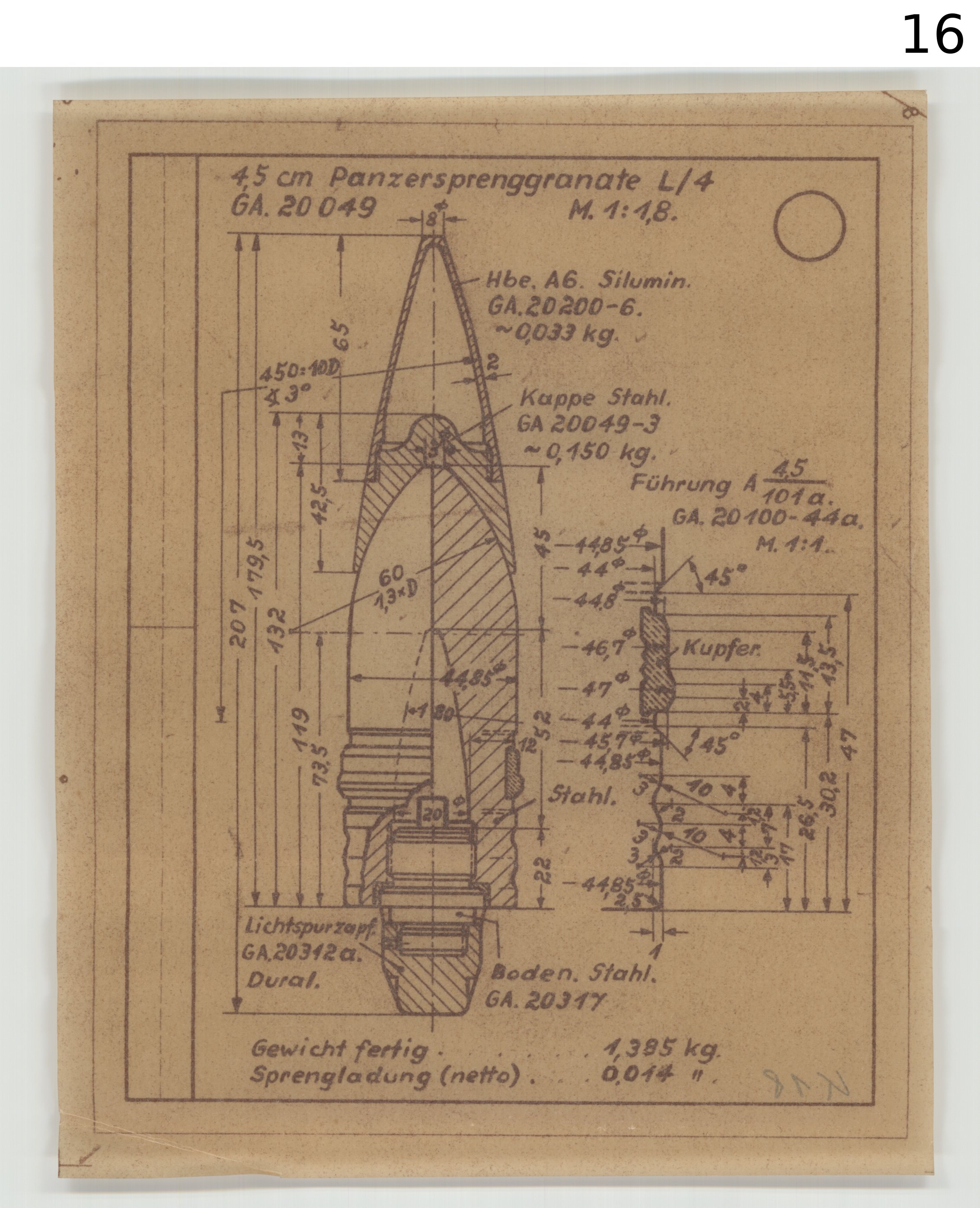
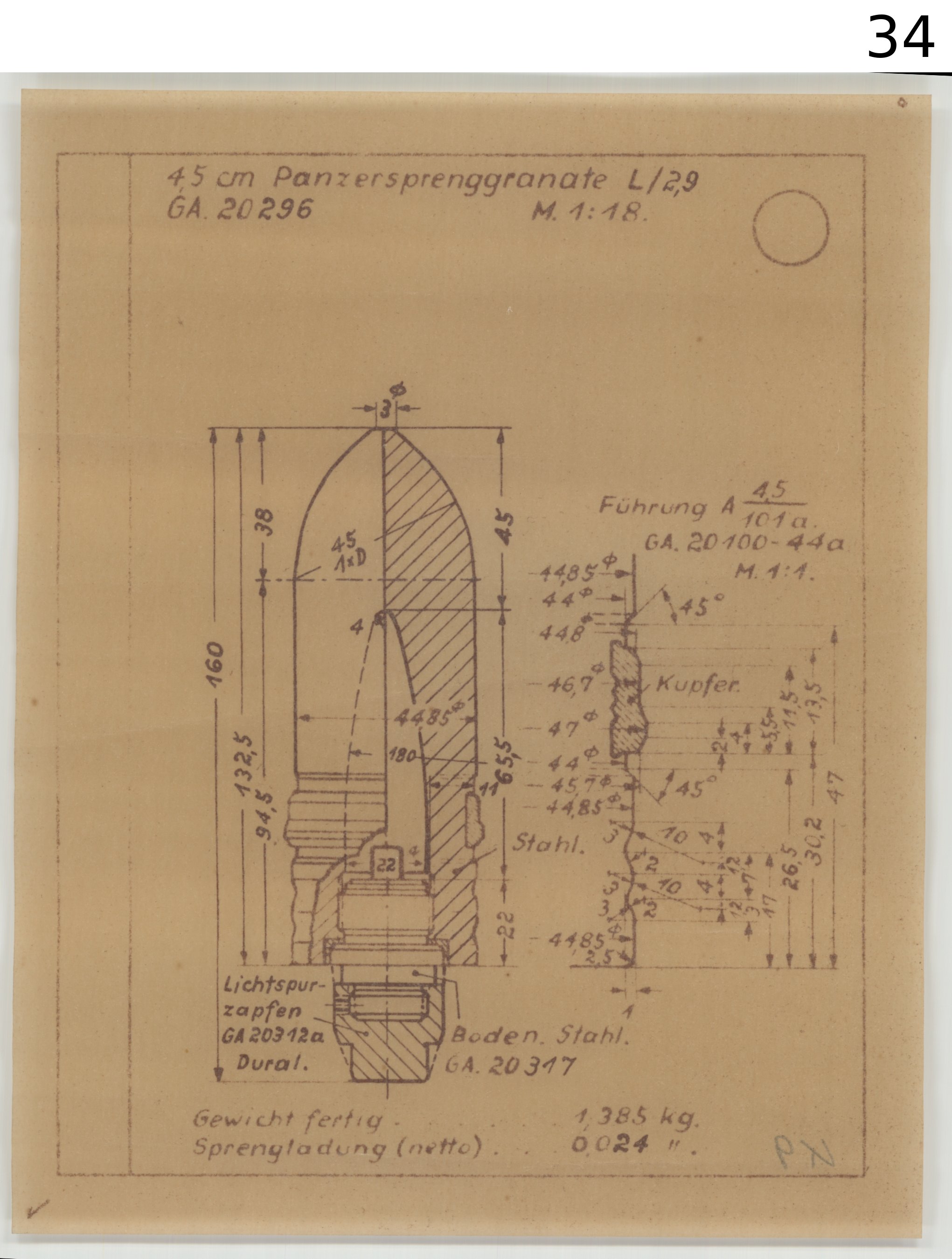
HE:
4,7 cm Pak 35/36 (ö) L/35,6


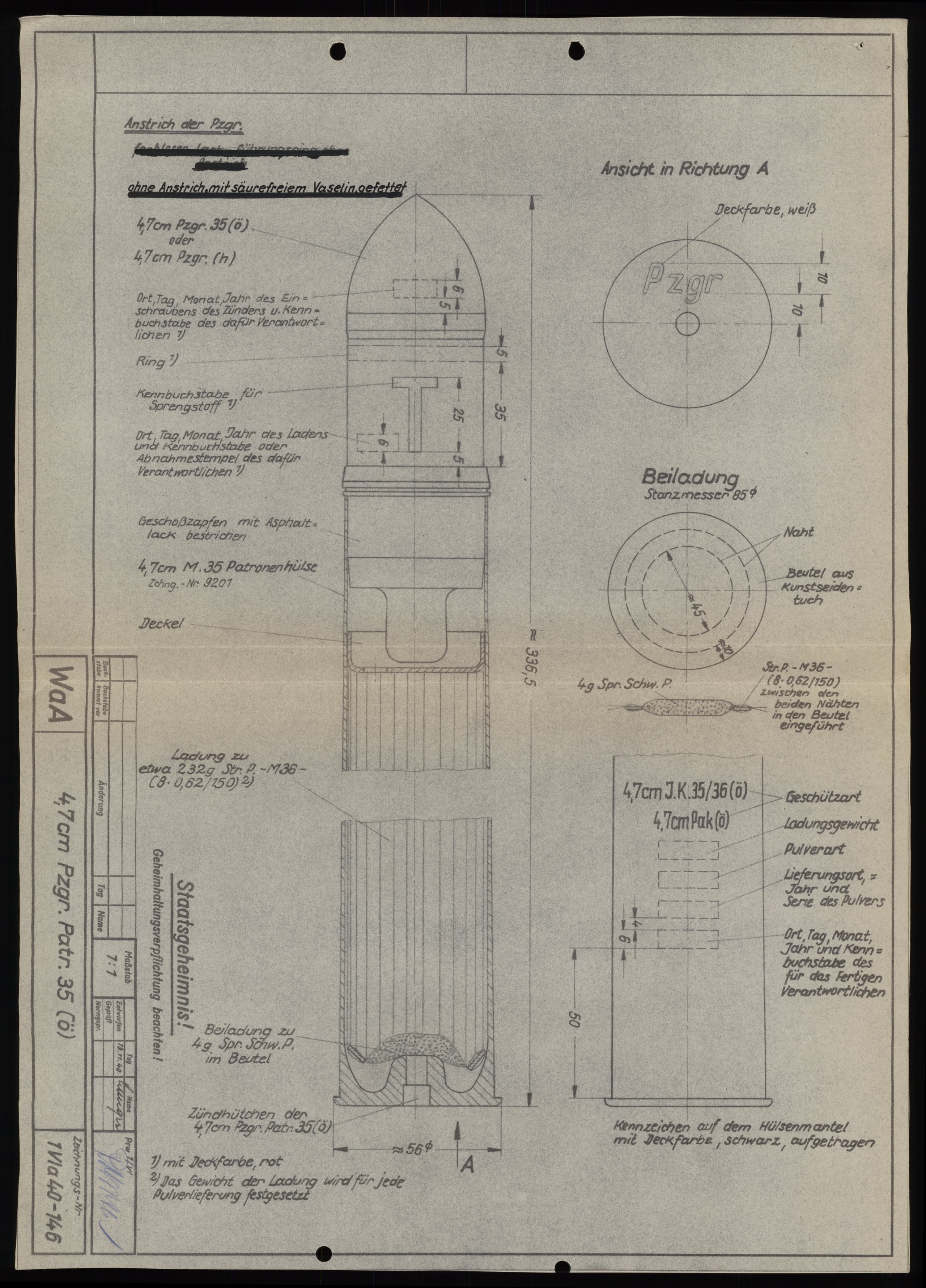
Originally a Austrian gun, after Austria connected to the German Reich, many guns were also adapted into the german army, used as light infantry guns as they had both relatively good Ap and He rounds, as well as mounted of a couple of Captured and own Vehicles such as Bren Carriers and Morris CDSW.
It was also build under licenced copy by the italians as the 47/32 M35 gun. And later on also captured Netherlands and Russian stock of the gun (Kanon van 4.7 and M35B).
It was integrated into the german arsenal with even having own production ammo, as well as czech ammo adapted to it. And duo to the usage of a Muzzle brake it could fire higher charge ammo, than the Italian copy.
Used the same rounds (shells) as the 4,7 cm Pak (t)
Caliber: 47mm
Ammo: 47x195mmR
Fire Rate: 20 rpm
Single Shot, Horizontal Breechblock
Muzzle velocity: 595 - 880 m/s
Weight: ? kg
Mounting: Pak 35/36 Mount
Ammo Types: Aphe, Apc, Apcr, He
Ap:

Pzgr.35(ö) (Aphe) 1,51 kg 15g Fp.02 640m/s 55mm/10m
The Umg. (reworked) designation is only for the changed rounds with different driving band for the Czech guns.


Pzgr.36(t) (Apc (no Tracer)) 1,65 kg 15g Fp.02 630m/s 64mm/10m

Pzgr.36(t) L'Spur (Apc) Identical to the normal one, but equipped with Tracer unit Nr. 8

Pzgr.40 (Apcr) 0,86 kg 21x75 mm 335g Core 915m/s 93mm/10m


He:
Sprgr.M35 (He) 1,48 kg 175g Fp.02 and Np.10 (220,5g) 595/650m/s


4,7 cm Pak (t) L/43,4 (Sfl.)


The 4,7 cm Pak (t) was a as the name tells czech captured and into german service adatped 47mm AT gun, that was quite liked and used as a universal light infantry gun. It was at the beginning the most powerfull light dedicated AT gun of its size, until the Pak 38 came into service, while overall beeing around as powerfull as the 5 cm KwK 38 L/42, only really sitting in its shadow in terms of smaller He round.
It was used as an field infantry/AT gun, as well as mounted on 2x Tankchassis as TD (Pzj I Ausf. B and R35 (f) chassis) and in Bunkers.
It had its own ammo, but also Austrian ammo was adapted and produced for it.
Caliber: 47mm
Ammo: 47x405mmR

Fire Rate: 20 rpm
Single Shot, Horizontal Breechblock
Muzzle velocity: 600 - 1080 m/s
Weight: 590 kg
Mounting: Pak (t) (Sfl.) Mount
Ammo Types:
Ap:


Pzgr.35(ö) umg. (Aphe) 1,51 kg 15g Fp.02 805m/s 77mm/10m

He:

5 cm KwK 38 L/42
Pictures:(Click to show)


It was the further development of the 5 cm Pak 37 L/42, which was discontinued after the specifications were increased and instead the Pak 38 L/60 was developed. However the Pak 37 L/42 still went into development and production as the KwK 38 L/42. For its time it was a relatively powerfull gun and in its categorie (47-50mm) it was for its size at the top in terms of Penetration and He power (compared to Czech and French 47mm Tank guns) it was well liked and could even penetrate the heavy Kw-1 and 2 tank with Pzgr.40 as well as the weakpoints of the T-34 from shorter distance with the Pzgr.39.
It was mainly used on the Pz III until it was replaced by the KwK 39 L/60 and put into secondary rolles mounted on Sockellafetten as AT and Coastal guard emplacement. And even mounted on a Matilda II “Oswald”
Caliber: 50mm
Ammo: 50x289mmR


Fire Rate: 20 rpm
Single Shot, Vertical Breechblock
Muzzle velocity: 450 - 1050 m/s
Weight: 400 kg
Mounting: Tank Maingun, Sockellafette I
Ammo Types: Apc, Apcr, He
Ap:
Pzgr.39 (APC) 2,06 kg 17g Np.10 (28,9g TNTe) 685m/s 80mm/10m


Pzgr.40 (APCR) 0,925 kg 21x75mm 335g Core 1050 m/s 118mm/10m
(Yes the drawing sayes 0,9kg, however pretty much all captured stock was 0,925kg, as well as other german sources.)


He:
Sprgr.38 (HE (No Tracer)) 1,82 kg 200g Fp.02 und Np.10 (256g TNTa) 450 m/s

5 cm Pak 38 / KwK 39 L/60


The 5 cm Pak 38 L/60 was the result and redevlopment after new requirements were set after the 5 cm Pak 37 L/42. For its Class (47-50mm) it was if not the most powerfull and universal gun having both great Firepower and He power, enove to penetrate the Kw-1 and Kw-2 tanks as well as the T-34 (with exception to the angled hull front). Overall it was very good for its time, only overtaken by the bigger more powerfull Pak 40, however because of its size and availability it was till used in great numbers and mounted on different vehicles as well as further developed into the KwK 39 L/60, which was mounted into the Pz III and Sd.Kfz.234/2 beeing the best known. And even further developed into the Bk 5 and Mk 214A.
Caliber: 50mm
Ammo: 50x420mmR


Fire Rate: 20 rpm
Single Shot, Vertical Breechblock
Muzzle velocity: (160) 550 - 1180 m/s
Weight: 540 kg (Bk 5)
Mounting: Tank Maingun, Sockellafette II
Ammo Types: Apc, Apcr, He and Supercaliber Heat-FS (Only open compartment)
Ap:


Pzgr.40 (Apcr) 0,925 kg 21x75mm 335g core 1180/1200m/s 139-142mm/10m
(Yes the drawing sayes 0,9kg, however pretty much all captured stock and other german sources say 0,925kg with 1180m/s. And British, USA and Russian Source shows 1200m/s, German velocitys are for mid life barrles.)


Pzgr.40/1 (Apcr) 1,07 kg 21x75mm 335g core 1130/1150m/s 130mm/10m
A Different design, longer and heavyer, to increase range, in flight stability and to use standart Casings.
(The shorter Pzgr.40 required a case with a long neck to sit properly.)


He:
Sprgr.38 (He (No Tracer)) 1,82 kg 200g Fp.02 und Np.10 (256g TNTa) 550-870m/s


(Only for open compartment guns)
15 cm Steilgranate 42 (Supercaliber Heat-FS) 8,5 kg 2,42 kg Füller 95 (Hexagon/TnT 60/40) Filler 110 m/s 180mm/30°/all distances effective range up to 300m, max range 700m
(Adapted 3,7 cm Stielgranate 41)

Developmental:
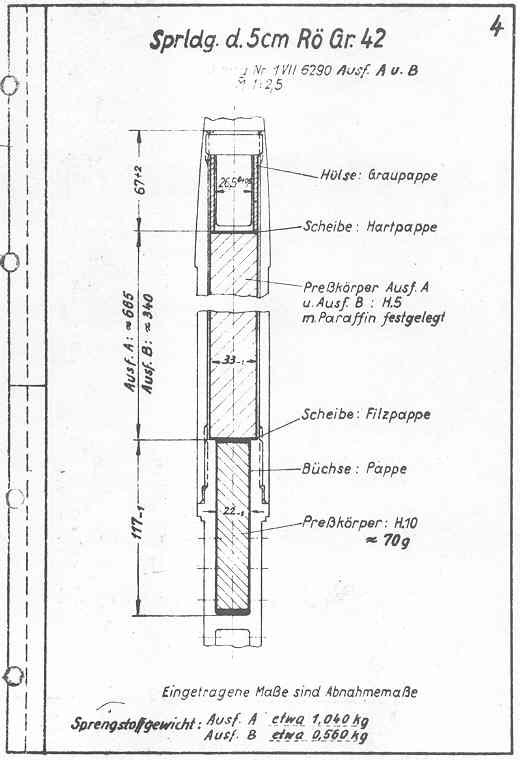
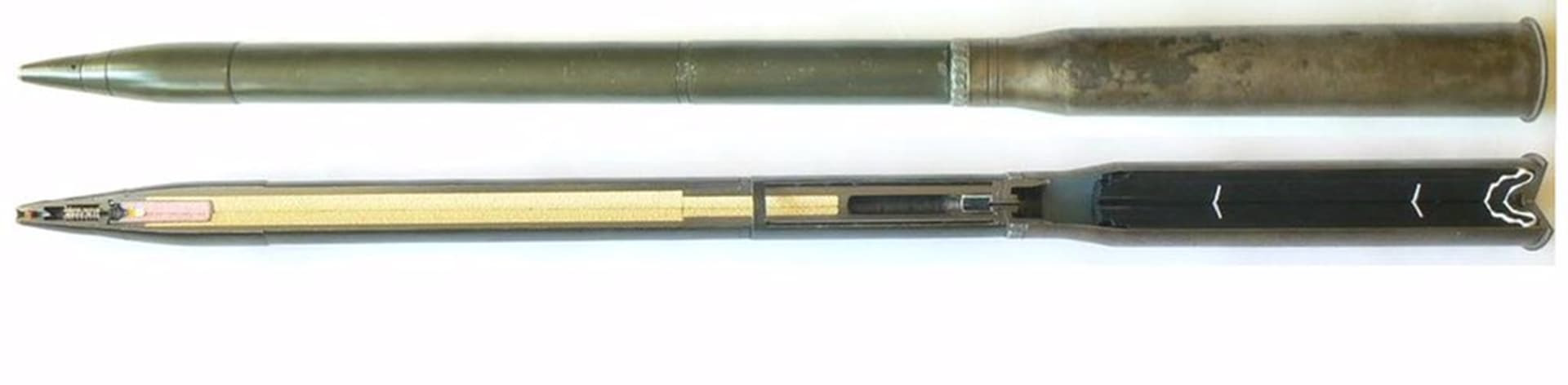
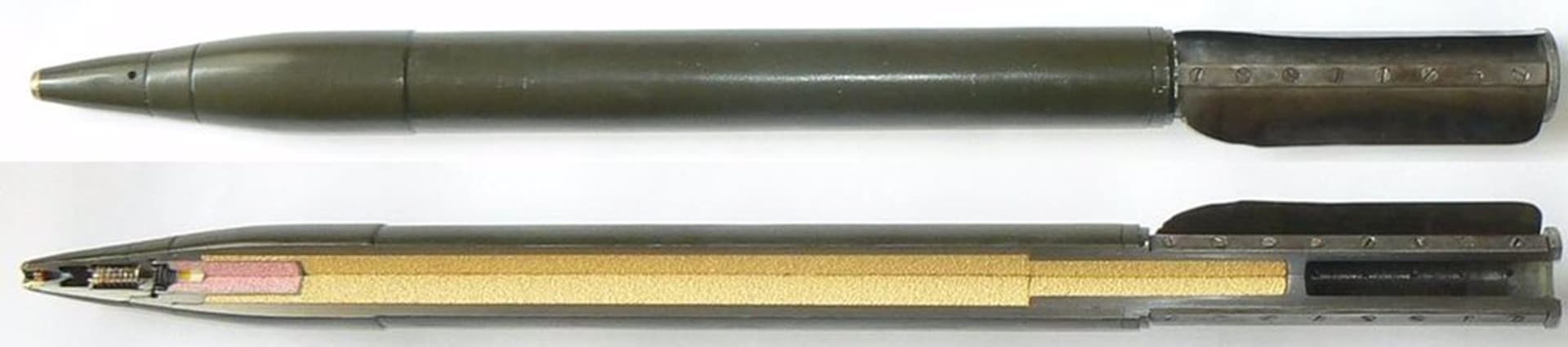
5 cm Flak 41 L/67


Caliber: 50mm
Ammo: 50x345mmB
Fire Rate: 130-140 rpm
Traverse:
Horizontal: 360°
Vertical: -10° +90°
Loading Tray 5 round Rahmen (Frame)
Muzzle velocity: 830-840-950m/s
Weight: 3100 kg (Combat Position)
Ammo Types: Apcbc, He-T, Hei-T, HeI-T (m)
AP:
Pzgr.42 L'Spur. (Apcbc) 2,23Kg 830m/s 17g Pent (28,9g) 113mm/10m

Bottom Fuze active after 7mm (Note all Ap rounds starting from 37mm use the Bd.Z. d. 3,7 cm Pzgr.)
He:
Sprgr.41 L'Spur. (He-T*) 2,195Kg 840m/s 90g Pent (153g)

Br.Sprgr.41 L'Spur (HeI-T*) 2,195Kg 840m/s 96g 80% Np.10 & 20% Al-Powder (153,6g)

Minengeschoss:




Vehicles:


7,5 cm - 7,62 cm
7,5 cm Le.I.G. 18 L/12


Early on after WW1 the german army already saw the need of a light infantry gun, that can be easily carried and traversed around the field and can give firepower close to the troops, stronger that Mortars, but closer than Artillery can do behind the lines. As such the small brother of the allready familiar 15 cm s.I.G. 33 L/12 was developed, the 7,5 cm Le.I.G. 18 L/12 (Leichtes Infanterie Geschütz)
This gun was unique on its own with a Break action barrle and performance between 95-221m/s with 1-5 charges with semi-fixed casings, but also AT potential because of a Heat round. Later on the 1-5 charge was replaced by 1-3 + special charge, which increased the velocity.
Caliber: 75mm
Ammo: 75x89mmR Semi fixed (except heat)


Fire Rate: 20 rpm
Single Shot, Break Barrle
Muzzle velocity: 93 - 221 - 250 / 172,5 - 260 - 330 m/s
Weight: 400 kg (Combat)
Mounting: Field Mount, Wooden and Pneumatic wheels.
Ammo Types: Heat, He, HeI, Smoke

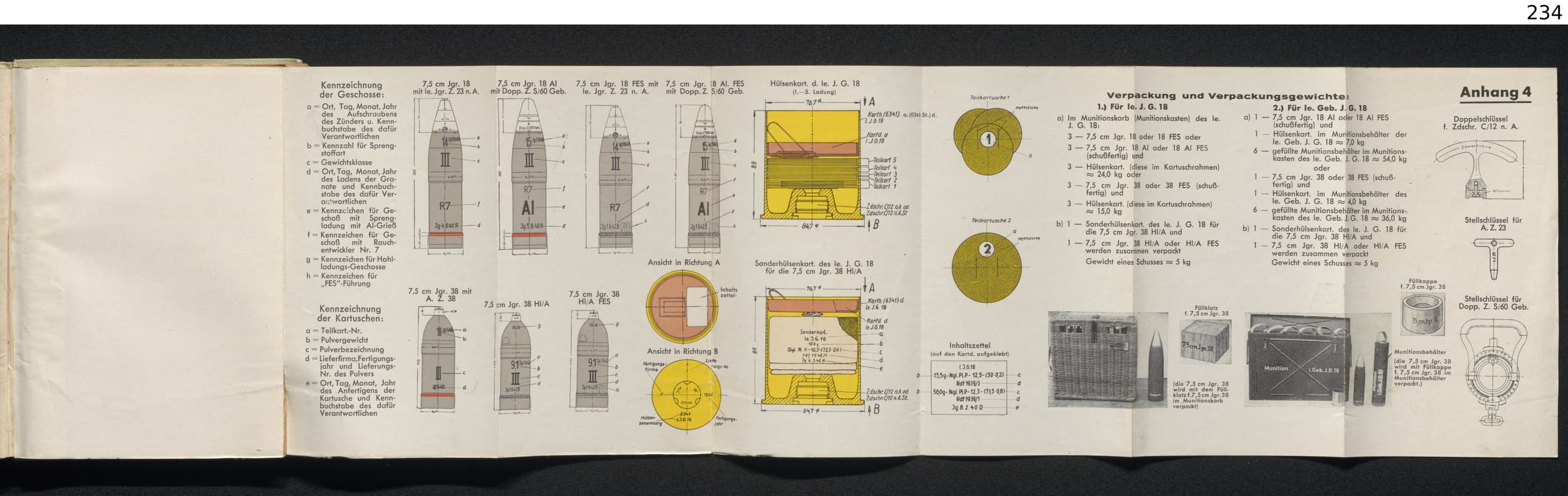
Ap:
7,5 cm I.Gr.38 Hl/A (HEAT (no Tracer)) 2,85 kg 520g H.5 (884g TnTa) 250 / 330 m/s 115mm/10m


He:
7,5 cm I.Gr.18 (Bo.Pr) (HE-TF (no Tracer)) 5,45 kg 680g Fp.02 und Np.10 (870,4g TnTa) 93-221 / 172,5-260 m/s
Bo.Pr stands for Bohr Pressstrahl (Drilled and pressed steel, these were cheap alternatives to increase production beyond standart ammo)


7,5 cm I.Gr.18 Al (Bo.Pr) (HEI-TF (no Tracer)) 5,45 kg 680g Fp.02 und Np.10 (870,4g TnTa) 93-221 / 172,5-260 m/s
Bo.Pr stands for Bohr Pressstrahl (Drilled and pressed steel, these were cheap alternatives to increase production beyond standart ammo)
With Added Aluminium shavings in the HE filler for additional Incendary effect (and faster detonation speed).
Utility:
7,5 cm I.Gr.18 Nb (Smoke (no Tracer)) 5,5 kg 50g Smoke stuff 93-221 / 172,5-260m/s

7,5 cm KwK L/24 / K.51 L/24


The KwK/StuK/K. and K.51 L/24 were one of the most common and well know 7,5 cm guns of the german army, beeing a short infantry support gun with relatively good (especially for its time) AT performance with the K.Gr. Rot. Pz and effective later with the Heat rounds. As well as good He firepower. Beeing an Interwar designe it was from the beginning to the very end in usage on a multitude of vehicles, Pz IV, III and Stug III beeing well known. After the Pz IV and Stug III got their high velocity guns, lots of the L/24 guns went back into storage, as such along with the Pz III Ausf. N, lots of these were modernized into the K.51 L/24 and put on field mounts as well as Vehicles such as Halftracks and Trucks, Sd.Kfz.250, 251, 233 and 234/3. The addition of “37” is not historical, rather an after war addition in books.
Caliber: 75mm
Ammo: 75x243mmR

Fire Rate: 20 rpm
Single Shot, Vertical Breechblock
Muzzle velocity: 385 - 450 m/s
Weight: 490 kg
Mounting: Field Mount, Main Tank gun.
Ammo Types: Apcbc, He, Smoke, Heat, Canister Shot

Ap:
K.Gr. Rot Pz (Apcbc) 6,8 kg 80g Fp.02 und Np.10 (102,4 g TnTa) 385/400 m/s 52/55mm/10m


Gr.38 Hl (Heat (No Tracer)) 4,4 kg 570,2g H.5+Fp.02 (969,34g TnTa) 450 m/s 52-55mm/10m


Gr.38 Hl/A (Heat (No Tracer)) 4,5 kg 399g H.5+Fp.02 (678,3g TnTa) 450 m/s 81mm/10m

Gr.38 Hl/B (Heat (No Tracer)) 4,57 kg 513g H.5 (872,1g TnTa) 450 m/s 87mm/10m


Gr.38 Hl/C (Heat) 4,8 kg 515 g H.10 (875,5g TnTa) 450 m/s 115mm/10m
(Early production still without tracer, but during production implemented.)


He:
Sprgr.34 (He (No Tracer)) 5,74 kg 725g Fp.02 und Np.10 (928g TnTa) 420/440 m/s
Historic Penetration 30/10m and 26mm/500m


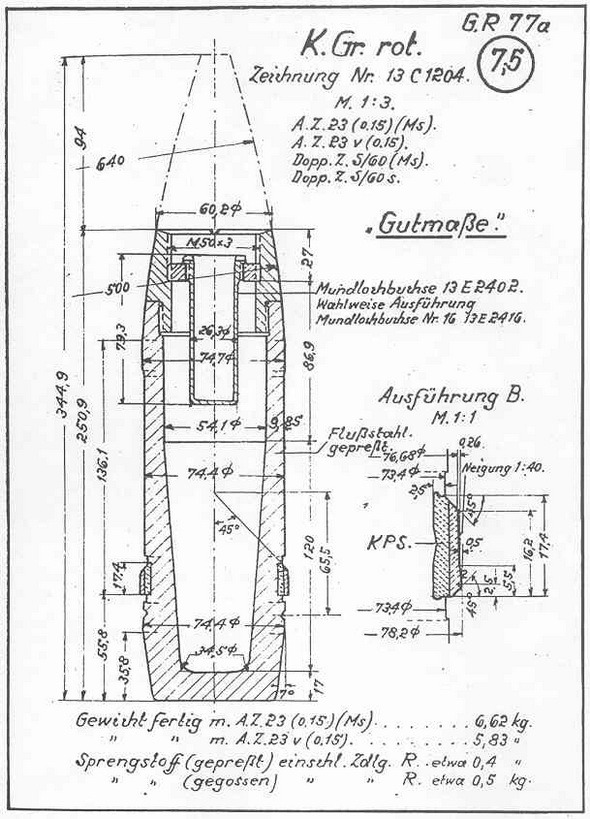
K.Gr. Rot ((SAP)He) 6,62kg 415-515g Fp.02 or Amatol und Np.10 (531,2-659,2g TnTa) 420/440 m/s

Utility:
K.Gr. Rot Nb (Smoke (No Tracer)) 6,2 kg 95g Pent 430/450 m/s
Early with copper Driving bands and 423m/s, replaced by FES Driving bands.


Kt. (Canister Shot (No tracer) 6,65 kg 430/450 m/s
Adapted 7,7 cm Kt. 7,5 cm Kt. KwK may be slightly different.
280 Lead or Steel Balls.


7,5 cm Pak 97/38 L/36 (And different versions)


The 7,5 cm Pak 97/38 L/36 was a combination of the French M1897, with a Rheinmetall Muzzle brake and placed on the 5 cm Pak 38 mounting. It was created out of need as not yet the Pak 40 was available and more guns with higher velocity were needed, as such this gun, equipped with the K.Gr. Pz. (P) which is unlike popular believe not a old Polish Aphe round, but instead the german K.Gr. Rot Pz adapted to the guns, which were used by the French, polish and American units and even up to the 75mm M3 gun. Furthermore the gun took great usage of adapted Heat rounds, beeing able to fight both the T-34 and Kw tanks, tho still with relatively low velocity.
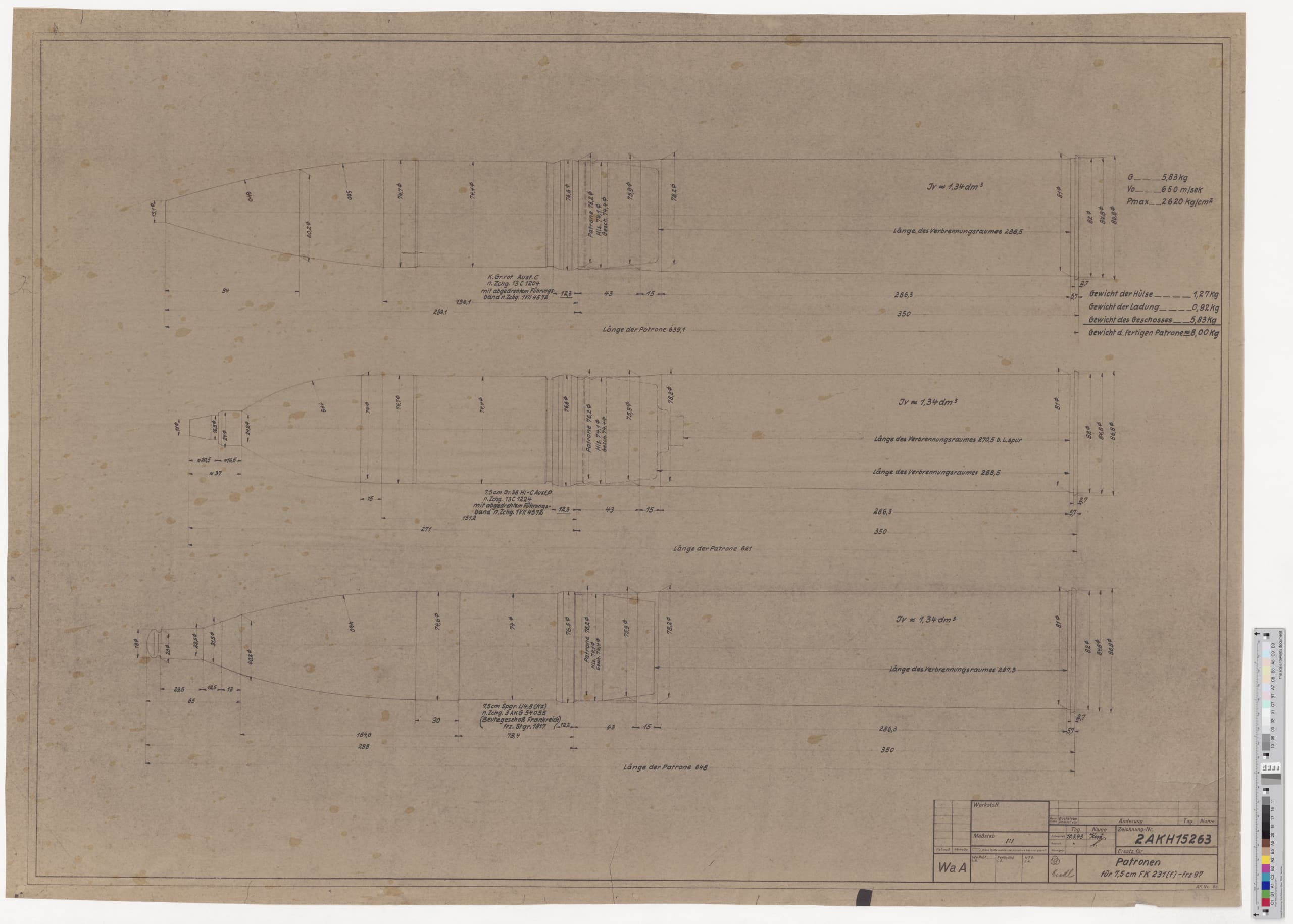
This also includes the 7,5 cm Fk 231 (f), 232 (f) and Fk 97 (p)
Caliber: 75mm
Ammo: 75x350mmR

Fire Rate: 14 rpm
Single Shot, Nordenfeld interrupted Screw
Muzzle velocity: 450 - 570 m/s
Weight: 1190 kg
Mounting: Field Mount, Main Tank gun.
Ammo Types: Apcbc, He, Smoke, Heat
Ap:
K.Gr. Pz (p) (Apcbc) 6,8 kg 80 g Fp.02 und Np.10 (102,4 g TnTa) 570m/s 91mm/10m


Gr.38/97 Hl/A (f) (Heat (No Tracer)) 4,4 kg 399g H.5+Fp.02 (678,3g TnTa) 450 m/s 81mm/10m
Gr.38/97 Hl/B (f) (Heat (No Tracer)) 4,57 kg 513g H.5 (872,1g TnTa) 450 m/s 87mm/10m
Gr.38/97 Hl/C (f) (Heat) 4,8 kg 515g H.10 (875,5g TnTa) 450 m/s 115mm/10m
(Early no tracer, implemented during production.)
He:
Sprgr.34 (He (No Tracer)) 5,74 kg 725g Fp.02 und Np.10 (928g TnTa) 550m/s
Utility:
K.Gr. Rot Nb (Smoke (No Tracer)) 6,2 kg 95g Pent 550m/s
7,5 cm FK 16 n.A. L/36
Pictures:(Click to show)


The 7,5 cm Fk 16 n.A. L/36 was the modernized 7,7 cm Fk 16 L/35, which recived a new 75 mm barrle and was one of the most powerfull pre war german 75mm guns, beeing taken as the golden standart for further development and resulting in the 7,5 cm K. L/41.
It was able to penetrate the Char 2C from 30° 600m which was also the basis taken for the gun above mentioned. It was placed and keep on the KD-I as well as was test fitted on one of the Großtraktoren for further development for the mounting of the K. L/41 into the Pz.Sfl. II.
It was heavily used at the beginning to also fight the heavy french tanks, but afterwards was mostly put into secondary roles as more powerfull AT guns emerged.
Caliber: 75mm
Ammo: 75x200mmR (Additional charges are larger than the caseing.)

Fire Rate: 18 rpm
Single Shot, Horizontal Breech block
Muzzle velocity: 450/480 - 665 m/s
Weight: 1524kg
Mounting: Field Mount, Wooden Wheels, Sockellafette (KD-I), Main Tank gun (Großtraktor)
Ammo Types: Apcbc, He, Smoke, Heat
Ap:
K.Gr. Rot Pz (Apcbc) 6,8 kg 80 g Fp.02 und Np.10 (102,4 g TnTa) 630/650 m/s 110mm/10m
Gr.38 Hl (Heat (No Tracer)) 4,4 kg 570,2g H.5+Fp.02 (969,34g TnTa) 450/480 m/s 52-55mm/10m
Gr.38 Hl/A (Heat (No Tracer)) 4,5 kg 399g H.5+Fp.02 (678,3g TnTa) 450/480 m/s 81mm/10m
Gr.38 Hl/B (Heat (No Tracer)) 4,57 kg 513g H.5 (872,1g TnTa) 450/480 m/s 87mm/10m
Gr.38 Hl/C (Heat) 4,8 kg 515 g H.10 (875,5g TnTa) 450/480 m/s 115mm/10m
(Early no Tracer, implemented during production.)
K.Gr. Rot. (SapHef (No Tracer)) 6,62 kg 650/670m/s 520g Amatol (520g aquivalent)(Some penetration (Historical 20mm/30°/600m)
(with A.Z.23 (0,15)(Ms.)
He:
Sprgr.34 (He (No Tracer)) 5,74 kg 725g Fp.02 und Np.10 (928g TnTa) 665 m/s
K.Gr. Rot. (Hef-TF (No Tracer)) 5,83 kg 662 m/s 520g Amatol (655,2g aquivalent)
(With Dopp.Z./60s Time Fuze: 6,37kg at 655m/s)
Utility:
K.Gr. Rot Nb (Smoke (No Tracer)) 6,2 kg 95g Pent 660m/s
Schr. L/3,2 (Shrapnell-TF (No Tracer)) 6,08 kg 0,08 kg Blackpowder 661 m/s 46mm/10m
Some Incendary effect by the Pitch inbetween the balls.

7,5 cm K.37 L/41


The 7,5 cm K. L/41 was developed upon the Fk 16 n.A. as basis, to have better performance and be a more modern improvement to it, used both as an Mobile AT gun (Pz.Sfl.II) as well as StuK. L/41 on a Stug III prototype. It was a prewar development, however was never put into service duo beeing cancelled in favour of the Pak and KwK 40, and the multiple pre production guns were placed into the 2x Pz.Sfl.II, 1x StuG III Prototype as well as the rest build into Panzerzug 3.
Caliber: 75mm
Ammo: 75x574mmR

Fire Rate: 20 rpm
Single Shot, Vertical Breechblock
Muzzle velocity: 450 - 685m/s
Weight: 550 kg
Mounting: Main Tank gun, train turret
Ammo Types: Apcbc, He, Smoke, Heat
Ap:
K.Gr. Rot Pz (Apcbc) 6,8 kg 80g Fp.02 und Np.10 (102,4 g TnTa) 685m/s 118mm/10m

Gr.38 Hl/B (Heat (No Tracer)) 4,57 kg 513g H.5 (872,1g TnTa) 450 m/s 87mm/10m
Gr.38 Hl/C (Heat) 4,8 kg 515 g H.10 (875,5g TnTa) 450 m/s 115mm/10m
(Early no tracer, implemented during production.)
He:
Sprgr.34 (He (No Tracer)) 5,74 kg 725g Fp.02 und Np.10 (928g TnTa) 495 m/s

Utility:
K.Gr. Rot Nb (Smoke (No Tracer)) 6,2 kg 95g Pent 495m/s

7,5/5,5 cm Pak 41 L/57 (And Waffe 0725)
Pictures:(Click to show)


(The barrle looks odd, as it is in travel position, with muzzle cover and moved back further in the mount to reduce overhang.)


It was the 3rd gun of the Gelrich Principal and was the contester gun to the Pak 40, which while lighter and with impressive penetration and velocity had 2 big downsides which lead to its downfall and only 150 were produced. These were the need of 1kg Tungsten Carbite Cores for the normal AP ammo as well as high barrle wear, which if ingnored resulted in rapid loss of velocity and accuarcy. It was first designed as a Tank and Anti Tank gun in form of the Waffe 0725, however while planned for the Vk 36.01 Series, never completed and only used as Pak 41, with exception to 1 mounted in an Pz III Ausf. L. Late War it was planned to complete the 10x Vk 36.01 (H) and arm them with the guns and use remaining Pak 41 ammo, however the factroys and hulls were bombed resulting in the loss of material and cancellation of plannes.
1x Pz III Ausf. F was also converted into a tank destroyer by removing the turret and placing the gun with shield on the hull.
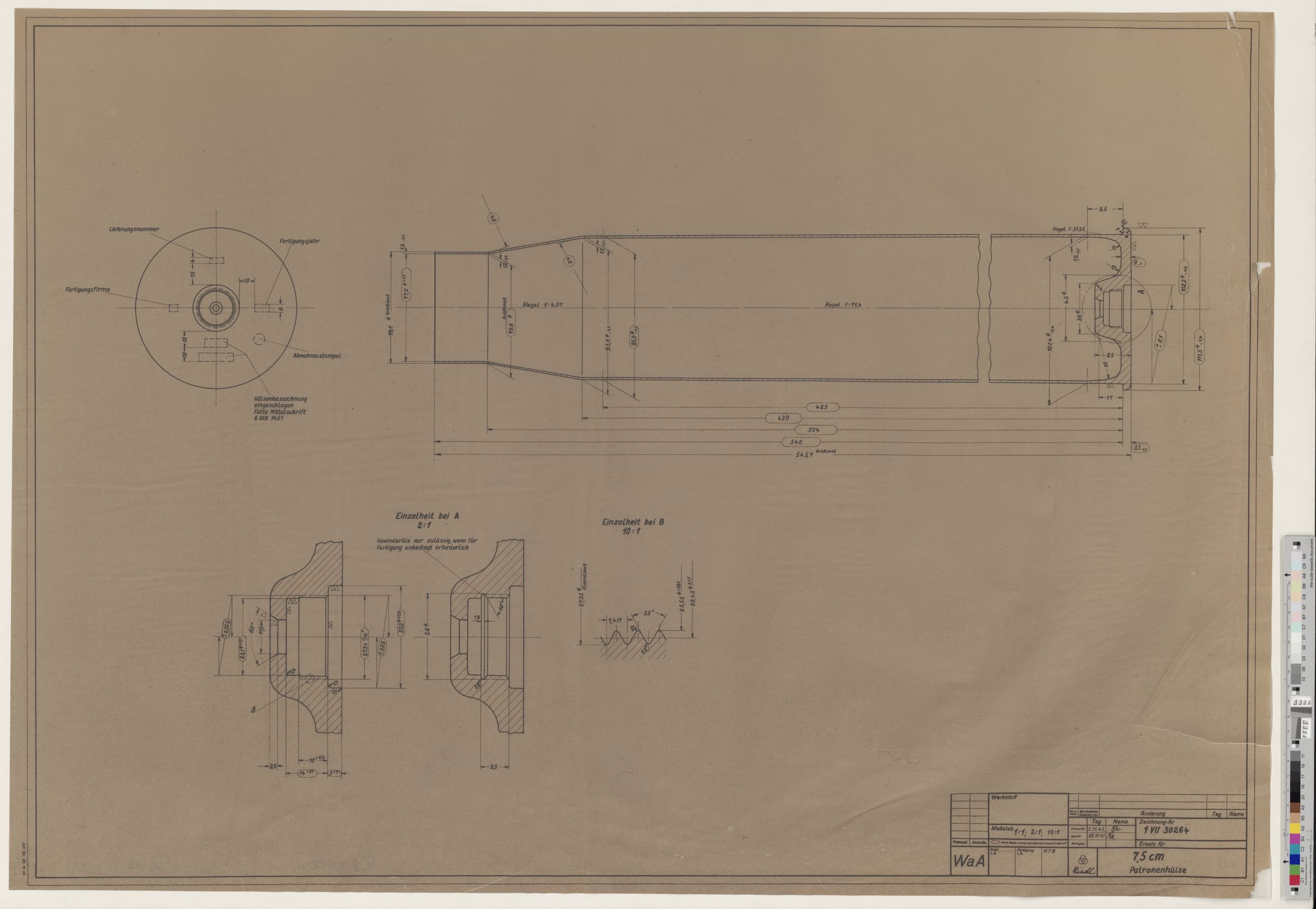
Caliber: 75/55mm


Fire Rate: 20 rpm
Single Shot, Vertical Breechblock
Muzzle velocity: 900 - 1260m/s
Weight: 650 kg
Mounting: Main Tank gun, Field Gun
Ammo Types: Apcr, Apbc, He


Ap:


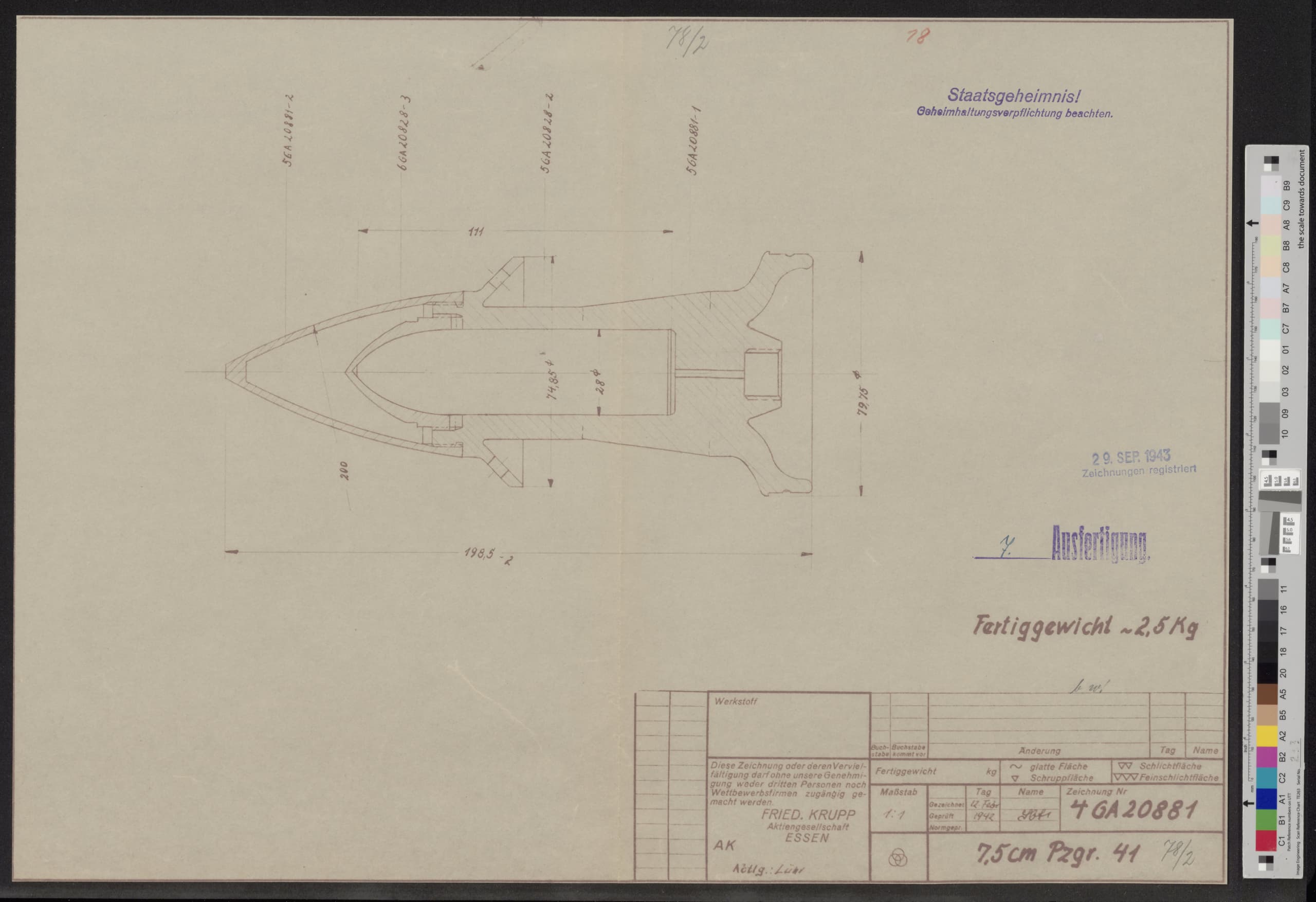


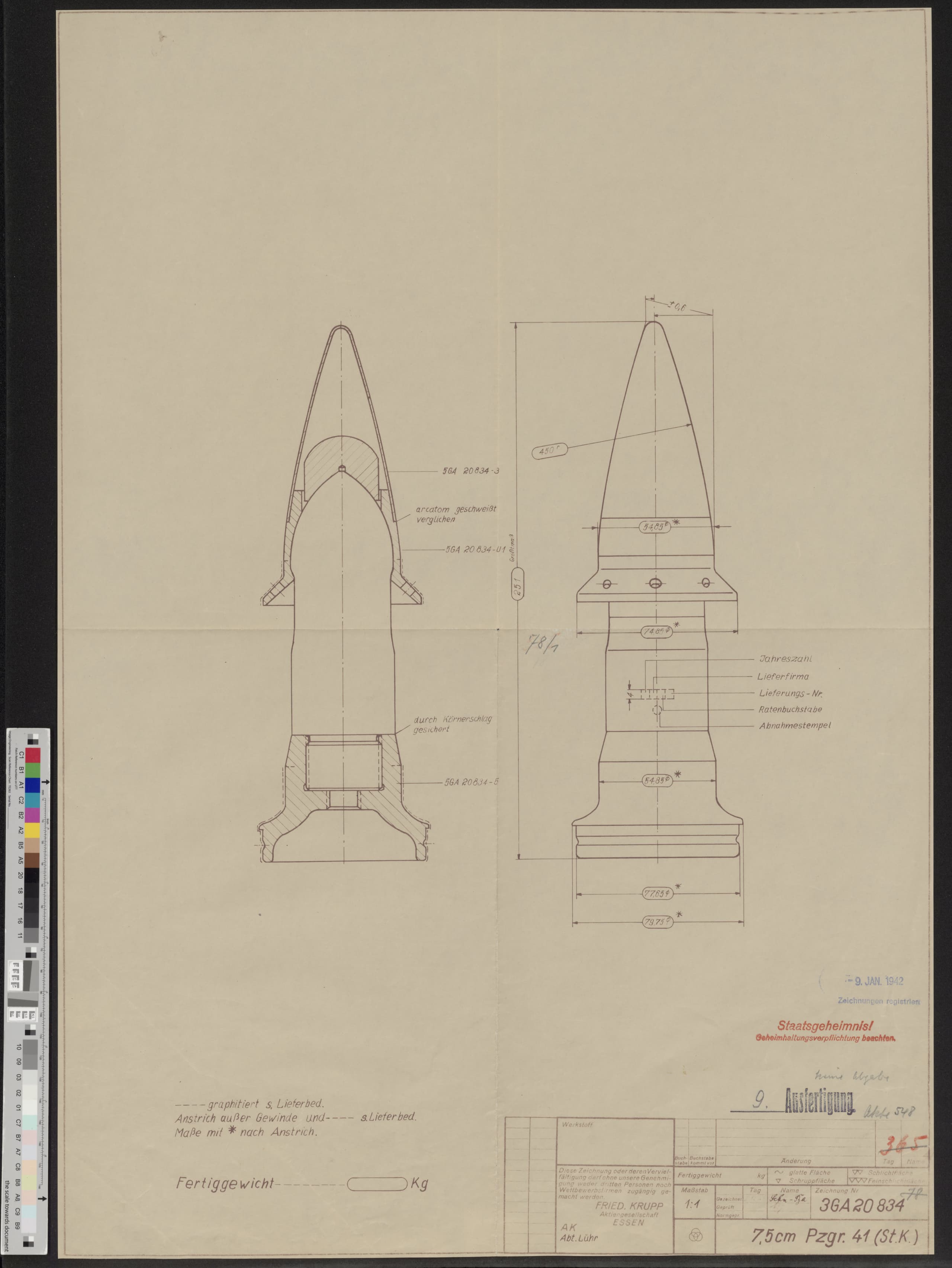

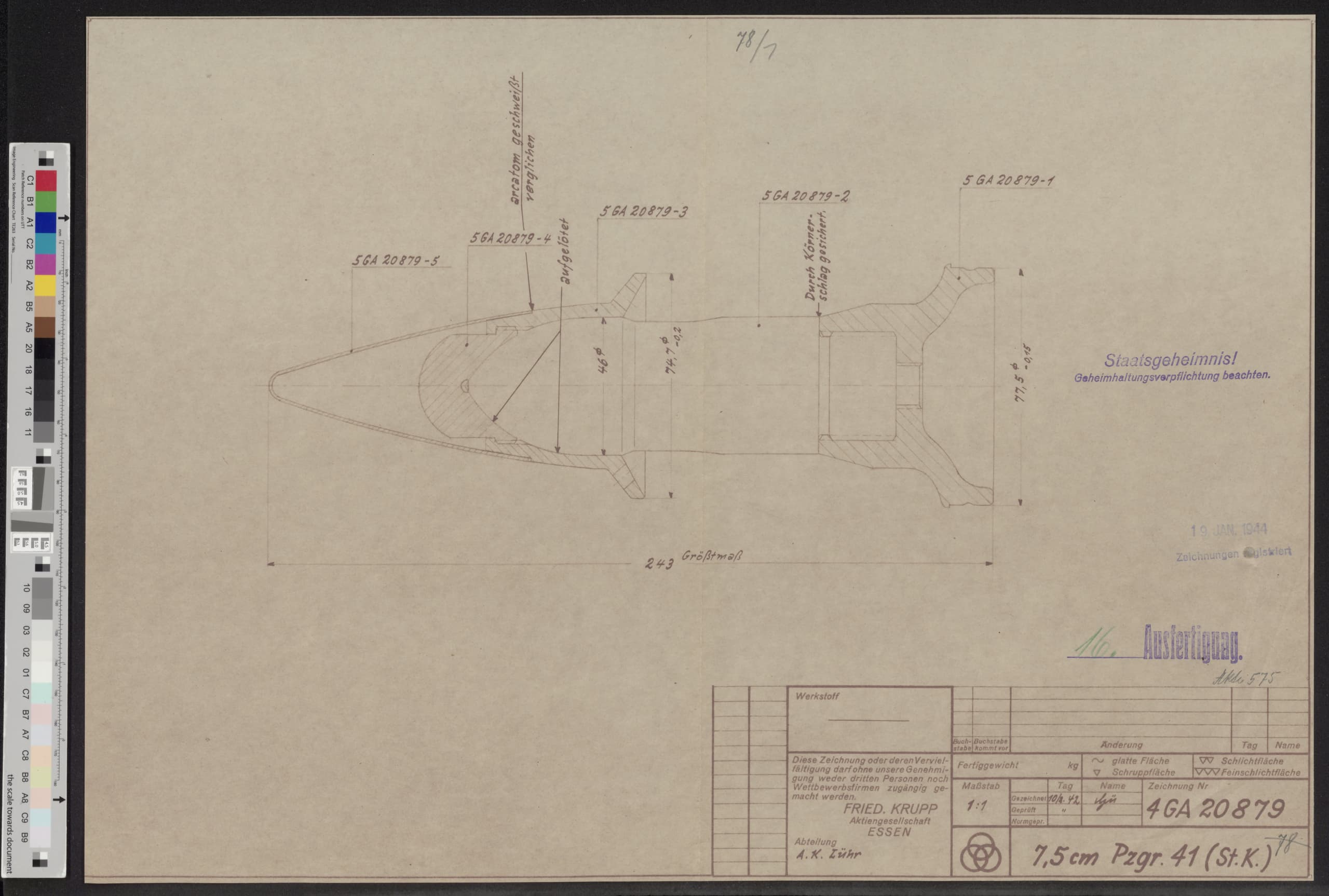


Pzgr.41/1 (Apcr) 3,1kg 28x140mm 1,35kg Core 1170-1190m/s 247mm/10m
A different design using a longer (140mm) core resulting in a heavyer shell for longer range and better penetration. (1190m/s by russian tests.)


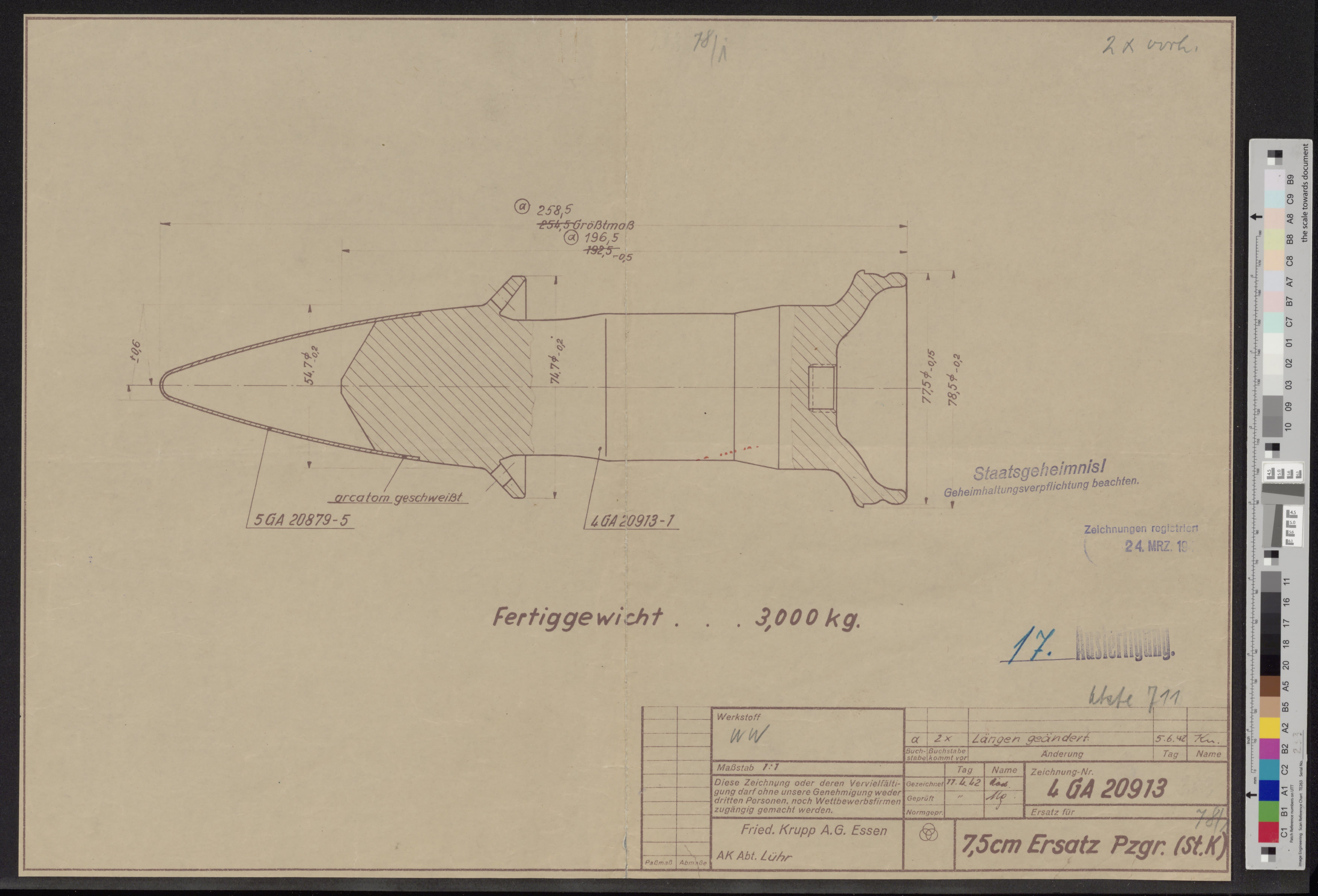
Pzgr.41(W) (Apbc) 2,5kg Solid 1230/1260m/s 182mm/10m
Made from Softsteel, pushes through instead of piercing, more effective against harder armor.


He:


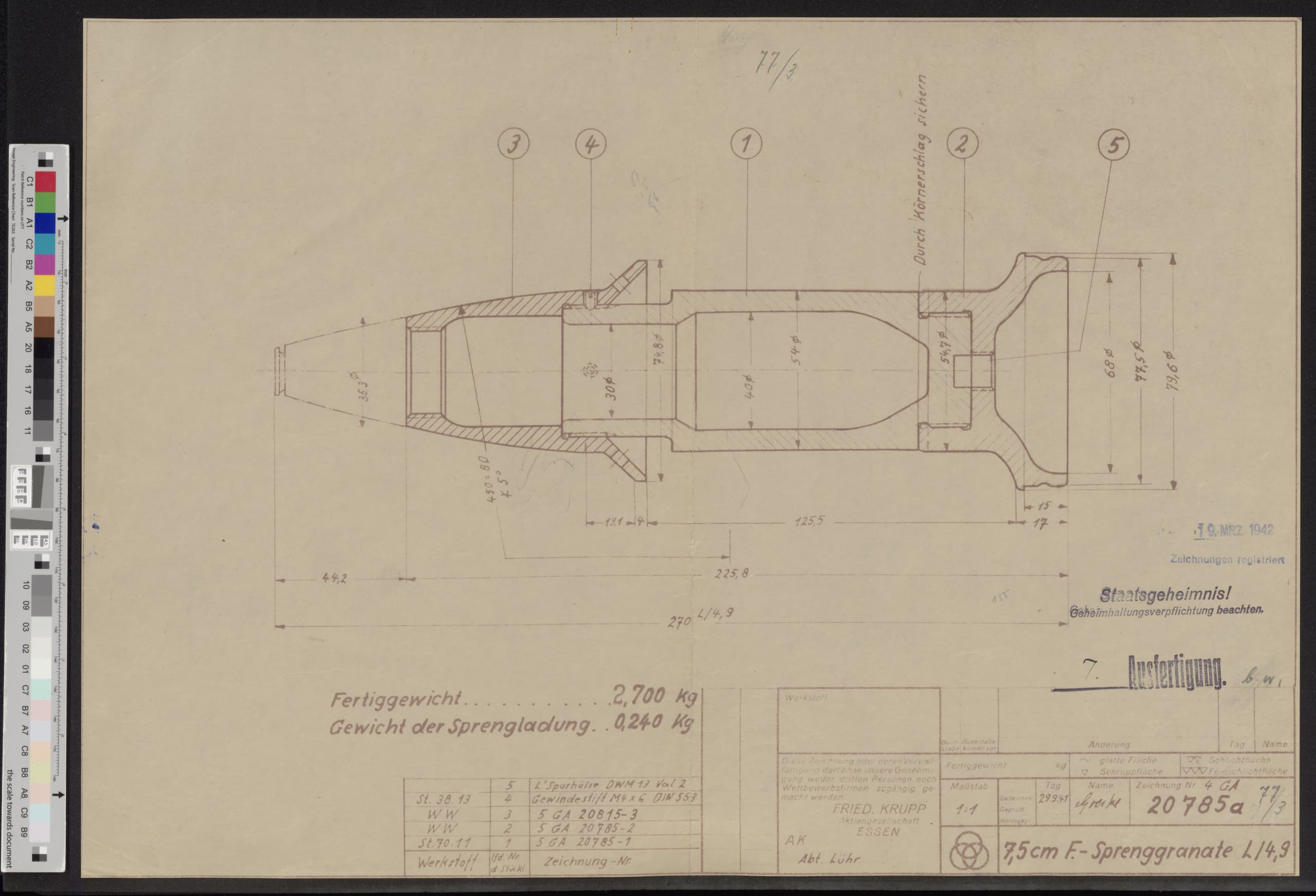
7,5 cm KwK 40 L/43 / L/48 (And other versions)
Pictures:(Click to show)


The 7,5 cm KwK 40 L/43 and later L/48 (along its other models such as StuK 40, Pak 39 and K. 40) were created under the requirement to reform the Pak 40 into a Tank adapted version and was the successor to the K. L/41, by taking the Pak 40s Barrle and combinating it with a new breech based on the L/41s gun with a new 495mm cartrige. It was a very versitale and powerfull gun for its time and quite well known to history. Starting its life with the L/43 barrle (The length difference of L/46 → L/43 comes from the shorter breech as the casing was only 495mm instead of 714mm, the rifleled part is the same) and was later extended to L/48 improving performance while also reducing the constant pressure and thus extending barrle life. Through the years they have recived different loadings resulting in different velocitys for the same gun, as the charge was increased in the mid life and reduced again and kept a bit lower to further increase barrle life.
Caliber: 75mm
Ammo: 75x495mmR

Fire Rate: 15 rpm
Single Shot, Vertical Breechblock
Muzzle velocity: 450 - 750 / 770 - 930 / 950 m/s (L/43) and 450 - 770 / 792 - 990m/s (L/48)
Weight: 750 kg
Mounting: Main Tank gun, train turret
Ammo Types: Apcbc, Apcr, He, Smoke, Heat
Ap:
Pzgr.39 (Apcbc) 6,8kg 17g H.10 (28,9) 770/792m/s 137-152mm/10m
(British Tests showed for the L/48 Guns up to 2655 fps (809m/s))
L/43 is 750/770 m/s


Pzgr.40 (Apcr) 4,1kg 28x111mm 0,91kg Core 970/990m/s 172mm-192mm/10m
L/43 is 950/970 m/s


Pzgr.40(W) (Apbc) 4,1kg solid 970 / 990m/s 119-132mm/10m
(Used till 1000m as cheaper alternative to Pzgr.39 and Pzgr.40, better velocity made it easyer to aim, flat block face meant its a bit better against angle, its made from softsteel, deforms instead of penetrates armor, better against harder armor. There is a difference between Pzgr.40(W) and Pzgr.40 (Üb).)
L/43 is 950/970 m/s


Gr.38 Hl (Heat (No Tracer)) 4,4 kg 570,2g H.5+Fp.02 (969,34g TnTa) 450 m/s 52-55mm/10m
Gr.38 Hl/A (Heat (No Tracer)) 4,8 kg 399g H.5+Fp.02 (678,3g TnTa) 450 m/s 81mm/10m
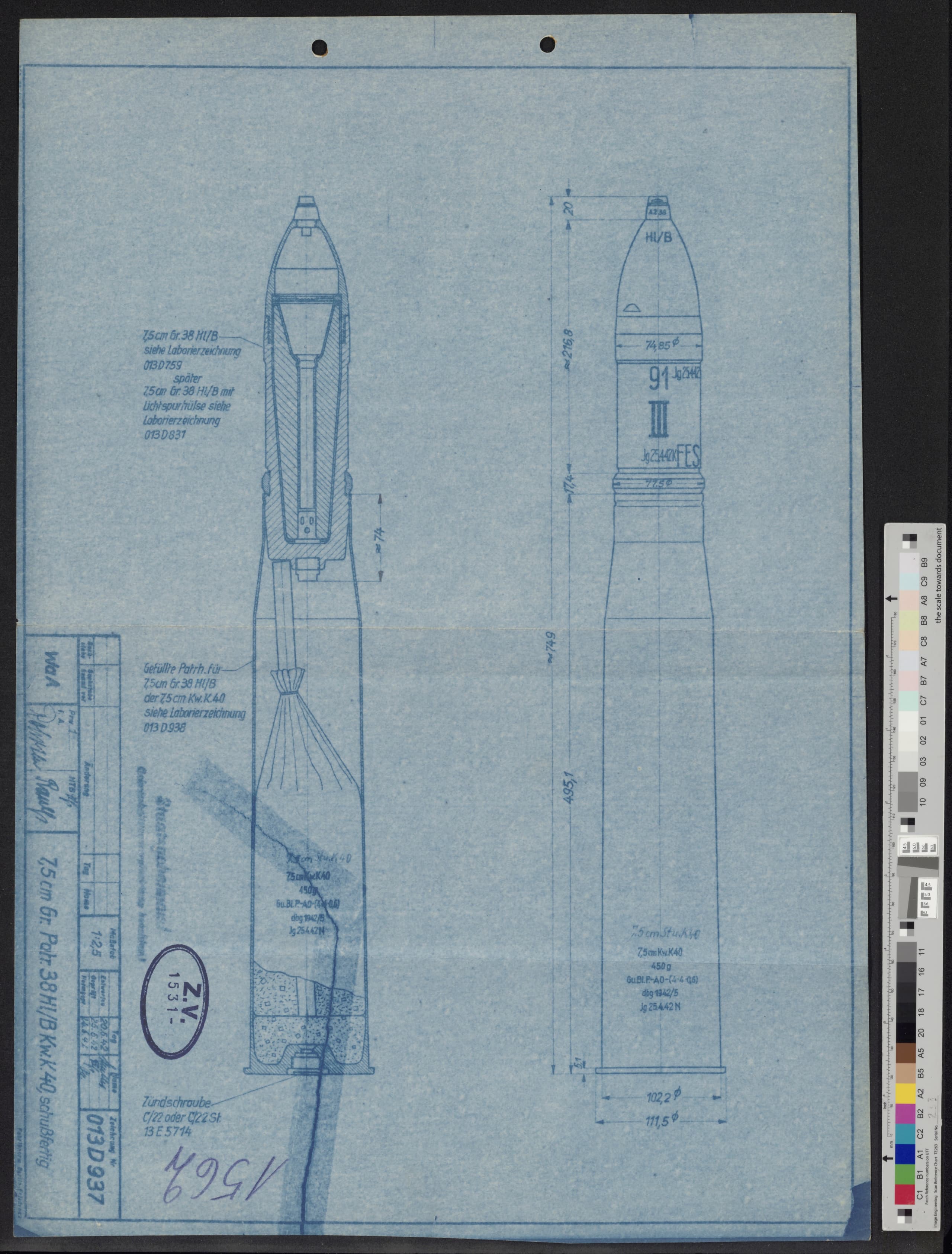
Gr.38 Hl/C (Heat) 4,8 kg 515 g H.10 (875,5g TnTa) 450 m/s 115mm/all
(Early no tracer, implemented during production.)


He:
Sprgr.34 (He (No Tracer)) 5,74 kg 725g Fp.02 und Np.10 (928g TnTa) 550 m/s
Historic Penetration 52/10m and 47mm/500m


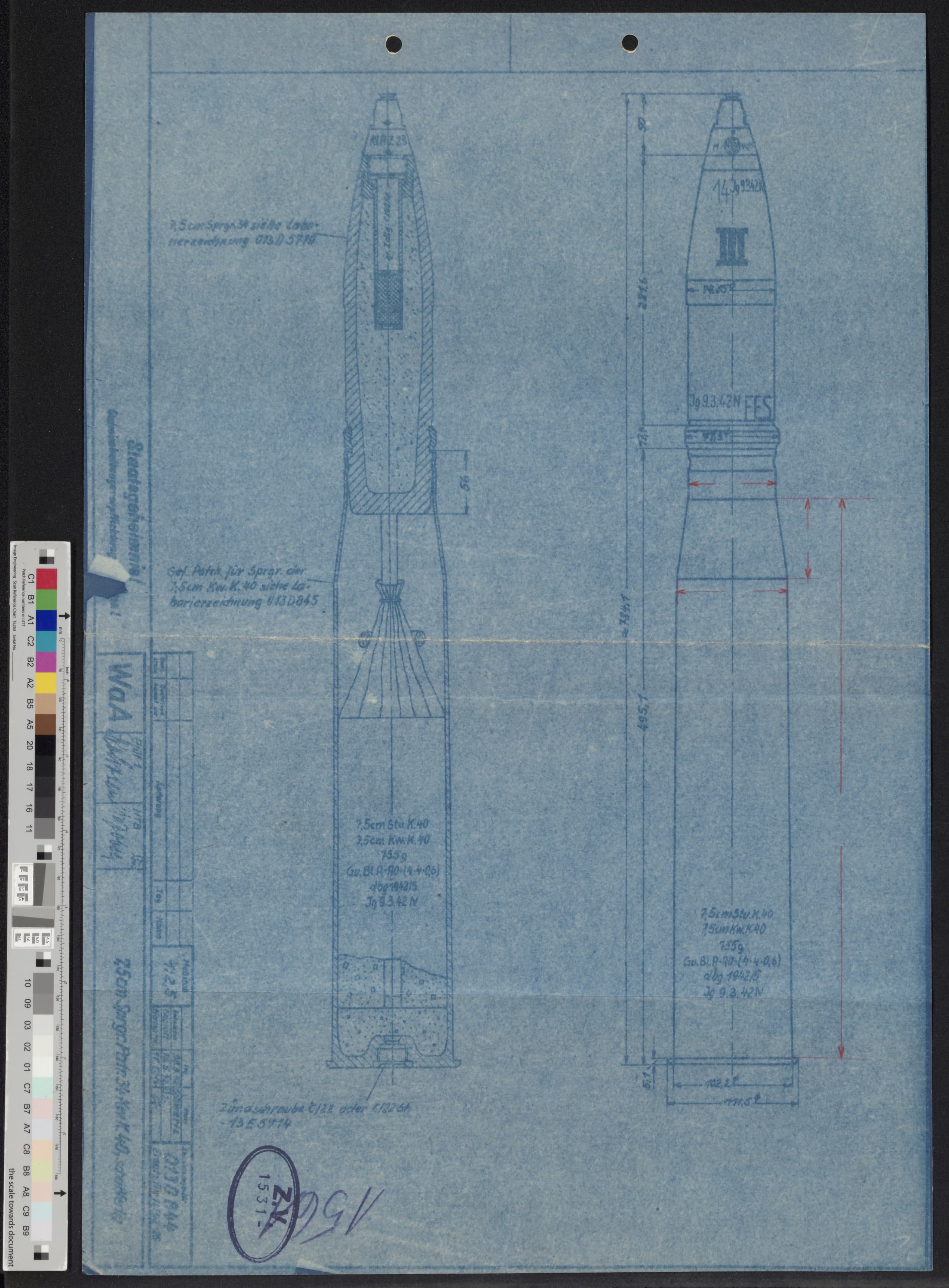
Utility:
K.Gr. Rot Nb (Smoke (No Tracer)) 6,2 kg 95g Pent 540 m/s

7,5 cm Pak 40 L/46


The 7,5 cm Pak 40 L/46 was a new designe upon a scaled up version of the 5 cm Pak 38 L/60, which began in 1939 after Informations about new sowjet tanks reached Berlin. While its development took some time along its contender the Pak 41. In the end the Pak 40 won, which was one of the most powerfull of its caliber along with beeing a legendary gun like the 8,8 cm Flak. Later it was taken into considderation to mount it into tanks, however duo to its long casings of 714mm and long recoil length a new development in form of the KwK 40 was needed. It was used effectively till the end of the war, with even late war development of ammo such as the Gr. 38 Hl/C mit KLW (Klappleitwerk / Basically HEAT-FS)
Caliber: 75mm
Ammo: 75x718mmR

Fire Rate: 15 rpm
Single Shot, Vertical Breechblock
Muzzle velocity: 450 - 990m/s
Weight: 1425 kg
Mounting: Main Tank gun, train turret
Ammo Types: Apcbc, Apbc, Apcr, He, Smoke, Heat
Ap:
Pzgr.39 (Apcbc) 6,8kg 17g H.10 (28,9) 770/792m/s 152mm/10m
(Later by Tactical and Technical Trends No.21-30 US War Department, the velocity was even increased to 2800fps/853,44m/s, to be in line with the 8,8 cm Flak in terms of Penetration.)


Pzgr.40 (Apcr) 4,1kg 28x111mm 0,91kg Core 990m/s 192mm/10m

Pzgr.40(W) (Apbc) 4,1kg solid 990m/s 132mm/10m
(Used till 1000m as cheaper alternative to Pzgr.39 and Pzgr.40, better velocity made it easyer to aim, flat block face meant its a bit better against angle, its made from softsteel, deforms instead of penetrates armor, better against harder armor. There is a difference between Pzgr.40(W) and Pzgr.40 (Üb).)

Gr.38 Hl (Heat (No Tracer)) 4,4 kg 570,2g H.5+Fp.02 (969,34g TnTa) 450 m/s 52-55mm/10m
Gr.38 Hl/A (Heat (No Tracer)) 4,5 kg 399g H.5+Fp.02 (678,3g TnTa) 450 m/s 81mm/10m
Gr.38 Hl/B (Heat (No Tracer)) 4,57 kg 513g H.5 (872,1g TnTa) 450 m/s 87mm/10m
Gr.38 Hl/C (Heat) 4,8 kg 515 g H.10 (875,5g TnTa) 450 m/s 115mm/10m
(Early no tracer, implemented during production.)


He:
Sprgr.34 (He (No Tracer)) 5,74 kg 725g Fp.02 und Np.10 (928g TnTa) 550 m/s
Historic Penetration 52/10m and 47mm/500m


Utility:
K.Gr. Rot Nb (Smoke (No Tracer)) 6,2 kg 95g Pent 540m/s
7,5 cm KwK 42 L/70


The 7,5 cm KwK and Pak 42 L/70 was a further development upon the 7,5 cm Flak L/60, which was developed into the legendary 8,8 cm Flak 18 L/56. The 7,5 cm Flak L/60 as is was seen as not powerfull enove for the Flakrole and it was decided to increase the diameter to 88mm, however with a velocity of 860m/s it was allready seen as powerfull in a different category, for anti tank. As such it was late or planned to mount it into the Tiger I H2, however with even further improved performance by lengthening the barrle to L/70. It was used on the Panther, Panzer IV/70 (A) and (V) as well as on a Prototype for 360° Fire on a Sd.Kfz.251 Ausf.B Teilgepanzert. It was an incedibly powerfull gun for its calliber and used as basis for 75/76mm guns after the war for example the french SA 50.
Caliber: 75mm


Fire Rate: 15 rpm
Single Shot, Vertical Breechblock
Muzzle velocity: 700 - 1120m/s
Weight: 1000 kg
Mounting: Main Tank gun
Ammo Types: Apcbc, Apcr, He
Ap:


Pzgr.40/42 (Apcr) 4,75 kg 28x121mm 1,12kg Core 1120m/s 258mm/10m


He:
Sprgr.42 (He (No Tracer)) 5,74 kg 725g Fp.02 und Np.10 (928g TnTa) 700m/s
Historic Penetration 72/10m and 61mm/500m
(Couldnt find the correct picture, however its simply a Sprgr. 34 with a 2nd driving band)


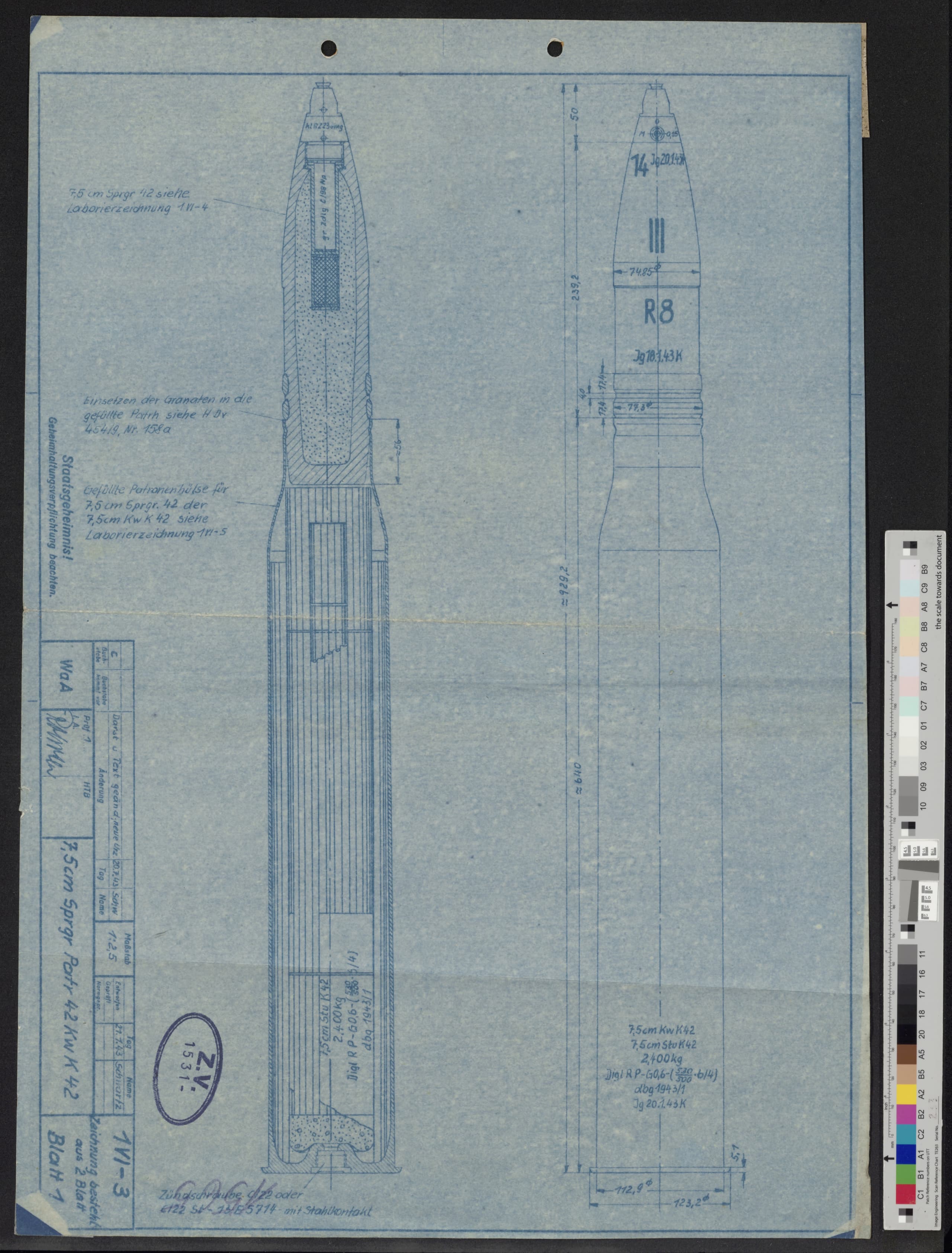
7,62 cm Fk 36(r) L/50
Pictures:(Click to show)


The 7,62 cm Fk 36(r) L/50 was the russian captured F-22 gun, used as is as well as with own production ammo. It was used as a Field Gun (Feldkanone) as well as on the Sd.Kfz.6/3.
Originally the F-22 was developed to use a bigger casing than the ZiS-3 gun, however for better supply chains it was choosen against that and used the same ammo, however cince it was build with still a stronger breech, germany modified those into the 7,62 cm Pak 36 (r) L/50by giving them a new german muzzle brake as well as drilling out the chamber to accept 714mm casings (like the Pak 40), to achiv greater velocity. In that form they were also mount on the Marder II and III.
Caliber: 76,2mm
Ammo: 76,2x385mmR

Fire Rate: 15 rpm
Single Shot, Vertical Breechblock
Muzzle velocity: 455 - 850m/s
Weight: 1620 kg (Combat ready)
Mounting: Main Tank gun, Field Gun
Ammo Types: Apcbc, Apcr, He, Heat
Ap:
Pzgr.39 Rot (Apcbc) 7,6 kg 20g H.10 630/660m/s 117mm/10m

Pzgr.39 (Apcbc) 7,1 kg 80g Fp.02 and Np.10 (102,4 g TnTa) 660/695m/s 115mm/10m

Pzgr.40 (Apcr) 4,15 kg 28x111mm 0,91kg Core 850 m/s 155mm/10m

Gr.38 Hl/C (Heat) 5,05 kg 515 g H.10 (875,5g TnTa) 455m/s 115mm/10m
(Early no tracer, implemented during production.)
Just a adapted 75mm Gr. 38
He:
Sprgr.39 (He) 6,25 kg 585g Fp.02 and Np.10 (748,8g TnTa) 550 m/s

7,62 cm Pak 36(r) L/50
Pictures:(Click to show)


The 7,62 cm Fk 36(r) L/50 was the russian captured F-22 gun, used as is as well as with own production ammo. It was used as a Field Gun (Feldkanone) as well as on the Sd.Kfz.6/3.
Originally the F-22 was developed to use a bigger casing than the ZiS-3 gun, however for better supply chains it was choosen against that and used the same ammo, however cince it was build with still a stronger breech, germany modified those into the 7,62 cm Pak 36 (r) L/50 by giving them a new german muzzle brake as well as drilling out the chamber to accept 718mm casings (like the Pak 40), to achiv greater velocity. In that form they were also mount on the Marder II and III.
Caliber: 76,2mm
Ammo: 75x718mmR
Fire Rate: 15 rpm
Single Shot, Vertical Breechblock
Muzzle velocity: 455 - 990m/s
Weight: 1710 kg (Combat ready)
Mounting: Main Tank gun, Field Gun
Ammo Types: Apcbc, Apcr, He, Heat
Ap:
Pzgr.39 Rot (Apcbc) 7,6 kg 20g H.10 720/740m/s 141mm/10m


Pzgr.39 (Apcbc) 7,1 kg 80g Fp.02 and Np.10 (102,4 g TnTa) 740/760m/s 134mm/10m
Pzgr.40 (Apcr) 4,15 kg 28x111mm 0,91kg Core 960/990 m/s 193mm/10m
Gr.38 Hl/C (Heat) 5,05 kg 515 g H.10 (875,5g TnTa) 455m/s 115mm/10m
(Early no tracer, implemented during production.)
Just a adapted 75mm Gr. 38
He:
Sprgr.39 (He) 6,25 kg 585g Fp.02 and Np.10 (748,8g TnTa) 550 m/s


8,8 cm
8,8 cm KwK/Flak 36 L/56


The 8,8 cm KwK 36 L/56 was based on the Flak 18 L/56, which was based on the 7,5 cm Flak L/60, after it was found to be lacking in diameter and payload. The Flak 18 allready had prooven itself in the Spanish Civil war where it was effectively used against all tanks (tho still all quite light) and again in the french campain when it was even placed on 2 different Halftrack basis of Sd.Kfz.8 and 9.
Its combination of projectile with great effect and penetration duo to good velocity made it usable to effectively fight strong positions, bunkers and tanks as well as to be used as field artillery.
Caliber: 88mm
Ammo: 88x570mmR

Fire Rate: 10 rpm
Single Shot, Vertical Breech block
Muzzle velocity: 600 - 930 m/s
Weight: 1000kg (?) (Flak Combat ready 7,407 kg)
Mounting: Field Mount, Main Tank gun, Self propelled mount
Ammo Types: Apcbc, Apcr, He, Heat
Ap:

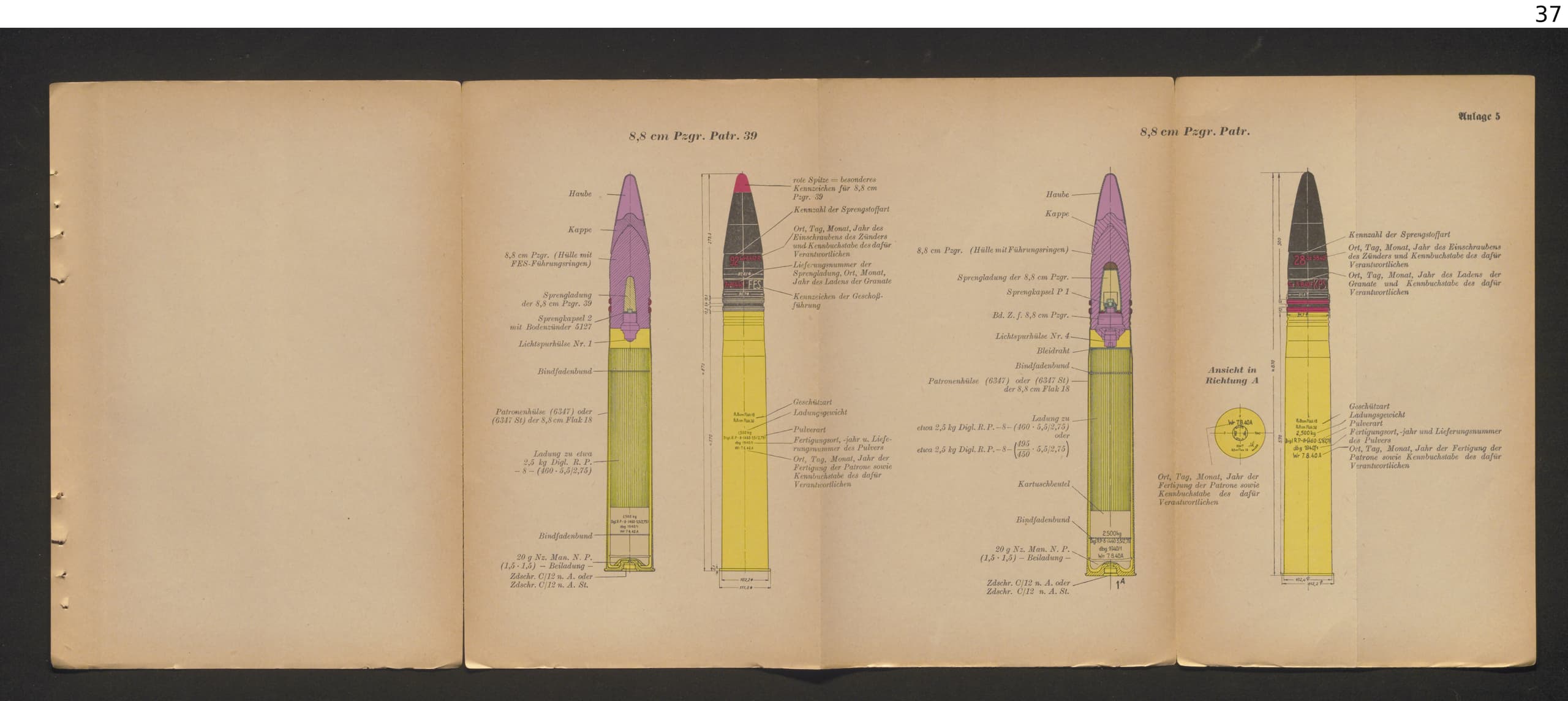


Pzgr.40 (Apcr) 7,3 kg 35x140mm 1,93 kg core 930m/s 211mm/10m


Gr.39 Hl (Heat) 7,64 kg 650g H.10 (1,1kg) 600 m/s 110mm/all


He:

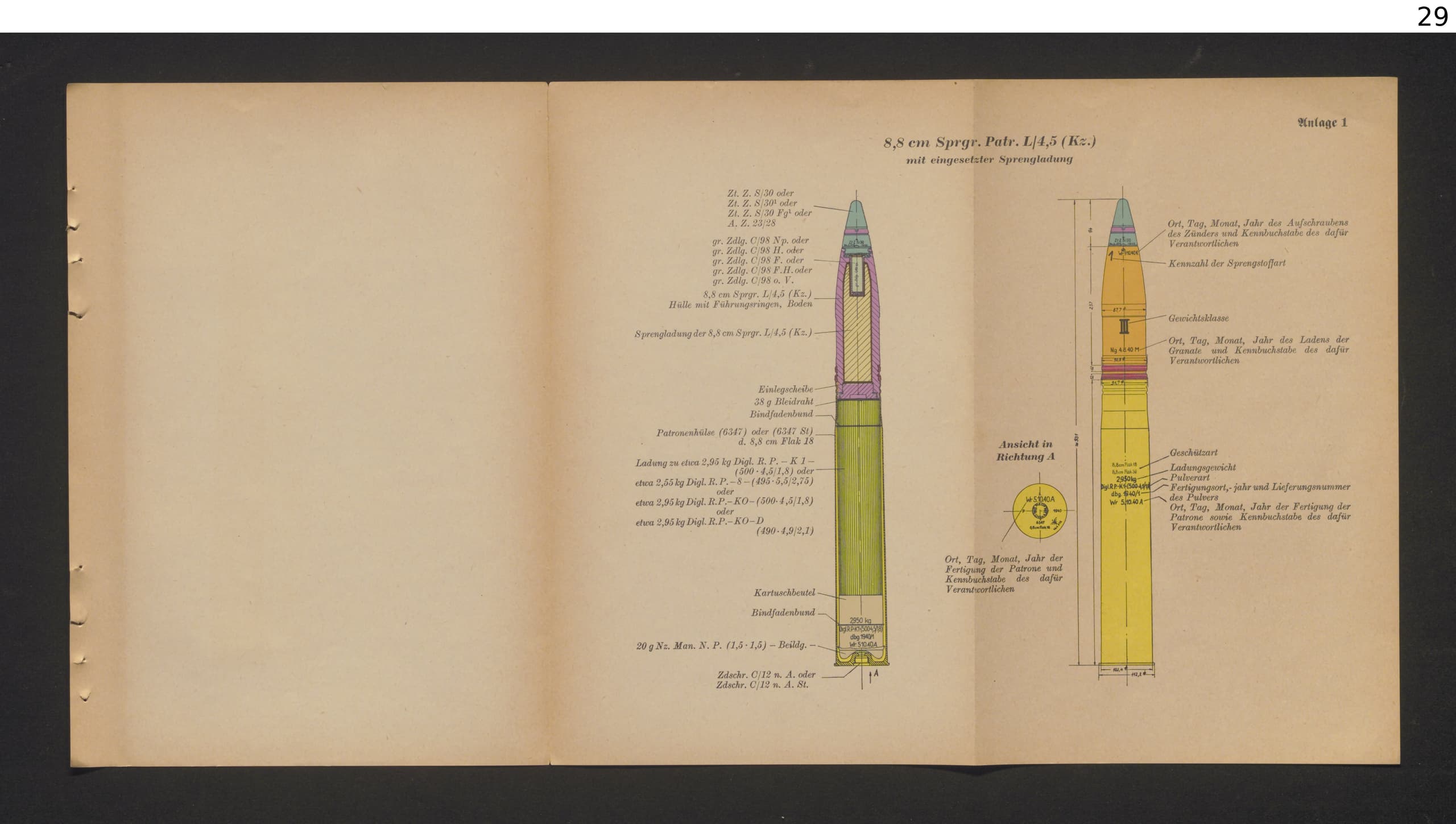


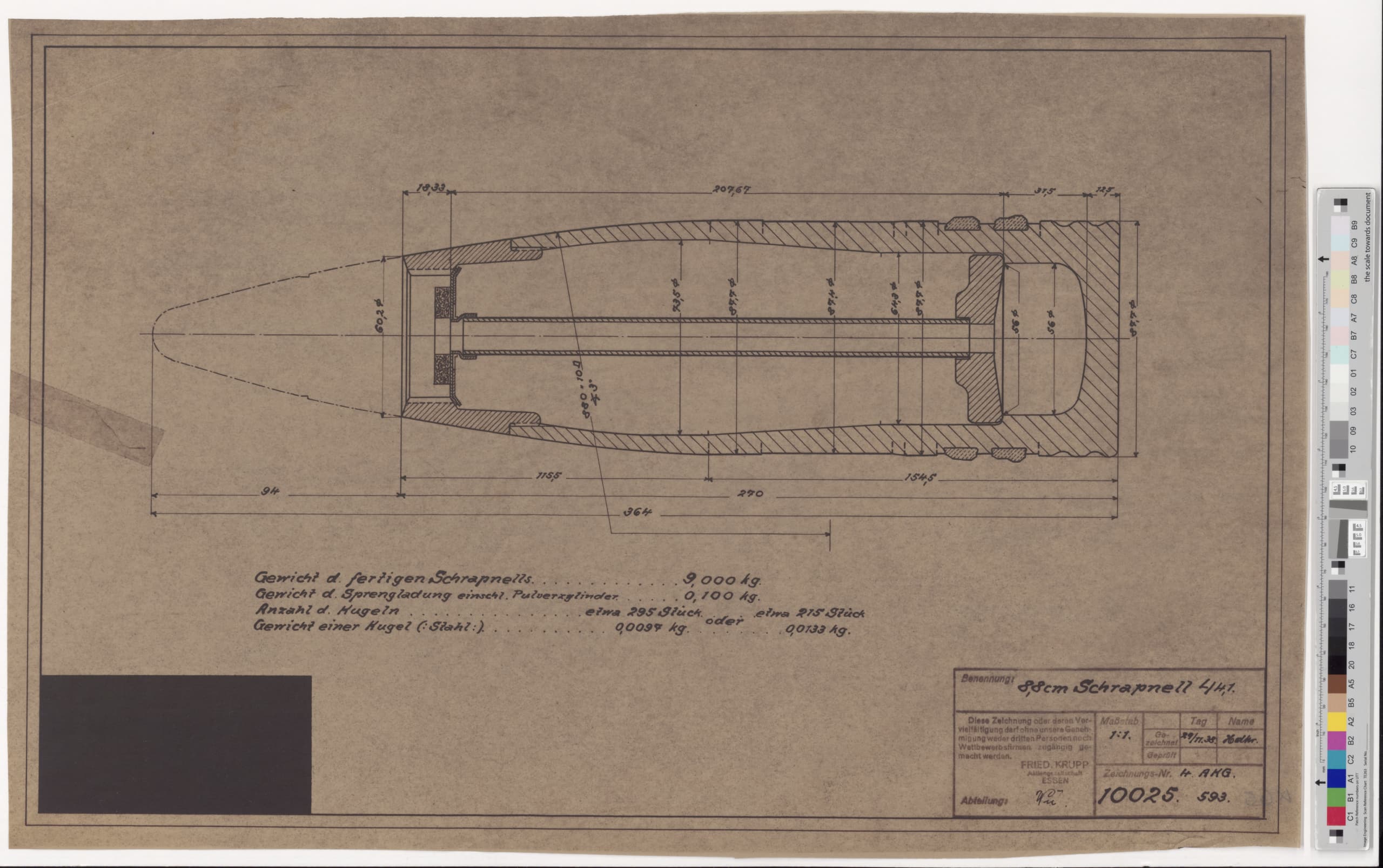
Schr.Gr. L/4,1 (Shrapnell-TF (No Tracer)) 9kg 100g Blackpowder 820/840m/s
Either 295 9,7g or 215 13,3g Steel balls.
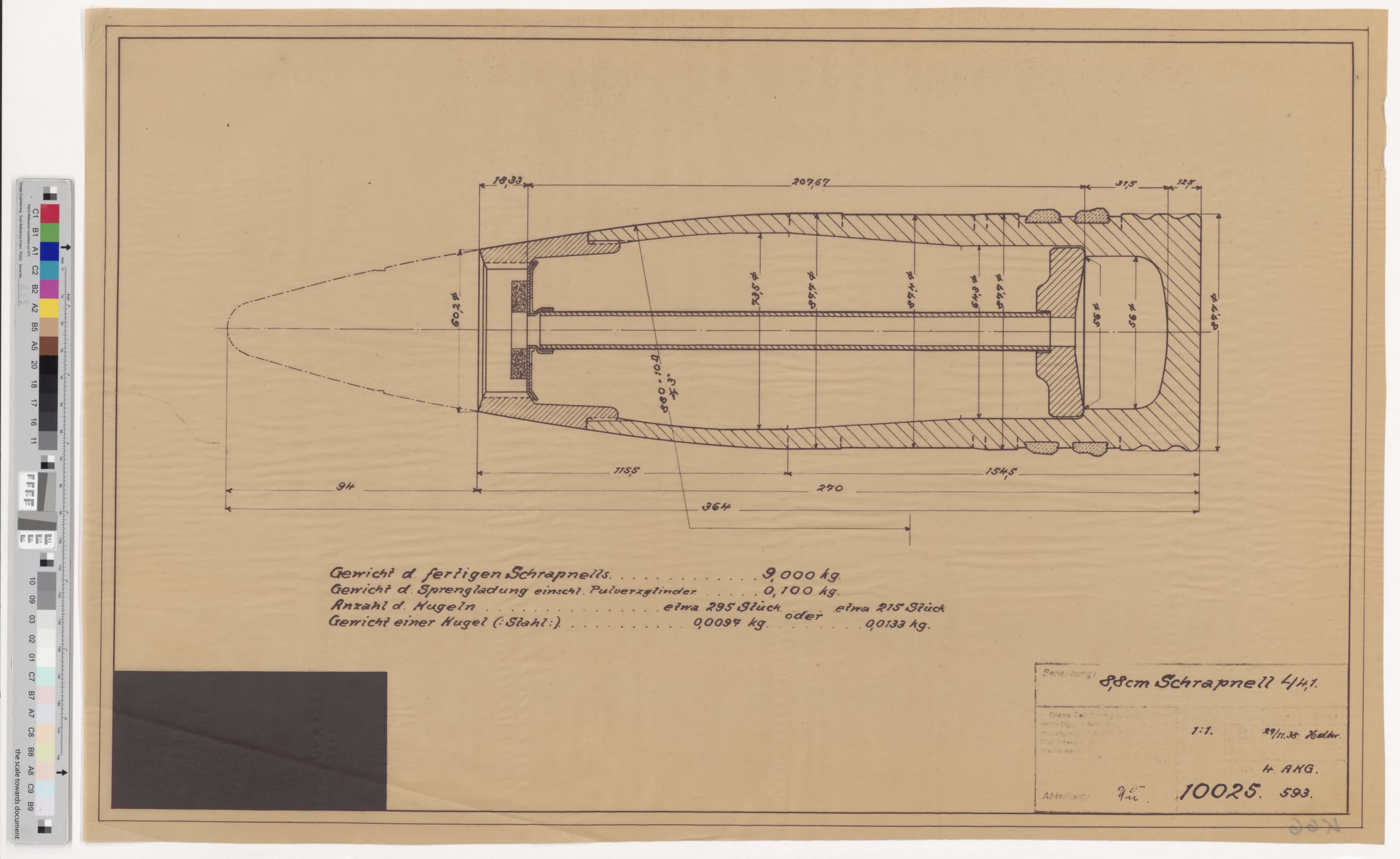
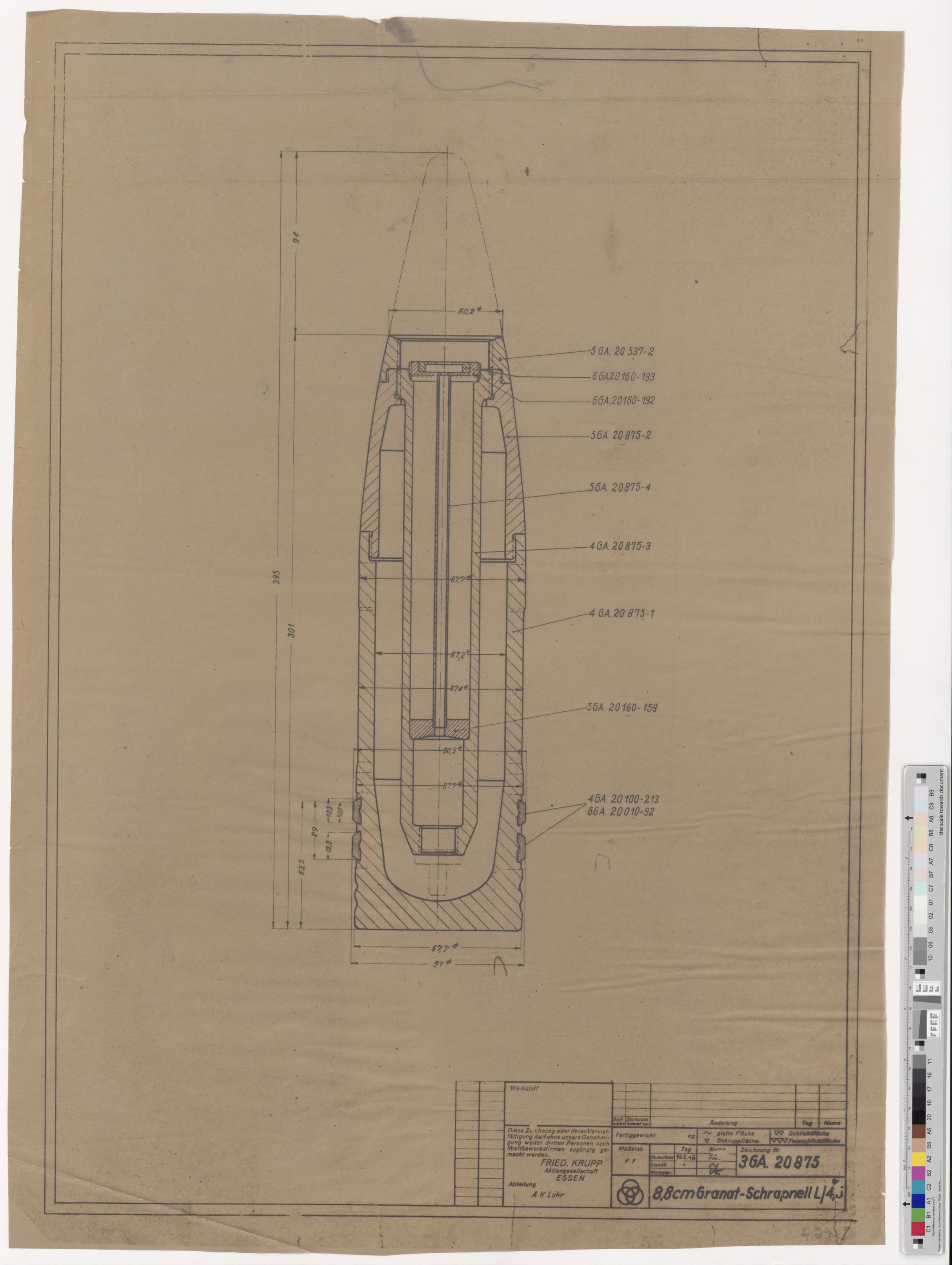
Br.Schr.Gr. (Shrapnell Incendary-TF (No Tracer)) 9kg Filler see inside Spoiler 820/840m/s
Expelling Charge: 56g Smokeless powder
Brusting Charge: 114g Amatol
Incendary Pelets: 72x of 30mm x 15mm
Made of Barium Nitrate, Magnesium Alloy, Alluminium Alloy, Acid Insoluble


Developmental:

8,8 cm KwK/Pak 43 L/71


The 8,8 cm KwK 43 L/71 (and Pak) where if not the most powerfull dedicated AT gun, used after the war as a standart for protection against in new tank designes. It was a development upon the 8,8 cm Flak 41 L/74, which was a new requirement to create a Flak with 1000m/s and increased fire rate. The Tiger I was to be equipped with a L/71 gun (1 produced) and it was taken as the main armarment of the Tiger II as well as a couple Tank destroyers and self propelled guns. The Pak 43 was created by mounting the KwK 43 on the mount of the LeFH 18 and giving it the wheels of the s.F.H. 18.
Caliber: 88mm
Ammo: 88x822mmR

Fire Rate: 10 rpm
Single Shot, Vertical Breech block
Muzzle velocity: 600 - 1130 m/s
Weight: 3650kg (?) (Pak 43)
Mounting: Field Mount, Main Tank gun, Self propelled mount
Ammo Types: Apcbc, Apcr, He, Heat
Ammo Sheet:(Click to show)

Ap:
Pzgr.39/43 (Apcbc) 10,16kg 64g H.10 1000/1020m/s 237-244mm/10m
(The drawings weight is wrong, other documents say 10,2 kg, the Schusstafel mentiones the 39-1 with 10,16kg)

Pzgr.39/1 (Apcbc) 10,2kg 64g H.10 1000/1020m/s 238-245mm/10m

Pzgr.40/43 (Apcr) 7,3 kg 35x140mm 1,93 kg core 1130m/s 279mm/10m
Gr.39 Hl (Heat) 7,64 kg 650g H.10 (1,1kg) 600 m/s 110mm/all
He:
Sprgr.43 (He (No Tracer)) 9,4kg 1kg Fp.02 and Np.10 750m/s 14mm/all

Developmental:
Continued in Part 2 High Caliber 10,5 cm - 21 cm guns below, duo to Comment size limit. As well as WW1
Sources in 2nd Post because of the sheer size.