History
Background
After Singapore’s independence in 1965, the predecessor to the Republic of Singapore Air Force, the Singapore Air Defence Command, was formed on 1 September 1968. While it was in its infancy, Singapore relied on the United Kingdom’s Royal Air Force for air defense, and the SADC was equipped with British aircraft such as the Hawker Hunter and English Electric Canberra for training.
Later, as a consequence of the Suez Crisis, all British presence, including Royal Air Force units, was withdrawn from Singapore and Asia by September 1971. The SADC became responsible for maintaining Singapore’s air defense, taking over the former UK air bases and air defense installations.
It became necessary to transform the SADC into a fully functional air force branch, so Singapore procured A-4 Skyhawk fighter-bombers and Shorts Skyvan utility aircraft to reinforce its fleet, along with British equipment. In 1973, the SADC began receiving 44 refurbished ex-US Navy A-4Bs. After the overhaul, these were designated A-4S, along with three airframes designated TA-4S (two-seat trainers). The A-4S fleet was upgunned with a pair of 30 mm DEFA cannons, replacing the original US Navy 20 mm Colt Mk 12 cannons. Other upgrades included new avionics, expanded hardpoints, and a brake parachute.
In 1975, the SADC was renamed the Republic of Singapore Air Force on 1 April. In 1980, it placed an order for a second batch of 70 Skyhawk airframes, a mix of ex-US Navy A-4Bs and A-4Cs. Refurbished A-4Cs in Singaporean service were designated A-4S-1 and TA-4S-1 (two-seat trainers), though these retained the original 20 mm Colt Mk 12 cannons.
Enter the Super Skyhawk
By 1985, it had become a growing concern within the RSAF that the aging J65 engine in the A-4 fleet was contributing to increased unreliability and accidents. It became clear that the engine was approaching the end of its service life, leading the RSAF to decide on re-engining the A-4S-1 and TA-4S-1 while further upgrading their avionics. These aircraft were fitted with the General Electric F404-GE-100D turbofan, as used in the F/A-18 Hornet, but without the afterburner. Singapore Aircraft Industries (later Singapore Technologies Aerospace) was responsible for carrying out the upgrades and extending the service life of the fleet.
The first upgrade phase involved fitting the A-4S-1 fleet with the F404-GE-100D. Due to its lighter weight, the engine provided a higher power-to-weight ratio, significantly improving performance and reliability. The re-engined A-4S aircraft entered service with the RSAF in 1989, with No. 143 Squadron receiving them first, followed by 142 and 145 Squadrons.
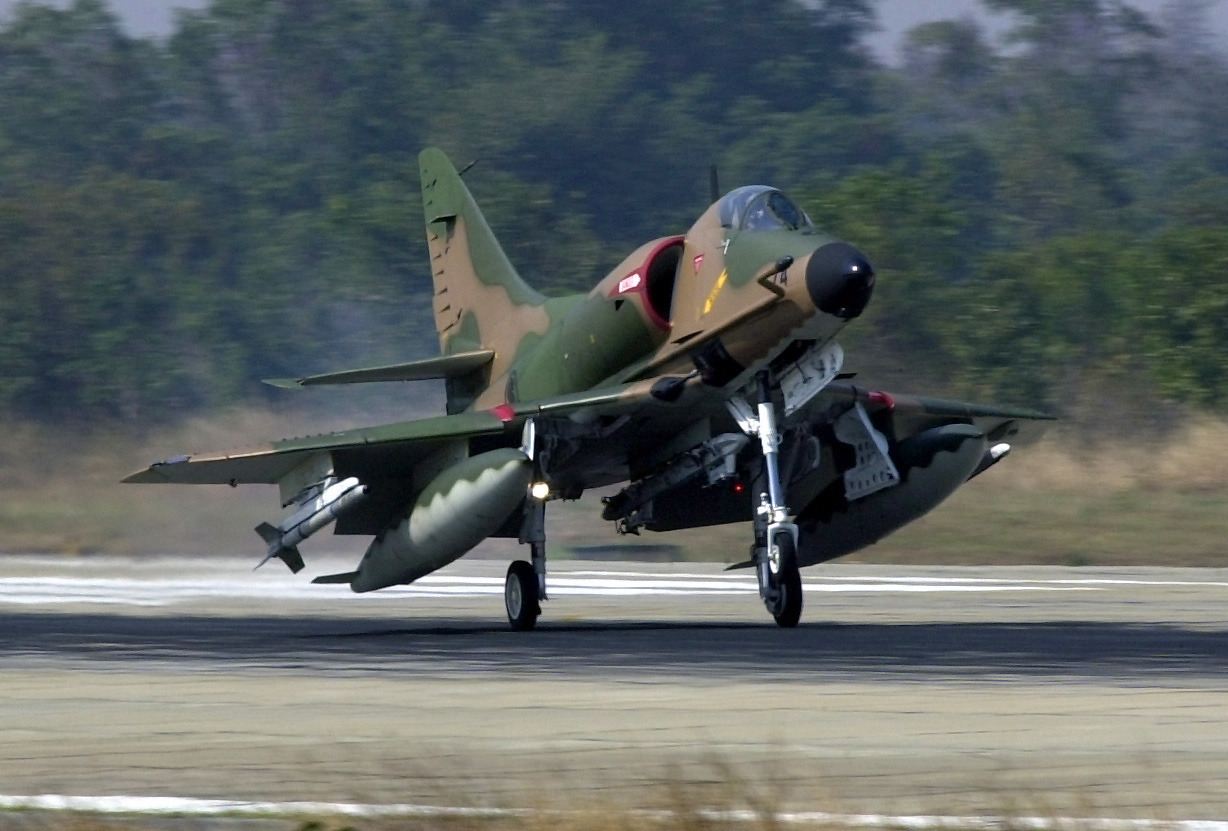
In 1991, a second upgrade was applied to the already re-engined A-4S-1 fleet, resulting in the A-4SU and TA-4SU “Super Skyhawk” redesignation. These aircraft received further avionics upgrades, including a Ferranti HUD, a Litton LN-93 laser INS, a Pave Penny laser seeker mounted in the nose, radar warning receivers, and chaff/flare countermeasures. With this upgraded avionics suite, the A-4SU could employ AIM-9P Sidewinders, AGM-65 Mavericks, and laser-guided Paveway munitions. A total of 56 A-4SU and 22 TA-4SU airframes were upgraded to the “Super Skyhawk” standard. However, the A-4SU (based on the A-4C airframe) still retained the original Mk 12 20 mm cannons.
From 1991 onward, the A-4SU served as the RSAF’s frontline strike aircraft. On 31 March 2005, the RSAF officially retired the A-4SU fleet from frontline service, with the final Skyhawk unit, No. 142 Squadron, disbanding on 1 April 2005.