Would you like to see this in-game?
- Yes
- No
0
voters
Which engine variant would you like to see implemented on the A-4E (Late)?
- 8,500-lbf J52-P-6A turbojet (initial engine)
- 9,400-lbf J52-P-8A turbojet (upgraded engine)
- Both. Start with the J52-P-6A and unlock the J52-P-8A as a modification.
- I said “No” in the first poll.
0
voters

Douglas A-4E ‘Late’ Skyhawk
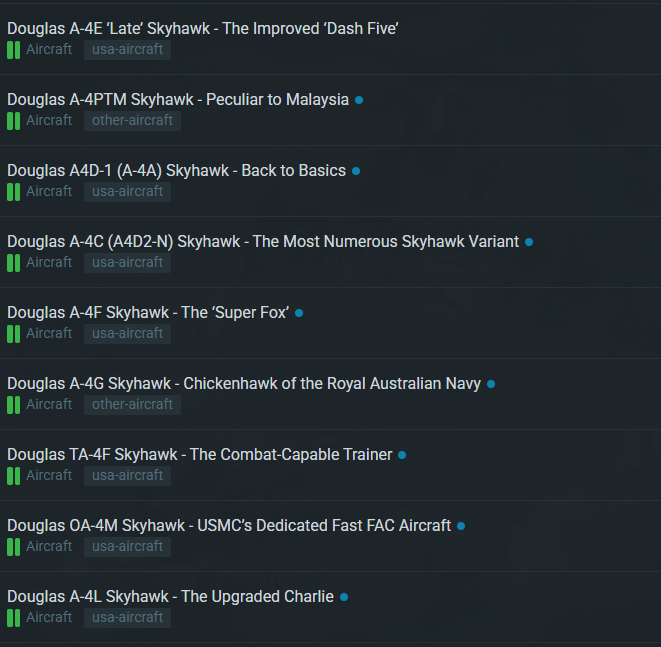
Hey everybody. I’d like to suggest a late-production model of the Douglas A-4E Skyhawk as a follow-up addition to the A-4E (Early) currently present in-game. The late-production A-4E differed visually and operationally through the addition of the avionics hump and the “cranked” in-flight refueling probe later associated with the A-4M. Depending on the airframe, it could either retain the original engine or receive the more powerful 9,300-lbf Pratt & Whitney J52-P-8A turbojet. Potentially, it could also receive access to the AIM-9D Sidewinder.

Related Suggestions
Sources
- Standard Aircraft Characteristics A-4E Skyhawk (1 July 1967)
- Squadron/Signal Publications Aircraft No. 11 - A-4 Skyhawk in Action (1973)
- A-4 Skyhawk in Detail & Scale Vol. 32 (1989)
- Douglas A-4 Skyhawk Attack and Close-Support Fighter Bomber (2005)
- A-4 Skyhawk Production History | The Skyhawk Association
- Douglas A4D-5/A-4E Skyhawk
- Douglas A-4 Skyhawk - Wikipedia
Thank you for taking the time to read my suggestion! 😃