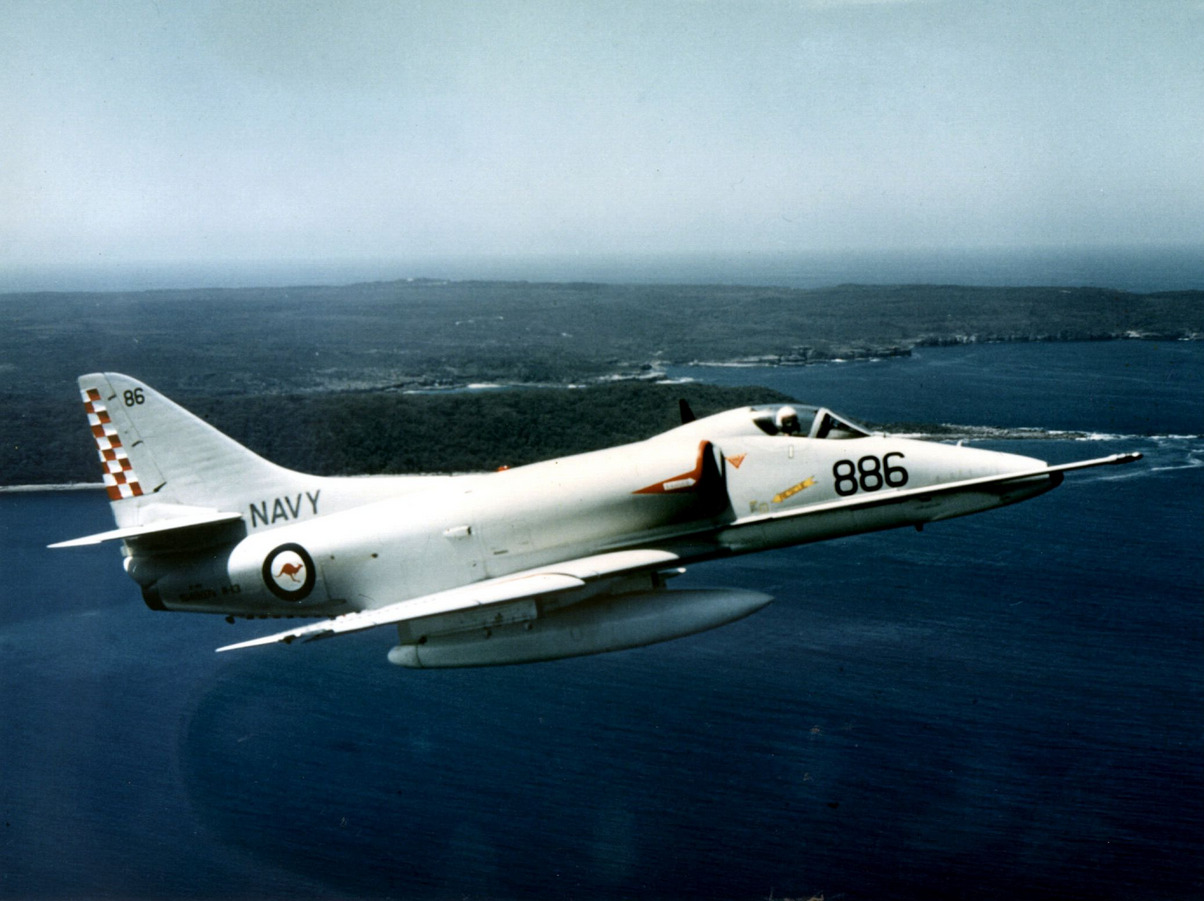
History
On October 26, 1965, the Royal Australian Navy announced plans to procure ten Skyhawks consisting of eight single-seat aircraft and two two-seat trainers for operation aboard the aircraft carrier HMAS Melbourne, formerly the Royal Navy’s HMS Majestic. The purchase was driven largely by concerns over growing regional tensions and the potential threat posed by Indonesia during the period. These aircraft would receive the designations A-4G and TA-4G, respectively.
Interest in the Skyhawk had developed after HMAS Melbourne conducted flight trials with US Navy Douglas A-4 Skyhawks and Grumman S-2 Trackers during a visit to Subic Bay in the Philippines in July 1964. The trials demonstrated that the compact Skyhawk and Tracker were suitable for operations from Melbourne’s relatively small flight deck, though it required minor modifications to safely operate both types of aircraft.
Douglas was authorized to begin construction of the Australian order on April 15, 1966. The A-4G was fundamentally based on the A-4F but tailored specifically for fleet defense duties. It retained important improvements introduced on the A-4F, such as wing spoilers, nosewheel steering, and the zero-zero ejection seat. The aircraft was powered by the Pratt & Whitney J52-P-8A engine producing 9,300 pounds of thrust.
What made the A-4G distinctive was its Sidewinder capability. The aircraft was wired to support four AIM-9B Sidewinders simultaneously across all four wing pylons, a configuration rarely made possible with other Skyhawk variants. However, because the Royal Australian Navy primarily intended the aircraft for defensive carrier operations, the A-4G retained only limited strike capability. Advanced guided munitions and nuclear delivery capability were omitted, restricting the aircraft largely to conventional free-fall ordnance such as Mk 81 and Mk 82 bombs, 750-pound M117 bombs, and 2.75-inch and 5-inch rocket pods.
Unlike the A-4F, the Australian Skyhawks did not feature the dorsal avionics hump and had slightly revised avionics equipment. Externally, this gave them a cleaner appearance more closely resembling earlier Skyhawk variants.
The first A-4G completed its maiden flight on July 19, 1967, while the first TA-4G flew two days later. Deliveries began on July 26, 1967, with the first aircraft formally handed over to the Royal Australian Navy during a ceremony at the Douglas Long Beach facility. The remainder of the aircraft awaited transport at NAS North Island in California until HMAS Melbourne arrived to ferry them to Australia. Meanwhile, Royal Australian Navy pilots trained at NAS Lemoore using US Navy Skyhawks to familiarize themselves with carrier operations and the aircraft itself.
The operational A-4Gs were assigned primarily to No. 805 Squadron, later redesignated VF-805, which served as Melbourne’s carrier-based combat squadron. The TA-4G trainers and additional aircraft were assigned to No. 724 Squadron based at Nowra, which handled operational conversion and pilot training duties. Due to center-of-gravity concerns, the TA-4G was not certified for regular operations from Melbourne’s short carrier deck.
The A-4Gs of VF-805 first operated at sea in November 1968 when they landed aboard the visiting British carrier HMS Hermes during exercises near Australia.
In 1971, the Royal Australian Navy supplemented its original fleet with eight former US Navy A-4Fs and two TA-4Fs, which were redesignated as A-4G and TA-4G, respectively, before transfer. These aircraft were acquired from San Diego by HMAS Sydney in July 1971 and delivered to Jervis Bay the next month.
Service with the Royal Australian Navy proved demanding, and attrition rates were severe. Half of the twenty Australian Skyhawks acquired were eventually and permanently lost in accidents, most of them related to the inherent dangers of carrier aviation and operations from HMAS Melbourne’s small deck.
Following the decommissioning of HMAS Melbourne in 1982, the Royal Australian Navy no longer required most of its fixed-wing combat aircraft. In 1984, ten surviving A-4Gs were sold to the Royal New Zealand Air Force, where they were upgraded and redesignated as A-4K Skyhawks. The two surviving TA-4Gs were also transferred and converted into TA-4K trainers.