History
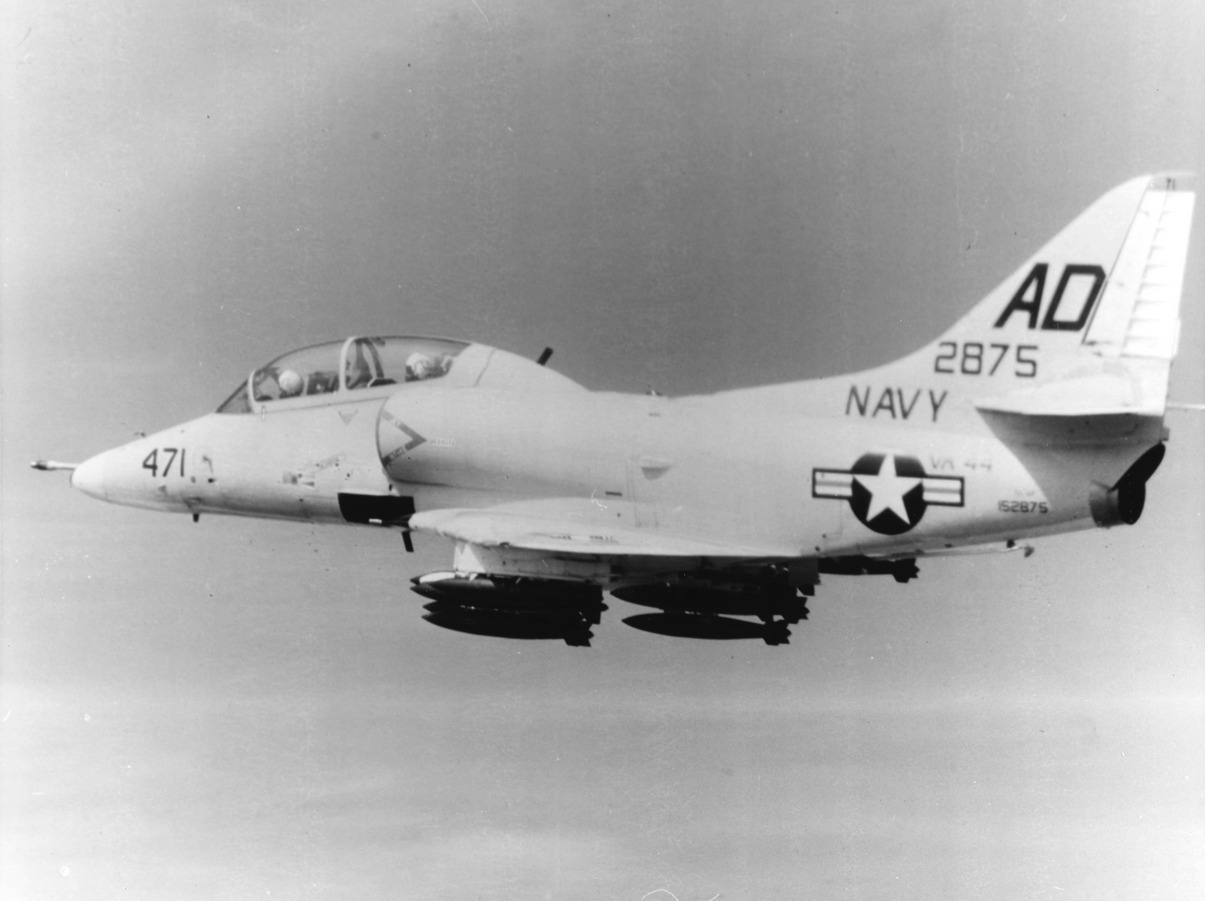
When the A-4 Skyhawk first entered service with the US Navy, Douglas proposed the development of a two-seat variant that could serve both as an operational trainer and a fast forward air control aircraft. Initially, the Navy rejected the concept due to budget limitations. However, by 1964, the Navy reconsidered the idea and successfully secured Department of Defense funding for two prototype aircraft.
These prototypes were created from the final two A-4E airframes taken directly from the production line and were originally designated TA-4E. Douglas incorporated several improvements already planned for the newer A-4F variant, including wing lift spoilers, nosewheel steering, and the Escapac zero-zero ejection seat.
To accommodate the second cockpit, the forward fuselage was lengthened by 28 inches. This modification reduced internal fuel capacity because part of the fuselage fuel tank space was lost to the additional crew position. Despite this compromise, the aircraft nearly retained all of the combat capability of the standard A-4F.
The TA-4E prototype completed its maiden flight on June 30, 1965. Since the aircraft incorporated so many A-4F features from the beginning, the designation was quickly revised from TA-4E to TA-4F.
Production eventually totaled 241 TA-4Fs, including the original two prototypes. The type entered operational service in May 1966 with VA-125 at NAS Lemoore, California, which served as an A-4 Combat Readiness Air Group responsible for training Skyhawk pilots.
Unlike later downgraded trainer variants, the TA-4F remained fully combat capable. The aircraft retained offensive systems and weapons capability equivalent to frontline single-seat Skyhawks. Many Navy and Marine Corps attack squadrons operated at least one or two TA-4Fs alongside their standard A-4 strike aircraft for training and operational support purposes.
The TA-4F also became the first combat-capable two-seat Skyhawk to see action during the Vietnam War. The US Marine Corps employed the aircraft primarily in the fast forward air control role, where crews directed strike aircraft toward enemy positions and coordinated close air support operations over the battlefield. The second crew member proved valuable during these missions by assisting with navigation, target identification, and radio coordination.
During the late 1970s, twenty-three TA-4Fs were further modified into the OA-4M configuration specifically optimized for the forward air control mission.
As the Skyhawk fleet aged, many surviving TA-4Fs were eventually rebuilt into the downgraded TA-4J trainer standard. These conversions removed much of the combat equipment, deleted the outboard pylons, and, in some cases, removed one or both of the internal cannons in order to simplify maintenance and focus solely on pilot training duties.