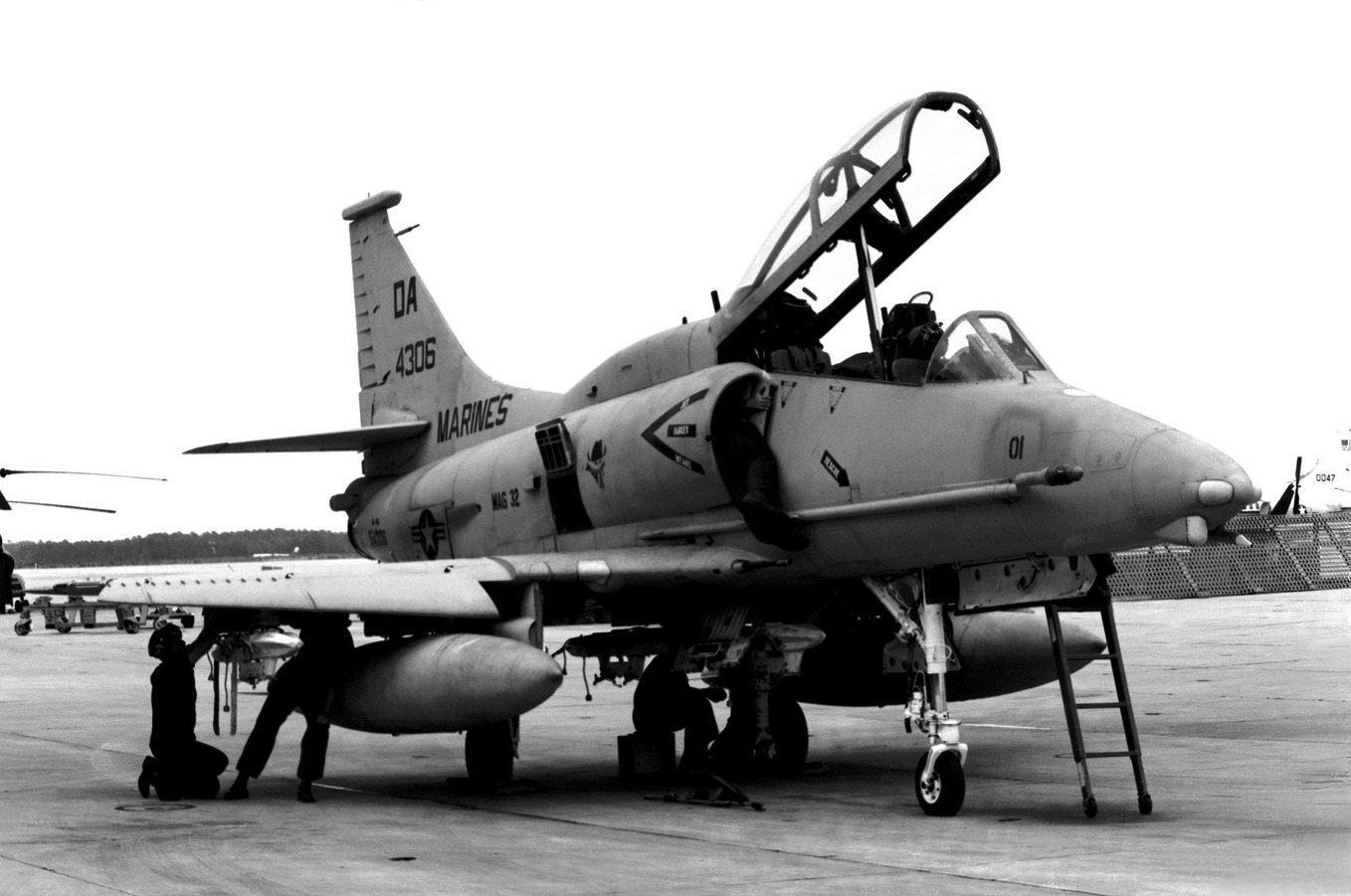
Hello everybody. I’d like to suggest a dedicated American forward air control variant of the Skyhawk, the OA-4M. Essentially, it was a TA-4F fitted with avionics improvements associated with the A-4M, developed as part of lessons learned from the Vietnam War.
I unfortunately have to disagree, as it’d get no ballistics calculator, would have a weaker engine, and would be vastly heavier. If we were to get a proper TT 9.7 Skyhawk, an early A-4M or basic A-4F would work (APR-25 RWR, two AIM-9D/Gs, etc).
As much as I’d like to see the OA-4M in-game, it’d fit better as an event vehicle or GE premium like the A-7K Corsair II.
in theory (this was also used) you could use the back seater to lase targets for LGBs, although it wouldn’t be stabilized and you would need to tilt you wing over a bit to even start the track, it is technically possible, if not, then if gaijin ever implements a buddy lase system, you could be the one to lase targets for your fellow A-4s if they were to carry LGBs (no special racks needed as the bomb encloses the whole system needed as its a special package that’s screwed onto a basic MK.82)
The only problem with buddy-lasing with the OA-4M is that I’m not 100% sure it had that capability, as it lacked the AN/ASB-19 ARBS that the standard A-4Ms (starting around 1974-1976) had. If the OA-4M was confirmed to use the handheld/cockpit mounted lasing system found on some foreign F-5s and Vietnam-era F-4Ds, then I could see it lol.
I’m talking about the back seater using a hand guided laser, it was used a few times by the back seater, but it would be more accurate if a vehicle on the ground lased a target for a OA-4M to drop laser guided bombs with (hoping that buddy lasing gets added that is, as anything guided by a hand held laser is gonna be incarnate if not stabilized