History
In the early 1950s, as military aviation rapidly transitioned from piston-powered aircraft to jet-powered combat aircraft, the US Navy sought a compact, lightweight, and affordable attack aircraft capable of striking surface targets while retaining minimal air-to-air combat capability. In addition to being powered by a stronger jet engine, the aircraft needed to carry heavy loads over long distances and possess nuclear strike capability. Although the Navy already operated the Douglas A-1 Skyraider, the type was increasingly showing its age in the emerging jet era.
The Navy, therefore, issued specifications for a replacement aircraft requiring a top speed exceeding 500 mph, the ability to carry a 2,000-pound bomb load over a 460-mile combat radius, and a unit cost below one million US dollars. Douglas Chief Engineer Ed Heinemann led a design team that developed a lightweight, low-wing attack aircraft built around a compact, modified delta-wing layout. This proposal became the XA4D-1 Skyhawk and was submitted to the Navy.
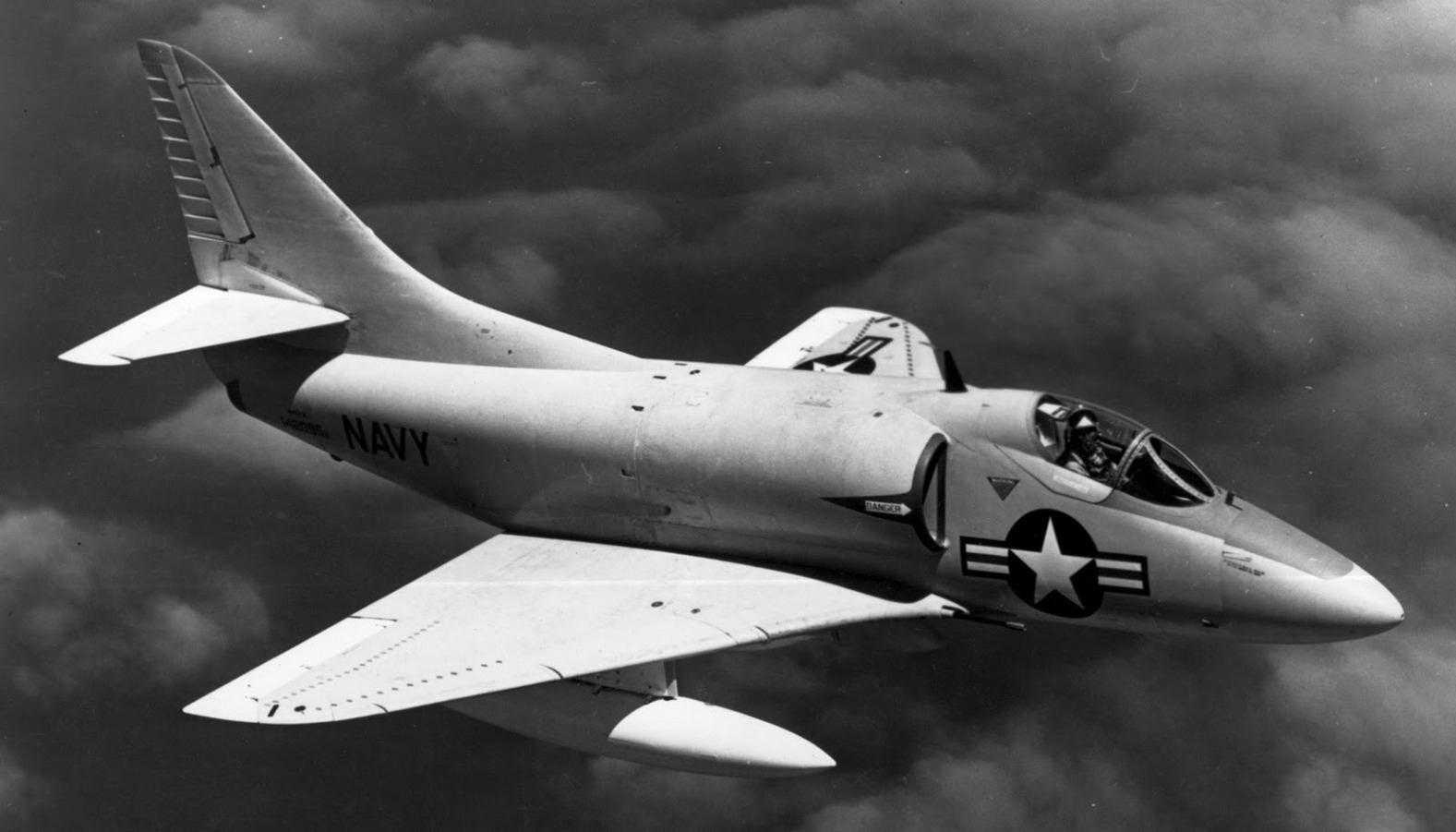
A contract for two prototypes was issued on June 21, 1952, followed only three months later by additional contracts for nineteen pre-production aircraft. The XA4D-1 prototype was assembled at Douglas’ El Segundo plant and rolled out in February 1954 before being transported to Edwards Air Force Base. Delays in the delivery of its Wright J65-W-2 turbojet postponed the maiden flight until June 22, 1954. Initially, the prototype lacked a tailhook, jetpipe fairing, and all three weapons pylons, though these would later be installed.
Only two months after the prototype’s first flight, the first production A4D-1, Bureau Number 137813, completed its maiden flight on August 14, 1954. The first nine production aircraft were informally known as YA4D-1s for testing purposes, although the designation was rarely used officially. These first nineteen aircraft also featured a distinctive one-piece curved windscreen before production shifted to a three-piece windscreen with an oval center panel.
The production A4D-1 incorporated the jetpipe fairing, arrestor hook, and three pylons: one mounted beneath the fuselage centerline and one under each wing just outboard of the landing gear. The aircraft was certified for nuclear strike operations.
What distinguished the A4D-1 from all later Skyhawk variants was its lack of an in-flight refueling probe and its skinned conventional rudder design. Additionally, it lacked radar entirely, as the nose compartment instead housed avionics equipment dedicated primarily to navigation functions.
Following service evaluations, the first factory-to-fleet delivery of the A4D-1 was made to VA-72 at NAS Quonset Point, Rhode Island, on September 26, 1956. This was followed by deliveries to Pacific Fleet squadron VA-93 aboard the USS Ticonderoga (CV-14) in September 1957. The first Marine Corps squadron to receive the Skyhawk was VMA-224 in January 1957.
A total of 166 A4D-1s were built and eventually assigned to eighteen Navy and Marine Corps attack squadrons. Many of these units were formerly fighter squadrons redesignated from VF or VMF into VA or VMA attack squadrons. Navy Skyhawk squadrons commonly operated alongside piston-powered A-1 Skyraiders aboard aircraft carriers during the late 1950s.
As more advanced Skyhawk variants entered service, surviving A4D-1s were transferred to Navy and Marine Corps Reserve units. In September 1962, the aircraft officially received the new designation A-4A under the tri-service aircraft designation system. Some surviving A4D-1/A-4A airframes were later redesignated TA-4A and assigned to reserve training units to help transition pilots into more advanced Skyhawk variants such as the A-4B and A-4C, although these training aircraft did not undergo major structural modifications.