History
After Singapore’s independence in 1965, the predecessor to the Republic of Singapore Air Force, the Singapore Air Defence Command, was formed on 1 September 1968. While it was in its infancy, Singapore relied on the United Kingdom’s Royal Air Force for air defense, and the SADC was equipped with British aircraft such as the Hawker Hunter and English Electric Canberra for training.
Later, as a consequence of the Suez Crisis, all British presence, including Royal Air Force units, was withdrawn from Singapore and Asia by September 1971. The SADC became responsible for maintaining Singapore’s air defense, taking over the former UK air bases and air defense installations.
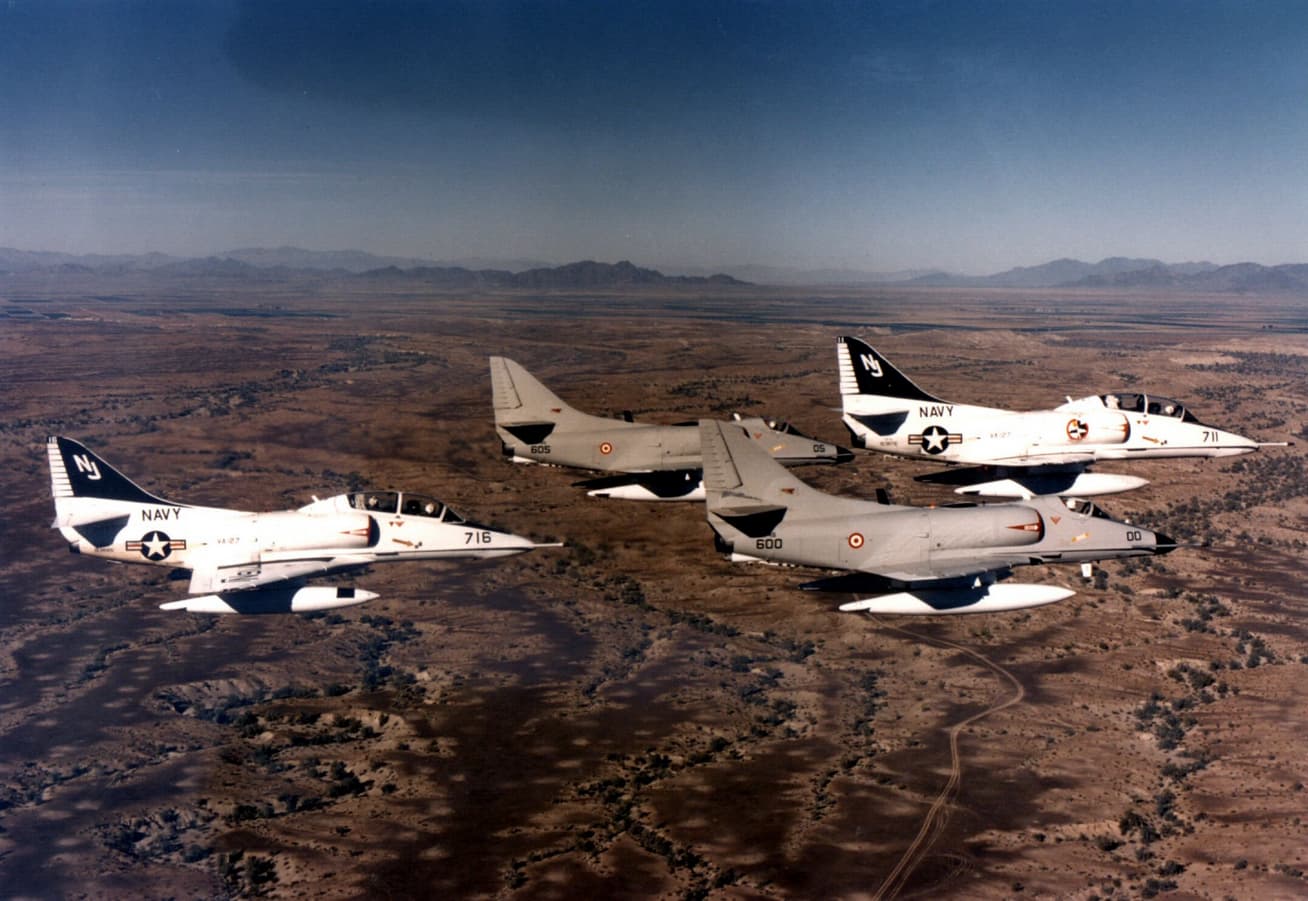
It became necessary to transform the SADC into a fully functional air force branch, so Singapore procured A-4 Skyhawk fighter-bombers and Shorts Skyvan utility aircraft to reinforce its fleet alongside existing British equipment. In 1973, the SADC began receiving 44 refurbished ex-U.S. Navy A-4Bs, along with an additional six A-4 airframes and three tandem-seat trainers converted in the United States. After conversion, these were designated A-4S, along with three airframes designated TA-4S (two-seat trainers). On 14 July 1973, the first flight of the A-4S was completed.
These A-4S and TA-4S initially operated with two squadrons in Singapore (Nos. 142 “Gryphon” and 143 “Phoenix”).
The A-4S fleet was upgunned with a pair of 30 mm Aden Mk 4 cannons, replacing the original U.S. Navy 20 mm Colt Mk 12 cannons, simplifying logistics as they were also used by RSAF Hunters. Over 100 modifications were applied to the A-4S, including a lengthened nose housing a new communication and navigation package, five weapon pylons (instead of the standard three on the A-4B), a dorsal air direction-finding aerial in a saddle fairing, wing spoilers, and a braking parachute. A cranked refueling probe was fitted to some A-4S aircraft. The capability to carry AIM-9B missiles was already present. Avionics upgrades included a new Ferranti lead-computing gunsight and weapons delivery computer, a Decca Type 72 Doppler system, new radios, IFF, TACAN, and a radar altimeter. The original APQ-145 mapping and ranging radar was still in its place.
In 1975, the SADC was renamed the Republic of Singapore Air Force on 1 April. In 1980, it placed an order for a second batch of 70 Skyhawk airframes, a mix of ex-U.S. Navy A-4Bs and A-4Cs. Refurbished A-4Cs in Singaporean service were designated A-4S-1 and TA-4S-1 (two-seat trainers), though these retained the original 20 mm Colt Mk 12 cannons. These A-4S-1 and TA-4S-1 aircraft equipped a third unit, No. 145 “Hornet” Squadron, in 1984.
These Skyhawks supplemented the RSAF’s Northrop F-5E in the air defense role while also providing significant ground attack capability. Frequent deployments were made to Malaysia, Indonesia, and Australia for training and exercises.
By 1985, the age of the A-4S airframes, along with their Wright J65 engines, had become a major concern for RSAF leadership. Several A-4S aircraft were lost in accidents due to engine failures or withdrawn from service due to a lack of spare parts. This led the RSAF to initiate a program to re-engine a portion of the A-4S-1 fleet with non-afterburning General Electric F404-GE-100 turbofans by 1989, followed by avionics upgrades by 1991. These upgraded aircraft became known as the A-4SU Super Skyhawk, as further locally modernized by Singapore Aircraft Industries (later Singapore Technologies Aerospace).
In 1993, the RSAF retired all original A-4S models from frontline service, with the A-4SU Super Skyhawks replacing them and continuing service until April 2005.