- Yes
- No

JSC Sukhoi Company Su-57 Felon
This post will get continually updated as I gather new information and as the aircraft continues its lifecycle, thank you.
More Eye Candy
Serial-production Su-57 at Kubinka airfield. Thanks to CaptKaMeLRo for the images in a seprate post.


Hello again, today I would like to introduce The Su-57 Felon, it is Russia’s answer to the modern era of stealth fighter jets. Developed by Sukhoi, it’s designed to take on multiple roles from air superiority to precision ground attacks while staying off the radar. As Russia’s first true fifth generation fighter, the Su-57 combines stealthy shaping with advanced avionics, supermaneuverable flight thanks to thrust vectoring engines, and internal weapons bays for reduced radar signature. Compared to earlier Russian aircraft, it’s a big leap forward in terms of survivability, situational awareness, and multirole capability. Though its development has seen delays, the Felon is steadily being refined and upgraded, aiming to form the backbone of Russia’s future tactical airpower. Whether it’s going head to head with enemy fighters or slipping past radar systems for a precision strike, the Su-57 was built to meet the demands of modern combat.
The Felons story began its journey as the T-50 prototype under the PAK FA (Prospective Airborne Complex of Frontline Aviation) program. This was Russia’s ambitious effort to develop a fifth generation fighter that could rival the U.S. F-22 Raptor and F-35 Lightning II.
The first prototype, T-50-1, took to the skies on January 29, 2010, flown by test pilot Sergey Bogdan from the Komsomolsk on Amur plant. It marked a huge step forward for Russian aviation, being the country’s first stealth aircraft to fly. Over time, a series of prototypes from T-50-2 to T-50-11 followed, each testing improvements in aerodynamics, stealth features, avionics, and flight performance.
These aircraft were tested extensively at facilities like Akhtubinsk and the Gromov Flight Research Institute. The goal was to refine systems like radar, weapon bays, and the aircraft’s ability to perform extreme maneuvers. The prototypes initially used the AL-41F1 engines, borrowed from the Su-35, until the more advanced “Izdeliye 30” engines were ready.
Though they looked like the final Su-57, the T-50 prototypes weren’t fully operational fighters some had incomplete systems or test only equipment. There were also setbacks, such as when T-50-5 caught fire in 2014. Still, each prototype contributed valuable data that shaped the final production model.
In 2017, the aircraft was officially named the Su-57. While the T-50 prototypes are no longer flying, they played a critical role in bringing Russia’s first fifth generation fighter to life. Their legacy lives on in the operational Su-57s that are now flying with the Russian Air Force.
Characteristics
Stealth
- Shaping: Angular airframe with internal weapon bays to reduce radar cross-section.
- Radar-Absorbent Materials (RAM): Composite skin and coatings help minimize detection.
- Infrared Signature Reduction: Engine nozzle design and surface treatment lower IR emissions.
- RCS with RAM:
-
- 0.006m² (-23/-24 dbsm) with a closed IRST sensor.
-
- 0.017m² (-20dbsm) with an open IRST sensor.
This puts it not far behind the F-35 in stealth performance.
(These are just public estimations)
- 0.017m² (-20dbsm) with an open IRST sensor.
I recommend the reader to take a look at this Simulation to get a better understanding about this aircrafts RCS and how it compares to others.
Advanced Armament
-
Internal Weapon Bays: Maintains stealth while carrying a wide range of air-to-air and air-to-ground weapons.
-
Guns
x1 30mm Gryazev-Shipunov GSh-30-1 (150 rounds) -
Hardpoints: 12 hardpoints (x6 internal, x6 external) with a capacity of 7,500 kilograms (16,500 lb) maximum payload
-
Air to air missiles
-
- R-77M (x4 Internally, x6 Externally)
-
- R-77-1 (x4 Internally, x6 Externally)
-
- R-74M2 (x2 in wing-glove bays, x6 externally)
It may be able to carry four of them in the main internal bays.
- R-74M2 (x2 in wing-glove bays, x6 externally)
-
- R-37M (x4 Externally)
-
- Izdeliye 810 (x4 Internally)
-
- R-77ME (x4 Internally, x6 Externally) (Izdeliye 180-BD an advanced Ramjet R-77 variant under development with longer range and better ECCM)
-
Air to ground
-
- x4 Kh-59MK2
-
- x4-6 Kh-38ML/MT/MA
-
- x4 Kh-69
-
- x4-6 Grom-1
-
- x4-6 Grom-2
-
- x2 S-71K
-
- x2 S-71M
-
Anti-ship missiles
-
- x4 Kh-35U
-
- x4 Kh-31AD
-
Anti-Radiation missiles
-
- x4 Kh-58UShKE
-
- x4 Kh-31PD
-
Bombs
-
- x4-6 KAB-250 guided bombs
-
- x4-6 KAB-500 guided bombs
-
- x4-6 Drel precision guided stealth glide bombs
-
Future Integration: Planned compatibility with hypersonic and AI-assisted smart weapons such as Kh-95.
Avionics & Systems
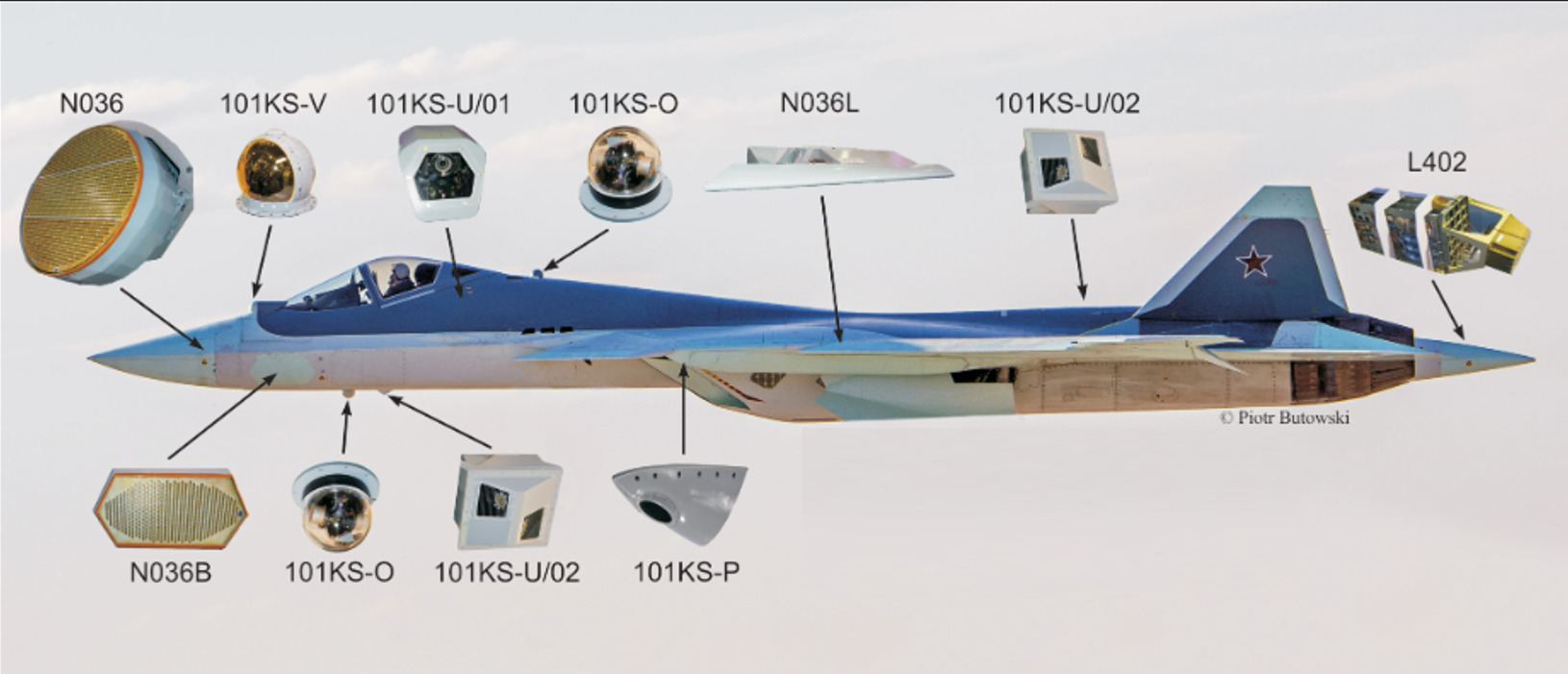
- N036 Byelka AESA Radar: Powerful active electronically scanned array radar with multiple arrays for 360° coverage.
-
- N036-1-01: Frontal X-band active electronically scanned array (AESA) radar.
-
- N036B-1-01: Cheek X-band (AESA) radars for increased angular coverage.
-
- N036L-1-01: Slat L-band arrays for [IFF].
-
- N036Kh: X band rear awareness & jamming.
- 101KS Atoll electro-optical suite
-
- 101KS-O: A new laser based DIRCM designed to protect the aircraft from incoming infrared missiles.
-
- 101KS-V: IRST (infrared search and track). (this system is reportedly protected with RAM.)
-
- 101KS-U: (MAWS) UV missile warning sensors.
-
- 101KS-P: Infrared low flying-landing navigation sensor.
-
- 101KS-N: Targeting Pod
- L402 Himalayas EW Suite: Advanced electronic warfare and countermeasure system, with its own rear facing AESA radar (N036Kh)
- Sensor Fusion: Integrates radar, infrared search and track (IRST), and datalink inputs for enhanced situational awareness.
- Flares and Chaff: x42 (With the existence of an advanced DIRCM and Radar Jamming its low countermeasure amount shouldn’t be an issue.)
- Expendable Jamming Transmitter x42 (Uses normal countermeasure dispensers)
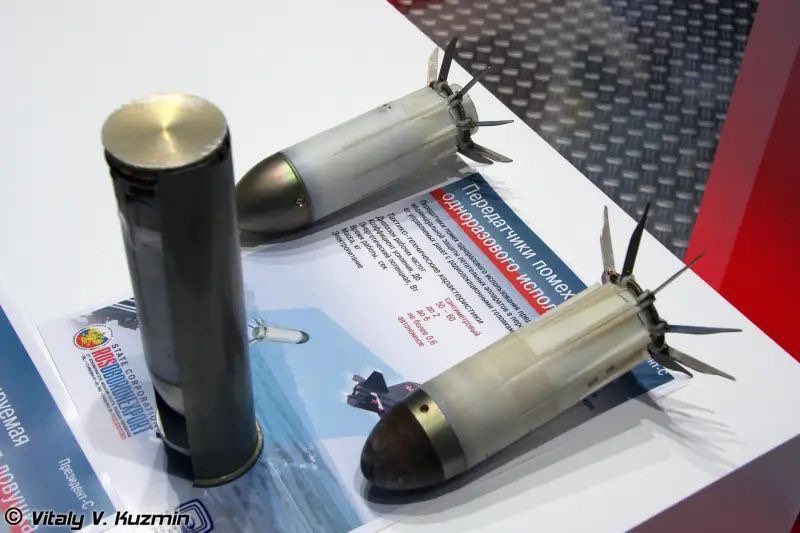
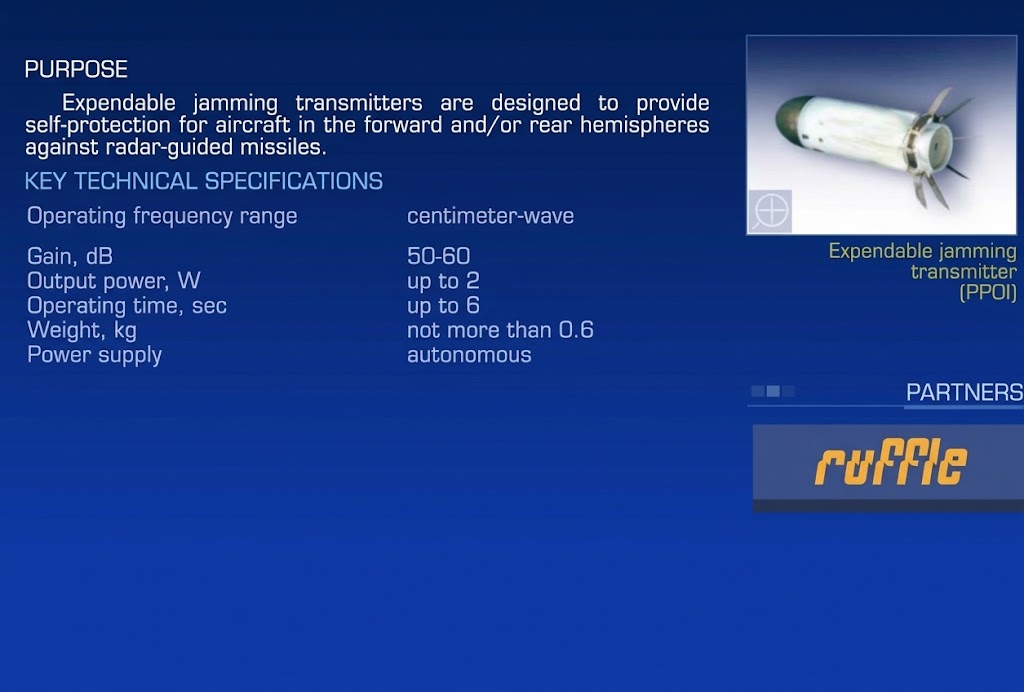
Photos for Electronics
Electronic Layout


Targeting Pod
101KS-N TGP (A pod Specially made for the Su-57)


Unknown probably nothing burger images


Radar Angles and Coverage


Specifications
- Crew: 1
- Length: 20.1 m (65 ft 11 in)
- Wing area: 78.8 m2 (848 sq ft)
- Wingspan: 14.1 m (46 ft 3 in)
- Height: 4.6 m (15 ft 1 in)
- Empty weight: 18,500 kg (40,786 lb)
- Gross weight: 26,700 kg (58,863 lb) normal takeoff weight, 29,770 kg (65,630 lb) at full load
- Fuel capacity: 10,300 kg (22,700 lb)
- Max takeoff weight: 35,000 kg (77,162 lb)
AL-41F1
Spoiler
General Information
- Development designation: (Izdeliye 117) Stage 1
- Type: Twin-spool low-bypass afterburning turbofan with 3D TVC
- Manufacturer: NPO Saturn / UEC
Engine Performance & Mass
- Dry Mass: 1,600 kg
- Dry Thrust (100% Military): 93.1 kN (9,500 kgf)
- Afterburner Thrust (WEP): 147.0 kN (15,000 kgf)
- Thrust-to-Weight Ratio: 9.36:1
- Bypass Ratio: 0.56:1
- Overall Pressure Ratio: 23:1
Dimensions
- Length: 4,940mm
- Inlet Diameter: 932mm
Thrust Vectoring Control (TVC)
- Nozzle Type: All-aspect axisymmetric 3D vectoring
- Pitch Deflection Range: ±16°
- Yaw Deflection Range: ±15°
- Vectoring Actuation Speed: 30°/s
Izdeliye 177
Spoiler
General Information
- Development designation: United Engine Corporation Product 177 Stage 1.5
- Type: Twin-spool low-bypass afterburning turbofan with 3D TVC
- Manufacturer* NPO Saturn / UEC
Engine Performance & Mass
- Dry Mass: 1,550 kg (1,500 kg for 177S variant)
- Dry Thrust (100% Military): 107.8 kN (11,000 kgf)
- Afterburner Thrust (WEP): 156.9 kN (16,000 kgf)
- Thrust-to-Weight Ratio: 10.32:1
- Bypass Ratio: ~0.50:1
Dimensions
- Length: 4,900mm
- Inlet Diameter: 932mm
Thrust Vectoring Control (TVC)
- Nozzle Type: All-aspect axisymmetric 3D vectoring with serrated chevron edges
- Pitch Deflection Range: ±16°
- Yaw Deflection Range: ±15°
- Vectoring Actuation Speed: 30°/s
AL-51A1
Spoiler
General Information
- Development designation: izdeliye 30 Stage 2
- Type: Twin-spool low-bypass afterburning turbofan with 3D TVC
- Manufacturer: NPO Saturn / UEC
Engine Performance & Mass
- Dry Mass: 1,450 kg
- Dry Thrust (100% Military): 107.9 kN (11,000 kgf)
- Afterburner Thrust (WEP): 171.6 kN (17,500 kgf)
- Thrust-to-Weight Ratio: 12.06:1
- Bypass Ratio: ~0.45:1
Dimensions
- Length: 4,900 mm
- Inlet Diameter: 932 mm
Thrust Vectoring Control (TVC)
- Nozzle Type: All-aspect axisymmetric 3D vectoring with serrated chevron edges
- Pitch Deflection Range: ±16°
- Yaw Deflection Range: ±15°
- Vectoring Actuation Speed: 30°/s
Other 5th generation Aircraft
- F-22A Raptor — by Nostalgistic
- F-35A Lightening II — by Nostalgistic
- F-35B Lightening II — by Nostalgistic
- F-35C Lightning II — by Nostalgistic
- YF-23A Black Widow — by Nostalgistic
- J-35A — by Surbaissemaxxing
- MiG 1.44 — by Savage_Virus_R6
- RAF F-35B Lightening II — by AVROVULCANXH558
If there are any that I missed do let me know so I can add it.


Sources
https://defence-blog.com/russia-delivers-upgraded-su-57-stealth-fighters-to-its-air-force/
Russia’s Su-57 Flies with New Izdeliye 177 ‘Gen. 5’ Engine - The Aviationist
Russia’s New Top Fighter: Su-57M1’s Five New Features That Make It Far Superior to the Original
ODIN - OE Data Integration Network
Sukhoi Su-57 - Wikipedia
https://www.youtube.com/watch?v=diZfcm3IJ1U&t=520s
Su-57's 101KS-O Directional Infrared Counter Measures: how to make a virtue of necessity.
Su-57 Radar scattering simulation – Aircraft 101