Whole lot of typing just to be blatantly wrong.
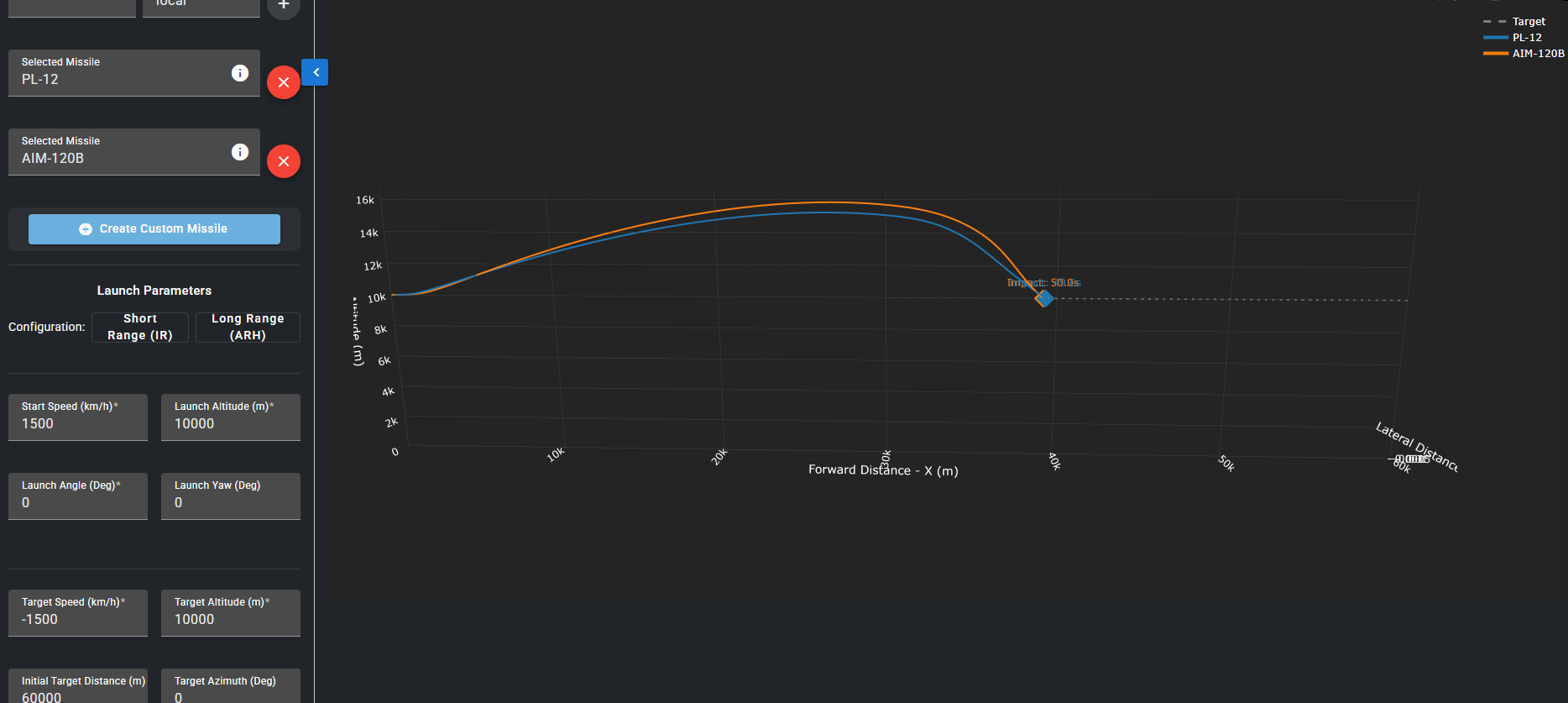
60km shot at 10 km altitude
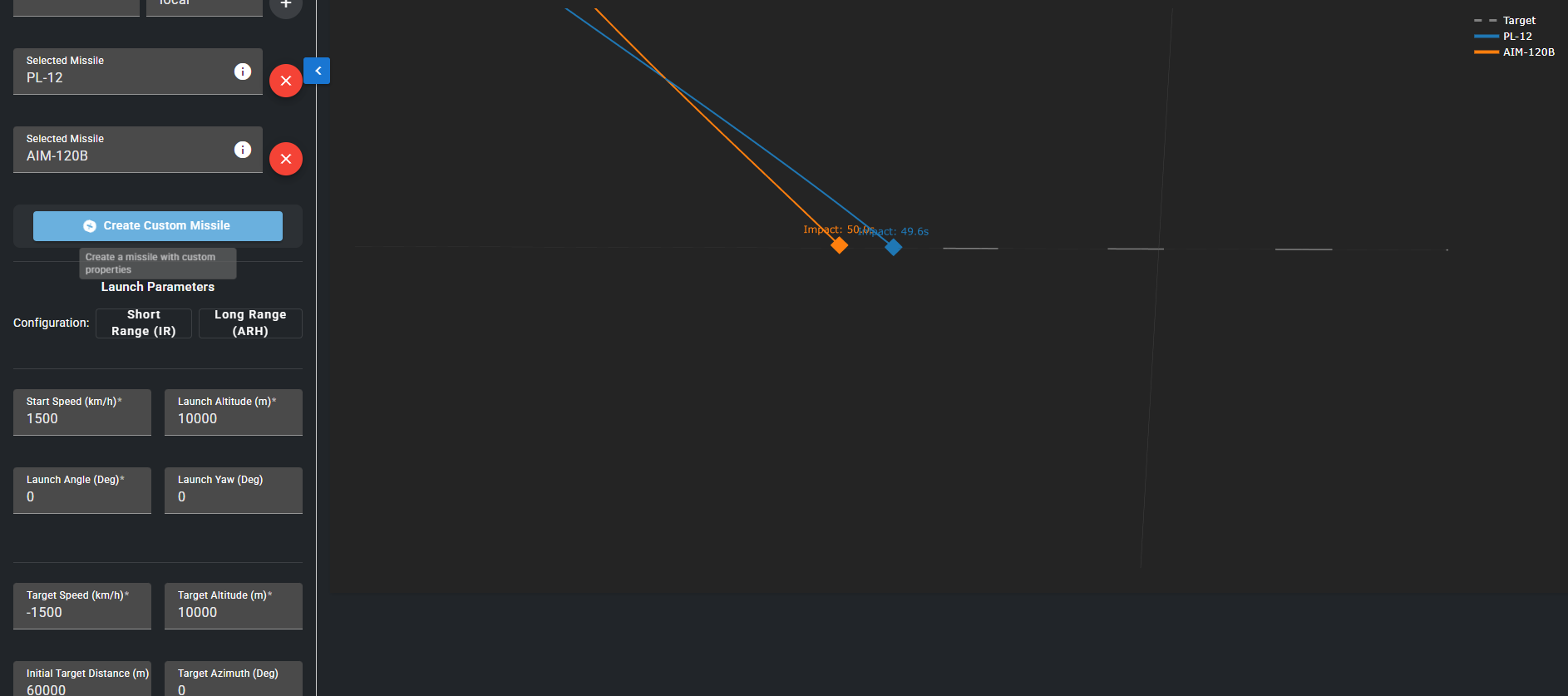
The AIM-120B is actually faster, but not only is it only a 100kph difference, it actually impacts later because it has to correct its loft and loses a lot of energy
Whole lot of typing just to be blatantly wrong.
60km shot at 10 km altitude
The AIM-120B is actually faster, but not only is it only a 100kph difference, it actually impacts later because it has to correct its loft and loses a lot of energy
Yeah pretty much this.
We quite literally had a real-time view one them first copy-pasting 30SM and then iteratively changing its stats/kit one by one. If thats not a proof that SM2 was an erzats solution, then nothing is.
Outside of the argument if the Su-30SM2 was planned or not, they do this quoted part all the time though. The Gripen E did show up on the second leak list, but that also started out with pretty much all of it’s stats being copy pasted placeholders from the Gripen C.
Yeah I am not arguing they do this all the time, but “being planned” is the whole difference here.
One was leaked before the trailer (and moreseo the DEV) was released, the other we had not a single mention of existing right untill the MKM fiasco. And then all of a sudden it appears in a heavy WIP state (as if it was decided to come some 30 minutes ago). Which to me says it all.
How did you lie in every sentence.
Part 2/2 of a monologue about PL-12 vs AIM-120.
Tangential arguments/context
The most important topic of concern is the inability to use PL-12s at long range. The argument that “Range doesn’t matter” is overused, yet perplexing to me, because engagements at long range (>30km distances) are common at top tier. What many people don’t realize is that the perceived uselessness of the range of Fox-3 missiles is only attributable to their own failures as a player to effectively use their weapons. Anybody who disputes this would be arguing in bad faith.
Long range missiles have the greatest match presence, and for Fox-3, it is more important still, as a few launches can scare or destroy a decent amount of the enemy team on the opening phase of the battle. In high-altitude BVR encounters, the differences in missile range are substantially increased.
Let’s examine the disparity between the PL-12 and AIM-120 variants at range. Since “Seek and Destroy” in June 2024, the AIM-120 has consistently stayed the most powerful active radar homing missile in BVR role at top tier, with minimal nerfs. It isn’t as great overall as the MICA or R-77-1, but is still a top contender.
I think everyone can agree that the implementation of Fox-3 missiles into the game was disastrously inaccurate, and still is to this day. Everybody, including US mains, was disappointed in this or that missile, some more than others. However, the best-performing and closest to real life capabilities was the AIM-120A/B. The addition of PL-12, in comparison, disappointed all Chinese tech tree players tenfold, since even the AIM-120A was better than it. There used to be much debate over this imbalance, which clearly favored the US top tier air, but not much after the EF and Rafale meta we now have.
The later addition of AIM-120C-5 would be a disappointment on a similar scale, but even still, the range wasn’t as gimped as the PL-12’s range was. The AIM-120A/B/C5 stayed the best at BVR engagements throughout this entire period and still is, while PL-12 was/is among the worst, being close to R-77 in this respect.
Guidance Logic of PL-12 in WT
The real issue with the PL-12 isn’t the high drag and lack of energy retention, it’s the missile’s control logic itself that is bugged. If you’ve ever used the PL-12, you may have noticed the fact that the PL-12 wobbles and falls out of the sky starting at ~15-20km (even when given above average standard parameters such as Mach 1.2 launch at 1-4 km altitude.). The following is a detailed explanation of why this phenomenon happens to the PL-12, and why other missiles do not have this problem.
PL-12 has very unique PID terms compared to all other ARH missiles in-game. The proportional term is 0.0046, the integral term is 0.0375, and the derivative is at 0.00015. To understand this relatively:
Selected Parameters of 3 Active Radar Homing Missiles
Note: dcm-cs refers to distance between centre of mass and stabilizers/center of stability.
| Missile | PID P | PID I | PID D | I / P | dcm-cs (cm) | Wing area mult. | Max fin AoA |
|---|---|---|---|---|---|---|---|
| AIM-120C-5 | 0.0091 | 0.051 | 0.00025 | 5.604 | 12 | 1.225 | 24.2° |
| R-77 | 0.0076 | 0.005 | 0.00025 | 0.658 | 17.5 | 1.45 | 41.5° |
| PL-12 | 0.0046 | 0.0375 | 0.00015 | 8.152 | 30 | 1.4 | 33.7° |
The table explains exactly why the PL-12 is one of the worst performing ARH missiles at medium to long range. The I term of the PL-12 is ridiculously massive in relation to its P term. The I term integrates the error over time, and is slow to react to changes. An high I term is useful in eliminating steady-state error, especially when the change in error is gradual. But the absurdly high ratio of I/P, over 8.1, means that the PL-12 is prone to overcorrecting even in response to relatively slow changes in error. This is something not seen in perfect testing scenarios, but practically guaranteed to happen in real battles.
But why doesn’t the AIM-120 suffer the issue despite also having a high I/P of 5.6? This is because the AIM-120 makes up for it in both having the highest P and high D, meaning it ends up being responsive with good damping. That doesn’t mean it flies perfectly straight, but the oscillation is so small it is a non-factor. Additionally, the very downside of the AIM-120, its maneuverability at close range, ends up being a major advantage when it comes to long range, and vice versa for the PL-12/R-77. With the lowest wing area multiplier and lowest max fin AoA, the AIM-120 is both stable and efficient.
You may also wonder, why doesn’t the R-77 wobble out of control even though it has the highest maneuverability (50G, large wing size, very high max fin AoA) by far? Again, it is the overall picture that matters. R-77 has a miniscule I of 0.005. That’s only 13% of PL-12’s value and less than 10% of AIM-120! R-77 reacts the fastest and isn’t burdened by integration building up.
The PL-12 has the worst possible combination. The f**ked up PID, in combination with the higher maneuverability, are the exact factors which make it among the lowest-range ARH missile in War Thunder, quite possibly THE single lowest range ARH. Even with small changes in the target aircraft’s path, the PL-12 will overreact heavily. Low authority (low P), high stored change (strong I), and weak damping (low D) combine and multiply this negative effect. It plays out exactly as described:
Typical PL-12 Launch
The issue was reported on the CBR site shortly after release, now more than a year ago. It was accepted without incident shortly after, but it has since been ignored to this day. All Gaijin would need to do to fix this basic issue is massively lower I, increase D, and increase P. 3 variables. Gaijin couldn’t care less. This is not to mention the tons of other issues with the PL-12 in War Thunder, such as having less than half of its IRL range, inability to reach the documented top speed, and engine lacking almost 100 m/s of ∆v. The incompetence and ignorance of CBR site managers borders on malice, after all. We can only hope of change.
End of final part 2/2 on the PL-12.
The tool you are using provides a rough approximation, not an accurate simulation, and does not provide valid evidence for your claims. This is highlighted by the fact that the specific PID guidance logic is completely neglected. Even site owners admitted it is not exact in results, to put it lightly. Lastly, this ideal scenario disproportionately inflates the PL-12’s range, and the results are laughably unrealistic.
Its still copy pasted in most ways.
They decided to use regular Gripen airframe instead of actual E frame (I know first couple JAS39E’s uses same airframe that C has but point still stands).
It still uses same old RWR while it should be much better and same EFT/Rafale’s sensors capabilities.
It lacks double A2A pylons under wings.
Still lacks sensor fusion and VWS.
Current Gripen E is basically Gripen C with AESA radar/IRST plus extra missiles and more powerful engine, its basically half baked JAS39E.
You are using tons of highly specific data that doesnt mean anything.
Yes, statshark isnt 100% accurate, but that doesnt mean that the simulation where PL-12 impacts sooner at 60km launch is unreal and the missile “falls out of the sky” like you say.
You are very brave to say that 1-4km alt is perfect launch parameters.
It is not, the worst long range FOX 3 is the MICA, but the fact that Rafale is incredibly fast makes up for it.
I am not saying that the PL-12 is the best missile, it is not, but I dont really feel any struggle with getting kills using it. The biggest difference is what launches said missiles, of course the 120 and MICA will be better at long range, but thats not because the missile itself, but because by the time you get to 8,000 meters and mach 1.2 in J-10C, EF and Rafale get to 10,000 meters and mach 1.6-1.8 thus giving their missiles far more energy.
“Highly specific data that doesnt [sic] mean anything” is just another way to say “You must be wrong if I don’t understand it”, it’s vaguely anti-intellectual for no reason. PID controllers/theory are widely used in engineering. In fact, it is the most popular control model worldwide by far, and in War Thunder, the only control model used. Matter of fact even the missiles which use bang-bang in real life (such as Igla) are instead simulated using PID control in War Thunder. It’s the entire logic for how the missile maneuvers. Everything else is only the limits of missile’s capability, PID is how the missile behaves and uses that capability.
You can try testing PL-12’s real performance in game if you don’t believe me. Statshark’s missile simulation is not a matter of “not 100% accurate”, it’s “can be a mediocre estimation for some situations/missiles, and is completely wrong in others”.
I meant “good conditions in average use”, minor mistake on my part (now fixed). Since trying to get close enough for a PL-12 launch involves significant amount of notching/defensive maneuvers due to the lower range, and at higher altitude one or two 90° turn will put you into subsonic, this is a decent standard.
It is very much both factors, in combination. PL-12’s low range can be compensated for by a change in strategy; this involves restricting yourself largely to close-range launches. You can still get kills with it, it is slightly better than most of the competition at close range (<10km~) in fact, but your overall capability is diminished, and you won’t be able to change tactics even when the situation calls for it.
Since PL-12 is disadvantaged in medium to long range, players are frequently forced to go defensive, multipath to get close, etc. Even if the launching aircraft were similarly fast, the PL-12 would perform worse.
pid controllers are actually fairly useful, if you’ve ever used them IRL or even other simulation style games.
It definitely wasn’t planned; it was a last-minute addition, perhaps because they didn’t want to add the Su-35 and wanted to save it for this year, or because they didn’t have anything ready. But also, the Su-35 would be, let’s say, an unstoppable machine, especially if equipped with R77M missiles. I wasn’t ready to give up my Su-30SM to get another Su-30, but here we are.
Gaijin is saving PL15s for himself, F15EXs and Su-35s for us with new missiles, so they can face the 5th generation that will arrive by the end of this year, I’m sure (I can’t die or get arrested before then).
So, uh, the derivative value isn’t actually that low proportional to the control authority of the missile. One of the values not included in the weapon datamine sheet, is that each missile has it’s own distance from center of stability to center of mass, except that the acting force of steering in warthunder is applied directly to the center of stability.
The PL-12 has this value set to 0.3(m?), whereas the R-77 has 0.175, and the 120C-5 has 0.12. So the PL-12 actually has higher pitch authority relative to fin deployment. As such a lower derivative value is needed to account for it. Its actual functional derivative authority is very near that of the R-77 and Aim-120.
consider the oscillating problem, should be the P being too low?
It could be? The one other missile with notable issues wiggling is the mica, which also has low P value?
I’m actually unaware if PID logic in warthunder has to do with change relative to current deployment, or if its is fixed relative to constant. If it’s change relative to current then too low a P value could very well be an issue, although I wouldn’t expect it to be as bad as it is on some missiles. Server desync is known to make it much worse though.
That’s cute.
If Gaijin would actually model PESA and AESA radars and EW suites properly Su-35 would go blind against current NATO 4.5th Gen’s in game.
Not to mention with addition of Meteor,MICA NG missiles Su-35 would have serious issues against NATO jets, if they add F-22/35 however situation would become even worse.
Fixed.
Add Su-35, be hit by an R77M violently
Correct, the distance from center of mass (CoM) to “center of stability” is greater for the PL-12. However, this does not mean that “a lower derivative value is needed to account for it”, this statement has no basis in fact.
The “center of stability” is the point at which the control force acts, therefore the distance between it and the CoG is basically like a lever arm. Since T = rF (when θ = 90°), a bigger r (moment arm) increases torque with force being constant. So a higher distFromCmToStab gives the missile more control authority, which effectively multiplies D, that much is correct.
However, this means that the missile is even more prone to oscillation unless PID tuning is adjusted, because greater control authority affects the effect of everything, including all the PID values. Higher plant gain means increased sensitivity to oscillation, this is pretty intuitive. I have no idea why you thought only the D term needed to be decreased, because the absolute effect of all the PID terms are changed in effectiveness, but there is no relative change since everything is proportional. And while the D term should be decreased absolutely, it should be increased relatively (relative to P and D terms).
You seem to have a mistaken or lacking understanding of PID controllers, please clarify what you mean using standard terms which are used to describe PID.