The Suffering Endured By German Tech Tree Players " SİMULATİON WARS "

Skill issue. Shoot the turret or the lower front plate like anyone with a modicum of experience.

While the IS-2 can just centre mass the Panther, it’s much easier for the Panther to kill the IS-2 frontally than it is for the T-44 to kill the Tiger II frontally, and the rate of fire difference between the IS-2 and Tiger II further warps your bad analogy.

3 Likes

It simply isn’t. The difference between pre and post nerf tiger 2 is immense. People also keep judging the tech tree one like it has the horsepower of the SLA.16 The SLA.16 is slow now too btw

2 Likes

Really ? I remember years ago people letting flying the BV 238 on automatic, and farming plane kills while AFK

This was bombers before the buff
https://www.youtube.com/shorts/P6bLC9bQX8g

Of course without gunners they were easy, but with real players with good crew in gunners, that was imposible.

Algo gunners gave you warning of the attack, a fighter doesn’t get warning.

If you are so blind as to not see a bomber honing in on you, you need to get a better computer or get glasses

2 Likes

I meant fighters don’t get warning when other fighters aproach them, obviously

I don’t intend to defend IrzDüşmanı, but please allow me to raise a slight objection. If I’m fighting a P-51C, I’d rather use the Bf 109G-6/14.
When I previously engaged a P-51C-11, I was nearly equal in climb rate and level speed and couldn’t create any separation.
Then I was outclassed by its engine performance above Alt 8,000 m, its turn radius, and its turning performance utilizing dives.
The P-51C-11 is a meta aircraft against the Bf 109 F.
The Bf 109G is better at using WEP engine power to haul the aircraft upward, so I don’t want to use the F-4. If I were only dogfighting, I’d rather fly the E-4 or T-2.

@IrzDüşmanı
Hey IrzDüşmanı.
You should first master the basic usage of the Bf 109 by flying the Bf 109 E-4 or T-2 at BR 4.0–5.0.
That way, you’ll gain a clearer understanding of what the Bf 109 can and cannot do.

And in the end… you should arrive at the Fw 190.

You don’t really need to create separation against the P-51C if you’re 1 on 1 though. You can just roll with it and abuse your flaps.

As for 8000 meters - I basically cannot recall ever going over 4500 meters unless it’s a certain group of german bf 109 G spammers who always play together being on the enemy team. Most activity occurs 0-4500, maybe 5km altitude.

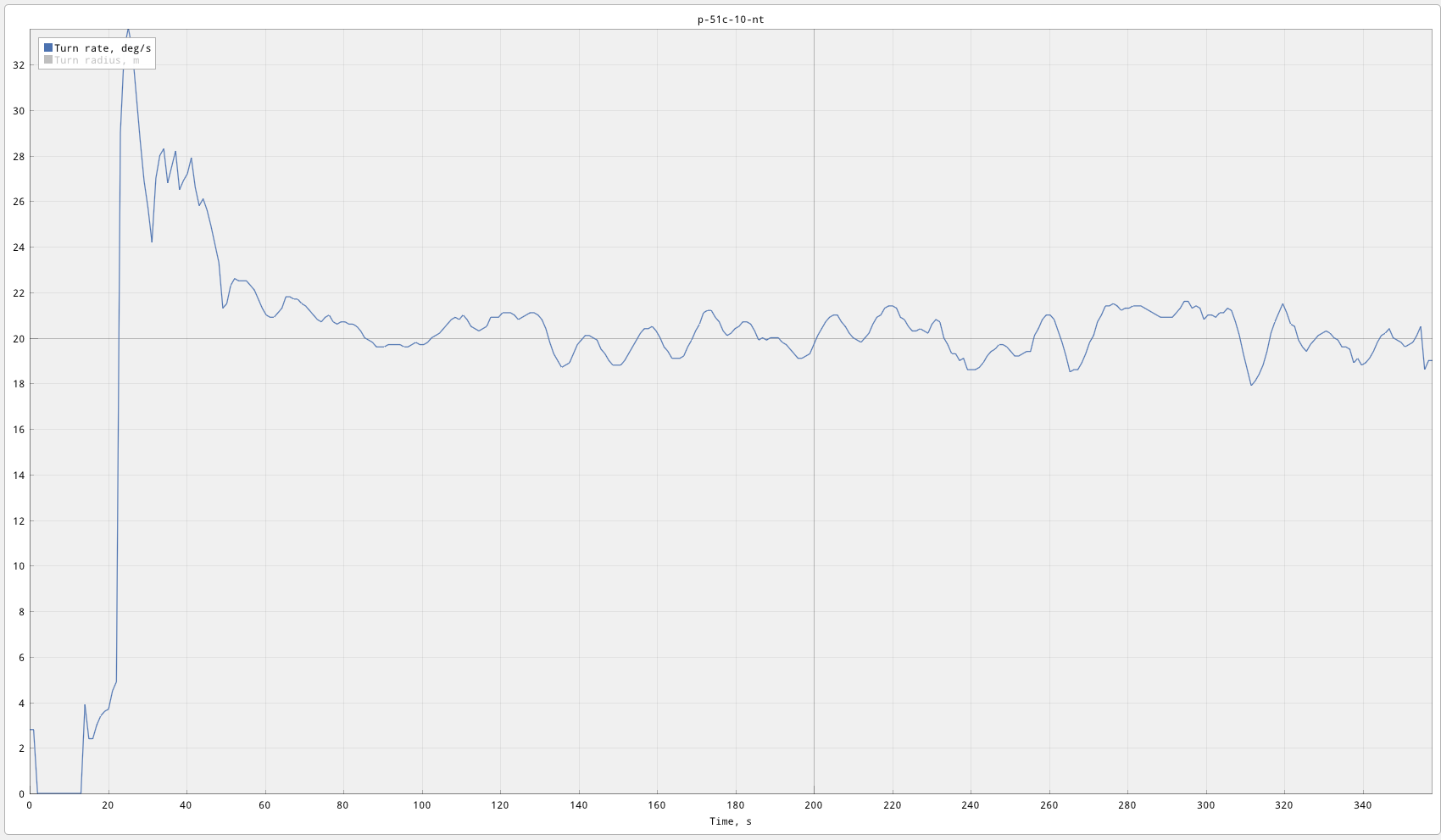
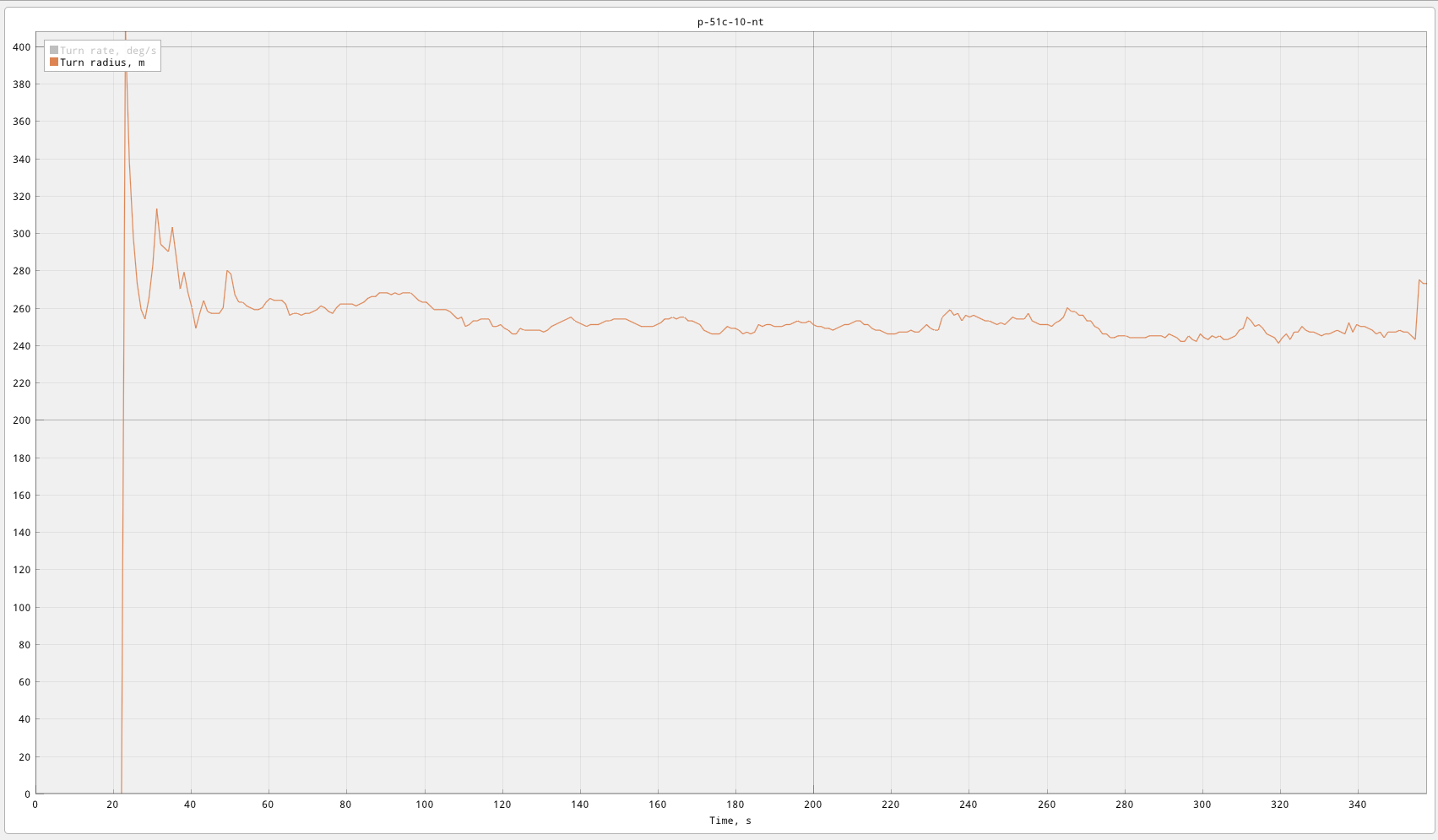
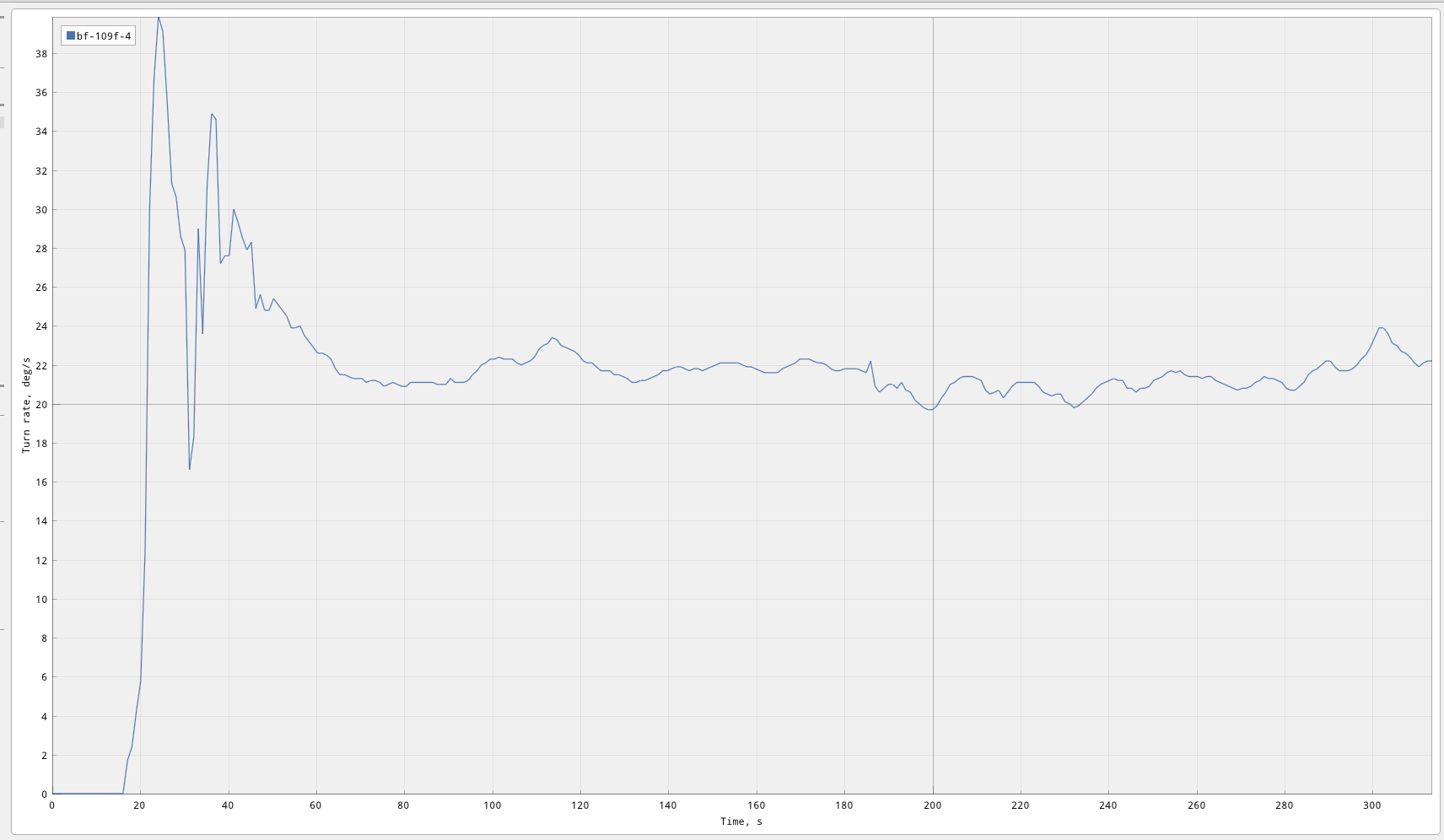
Sea level performance for the 109 F-4:
I spawned at 2km alt, dived to the deck, turned with 100% nose up trim then started turning flat on deck maintaining a 14.5-15.5 deg aoe with ~20% left rudder (minor adjustments to bob up and down as I can’t hold perfect rate) (keeping my angle slip between 0 to 1.0, as flying on perfect knife edge and perfect coordination usually leads to me losing altitude)

At 200 seconds, I swapped to manual engine controls (59% pp, 55% rads) for perma WEP.


The little dip around 30 seconds is me passing out from over-G because the 100% nose up trim is for 1.5km not 2km so I built up too much speed for what I’m used to.

Did the same with min-fuel P-51C, albeit I dunno where it’s optimal AoA is.


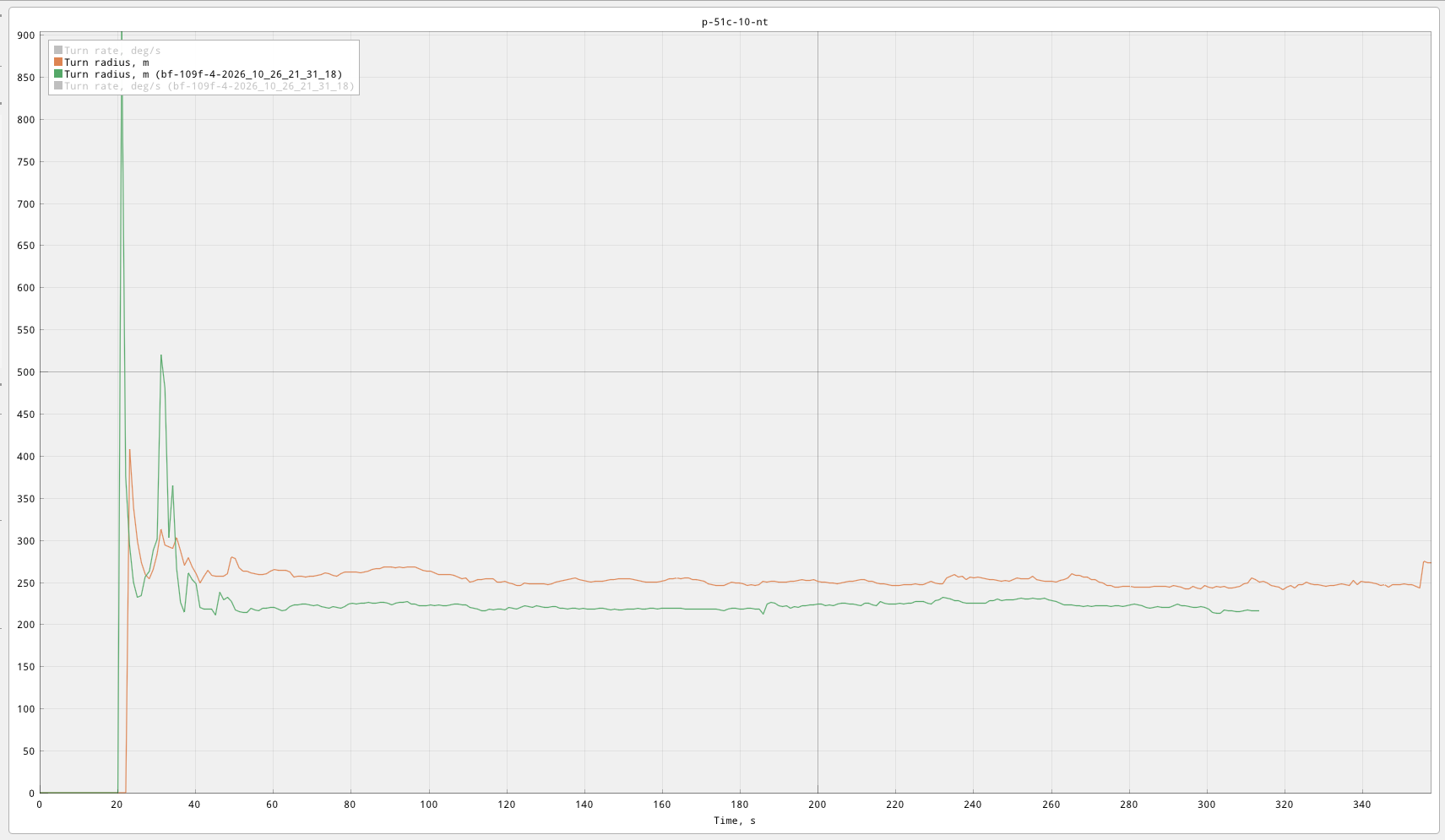
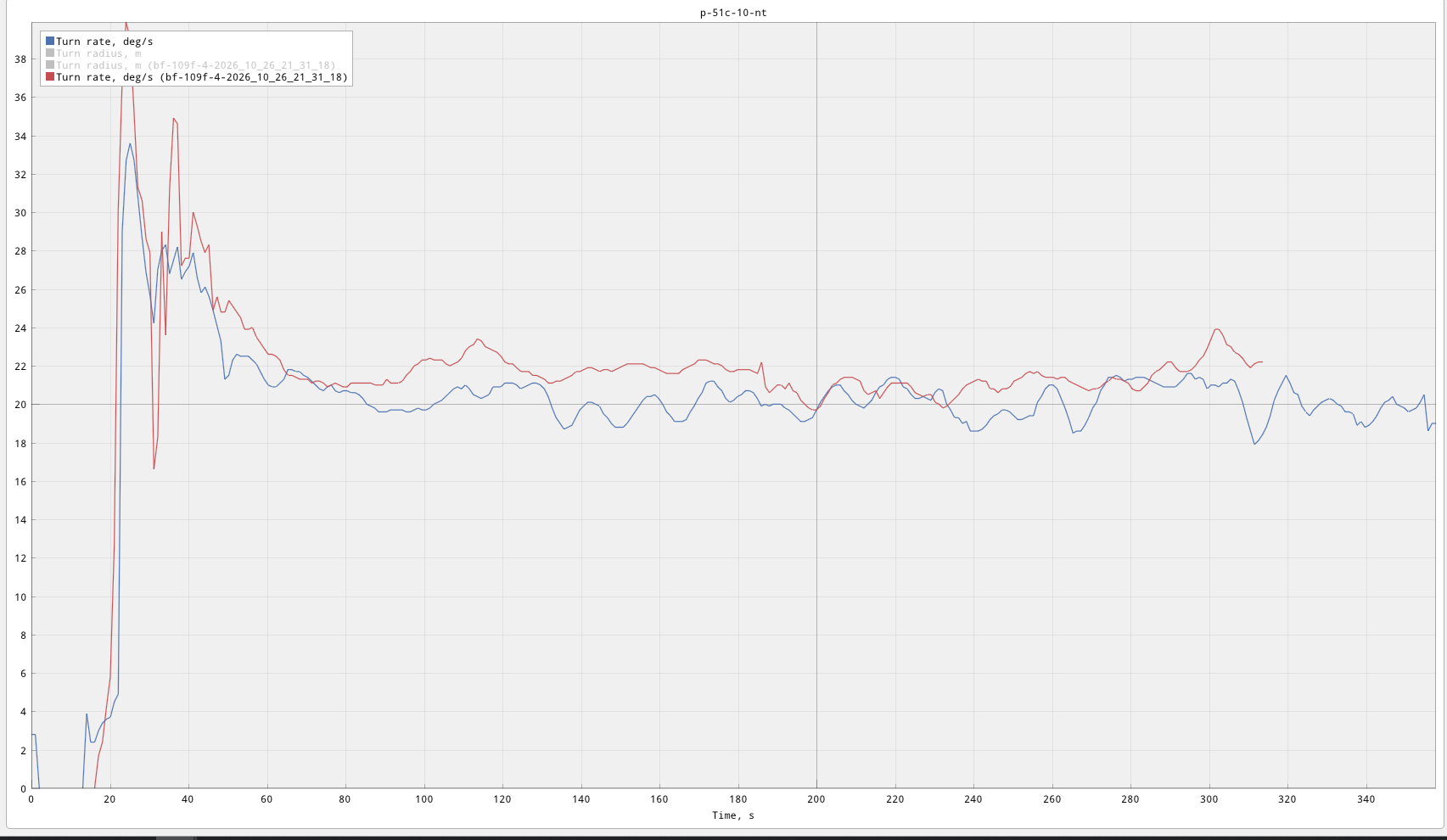
Side by side:


Maybe someone who actually spams the P-51C and can hack her MEC can get better performance out of her. But also there are people FAR, FAR better than me with the Bf 109 F-4, especially when it comes to holding optimal rate and abusing MEC. Especially abusing MEC, as kicking my 109 F-4 over into permaWEP mode is a rather precarious move of desperation on my part and it took me a bit to re-adjust my rudder and everything back until stable while some guys will casually run MEC the whole time we’re rolling avoiding over-rev and maximizing long-term energy generation and heat generation/dissipation.

And performance on deck is what actually matters most of the time given objectives are on the ground (arrows), near the ground (bombers, attackers) and mostly under 4K (A points). I have never had any reason to climb to the stratosphere outside of a random bomber hiding there being a nuissance.

The main point the P-51C has an advantage is in the insane high-speed dive into high-yoyo. We’re talking 700 km/h+ and it doesn’t last for very long either.

I held both for ~5 minutes for the sake of averaging out my skill issue in holding rate.

I’ve no idea how to reliably and reproducibly test the impact of flaps. I still suck at properly using my flaps to counter-attack too, so my own results likely wouldn’t be representative of someone who actually knows how to 109 F-4 to its maximum, but its flaps can be very stupid.

I’ll find you in-game; show me how to fly the F-4. It’ll also be my first time flying the Yak-3. I’m online right now—come find me.

Should I climb when a P-51 starts turning? Actually, I don’t even know that!

You’re just repeating things by rote. Look, Alule—even though we’ve had our disagreements—and I actually agree when it comes to the P-51. There’s no need to parrot the same points. I already explained in the comments above what kind of beast the P-51 C-10 is.

The G-6 and G-14 don’t perform better than the P-51s at their respective tiers; for starters, the P-51 doesn’t lose energy. What’s on paper doesn’t always hold true in-game—the P-51 practically hangs in the air, much like the Yak-3. Not long ago, I was in a G-6 chasing a British Mustang Mk-1; we flew 4–5 vertical loops, and it barely lost any energy. I can’t even imagine what the 5.0 BR variants are like. I seem to recall catching an enemy while flying a G-14, though I should test that again. If you’re up against a P-51 (D-5, D-10, D-30, or K-series) flown by someone who actually knows the game, you’re going to end up in a bad spot—with the possible exception of the K-4 series.

Alule, I’ve played the German tech tree for years. I absolutely hate the 109 E-series because of those FF/M cannons.

Besides, even “Star of Africa” ​​Joachim Marseille only really started to shine once the F-series arrived. I just can’t seem to get the hang of this series—though I do fine with the Fw 190 A-1.

As for the tanks, why are we even discussing the base IS-2? Why choose the standard IS-2 when the IS-2M and the 1944 model are available? Much like how one would choose the Tiger II (H) over other options, why would anyone play the T-44 when the T-44-100 is available? For that matter, the T-44-100 can destroy a Panther in a single shot—as can the IS-2. However, the IS-2M and the IS-2 (1944) are not as easily destroyed as the standard IS-2, at least according to damage tests. In Simulator mode, things aren’t quite that simple; aiming takes time, and by the time you’ve adjusted your angle, you’ve likely already been taken out in one hit from any distance.

As for the debate between the early-series Panther D and the T-34-85, both sides have a point: the Panther dominates at long range, while at close range, a mobile T-34 can strike the Panther’s turret. To be fair, the Panther D is a solid vehicle. That said, if you look at the current tech tree, a significant number of Soviet vehicles have been added for the sake of balancing—such as the KV-122, variants with the ZiS-6 gun, and the IS-1 (1945). And then there’s the monster known as the EBR 1954—take a look at that one. Yes, the Tiger I and the Panther now have to contend with the EBR 1954; as if the M18 wasn’t enough of a challenge, now we have to deal with this, too.

Furthermore, as I mentioned earlier, the T-34 and the Panzer IV complement each other perfectly—one excels in armor, the other in firepower.

It’s weeknight and I am going to bed soon (booted up WT for quick measurements only). Saturday and sunday I’m free UTC+0 10-22. I’d be happy to give things a go, I really, really like my 109 F-4!

For this, my rule of thumb is:

“Does it look like I am going to over-shoot my enemy while we’re turning in a circle? If yes, input rudder so that I roll up and put my enemy into the little notch between my engine and wing before the over-shoot moment happens then input rudder so that I can pull into the enemy.”

Done optimally, it leads to a very subtle little bobbing motion. It’s essentially a turn-circle extension but done at constant AoA to maximize your turn rate by displacing your radius out of plane over the standard extension where you ease up on the stick when the enemy is 1-2 beercans above your canopy frames (per Mike Solyom’s videos). Your cue is mostly the same tho (1-2 beercan ish) (although this has a use too to widen your turn legitimately before an attack. At least in theory. I suck at implementing it in reality. Others aren’t and kick my ass.)

In truth while stressed, I often forget about my rudder and often do it with aileron which can cause one of my wings to drop and my plane to wobble and lose energy. It’s a skill issue I’m working on.

I also think you may possibly be not pulling nearly hard enough with you 109s. I once practiced with a random guy and I found they kept way under-pulling as they were afraid of stalling, which kept giving me free turn rate wins. 109 F-4 can pull very hard and remain quite flyable AND have good energy outcomes.

2 Likes

I don’t want to sound like a broken record, but I’ve faced the P-51 C-10 model many times. I’m a fan of the F-4 myself, but liking it isn’t enough—that actually sounds like a line from a Turkish song, doesn’t it?

First of all, when dealing with any P-51 variant, your absolute last resort is to engage in low-speed turn-fighting. If an inexperienced pilot gets into that situation, they’re done for; however, a skilled pilot can perform miracles even there—I’ve even seen them out-turn opponents.

Imagine an aircraft that possesses the following: 1. Incredible maneuverability at high speeds—if you try to pursue one, it simply dives away, and at equal speeds, there’s no chance of catching it. 2. Superior straight-line acceleration compared to its rivals. 3. The ability to seemingly “hang” in the air at certain speeds. 4. Exceptional energy retention. 5. The ability to maintain that “hanging” behavior even during low-speed turns. 6. The capacity to climb back up easily from a dive, thanks to its high speed. 7. 12.7mm machine guns that act like laser weapons, capable of landing shots from extreme distances. (Personally, I can’t pull that off, though some players manage it quite well—to the point where we sometimes report them, thinking, “Surely it’s impossible to be that accurate!”)

Yes, the P-51 C-10 has all of these traits. It’s a beast that entered service in 1944. In my own brief research on the D-9, I noticed that the ability to outrun these P-51s was essentially used as a benchmark. Furthermore, following the arrival of this “beast,” the German defensive effort effectively collapsed. In fact, the Germans’ attempt to respond to these—using the D-9, K-4, and Ta 152 series against the later P-51 models—came far too late.

Here is where the problem begins:

  • When the Bf 109 F-4 (1941) and G-2 (1942) entered service—even though models like the Mustang Mk I already existed—how is it possible for the P-51 C-10 (which entered service in 1944 and saw subsequent iterations) to have a Battle Rating (BR) of 4.0?

Frankly, these BRs are complete nonsense.

For instance, the C-10 should be equivalent to the G-6; the D-5 and D-10 to the G-14; the D-20 to the G-10; and the D-30 to the K-4 series—at the very least in simulation battles. If you look at their respective entry-into-service dates, they appeared around the same time, with only a few months’ difference.

Actually, intermediate Bf 109 models could also be added to the game; that would be fun.

I’m looking forward to the Fw 190 A-3—the version with 2x MG 151 cannons and 2x 7.92mm MG machine guns. It’s high time these were added to the game.

The additional guns on the 109 series might seem to complicate things, but they significantly affect flight performance—both in terms of realism and historical accuracy. Given that the C-10 (which I mentioned earlier) and, in fact, all P-51 variants share the same general flight characteristics, I believe this should be considered an advantage—even if such an aircraft wouldn’t be the first choice for a dogfight.

Now, let’s turn to you, Mr. “Paint-program artist.”

First of all, we are talking about simulation battles.

If someone who knows how to play the EBR 1954 advances rapidly along the flanks—and doesn’t happen to run into an Italian M24 or M18 by pure chance—they can set an ambush along the enemy’s path. Since the EBR 1954 was designed based on 1950s standards, it can acquire targets extremely quickly; if it catches an enemy from the side, it can systematically destroy them, one by one, with a fire rate of one shot every 5 seconds.

Alternatively, if the player has set an ambush along a route, they can pop out the moment they hear the rumble of approaching tanks, snap onto the target, and fire. By the time the enemy tank has even managed to stop and begin turning its turret—at a “tortoise-like” pace—the EBR 1954 is already firing its second shot (at the 5-second mark), either destroying the target or allowing the player to retreat to safety. For comparison, the Tiger and Panther have a reload time of 7.4 seconds. Honestly, I still can’t fathom how this vehicle was even added to the game, given how rarely it’s actually seen in matches.

Frankly, I want the WT auf E 100 added, too—let everyone just empty their magazines!

And keep in mind, these vehicles use ammunition designed in 1951 that boasts 200 mm of penetration.

Battles involving the Tiger II (H) series often witness even more pathetic outcomes.

In this context, armor becomes completely irrelevant.

Because you are moving at high speed, you have a better grasp of the area.

Are you trying to say the Tiger 2 can’t pen 200mm rn? Are you deadass rn

1 Like

You are describi g the 109 there.

The 109 f4 is incredible at low speed maneuverability and generating energy at low speeds. The p51s turn into a brick in the same conditions.

Yes, they can theoretically run away. That is their big strength: running away and hit and run attacks. However running away does not win objectives or matches. It just allows you to reset an unfavourable engagement.

The 109f4s big strength is imo that it can do everything if done at the right time and against the right enemy. It can turn, it can climb, it can run. And it is capable of stupid nonsense at very low speeds.

Regarding the hanging i must ask: what does your rudder control look like? Proper rudder control makes a big difference for how well behaved a plane is at low speeds. Prop pitch nonsense can also help (you can get about 1/3 more thrust by using manual prop pitch in 109s under 200 km/h. Risky and needs good binds to do safely)

As for year of service: irrelevant. Performance in hands of people who know what they are doing is relevant.

A lot of late war considerations are also inconsequential in sim - namely, escort range, ease of maintenance, mass producibility. Also pilot numbers and skills of those numbers really skews things as well as quality of maintenance.

Oh and ease of engine management. Germans basically got late war tech with “move throttle and it all happens automatically” starting with the 109f4.

The 109 f4 is a plane that remains capable well up to 5.7. Possibly even at 6.0 if not for ju 288 ruining 6.0 and above. Your main weaknesses are f4u4b (stupid energy generation, stupid flaps, stupid roll, perfect visibility), re2005vdm, ki84, lf mk ix and similar. Yak3 and higher are dependent on your opponent’s skill and the fact that if there isnt a significant skill difference, yak 3 fights can take a long time leaving you vulnerable to third parties.

Honestly i prefer the 109 f4 to any of the gustavs. K4 i kinda enjoy but rarely fly because 5.7 means you have ju 288s on your team 3 out of 4 br rotations.

Drawing conclusions about the whole based on exceptions does not reveal the general reality.

As I’ve already mentioned, the F-4 performs well at low speeds—it can almost “hang” in the air—but the Yak-3 and P-51 variants can maintain their energy while also remaining capable of maneuvering at high speeds.

Furthermore, combat engagements do not last as long as you suggest; because the Yak-3 doesn’t lose energy, it can deploy its flaps at a critical moment to execute a final maneuver, easily taking down a Bf 109 that has run out of energy. The P-51 series can do much the same.

You claimed that the F-4 can do everything—but it cannot.

It does not turn better than the P-51 or the Yak-3, and at low altitudes, it is slower than both (in the case of the P-51 C-10, it is slower in every respect). After two or three maneuvers, the F-4 exhausts all its energy, whereas the P-51 and Yak-3 do not. While I’m not certain about the Yak-3’s ammunition, the P-51 C-10’s “laser-like” guns can land hits from a long distance—even if the spread is wide—and a single solid hit is often enough to finish the job. The F-4 is capable of this too, but it needs to get much closer. Naturally, there must be pros and cons; if every aircraft were identical, there would be no real competition.

You suggested that if a pilot is skilled, nothing else matters—but when both sides are equally skilled, exceptions begin to emerge.

The F-4 lacks the ability to recover energy after maneuvers, a trait that both the American series and the Russian Yak series possess.

To reiterate: a smart P-51 pilot will never engage you in a turning fight; they will use their superior speed to take a shot and then move on. If you catch one at high altitude, all they have to do is dive away to escape. In other words, imagine an aircraft that is competitive in every category—and superior in most. We call this “balance.”

As it stands, air combat simulations are already struggling to survive. So, just keep doing what you’re doing.

The Bf 109 F-4 is such an aircraft that it could even hold its own against the F-4 Phantom series.

Furthermore, the year of production makes a world of difference, as technology is constantly evolving and building upon itself. For instance, the P-51 C-10’s guns are prone to jamming, whereas the D-5’s are not; similarly, the F-4’s tail rudder can become problematic at high speeds—an issue that was rectified in the K-4 series.

You were supposed to teach me how to play the game. I’m still waiting. I can’t exactly go around scheduling appointments with you people.

*I remember you. From what I gather, you’re constantly complaining about the Ju 288.

In that case, don’t get on my tail during tank sim battles! :D

I literally gave you measured stats proving the 109 F-4 turning better than the P-51C.

The Yak-3 turns SLIIIGHTLY better than the Bf 109 F-4. A better or equal yak-3 pilot will likely beat the bf 109 F-4, but such makes the match-up fun and a good test of your person skill.

I’ll accept that the yak-3 generates energy very well.

But the P-51C? American planes struggle once they lose their energy. They’re great at staying high-speed, but not once they give that energy up.

The 109 F-4 generates energy very well. One needs only look at their respective energy-maneuvering diagrams to see where their respective SEP 0 lines lie.

They will have to engage you eventually because running away constantly doesn’t win objectives. You just need to apply pressure and either: you get the respective objective or they are forced to engage you.

This has not been an issue I faced with my 109 F-4 thus far. It’s only really relevant if you dive at extreme speeds and try to make corrections with rudder.

Weekend as I said. During weekdays I leave home at 05:40 and get home at 19:00 Hungarian time. Not exactly a lot of time to play! Some days I get WfH (like today and yesterday), but those are unpredicable (they are fall-backs for when the trains decide to not move).

.50s do have better long range sniping capability, that is true. They’re excellent guns.

Mg151/20 is kinda very dependent on having good server connectivity, I found. Bad servers with lots of desync cause a lot of sparks. Low ping healthy servers (usually before 60 minutes in the match) tend to lead to nice fireballs if you can land your shots.

Yak-3 can indeed win the long-term ratefight if the Bf 109 F-4 does not finish the job assuming the yak-3 doesn’t do something very stupid. The 109 F-4 needs to win early on in my experience.

P-51C will lose a long-term ratefight as it CANNOT generate adequate energy and it also has a wider turnradius.

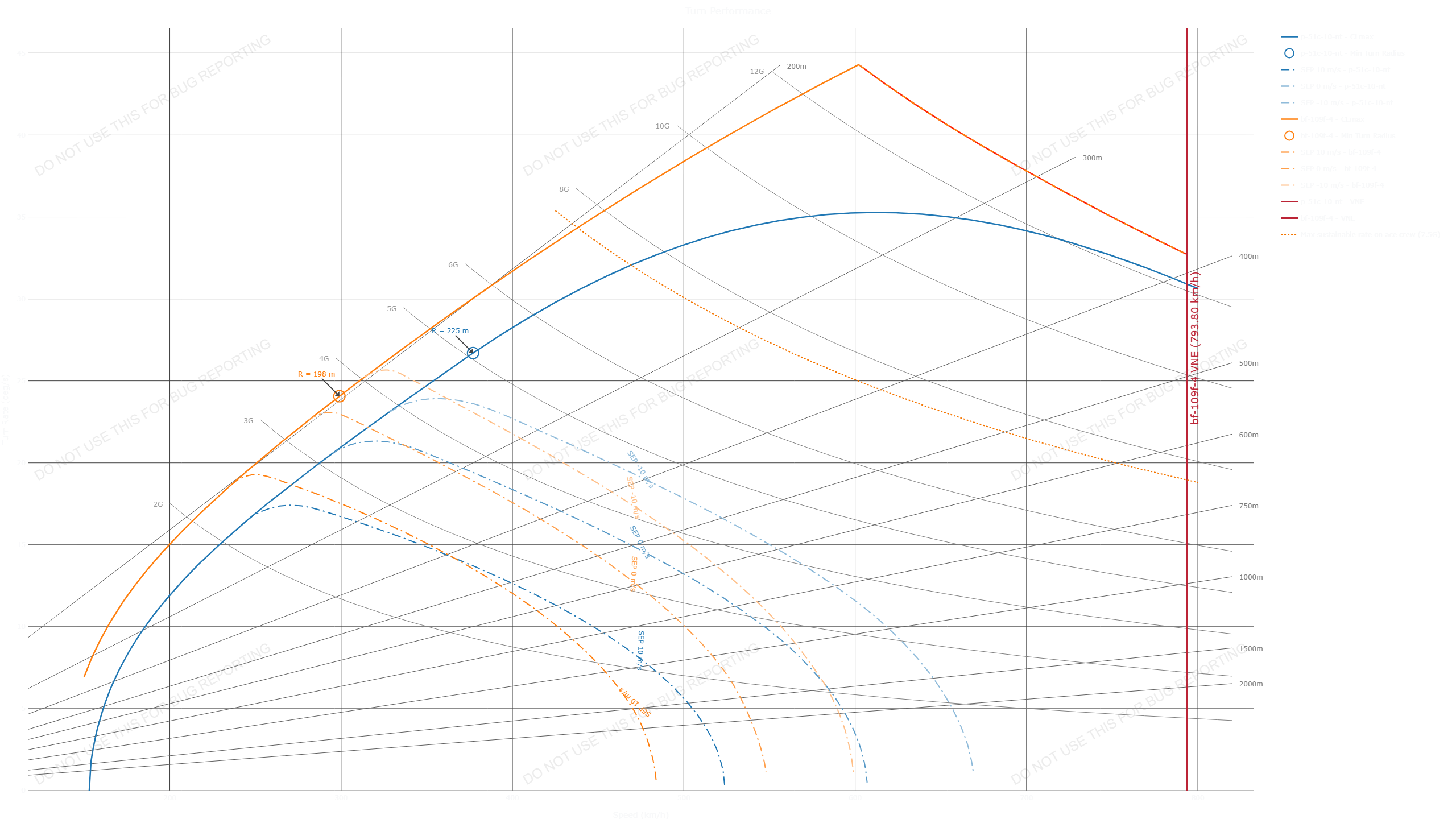
On this chart, you can clearly see that the 109 F-4 turns with a much tighter radius and with consistently higher turn rate at a SEP 0 m/s. Apply a bit of high-yoyo to extend your turn circle just enough and flaps to tighten the turn and the 109 F-4 will end the fight OR force the P-51C to jink.

The P-51C can theoretically retain its energy better at high speeds but look at its radius: it’s 400 meter or 500 meter. You can cut that off.

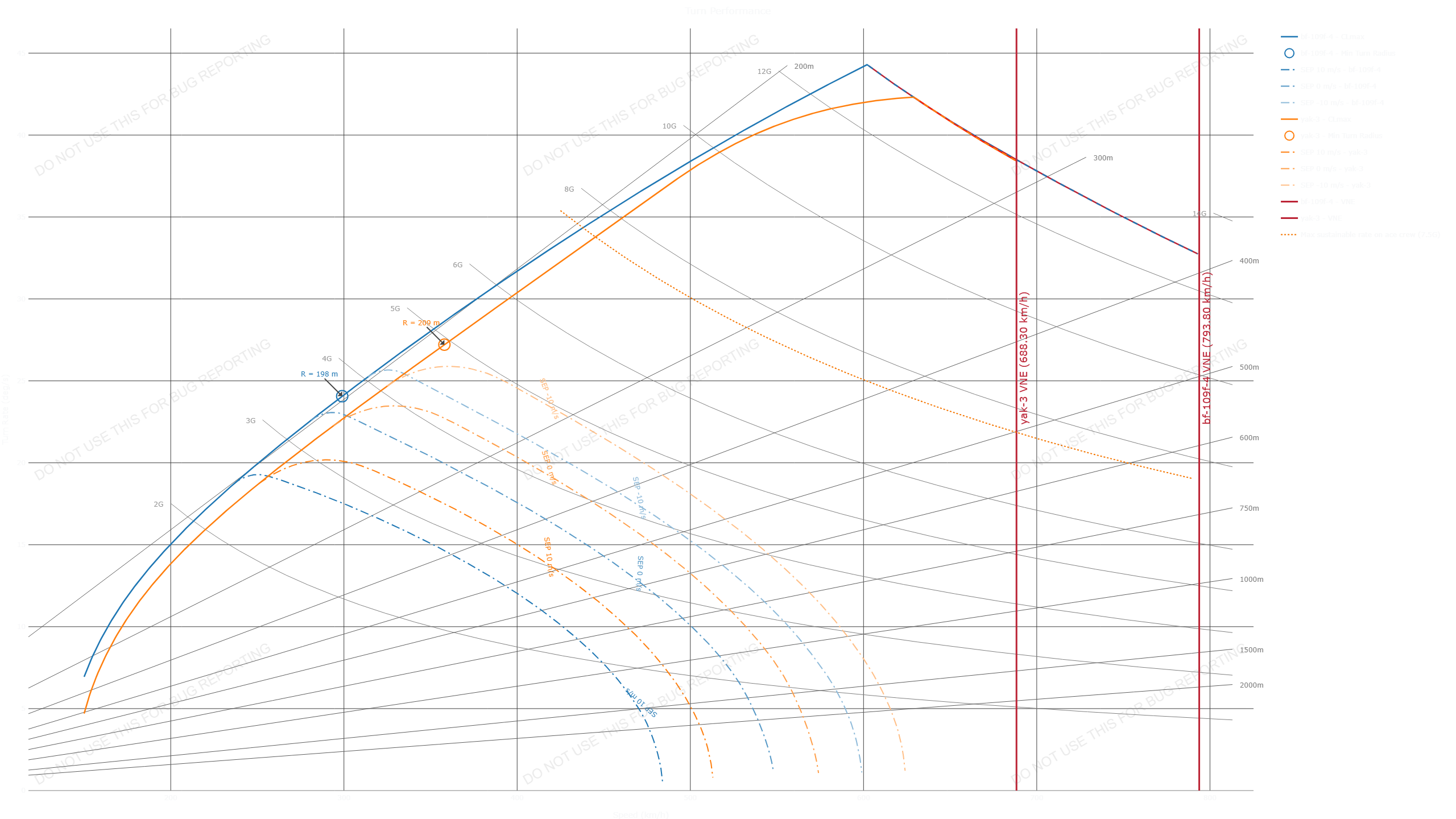
From this chart, we can see that the yak-3 will generally win extended rate as it is capable of higher sustained SEP 0 m/s turn rate. However, notice that the 109 F-4 turns a biiit tighter and can thus win early using radius, especially with flaps. But this is a VERY close call and is up to player skill differences. Complication is that the yak-3 is likewise capable of abusing its flaps (albeit harder due to rip speed and only 2 modes. I dunno how to fly the yak-3 well, not even to the theoretical level I have gathered for 109 F-4, only know of its second-hand through other people. I hate how easily it rips.).

1 Like

Alright, we’re both saying the same thing.

However, regarding the Bf 109 F-4 and the P-51 C-10, there’s a specific issue:

*We aren’t starting on equal terms.

First of all, the P-51 C-10 was produced in 1944 and designed based on lessons learned; it’s much more agile than the earlier, basic P-51 model (which I actually think is decent, though it struggles if you try to fly it like a Yak-3—whereas the P-51 C-10 and later variants hardly struggle at all!).

To begin with, this aircraft has a top speed of 708 km/h. In terms of maneuverability—partly because it carries fewer guns—it’s quite capable; it’s actually more agile than most D-series Mustangs (with the exception of the D-30).

When we get into a turn fight, the P-51 C-10 starts with a clear advantage—it enters the engagement at a much higher speed. Meanwhile, if I try to turn, a single misstep can cause my plane to wobble. The P-51 C-10, on the other hand—likely due to its wing design (a trait also seen in the Bf 109 E-series)—can execute a turn perfectly, staying locked on without any deviation. Honestly, I don’t recall ever fighting a C-10 while flying an F-4, but I have struggled against one while in a Bf 109 G-2—even though the G-2 has better speed and climb performance.

When we get into a turning duel, this guy starts with an advantage over me; he enters the engagement at a much better speed. As for me, the moment I start turning, a single wrong move makes me prone to wobbling. This fellow—likely due to his wing design, which is also a feature of the Bf 109 E series—can turn perfectly straight without any deviation. Honestly, I don’t recall ever fighting a C-10 while flying an F-4.

However, I did have a long, drawn-out fight against someone flying a 109 G-2. His aircraft held energy exceptionally well—both in the vertical and horizontal planes—so while I began to lose momentum, he kept flying as if nothing had happened, much like a Yak-3. There were moments where he gave me an opening, but I missed my shot—and he missed his, too—but eventually, as my 109 ran out of steam, I just bailed out.

To be frank, in my experience, the G-series has consistently underperformed against players who know how to handle the C-10 series well.

Also, you mentioned that I should “apply pressure.” :D But I can’t even catch the guy—how am I supposed to apply pressure? If I try to intercept him from above, but he’s positioned slightly higher, he just dives and pulls away. If I get on his tail, my wings snap; besides, it’s not just me he’s dealing with—he’ll simply shift his focus to another target. Even if you catch him at high speeds, he pulls a sharp maneuver to change direction, and by the time you recover, he’s already put distance between you. You don’t get it.

What I mean is this:

Imagine an aircraft: it’s significantly faster than the Bf 109 F-4, boasts an excellent turn radius at high speeds, maintains energy remarkably well even at low speeds, features lethal long-range weaponry, climbs impressively, and can return to its original altitude—or even higher—after a dive-and-attack maneuver. In short, it’s a bona fide “super-plane.”

The P-51 C-10, which entered service in 1944, is powered by the legendary Merlin engine and sits at a Battle Rating (BR) of 4.0.

The Bf 109 F-4 entered service in May 1941; it was the best of its time and is often cited by experts as the “best 109” variant—also at a BR of 4.0.

As for those turn-rate charts, they are practically meaningless in the context of this game. The P-51 is superior to the F-4 in every single category. Surely, the F-4 should at least be allowed to hold its own in a turn—though even that is debatable, given the various factors at play, most of which tend to disadvantage the F-4 (which is balanced based on its 1941 specifications).

This is a well-established fact, both in-game and historically. When the P-51 arrived, the only German aircraft capable of challenging it were the K-4, D-9, and Ta 152—and even then, the D-9’s effectiveness is questionable, while the K-4, despite some improvements, still suffers from similar issues (save for a slight edge in speed).

In their own reports, the Germans noted that the P-51 was still faster than the D-9 series. The Ta 152 is strong in terms of speed, energy retention, and incredible acceleration, but as a high-altitude interceptor, its wing design makes its maneuvers somewhat sluggish.

Honestly, I can’t even get any actual gameplay in because I’m too busy writing posts like this.

By the way—are you actually suggesting that the F-4 and the P-51 C-10 are equals? * They are absolutely not equal, not by a long shot. The P-51 C-10 is superior in every way. *

And in games with a 4.0 BR cap, those flying the 109 F-4 really struggle—you could even include the G-2s in that, too.
A few questions:

  1. Have you actually flown P-51C or Yak-3?
  2. Have you actually MEASURED things for P-51C or Yak-3, either via your cockpit’s heading indicator, altimeter and a stopwatch or WTRTI?
  3. Have you actually re-read what you wrote?

This is not a well-established fact.

The charts are very much meaningful in context of this game. The only time it is not meaningful is significant skill gaps (I saw a guy in a yak-3 beat 2 Spitfire LF Mk IXs. Said guy tends to do very well at dogfighting so he ran circles around them).

Also possibly in HIGHLY DYNAMIC environments, the charts can be … more of a suggestion (e.g.: proper flap usage or improper flight paths drastically affect real outcomes. The yak-3 beating those Lf Mk IX made very smart use of his trajectories while the spitfires only knew to monkeypull).

The P-51C is great. There’s no denying that. However, it is not superior in every metric to the 109 F-4: It’s only better at running away and very high-speed turns/dives.

I will happily demonstrate to you the 109 F-4 come weekend.

Sit on A-point, blow up ground targets, blow up NPC bombers, blow up his team’s player bombers, blow up his friends, harass him at the airfield. Prevent his team from blowing up your bombers or ground targets. In other words, play the objective rather than sit in the stratosphere looking pretty.

Are you using WEP? Are you saving your WEP for when it matters? I often cruise with ~1.1 ATA/60-80% throttle and only push her into 100% when near the objective and only to 110% when engaging in a fight. I usually have plenty of WEP for those moments of violence and I use it until my engine starts making scary noises and the radiator numbers start flashing.

Also G-2 is kind of the worst of all worlds. Heavier than the F-4, doesn’t have MW-50.

1 Like