Premium Hornets in post Line of Contact matchmaker - a review
Disclaimer: This review is still being worked on and might be expanded upon in the future as more clips are collected.
Foreword
Introduction of Su-30MK2 AMV and Su-30MKK in update Spearhead and Line of Contact was a pretty major shakeup to distribution of players in matchmaker.
Reasons for this are pretty much clear. Both premium Su-30s present massive upgrades in capability over their respective premium predecessors - much better radars and RWRs, IR missiles with IRCCM, access to much more potent SARHs and most importantly, access to ARH missiles.
Add to this the controversial BR reduction of F-15A and its variants to 12.7 and we find ourselves in the perfect storm…
In lieu of the aforementioned, many players are calling for “update” to their premium F/A-18C Hornets and variants with ARHs, claiming that Hornets became somewhat uncompetitive in the post Line of Contact matchmaker, specifically when facing these new ARH equipped premiums.
Some even go as far as to suggest for these theoretical ARH equipped premium Hornets to sit at 13.7 or even 13.3 to match the premium Su-30s.
But are such calls for “update” even valid?
To answer this question and to avoid the usual issue of WT forum of arguing about something without having the latest data and first hand experience, I decided to take a break from playing Su-30MKK and revisit my F/A-18C early, play it properly for the first time in several months and judge for myself whenever it remains competitive in post Line of Contact matchmaker.
The results surprised me quite a bit, but I won’t share them just yet.
Instead, let’s first take a look at what kit F/A-18C early other premium Hornets actually offer. For purposes of this comparison, we will take the US F/A-18C early as a baseline, and touch up on any differences in performance of the premium Swiss F/A-18C separately.
Flight performance
F/A-18C early (as well as CF-188A) are powered by twin General Electric F404-GE-400, each providing 7,280 kgf of thrust with afterburner on with combined thrust of 14,560 kgf. With a base weight of only 11.1t with empty tank, this gives the empty Hornet astonishing 1.31 TTW. For comparison, an empty F-15A has TTW of 1.36.
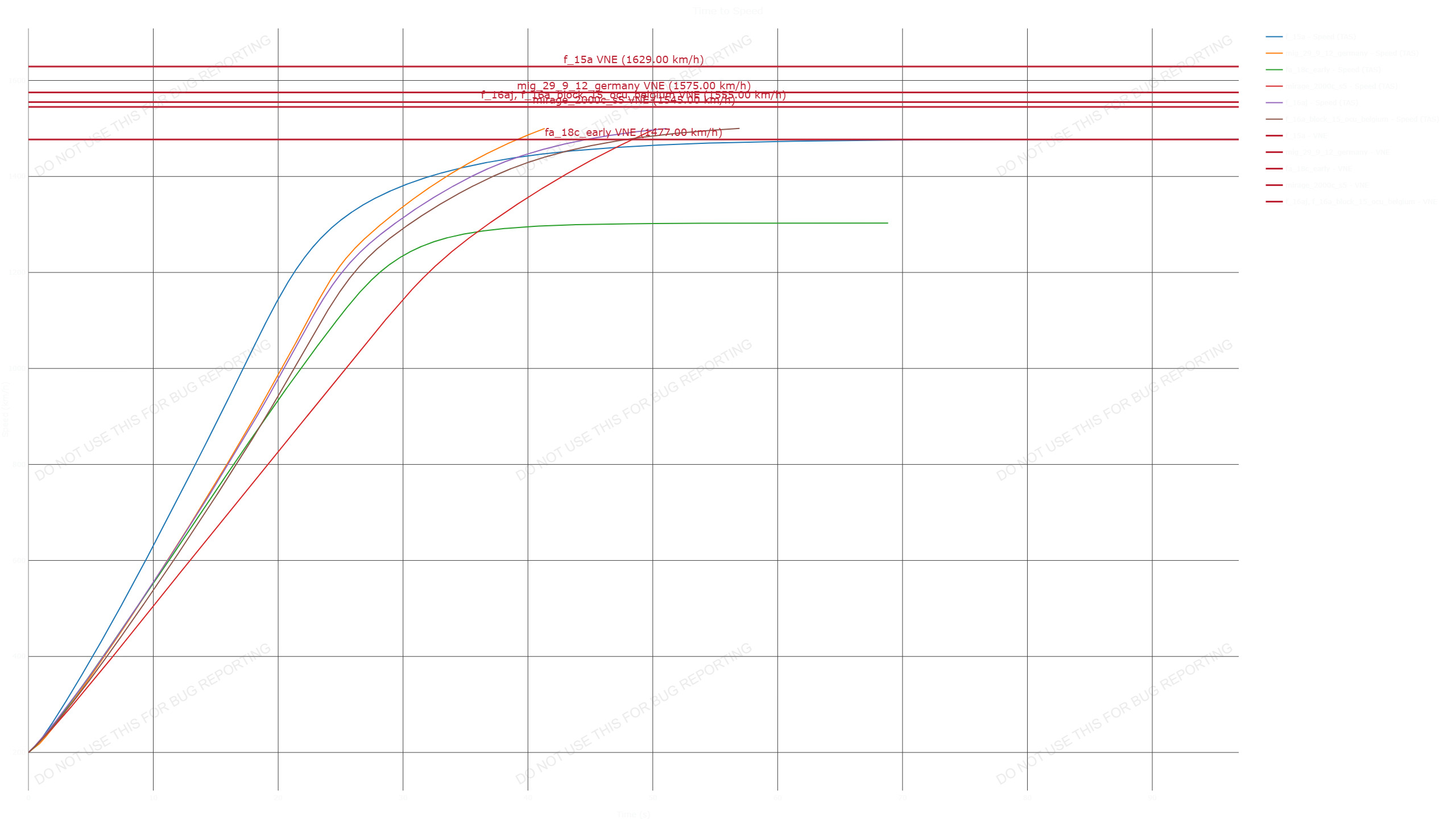
While the empty Hornet has great TTW, its max speed is poor when compared to its peers.
When compared strictly to other 12.7 planes, while somewhat similar in acceleration, it becomes clear at the first glance that the top speed is the worst out of all compared planes.
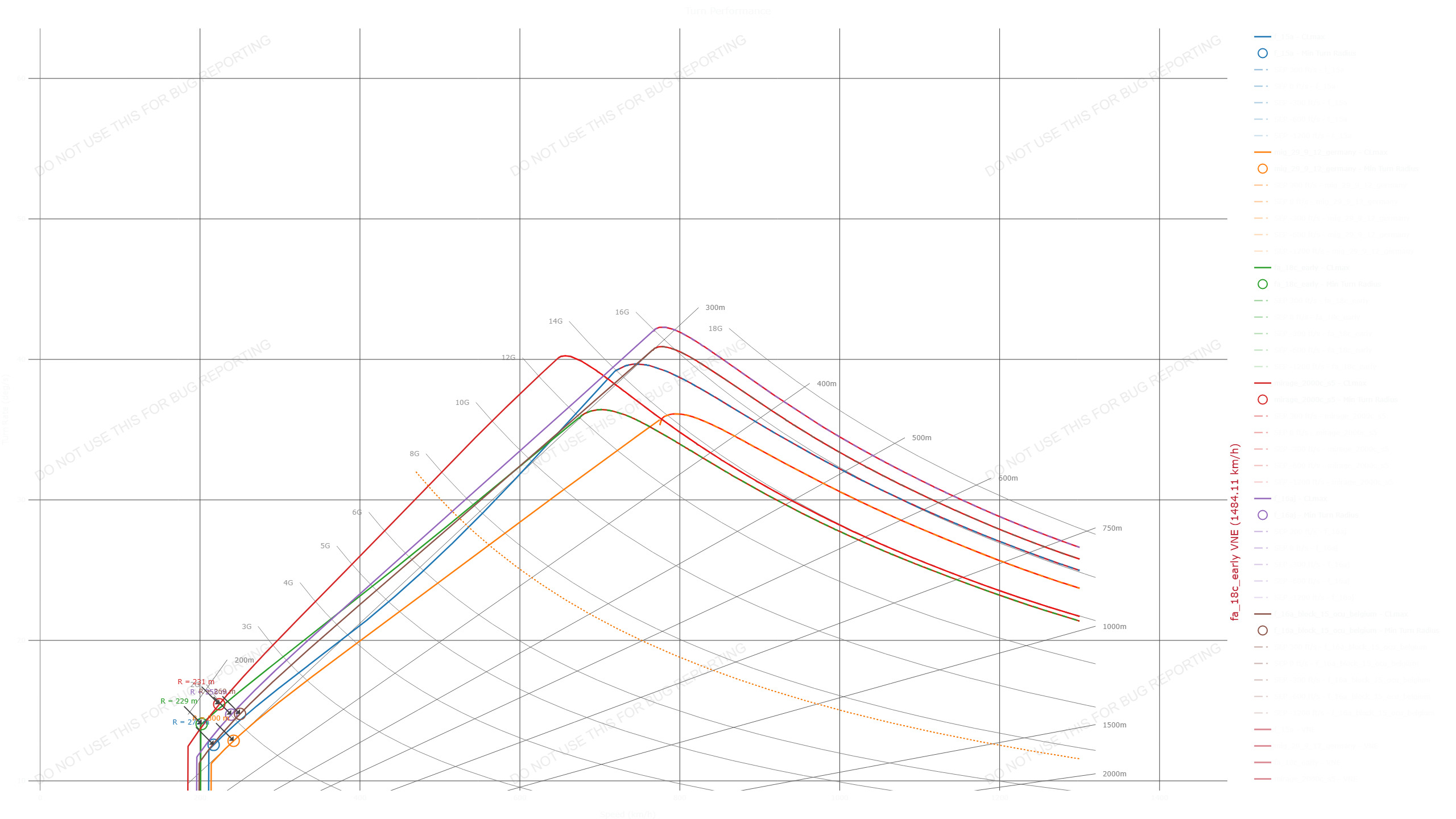
In terms of turn performance, Hornet sits in the middle of the comparison. While its peak AoA pull is not as high as some of its contemporaries, it’s still good enough to offer a solid fighting chance, as long as the player does not get caught up in sustained turnfight against F-16.
On top of this, Hornets get access to the AoA limiter on/off button. This allows Hornet to pull some funky moves, but players need to be careful with its usage, as its extremely easy to stall out in a horizontal turn with Hornet.
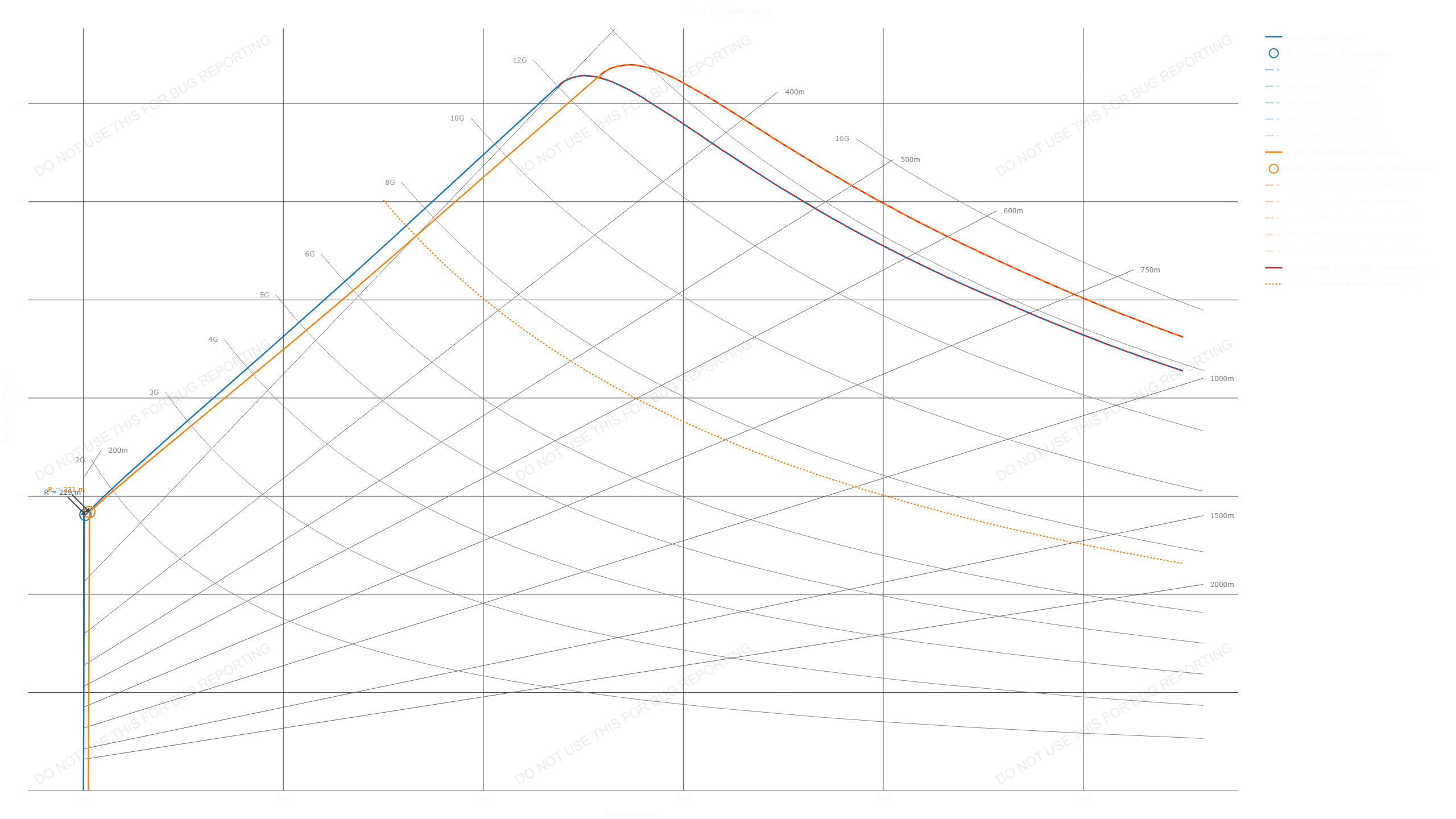
Last thing to note is the difference between the F/A-18C early/CF-188A and the premium Swiss F/A-18C. Since the Swiss variant is based on “F/A-18C late” airframe, it gets ever so slightly better engines - General Electric F404-GE-402, each providing 8,000 kgf of thrust with afterburner, a relatively large improvement over the “early” engines. The Swiss variant is also heavier by 540 kg, which means its empty TTW sits at 1.39.
The practical differences in performance between the US/CAN and Swiss variants are negligible.
Armaments
Premium Hornets offer the usual western assortment of weaponry, albeit with few unique twists:
-
Since this review focuses (mostly) on the A2A experience, I won’t be going over A2G ordnance in detail. I will however say that Hornets do offer nice possible mixes of A2A and A2G weapons, perfect for late game sorties where ground strikes might be necessary to lure out the airfield camper.
-
On the gun side of things, Hornets are equipped with the M61 20mm Vulcan with 512 rounds in store. There’s not much to say about the gun itself - it’s Vulcan, it goes brrrrr. What’s interesting tho is its placement on the airframe - centerline, directly behind radar. This eliminates any possible offset the pilot might have to deal with, offering ever so slightly better accuracy when it comes to gun fights.
-
For IR missiles, Hornet has access to AIM-9L missiles, up to 6x of them depending on the config. These also need little introduction - all-aspect Sidewinders, kinematically wise they are exactly the same as those found on Eurofighters and later aircrafts. Compared to them they however lack any IRCCM as well as smokeless motor, making them ill-suited against aware opponents or flare heavy environments (such as furballs).
-
Now comes probably THE reason for what makes the premium Hornets so special - the (relatively) unique AIM-7P Sparrows, up to 6x of them depending on the config. In all fairness these missiles would deserve their own detailed post and I love them dearly, but I decided to keep my scope relatively small for purposes of this review. While kinematically they are exactly the same as the F/M versions found on the Hornet contemporaries, they do hold one crucial ace up their sleeve - the additional IOG and DL guidance. These additional guidance modes pretty much fix the single most glaring issue of the F/M versions - the low hit probability and susceptibility to defensive measures. While R-27ER still vastly outperforms them kinematically and thus holds the crown for the best SARH missile not just on the 12.7 BR but in the game as a whole, AIM-7Ps do offer a competitive contemporary BLUFOR missile. And unlike TT Hornets, the premium Hornets are at BR where it makes sense to use them. These not only allow the premium Hornets to have one of the highest SARH missile count of ANY BLUFOR SARH carrier (on top of the 2x 9Ls that don’t interfere with Sparrow pylons), but to have the best BLUFOR SARH missiles as well, all that on a single platform.
In terms of armaments, there’s no difference between the US/CAN and Swiss variants. The Swiss variant however does get access to 120x CMs as opposed to 60x on the two, making it more sustainable in the long term. 60x CMs at 12.7 is however still workable.
Avionics
Radar wise, US/CAN variant is equipped with the advanced (relatively for the BR) AN/APG-65 radar. While not AESA, it is arguably THE best mechanical radar at 12.7.
Wide scan area, fast bar scan when using medium and wide TWS+ modes (2.4s as opposed to 3.7s on N001VE and 3.4s on AN/ANG-63 PSP), good range and free gimbal limit, basic NCTR, all of that makes for a very good 12.7 radar.
For details on the radars and their specifics, please refer to the linked
datamine, as the specifics would go way above scope of this review.
The only limiting factor is lack of HMS but hey, can’t win them all.
For RWR, Hornets are equipped with AN/ALR-67(V)2. Extremely strong digital RWR for 12.7, it effectively offers almost the same performance as the 14.0 TT Hornets. This means there’s little in terms of threats it can’t detect, and horizontal coverage is excellent too.
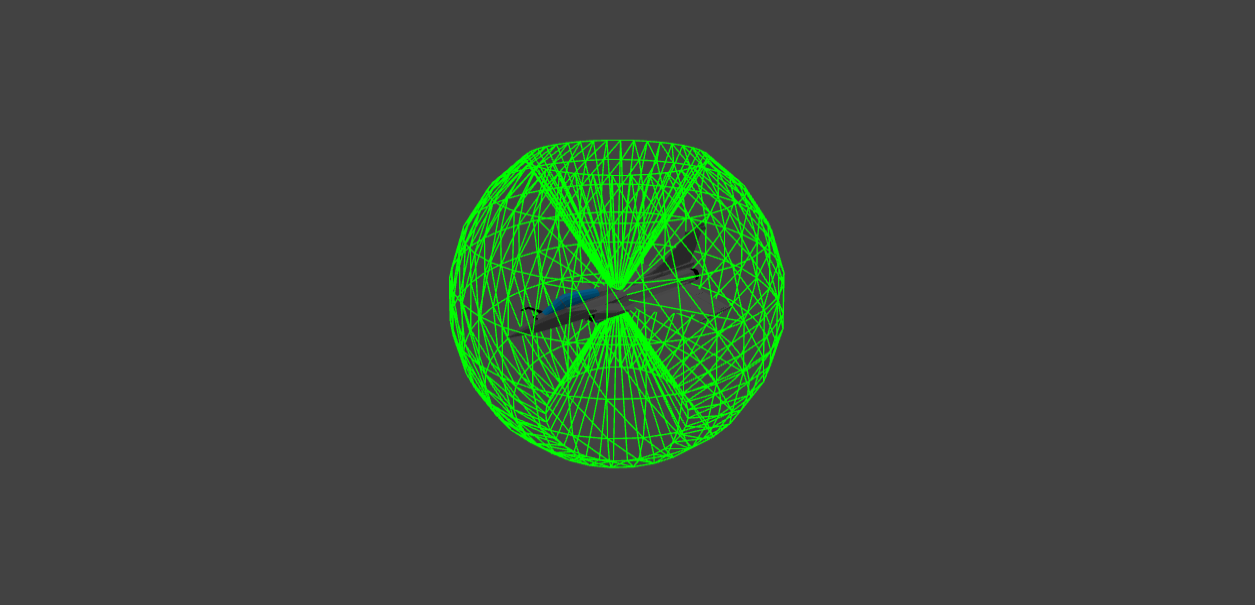
While Hornets RWR doesn’t cover the entire 360° sphere around the plane, there are few blindspots it has.
Last thing to note is the difference between the F/A-18C early/CF-188A and the premium Swiss F/A-18C. Since the Swiss variant is based on “F/A-18C late” airframe, it gets ever so slightly better radar, the AN/APG-73. The only practical difference is longer range (120km vs. 140 km) and more TWS (10 targets vs. 24 targets), otherwise the scan speeds and angles remain identical. RWR is identical between all versions. While there is no objective downside to being able to track more targets through TWS, the extra range AN/APG-73 has is an irrelevant advantage. Warthunder maps are simply too small for this to reasonably matter, and most if not all combat will happen within 30km range.
The post Line of Contact experience
Now, as advertised at the start of the review, I played the F/A-18C early for 117 games (out of 351 games total) in current matchmaker from March 22 to April 11, in order to see for myself whenever the calls for its “update” are valid.
I’ve ran with following setup:
- 2x 9L
- 6x 7P
- Air targets belt
- 20 flares / 40 chaff
- 85% fuel
- Default TWS mode, 74km range
The result?
Not only Ive performed significantly better when compared to how I played it previously (which begs the question what I was doing in the first place):
Ive also performed significantly better than I did with Su-30MKK, the supposedly superior aircraft:
So, what could possibly be the reason for this result?
Either I got lucky, it was coincidence, I am just that good or it’s the Hornets kit.
Clearly the sample size is large enough to rule out coincidence and luck.
And we can safely assume it’s not my skill either. First, I’m overall not that good when it comes to ARB and second, Hornet wouldn’t be an outlier, I’d have similar performance in other aircrafts, such as F-15A, which I also post the Line of Contact update.
This leaves the Hornets kit as the sole reason why I arrived at the results I did.
So what makes the Hornets kit so special?
FM? Middle of the pack.
CMs? 60 CMs on the US/CAN variant is pretty much standard if not on the lower end of scale for 12.7.
Weapons? 9L isn’t anything extraordinary at 12.7, and one could possibly argue that with recent additions and changes (ie. F-15A and its variants and the Belgian F-16s) it is even ever so slightly left behind. 7Ps, while amazing missiles, are kinematically still Sparrows.
Keeping the above mentioned in mind, I do believe we can safely conclude its the radar and RWR combo, or in other words unprecedented situational awareness for its BR, that makes the premium Hornets so good. This situational awareness allows the Hornet pilot to often position himself in a way that compensates for the Hornet deficiencies. However this advantage isn’t as straightforward as a better FM or more powerful missile would be, and highly depends on positioning.
The ARH question
As stated in the beginning of this review, the main drive for it was the fact that many players are calling for the addition of ARHs to the premium Hornets in lieu of the appearance of premium Su-30s to make them somehow equal or competitive.
And, one can understand why - the ARHs would undeniably open up new ways to approach the game, mostly in missile jousts where it would allow them to lead the attack while defending.
But would this be a good idea?
TL;DR: NO.
The longer answer is, premium Hornets would be worse off with ARHs, due to one thing, and one thing only - it would inevitably raise their BR, and with that, it would change their matchmaker. Hornets kit allows it to be more than competitive within its current BR spread. The sensor suite is arguably THE best 12.7 plane can get. But at higher BR, it would become less special.
Let me explain by drawing a comparison.
The Finnish F-18C Hornet sits at 14.0 and it is by many considered the worst out of all ARH Hornets currently in game. One does not need to think hard as to why. No HMD, 120 CMs with no option to increase its CM count through BOL rails while retaining the same weapon load, FM and sensor suite as the other ARH Hornets.
The conclusion to draw here is that Gaijin currently does not see an issue with a much inferior variant sharing the BR with more advanced contemporaries.
The absolute lowest they could possibly sit is 13.7, assuming they wouldn’t get a double wing rack for ARHs (and possibly not getting 9Ms either). This would substantially decrease their effectiveness, because with the current matchmaker, this would mean they can now see planes such as Rafale, E2K and Su-30SM2 in full uptier - planes with much better FMs, sensor suites and weapon loadouts.
All and all, current BR placement is a blessing for premium Hornets, allowing them to have much more favorable matchmaker and relatively much higher effectiveness.
How to Hornet
Hornet, for best results, wants to be kept both high and fast.
Faster and higher = more energy can be imprinted to the missile = less time to target = higher chance of successful interception.
Similar logic applies to defense. Faster and higher = enemy missile has to burn more energy to get to you = it’s easier to defeat.
Now as to where on map exactly the player needs to be high and fast highly depends on BR.
In downtiers, Hornet is arguably close to being THE best solo carry plane for its BR, and objectively it is one of the better choices at 12.7. Being able to carry up to 6x relatively potent SARH missiles for its BR (with possibly 2x 9Ls as backup) on top of the aforementioned situational awareness leaves little to wish for. In such situations, Hornet absolutely can be the tip of the spear, being first to engage the enemy at range thanks to its radar and 7Ps, leveraging the better positioning and situational awareness over its enemies. Sure, it might not be able to dive straight into the furball and dish out punishment left and right, but it doesn’t need to - why wrestle someone in the mud with a knife when you have a sniper rifle? It truly is the sigma lone wolf of planes.
Uptiers are a different story. ARH missiles do offer an undeniable advantage over SARHs when it comes to 1v1, and so do IRCCM IR missiles. But there are two things to note:
ARB isn’t a 1v1 duel. Each team starts with 16 players. Quality and average expiration date of such teams aside for now, Hornets situational awareness allows it to position itself in a way where it doesn’t need to be a 1v1 ARH carrier.
Hornet isn’t uniquely affected by uptiers. However it is uniquely equipped to deal with them, or at the very least mitigate the “suck” of being uptiered.
How to deal with uptiers? Simply put, dealing with uptiers in Hornet isnt that much different to other SARH only planes that got uptiered to ARH circus. Arguably, it’s easier in certain ways. Where Su-33 relies on sheer power of R-27ER and F-15A relies on its CM count and FM, Hornet needs to rely on the aforementioned situational awareness. In other words, it needs to be played smart.
A lone Hornet that gets focused on is a dead Hornet. It goes from sigma lone wolf to pack animal. Leveraging the situational awareness, the Hornet pilot should position himself in the second line, baiting enemy missiles and suppressing the enemy with his own missiles. In uptiers, missile launches are not necessarily about hitting the enemy, they are about forcing the enemy to choose between his successful interception, or eating a missile. They are about creating breathing space for his team mates so that when dust settles, there’s more blue jets in the air than red ones. While some people might see being a second line support fighter as something unfun or in extreme situations something to be ashamed of, it’s inevitably the way things are with current +1.0 BR spread. And luckily, the Hornet is a very good support fighter in uptiers.
In either scenario the pilot needs to properly utilize the Hornets radar/RWR combo. Using the radar’s wide gimbal limits, always keep the scanned area in the suspected direction of the enemy, turning the antenna either with use of key bind or manually with a mouse. Always keep an eye on any new radar contact that might appear on the RWR and learn which radars denounce which planes, and plan your encounter around that. Even the info relayed by the voice warning system might be invaluable as it tells you whenever the new radar contact is high or low, narrowing the search area. Keeping proper situational awareness is crucial for succeeding in Hornet.
For successful target interception, the best way is to have both altitude and speed, as it was outlined earlier in this post. For Hornet going around mach 1.15 at 8km altitude, max range one can expect successful target interception is 30km against non-maneuvering target at the same altitude. While launches at longer ranges are possible, they certainly aren’t reliable as they simply take too long to connect. Slower and lower player is, more his effective range diminishes. If the player is unsure about whenever the missile has enough energy to land, they can always consult their radar.
For further details, I recommend going through
Morvran’s guide on the topic, as it is highly informative and I would just rehash what he said here.
The trick with a pointy hat aka TRK MEM
TRK MEM is a relatively unknown radar mechanic that, in layman terms, allows the player to “track” his target beyond radar scan limit for a few seconds.
This mechanic effectively works as IOG for radar, providing targeting data for SARH missiles if the tracked target leaves the radar scan limit. What this effectively means is that SARH equipped planes can continue their attack for a few seconds even if they sit in perfect, ARH defeating notch.
Notice how in the second video, despite my radar cone not tracking the target aircraft, my AIM-7P is still flying on TRK and not IOG.
However this mechanic is extremely risky from my experience, as it relies mostly on timing - the impact needs to happen inside the small time window where radar is operating in TRK MEM mode. For all intended purposes, it is a parry mechanic not dissimilar to one found in From Software games. Use at your own discretion.
The other trick with a pointy hat aka stealth strike
This tactic relies on the fact that AIM-7Ps are equipped with a DL and IOG guidance modes. While SARH missiles cannot be properly guided and launched without a hardlock, they can continue to fly after the initial hardlock is released without self-destructing and then reacquire the target after it is hardlocked again, effectively giving the target decreased warning and in theory, allowing for higher hit probability over longer ranges. Many R-27ER users will recognize this “trick” as something they performed before on their MiG-29s or Su-27/33. Beside the differences in kinematic performance of missiles, trick remains the same in execution bar Hornets radar having much easier time reacquiring the target.
Finally Id like to offer my thanks to @Morvran and @MiGoon_Fox-3 for consulting with me on making this guide.