History
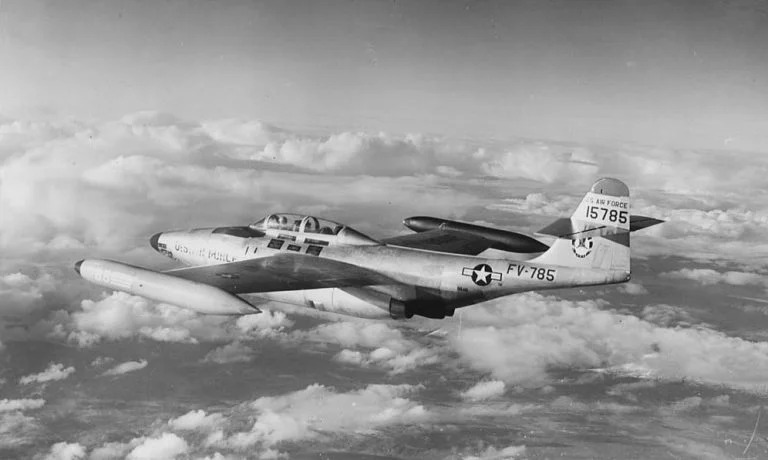
The F-89C was the first major production version of the Scorpion and the final cannon-armed variant of the aircraft. It incorporated all the changes demanded by the Air Force to make the F-89A a fully operational and safe aircraft. Externally, the F-89C differed little from the F-89B except for the addition of a tip tank fuel-dumping system, a selective cabin air-conditioning and pressurization system, and aerodynamically balanced, strengthened elevators with internal mass balances instead of the external mass balance horns used on earlier elevators. Center framing was also added to strengthen the canopy.
A note in the F-89C SAC states that a letter, dated May 13, 1953, deleted the provisions for bombs and rockets that had been included on earlier aircraft. As a result, the six 20 mm cannons were the only armament that could be carried by the F-89C.
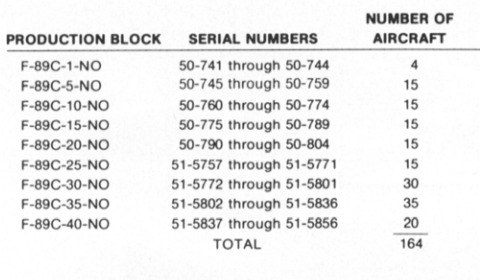
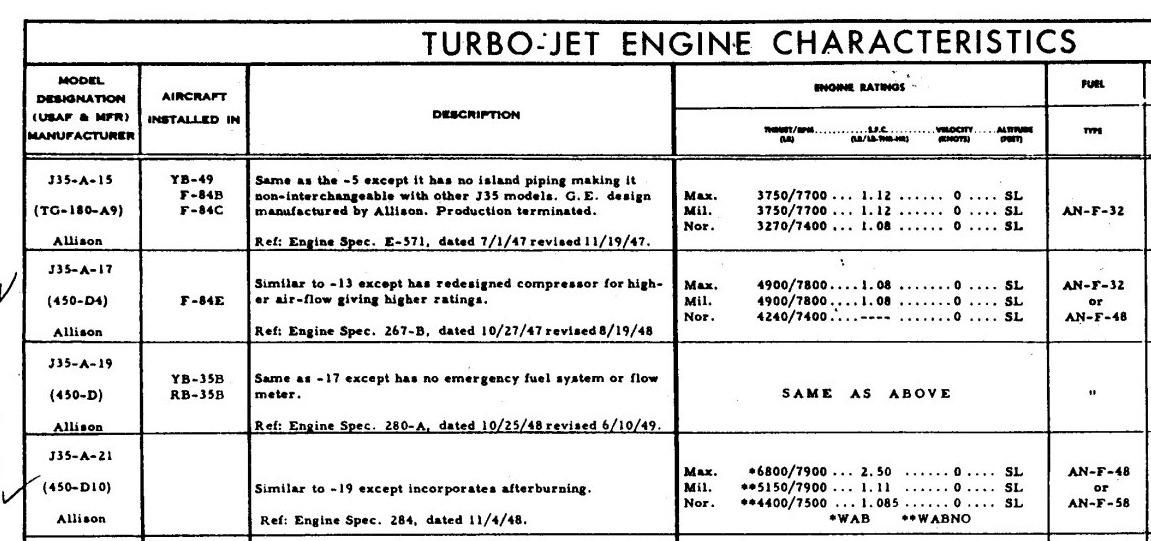
A total of 164 F-89Cs were built, and this number was high enough for the production run to be assigned nine different block numbers as follows: F-89C-1-NO and F-89C-5-NO through F-89C-40-NO. Initially, the early F-89C models were powered by the J35-A-21 previously used on the F-89A and F-89B. Blocks 15 and 20 received the J35-A-21A, which improved engine reliability. Blocks 25 and 30 were built with the J35-A-33, while Blocks 35 and 40 had the J35-A-33A installed. As improved versions of the engines became available, they were usually retrofitted to earlier aircraft as well. The adoption of the J35-A-33A engine resulted in greater power, but it required a redesigned inlet, deicing equipment, inlet guide vanes, and redesigned forward engine mounts for the F-89C.
One problem was that the intakes, being low on the fuselage and close to the ground, acted like huge vacuum cleaners, ingesting anything the aircraft rolled over. To rectify this problem, a retractable inlet screen was added to the -33A engines and became standard on all subsequent F-89 variants.
The Air Force accepted the first F-89C in September 1951, and the first unit to receive the aircraft was the 74th Fighter Interceptor Squadron at Presque Isle AFB, Maine, in January 1952. The 27th FIS, the 57th FIS, and the 433rd FIS were the only three other Regular Air Force squadrons to receive F-89Cs before the aircraft were transferred to the Air National Guard.
During early 1952, several F-89Cs crashed due to structural wing failures for no apparent reason. On February 25, 1952, an F-89C broke apart in midair and crashed. Five more similar in-flight breakups occurred in quick succession. The last of these took place on September 22, 1952, while the aircraft was flying at the International Aeronautical Exhibition in Detroit, Michigan. Ever-increasing flight restrictions failed to prevent the accidents, and after the September 22 crash, the entire fleet of F-89s was once again grounded, except for those used in flight testing, and production was suspended until the cause of these disastrous crashes could be determined.
It was eventually discovered that the problem was caused by the wing attachment points failing under certain high-G maneuvers and by a previously unfamiliar phenomenon, known at the time as aeroelasticity, involving aerodynamic twisting of the wings. The only solution was to strengthen the wing where it attached to the fuselage and to add small stabilization fins to the outer aft ends of the tip tanks. A total of 194 F-89As, Bs, and Cs were ferried back to Northrop by company crews, where they were fitted with the modified wings. Before the fleet was cleared to fly once again, a total of fourteen months had passed. The same fix also had to be applied to the F-89Ds that were already coming off the production line. By the time all of the F-89Cs had been modified, they had become some of the safest aircraft in the Air Force. Following its transfer to Thule, Greenland, the 74th FIS completed a full year without an accident of any kind.
As part of service modifications, the final engine installed in the F-89C was the J35-A-47. It was a modified version of the J35-A-35. The maximum performance of the J35-A-47 engine was superior to that of the -33A and -41 engines, especially at higher altitudes, because of the greater thrust augmentation provided by its high-altitude afterburner. The J35-A-47 engines were originally installed in F-89D Blocks -1 through -20, but the F-89B and F-89C were also upgraded to the -47 engines during their final years of service.
The F-89C was phased out of active Air Force service during 1954 as newer F-89 variants became available in greater numbers. The aircraft were transferred to the Air National Guard, where they became a vital part of its interceptor force, equipping approximately seven squadrons in the northern-tier states. Air National Guard squadrons continued flying the F-89C well into the 1960s.