History
In July and August 1945, the Army Air Technical Service Command of the Army Air Forces established a set of requirements for a next-generation all-weather night fighter to succeed Northrop’s commercially successful P-61 Black Widow night fighter. It was originally specified to be a propeller-driven fighter with a top speed of 550 mph at sea level, a rate of climb sufficient to reach 35,000 ft in 12 minutes, and a combat radius of 600 miles. The document outlining these requirements was known as the Military Characteristics for All-Weather Fighting Aircraft. Six manufacturers. Bell, Consolidated-Vultee, Curtiss, Douglas, Goodyear, and Northrop all responded by submitting design proposals, with Northrop submitting four different proposals in total.
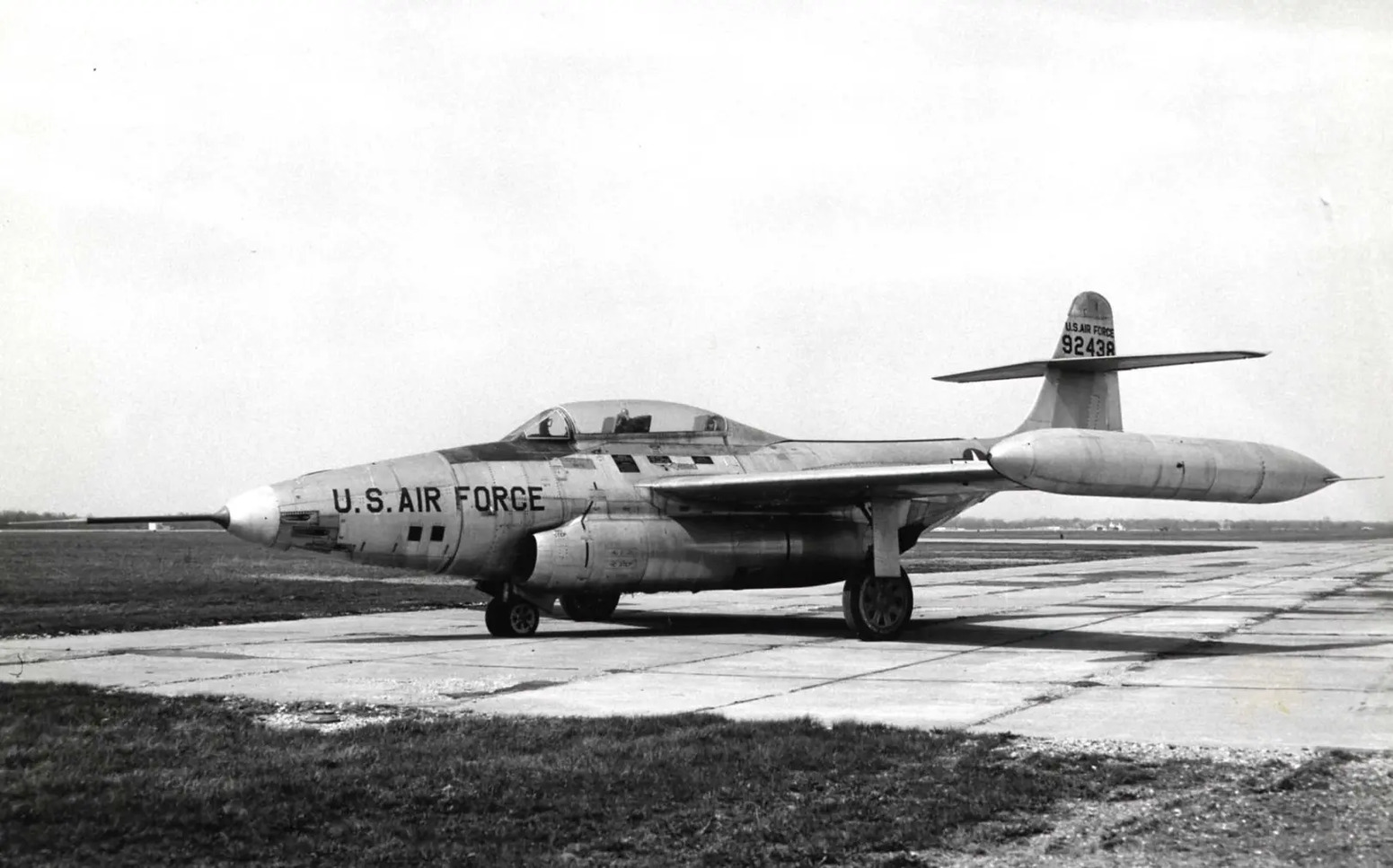
All of the design proposals had one thing in common: they were jet-powered. Propeller-driven aircraft technology simply could not achieve the Army’s required top speed of over 500 mph. One of Northrop’s four proposals won the competition, leading to a contract for two all-weather fighter prototypes under the designation XP-89 on May 3, 1946. The XP-89 emerged as a typical Northrop design. The aircraft was large and incorporated several unique features. The wings were very thin and had a low aspect ratio, acting much like a swept-back design by providing the speed advantages of a swept wing without the low-speed stability problems inherent in early swept-wing aircraft. The thin, straight wing also accommodated an internal fuel cell and could carry various wingtip stores. It included a combination aileron/dive brake/flap known as the Deceleron. The ailerons were split lengthwise and could operate in one of three ways. With both halves working together, the Deceleron functioned as a normal aileron system. It could also operate in conjunction with the flaps, creating a full-span flap for landing. When speed brakes were needed, the Decelerons split open like a clamshell.
The XP-89 was powered by two Allison-designed, 4,000-lbf General Electric TG-180-01 engines mounted under the fuselage. The aircraft’s armament was originally planned to consist of four M24 20 mm cannons. Originally, it was proposed that these four cannons be mounted in a movable turret, but this idea was later dropped in favor of a more conventional fixed-gun arrangement. Provisions were also included for two 1,600-pound bombs or up to twelve 5-inch rockets under the wings. The number of rockets that could be carried was later increased to sixteen. The tail was mounted high, with the horizontal stabilizer and elevators located well up on the vertical tail. This high tail gave the aircraft the appearance of an angry scorpion ready to strike and is credited with inspiring the aircraft’s nickname. However, some Northrop engineers claimed that the name was also a logical follow-on to the Black Widow nickname applied to their earlier P-61.
A mockup inspection was held in September 1946, and several deficiencies were discovered. After Northrop made many of the specified corrections, a second mockup inspection was held in December. Although further changes were ordered, Northrop was permitted to proceed with construction of the aircraft. The first XP-89 prototype was completed and rolled out of Northrop’s Hawthorne, California, assembly plant during the summer of 1948. After a number of taxi and brake tests at Northrop Field, the prototype was transported by truck to Muroc Dry Lake (later Edwards Air Force Base), north of Los Angeles, and made its initial flight on August 16, 1948.
In October, other all-weather interceptor designs were also reviewed. These included the Curtiss XF-87 and the Douglas XF3D Skyknight, which was being developed for the Navy. The evaluation team consisted of experienced interceptor (night fighter) pilots, radar operators (ROs), and crew chiefs. Cockpit arrangement (seating) was won by the XF-87, with the XF3D Skyknight placing second. Ease of maintenance went to the Skyknight, with the XF-87 in second place. Although the XF-89 ranked last in most categories, the evaluation team voted to procure it over the other two aircraft. The reason for this recommendation was simply stated by one member of the team: the XF-89 was a better fighter and had superior developmental potential. Consequently, this decision canceled Curtiss’ contract to build 88 F-87 Blackhawks and marked the end of its role as a military aircraft manufacturer.
The beginning of the Cold War standoff with the Soviet Union emphasized the need for air defense to protect the North American continent from attack by advanced Soviet strategic bombers. The Soviets had exploded their first atomic bomb during 1949, and the USAF knew it was imperative to have a new generation of interceptors ready to defend the homeland against Soviet bombers carrying atomic weapons over the polar routes. With that concern in mind, the first order for modification of the second XF-89 and 48 production F-89As was placed in July 1949. This was followed by a subsequent order for twenty-seven F-89As in September of that year. The second XF-89 was accepted by the Air Force in July 1949, and its nose was completely redesigned to house six fixed forward-firing 20 mm cannons. The redesigned aircraft was designated the YF-89, accepted by the USAF, and made its first flight on November 15, 1949. However, on February 22, 1950, the original XF-89 prototype was destroyed in a crash during its 102nd test flight. The cause of the crash was determined to be the failure of the right horizontal stabilizer due to stabilizer/elevator flutter. Air Force investigators found that many of the problems previously identified on the F-89, including tail flutter, had not been corrected in the XF-89. As a result, the YF-89 was grounded for further changes, and F-89A production was halted, with only three aircraft near completion being accepted.
The changes demanded by the Air Force for the YF-89 were extensive. The nose was completely redesigned, becoming more tapered and approximately three feet longer. Armament now consisted of six cannons and an AN/ARC-33 radar coupled to a Hughes E-1 Fire Control System (FCS). The 4,000-lbf J35-GE-3 engines were replaced with 5,200-lbf J35-A-21 turbojets. These engines were equipped with afterburners that increased their thrust to 6,800 lbf. The engine air intakes were redesigned to include external boundary-layer bleed ramps, and auxiliary pop-in doors were added to the nacelles to supply additional air during ground engine operations. The engine exhaust area was also extensively modified. Engineers believed that the tail flutter problem was caused by pulsations from the jet exhaust traveling up the rear fuselage and vertical tail. These pulsations caused the horizontal tail to flutter. To correct the problem, deflector plates were added to the fuselage behind the engine exhaust. Later, a more complex “jet wake fairing” was added under the rear fuselage to deflect the exhaust away from the tail area. The final modification made to the YF-89 was the replacement of the jettisonable 300-gallon wingtip fuel tanks with permanently mounted, more streamlined 300-gallon tanks. On June 27, 1950, the modified prototype, redesignated the YF-89A, made its first flight with the design deficiencies corrected, and the F-89 flight test program resumed.
The first production F-89A was accepted by the Air Force on September 28, 1950, followed by the second and third aircraft within a few weeks. All three F-89As were virtually identical to the YF-89A and included the “quick fix” modification intended to cure the stabilizer/elevator flutter. This modification consisted of a series of external mass-balance horns, known as “ice tongs,” attached to the hinge area of the horizontal stabilizer/elevator. Additionally, the under-fuselage exhaust deflector fairing was modified, and several different fairing designs were tested before the final jet wake fairing design was adopted.
With these changes, the tail flutter problem was finally resolved, and production of the F-89A resumed in January 1951. Final production of the F-89A was limited to eighteen aircraft. Enough changes had been made that the Air Force redesignated the remainder of the production run as either the F-89B or F-89C. Of the eighteen F-89As accepted by the Air Force, nine were retained as test aircraft, while the remainder were used as maintenance trainers. Eventually, a small number were delivered to operational units during the summer of 1952, nearly a year after the F-89B entered service. These aircraft were assigned to Hamilton AFB, California, and the 84th Fighter Interceptor Squadron. They remained there only briefly before being replaced by F-89Bs. By mid-1952, with flight testing and tactical evaluation complete, some of the F-89As were reassigned to the two operational units flying the F-89B: the 83rd and 84th Fighter Interceptor Squadrons, both based at Hamilton Air Force Base.
The F-89B was identical to the late-production F-89A equipped with the external mass-balance horns. Internally, the F-89B differed from the YF-89A/F-89A through the installation of a Lear F-5 autopilot, an instrument landing system (ILS), and a Sperry Zero Reader, which combined the functions of an artificial horizon, directional gyro, magnetic compass, and altimeter. A total of thirty-seven F-89Bs were completed before production ceased in September 1951. By 1954, all F-89As and F-89Bs had been transferred from Air Defense Command to the Air National Guard.