But the Viggen is a particularly notable example, thanks to the massive nerf that murdered it’s energy retention. It really cannot be understated how much worse it is now. You can pretty much only outdogfight stuff that’s already at a crippling energy disadvantage, and even then you have to fly kinda carefully since most planes will outaccelerate a Viggen at low speed, meaning if you bleed your speed too early and don’t get the shot, he will start to outrate you.
Your plane can do Mach 2? Didn’t know MiG-25s got AIM-7s…
Seriously though, it might be going about the same speed as your plane at long ranges, but it spent most of the time closing the distance above Mach 2. Unless you fire it at such short range that it doesn’t have time for the sustainer to get it up to it’s top speed, you won’t be wandering too close to the enemy. But speaking of that.
Why would I be firing an AIM-7F at only 10 km? Especially at medium altitude, where it’s effective range is practically double that. Under those conditions, I’d be firing off my AIM-7F at closer to 18 km and instantly cranking. This forces the enemy into an awkward position. They can’t fire at me with any missile outside an ER and expect it to hit, and even if they do I’m already in a good position to notch it. This forces them defensive, bleeding them of speed and position until they’re in a sitauation where they cannot dodge my followup.
The only time I’d be firing at someone within 10 km is A) A followup shot after my first F missed, in which case that intial long range F shot already set the tempo of the engagement or B) I got jumpscared by someone popping up unexpectedly. In which case, the F is still just as good as the E-2. The F will always be just about as good as the E-2 at it’s worst, and significantly better at it’s best.
Literally when did I say this?
All I’ve said was that the F was a better missile than the E-2/Skyflash due to it’s substantially better long range performance without sacrificing much close range performance.
I think id also like to add that even if you fired both an Aim-7E-2 (I assume in this case actually a Skyflash DF) and an Aim-7F at the same ranges, the Aim-7F still has far more energy to use. Impacting around 1 second before the Skyflash DF and being able to pull a lot more effectively.
10km is my usual max launch range for the Skyflash DF, under ideal conditions, in something pretty quick like the FGR2. Its not got a lot of energy left by the time it reaches the target. (not got much first hand experience with Aim-7F specifically, but Skyflash STs, 10km is probably in the LSZ)
Exactly. If I know an E-2 (or Skyflash) is being fired at me from medium/longish range, I know I don’t even have to notch. I can just dive down into thicker air and pull a gentle S turn before lightly cranking. This enables me to defeat it pretty trivially with no real loss of position and minimal loss to energy. If I want to maintain energy, I can just turn out, and it’ll never catch me unless it’s fired from literal point blank range.
Against an F, I have to notch or multipath it unless it’s fired from absurd ranges.
Or I can try to roll it, but that’s even more effective against an E-2 that’s burnt out.
Yeah, it’s still burning. You fire a missile at an incoming target, he’s still going to be heading around 900-1200kmh. So he’s still speeding himself towards the missile,
Do you just not shoot a follow up if your first was defeated? You’re thinking in a vacuum again.
Okay. I’m taking E-2s, I’m wanting to brawl people. Not sit there for 30 secs just to be multipathed or someone does a barrel roll. This isn’t AMRAAMS or MICAs or R-77-1s There’s no super special secret positioning in a BR where you’re flying around at 80km away from your opponent and you spend 5 minutes just to throw some missiles to be multi-pathed or the enemy inadvertently notches it because he’s dealing with someone else
“You don’t understand. You can only point out my explicit beliefs, not implicit.”
And I simply pointed out that within 10kms, The missiles have a similar impact point. Especially if someone jousts. And if you follow your AIM-7F from 20km, the missiles are slow enough you will nearly be in the single digits of kilometers by the time your missile reaches your opponent. Both factual statements. Oh and E-2 off the rail performance is better.
Ah. Ad hominems. The basis of all strong arguments. But since you seem insistent on this point.
The AIM-7F breaks Mach 2 (AKA around twice as fast as you’re likely to be when launching it) at just 3.5 seconds after launch. It retains that speed advantage out to around 18 km, where it’s going a mere 1200 kph.
If you are somehow keeping up with an AIM-7F during this period, you’re either taking them on an F-15E for some reason, or you’re lying.
I covered this already, but forcing the enemy to fly defensive to defeat a credible missile (Sacrificing both positioning and energy) is a sizable advantage.
Not to mention that this also means that you’re closing to well within his SARH weapon range. This is particularly notable given that you’re often fighting the MiG-23 swarm with R24Rs, which are substantially better than the E-2 within 10 km.
You have the largest supply of SARH missiles at any tier where these missiles are relevant, burning one to force an enemy to defend is a good trade early game.
AIM-7E2s are just as susceptible to being multipathed or corkscrewed. Even more so, as you will have a hard time engaging people at an altitude where they can’t do so just by diving a little.
If this is your experience, you’re lacking in both positioning and target selection.
Firstly, a plane can only notch one direction at once. Accordingly, if you’re positioned in such a way that you’re firing from one angle, and a friendly is firing from a seperate one with similar timing, your enemy is likely screwed.
He’d have to multipath both, or get the timings just right to notch both missiles sequentially, or know he can notch one while corkscrewing another. And that’s if he’s not tunnel visioned on the first missile.
Secondly, if you pick your targets well, there’s very little risk of them accidentally defeating a missile.
Step 1: Don’t fire at targets at low altitude unless you’re A) Directly above them, leading to a top down attack that can’t be multipathed or B) Surprising them at point blank range when they pitch up for something. Otherwise, understand that it’s a gamble.
Step 2: Don’t fire at a target that’s already defending, or is already being engaged by friendlies from your broad bearing. He’s likely to either die before you missile gets there, or defeat your missile incidentally.
BVR engagements require a very different playstyle than simple treetop brawling, but are no less consistent when you perform it correctly.
“It’s not a strawman if I’m pretty sure this is what he actually believes, despite what he’s saying.”
I think you mean only if someone doesn’t joust. Since if they pull any sort of crank after firing a missile, instead of barrelling headon towards the bright, glowing spot on their RWR, then this happens.
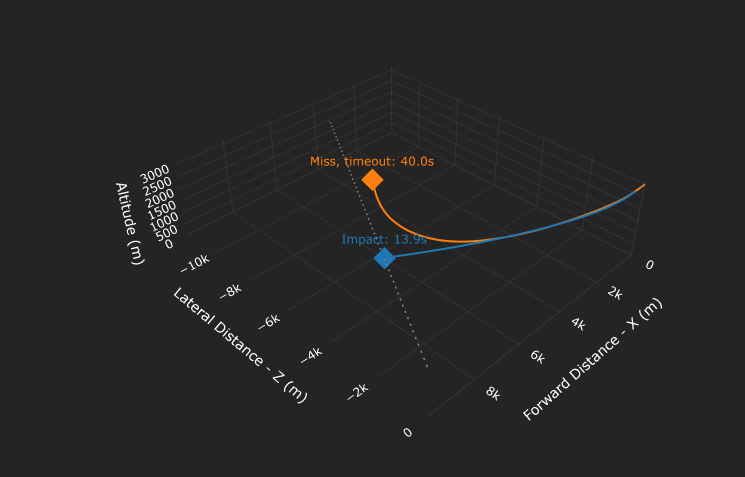
This is a 60 degree crank (Well within most plane’s RADAR gimbal limit at the tier) from 10 km of a target going the same speed as the launching plane. As you can see, even without notching or really any manuevers at all, the E-2 runs out of energy long before it’s anywhere close to the enemy, while the AIM-7F slaps him out of the sky in just under 14 seconds.
And this is pretty favourably unrealistic. If the target actually does manuever a bit to force the missiles to pull more lead, the E-2 would time out far sooner. If he dove towards the deck, the thicker air would slow the E-2 down more than the F. If the target did an S turn, the E-2 would fall out of the air long after the F slapped him.
Of course, if the target pulls out of the crank and into a notch, he’ll defeat both missiles. But he has to do that to defeat an F. Against an E-2, he knows that he can just sit in his crank in complete safety, possibly while guiding another missile at you.
I specified low altitude, IE 1000 meters. In the thicker air, the E-2’s weaker delta V has it quickly bleed it’s speed and end up slower than the F.
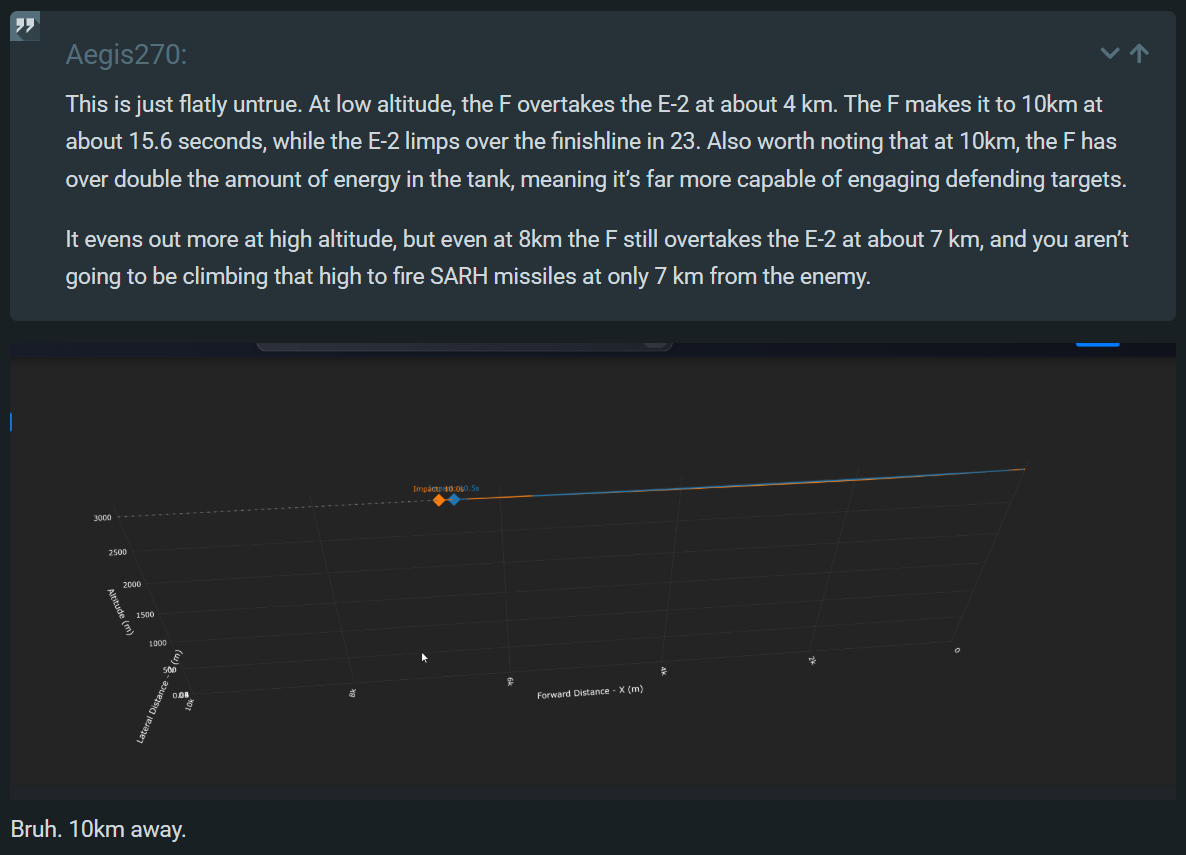
At higher altitudes, it evens out a bit more, but again, even if the time to impact is broadly similar, you’re still objectively better off with an F over an E-2 here due to the difference in the speed the missile has. As shown by the graph above, that extra energy allows it to hit things that know what an RWR is and are capable of defending.
They rip off the rail better and I’m already close to them anyway. They cork screw, I shoot them. I still got a bajillion missiles left.
Why would I fire an E-2 at an inoptimum angle?
Says the guy who thinks the Phantom beats a viggen in one-circle.
You start 80km away. You fly around on a huge map doing nothing for most of it and the whole fight devolves into a few furballs and you lawn dart a few enemies or an overzealous F-20. Bingo Bongo you stumble into an ace.
A) Not everyone knows to do this, which is why Sparrows are capable of getting any kills at all.
B) The E-2 is just as susceptible, if not moreso since they’ll be bleed of speed much faster.
And the difference with having an AIM-7F is… what, exactly? You’re still forcing them to corkscrew, you’re still a threat to them if they don’t. The difference is a modestly faster missile at closeer ranges, giving them slightly less time to execute the manuever. Unless you’re firing this off at around 3km, you won’t notice any difference, and even then an AIM-7F is still plenty lethal.
I can’t simulate a target pulling into a crank with the program, but that graph is roughly accurate to what would happen if he just pulled into the crank as soon as you fired, which is a realistic engagement scenario.
If you fired at him while he was already cranked, then unless he’s already being engaged by someone else, he’ll easily be able to defeat your missile by just pulling out even further and going defensive, doubly so if it’s an E-2 with limited range.
I never said this. I said that the F-4E (The second most agile Phantom in the game) is agile enough to not instantly lose against a Viggen in a one circle, and as a result the Viggen is largely helpless against the Phantom unless it has a massive energy advantage on the merge.
playing devils advocate for a moment and keeping with the thread being about the Viggen C and therefore the Skyflash DF and not the E-2 (i’ve kinda lost track though of what the argument is actually about) its much harder to roll the Skyflash because it has a larger prox fuse radius. I dont think ive ever had a Skyflash DF/ST be rolled, or even seen anyone try tbh.
I use the E-2 and Skyflash interchangably since (before now, at least) I considered them largely identical. They still are kinematically, to my knowledge. And even with that larger trigger radius, I’d still prefer an F over it.
All this bickering between Aim-7E-2 and Aim-7F is useless.
Aim-7E-2’s are good missiles, but the Viggen only gets 2 of em. It has an meh flight model, meh IR missiles, an okay a mount of countermeasures, and no tracers for its gun. It’s fine at 11.3.
If you see it as a possible 11.7, I ask you to reconsider your thought process by playing both the Viggen and Mig-23ML/D/A and tell me which you think would be better fighting 12.0 to 12.7. Just remember, you are asking it to fight R27ER’s with only 2 E-2’s and 4 9J’s.
And if you think the Viggen is broken at 11.3, you have either never played it, are not a skilled player, or both.
The simple fact that he’s asking for it to go up by two steps already says everything. If he understood anything about the serious compression of the game he wouldn’t be suggesting that.
Asking for a big BR increase is usually a sign of someone who is exceedingly frustrated and doesn’t try to actually understand what’s going on
This, people will sometimes throw BRs like that simply because they don’t want to face the plane ever again, without even looking at the environment of the plane they want moved up