This is why you dont compare marketing stuff, you could say that a missile has a lower radius and thus turns better, if you compare the radius at burn out… if you missile is slower it probably has a “better” turn radius.
Ah I must be mis remembering then. I just remember there was a source that stated like 1000m/s > or something like that
yeah thats the deltaV it was referring to, so slightly less than the 1100m/s ish we have in game. (but mica should loft so thats where the better range comes in at altitude)
2 Likes
I mean, I agree that statements made without any real numbers to compare (i have heard the IRIS-T having half the minimum turn radius of the R-73, but I cant actually find a source for that) cant really be used, but I do think the idea that the IRIS-T has a much smaller turn radius than the R-73 is quite likely.
The compairison between the R-73 and IRIS-T is unlike that made with any other 4th or 5th gen IRAAM seeing as germany owned the R-73 and the IRIS-T was made as a replacement for both it and the German produced AIM-9L variants.
This isnt X country saying that their missile is better than the missile from Y country, this is X country saying their new missile is better than the missile they actively employ.
As for the comparison of different launch or missile flight speeds, thats completely irrelevant. That’s just discussing a statement in bad faith. The most reasonable assumption of a statement saying “X missile has half the turn radius of Y missile” (as an example here) is that at any given launch condition missile X will have half the turn radius of missile Y. Regardless of how X missile achieves said reduced radius, the point still stands that the turn radius is reduced for any given matching launch condition.
Speaking of, I wonder if that quote actually exists? I’ve heard so many people talk about it but I’ve never actually seen the original source for that claim. Maybe it’s the Mandela effect or something
This was like when I asked for the 100G source after being told IRIS-T was 100G continuously.
2 Likes
Yeah, same with python 4/5 being 70gs… people say “oh it’s Dual plane so it should pull 70 Gs since it’s 50 Gs laterally/single plane” and then when asked for a source they just pull up articles that link to an untraceable source or just not provide any source at all. Form what I remember, I don’t think there’s a proper source that actual states the g overload for python.
Till this day, the highest g load I’ve seen that actually exists is the 60gs max of r-73/r-74m (probably not in single plane though)
I think I’ve seen a source that states that the iris-t reached 50gs, though not that it’s max is that. I would assume someone has a source for iris t max g load tho
1 Like
The Acutal Quote was
“If the Sidewinder turns 360 degrees on a watermelon, the Soviet Archer on an apple and IRIS-T on a plum”
and the source was this Auf gelenktem Feuerstrahl ins Ziel | SÜDKURIER
but if u now go to the site it gives u 404 error
1 Like

XD was just going to look if wbm had it
Sigh hahah, this reminds me of the Rafale bird RCS discussion. There is no world were that gets accepted as a metric haha.
3 Likes
Ngl, Im starting to think most/all statements specifically regarding the IRIS-T’s aerodynamic/kinemtatic performance are internet fabrications to some degree. Even the wiki page, which states “60G at 60°/s” has 2 sources linked that have quite literally 0 mention of either number.
There is surprisingly minimal info about just about any kinematic capabilities of the missile. The only thing I have found to be reliably stated being the 25km range. Even the Mach 3 top speed has become somewhat suspect seeing as Diehl themselves actually claimed it reaches speeds of more than M3.0:

The IRIS-T is clearly extremely maneuverable, that appears to be literally its entire design ethos, but any actual info beyond that seems poorly sourced at best, which is kind of impressive considering its actually quite commercially successful as a missile, so you’d expect some info being out in the public at this point, seeing as its a 20y/o missile.
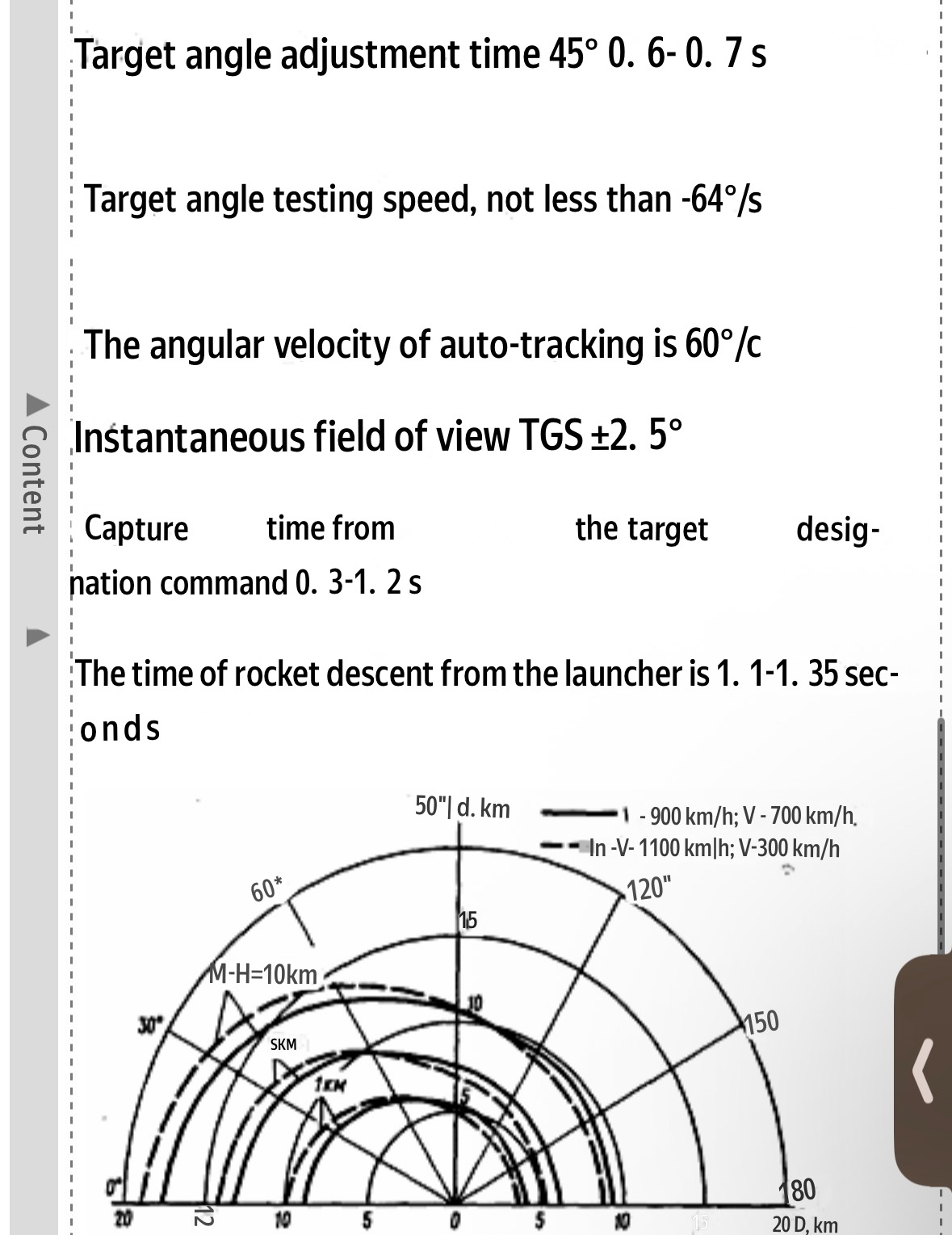
Sounds an awful a lot like r73s seekerhead capabilities in terms of tracking rate and its g load lol. Might be directly ripped off from that
Also tracking delay for r73 seems to be variable that ranges between .15 seconds to around 1 second. In game it’s just modeled as .15 second
I’ve often found Wiki citations to be awful, most cite random 3rd party sites with little to no authority on the subject other than “person who has a website” being the only credential.
A large number of them don’t even have the figures or text they claim to be citing.
2 Likes
Also irl it has launch limits while in game it has no launch limits (gaijin removed launch limits for missiles like 5 years ago, I would assume to make the game simpler)
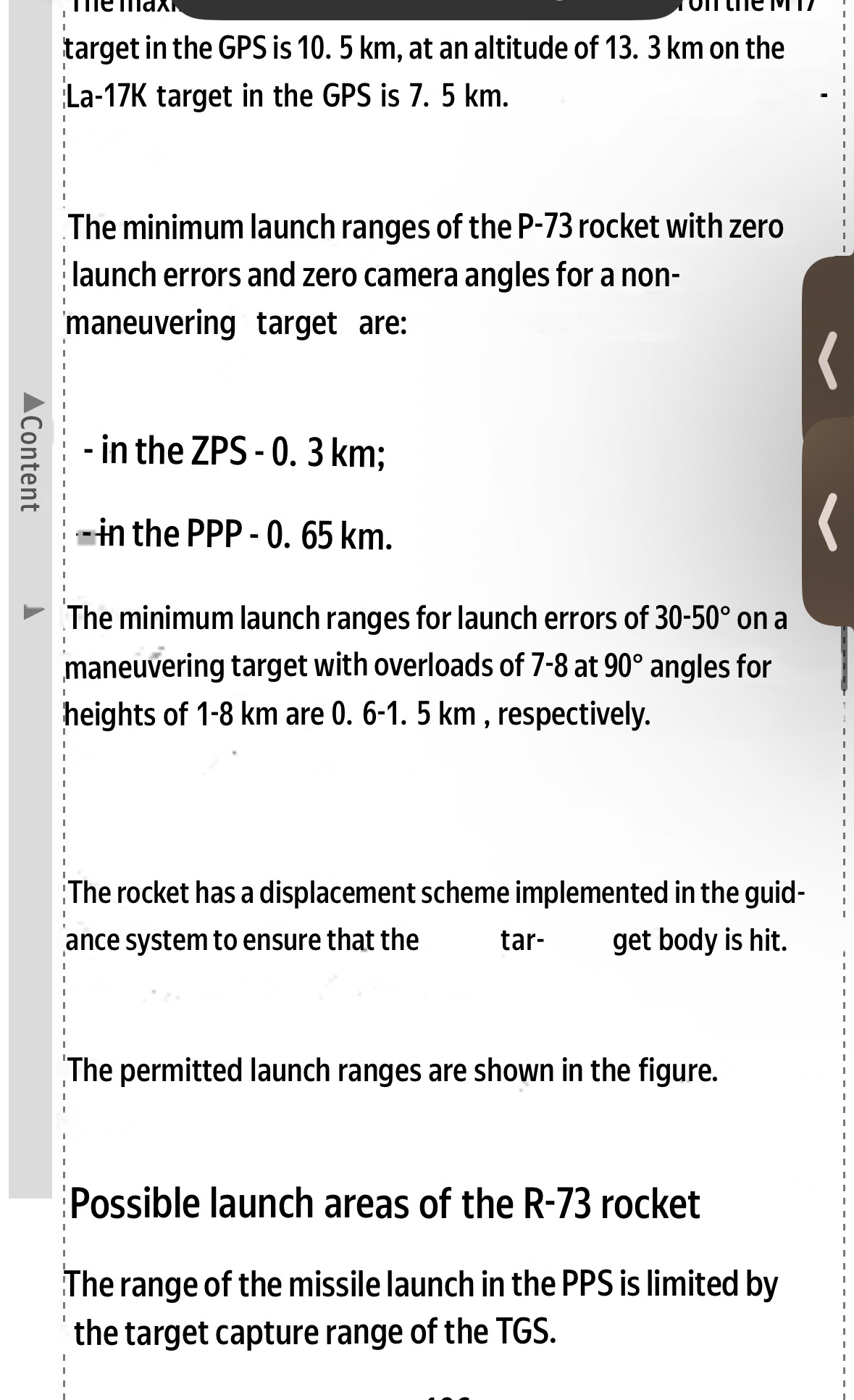
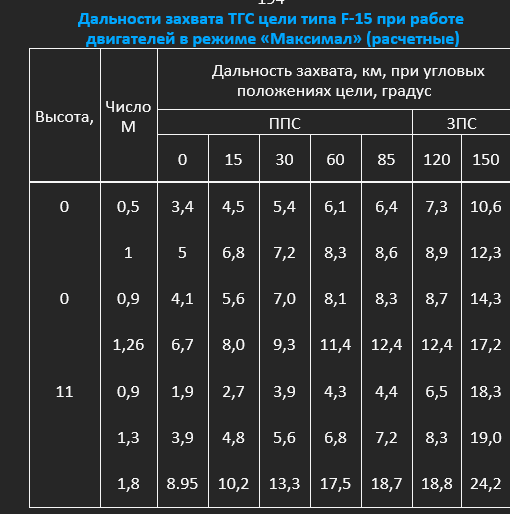
Lock ranges
Spoiler
They’re pretty good for some other stuff, but when it comes to defense stuff, it seems the editors are just like the fanboys on WT forums that just misquote, make stuff up, and/or massively blow statements out of proportion, which is incredibly annoying.
2 Likes
Yeah I specifically made a Wikipedia account to edit some stuff for Russian things on the English wiki.
Surprisingly the Russian wiki gets things right a lot more than the English one, you’d think the English articles would just be translations of the Russians ones but nope they’re not for some odd reason
In game Magic 2 has a motor with 27950N of thrust while CAMM/ASRAAM has 22662,5N; so Magic actually accelerates quite faster than ASRAAM
Tested in statshark, 10km altitude, 1200km/h launch speed, Magic 2 mach 3.37 after 2s; CAMM/ASRAAM mach 2.75 after 2s
at 1km altitude Magic still accelerate faster
Pretty sure that came from some incredibly shoddy maths in a German Wikipedia article
5 Likes