Maybe have a bit of source criticism.
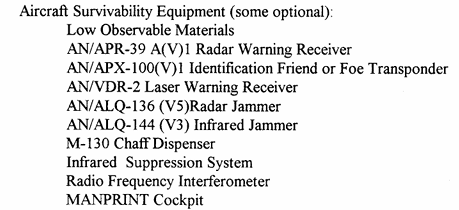
This is a interesting feature list, let go through a few:
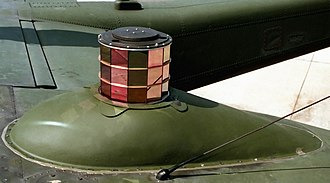
The AN/ALQ-144:
Well clearly this is not mounted on the Comanche
This externally mounted dispenser is clearly not mounted on the Comanche either. Of cause they were not going to be using it on the Comanche as it would weaken it’s stealth characteristics. If they were going to be adding flares and chaff to the Comanche they would make something dedicated with stealth ability.
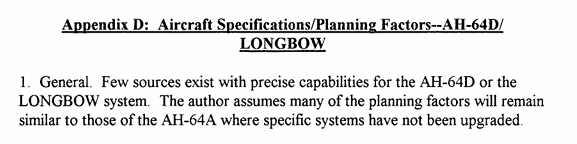
The authors says they just copy pasted the AH-64A’s features as a baseline where sources were missing:
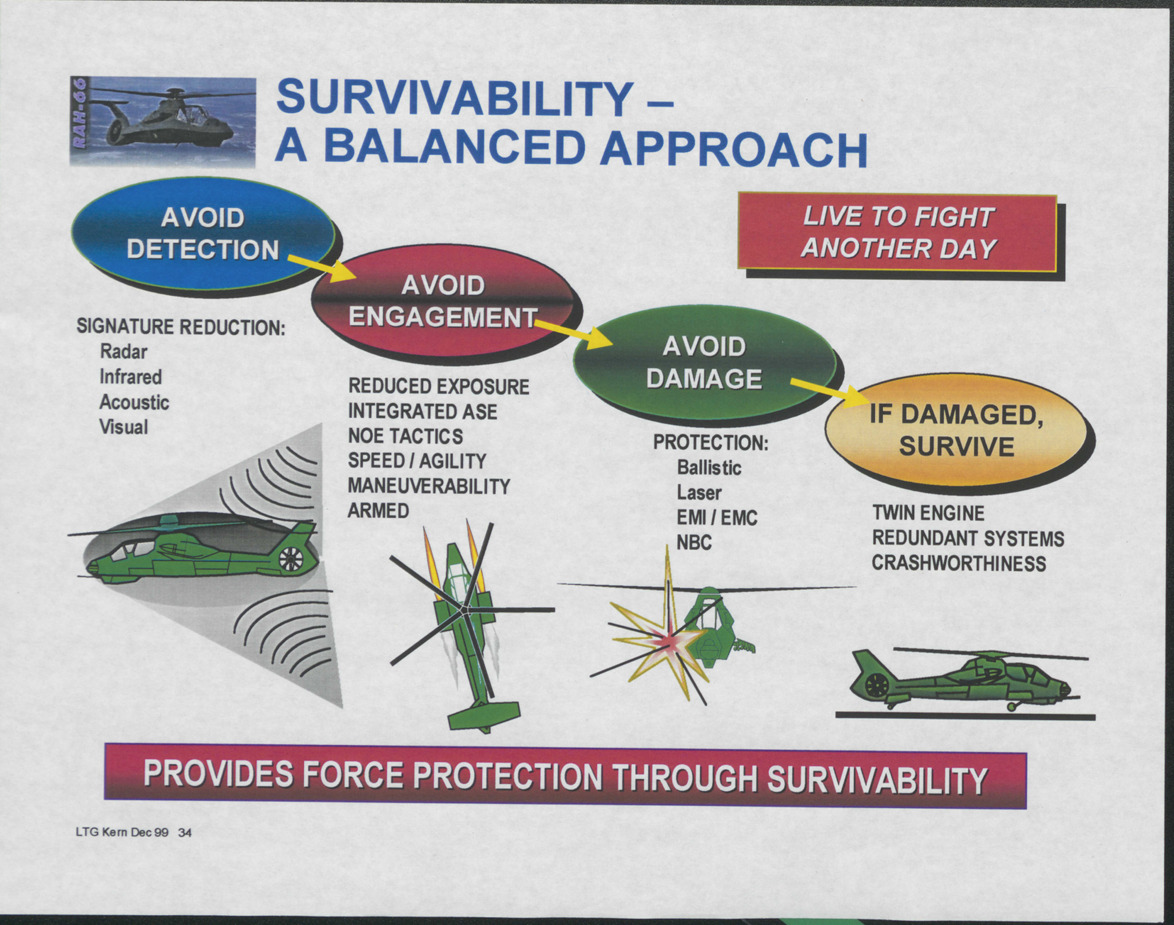
The reason the Comanche dosen’t have chaff and flares is because it was not a requirement:
From the RAH-66 Comanche Operational Requirements Document
" (4). Survivability. Detection of the RAH-66 Comanche must be minimized. If detected, it must minimize acquisition. If acquired, it must be difficult to hit. If hit, it must sustain minimal damage. If damage does not permit continued flight, it must be crashworthy. To maximize the potential self-protection capabilities of RAH-66 Comanche, the synergistic effects of the navigation, communication, target acquisition and armament systems must be integrated and optimized with other survivability and susceptibility features. Integration of these features must have minimal effect on other Comanche capabilities.
(a). Susceptibility Reduction. All RAH-66 Comanche survivability characteristics shall be optimized, balanced, and integrated. It must employ the balance of passive signature reduction and active countermeasures necessary to close within sufficient range to successfully observe, acquire or engage targets in less time than required for them to successfully engage the Comanche. Susceptibility reduction (e.g., low glint canopy, infrared (IR) suppressing paint and materials, IR suppression of the exhaust gases, reduced visual and acoustic signature, reduced radar cross section) and passive countermeasures (CM) (e.g., radar, missile, laser warning and chemical detection) are required. Active CM (e.g., radar, IR jamming, flares, chaff) shall be applied as necessary to preserve the appropriate balance of passive and active systems necessary for susceptibility reduction. RAH-66 Comanche must meet susceptibility reduction requirements in Appendix F. Application of low observable features must not reduce maintainability and logistical standards." RAH-66 Comanche Operational Requirements Document
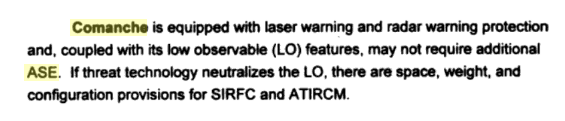
That is because it primarily uses IRCM jamming, not countermeasures, but it had the ability to field them. I want IRCM more than actual deployable countermeasures to be clear, as this tech is clearly built into the commanche as mentioned many times. From what I can tell, the commanche IS meant to have the AN/ALQ-144 somewhere on it.
and it says, Comanche is Survivable
• Low detectability
• Effective onboard countermeasures
• Ballistically-tolerant composite airframe, flight controls, fuel system, and rotors
• Redundant, self-healing electronics
• Crashworthy airframe, landing gear, crew seats, and fuel system
• Can operate in Nuclear, Biological, and Chemical (NBC) environments
However integrated ASE did not include chaff and flares because they thought flying low with it’s low observability features were enough at the time it was conceptualized.
Correct. That is the best source i’ve seen so far. It looks like the sales pitch from Boeing to the US military.
Not really, it’s a sales pitch from a company TO the us government.
The issue is that those “numerous links” can’t be used as sources as they aren’t primary and some might barely even be secondary but those secondary aren’t mentioning anything direct.
Yes, that’s the case for practically all of top tier. So we as players have to find the best sources we can and hope it’s enough. I’ve spent countless hours helping to find sources for the IRIS-T SLM and the JAS39C and E variants.
Agreed, still probably lower than a direct us gov document though but absolutely quite high on the list in trustworthiness.
Yes, hence why this report was sent as a suggestion :) It’s then a balancing decision up to the developers. So nothing more to do than hope for the best (or find better sources).
Again active Countermeasures were not required and not included, but theoretically they could be upgraded with them in the future, which of cause never happened.
accommodates means that there is a compartment in which it can easily be added to the heli. that is like saying that a f15e on paper doesn’t have an agm130a listed, therefor it cant use it. no redesign has to occur to fit this module to the heli, it can be loaded out in a hangar.
No it means that the internal space has been made large enough for future installation of provisions for countermeasures but that currently you can’t mount them and as it says they estimate it will add 2 million to the cost to add that capability, it was clearly not capable.
That’s not what Flyaway cost means. Flyaway cost is strictly for cost of production, not research or engineering required to change it.
It was capable and already designed as a consideration.
I don’t think you are being realistic. You realize the cost of one flight of hellfires is more than 2 million? Also, how did you come to the conclusion it didnt have holes, wiring, etc? From the sounds of what I have read, it absolutely did have all of the above. I doubt we are going to find any information suggesting otherwise as well. I think the evidence is strongly in favor of it having this capability.
When weapon systems are created, they have specific capabilities they want to achive, certain strategies they want the system to be able to perform. So they make a budget for cost and the make trade of calculations, to perform this mission for this amount of money what do they need, and what can they get. Adding features for certain missions degrades the system’s ability to perform other missions and adds to the cost. Ex: If you add extra hardpoints that creates drag, ads weight, which lowers your range, your speed, increases your fuel cost, wear on components etc. And in the case of the Comanche active countermeasures was one of those things that were traded off for stealth, lower weight, range etc. But systems are also scaled so they have “growth potential” during it’s multi decade service life. So they leave room in the hull for adding more computers, chaff and flares etc. at a later date if it becomes a requirement. They don’t just add a bunch of stuff they are not going to use. And because active CMs where not required they were not added to the Comanche.
And there was no plan to add them in production, so just adding them because you want them distracts from what the aircraft was meant to be. Sure in game you could add nukes to the L3 or make the object 292 shoot peas but it breaks the emersion completely. The Comanche was created at a time where it’s stealth characteristics was enough so they saved on the chaff and flares. So to reflect the aircraft the best it should not have features it was not intended to have.
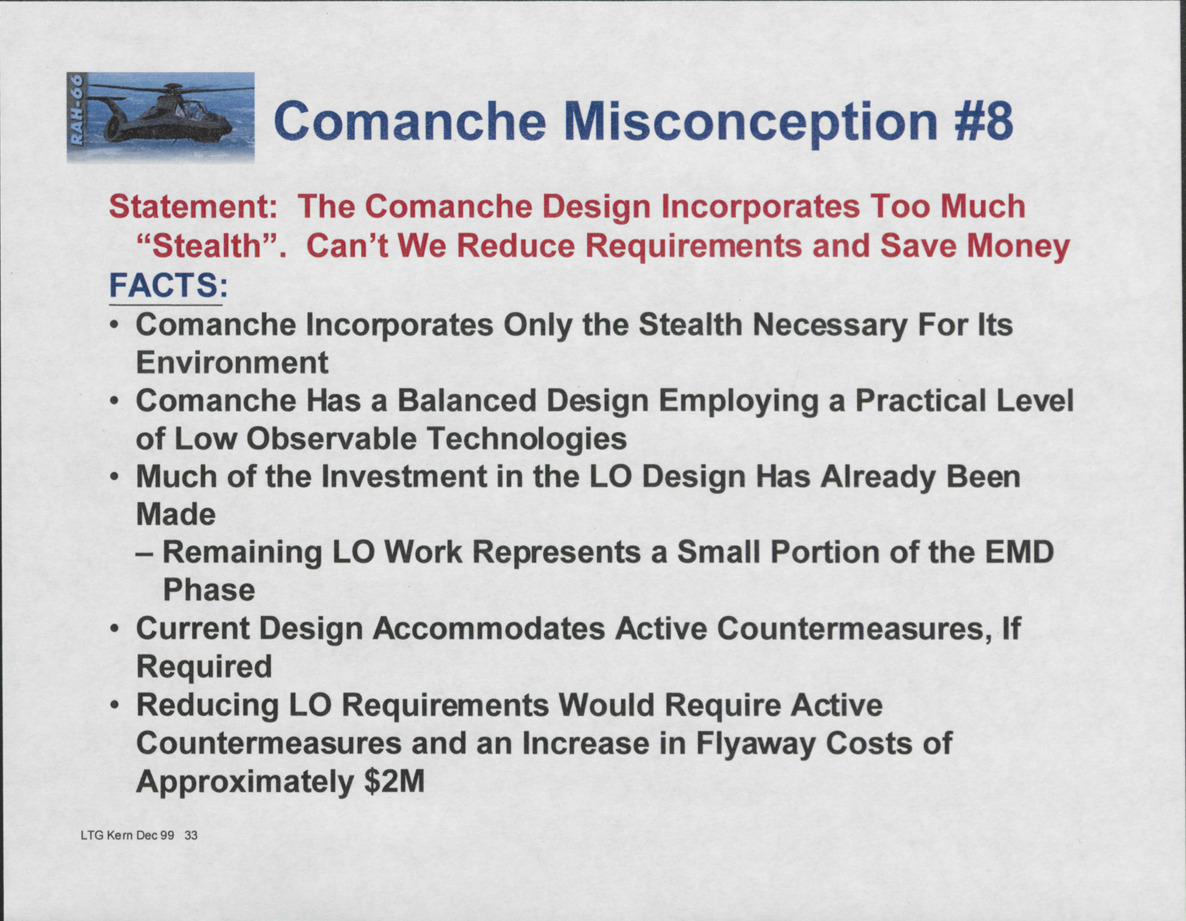
There is quite a bit of information the Comanche and nowhere is chaff and flares dispensers pointed out on the drawings instead there is multiple sources mentioning that it didn’t have them, that they were not required and that is why it should not be a feature infame. I have literally posted a slide from the program office that says it dosen’t have them and it would cost extra to add them, so they are not there.
I don’ know anything about the yak 141, if Gaijin made it fit the concept of what it was meant to be then I don’t care much. The Comanche concept was to skip chaff and flares and rely on stealth.
I am willing to accept that the m130 dispenser was not fit to it by standard, but it seems to be that it absolutely had a compartment(a hardpoint if you will), at minimum, to fit the AN/ALQ-136/144. They literally advertised it with the capability to fit active countermeasures and if that isn’t enough, idk what is. As I said, fitting this jammer is no different than fitting one of the numerous missiles it can carry considering it had the hardware to do so built into it already.
Really what this is exposing to me more than anything is that it’s stealth capability does not work nearly well enough for WT. There are 4 SPAA on the enemy team at minimum at all times scanning all angles of the field and this heli has 0 survivability at its current BR. It is also no where near as durable as these documents say it is, and you combine this with the fact it cannot be spawned until successful ground vehicle use(because rocket config is horrible for this heli due to its ONLY possible advantage being firing at MAX range, which usually results in a no-hit anyway because the hellfire sucks and cant be in flight long enough), it just becomes a limp noodle. This is mostly a different convo though.
Also, you are using terminology like “just because I want them” and that is not why I am making this argument. I genuinely believe I have listed solid evidence that in real life this vehicle possessed the ability to field this jammer.
It doesn’t have such a compartment, we have loads of images and even CAD drawings of the RAH66 project, none show a bay door to a CM dispenser holder.
Spoiler
During the General Schoomaker directed review, the Army Aircraft Survivability Equipment (ASE) office reported that the Comanche was vulnerable to modern infrared (IR) seeker threat systems and needed an IR jammer.
Defeating IR missiles was always one of the strong points of Comanche. We believed we had solved this requirement from our initial design days, and
the Army technical community had agreed. Our test engineers and pilots also did not believe this was an issue.
The threats had evolved over time from the Soviet (red) threats to multinational (blue and gray) advanced threat systems. In 2002, the Army had Boeing
Sikorsky perform a detailed survivability analysis of the Comanche operating within the acquisition range of the U.S. Stinger missile. The results of this analysis supported the Comanche IR signature levels and that a very small potential missile acquisition envelope resulted in a very low probability of
intercept by the missile. Earlier hardware-in-the-loop simulations with the Stinger missile seeker, conducted by Sanders, showed no intercepts.
However, the audience in 2002 receiving the results of the analysis took the position that if the analysis did not show the Comanche completely invulnerable to a Stinger engagement, the aircraft would require IR active countermeasure equipment that would increase the unit cost of the aircraft by $1 million.
The RAH-66 Comanche Helicopter: Technical Accomplishment, Program Frustration (AIAA 2022)
Not having dispensers makes historical sense as well, RAH-66 began as a very lightweight scout aircraft that would rely on stealth for defense, they tried as hard as possible to ditch everything that added weight, part of the problem with the program were the many changes to program requirements that ended up putting the weight back in – because the Army wanted it to ALSO do X, Y and Z functions that weren’t really the duty of a OH-58 replacement.
Well then all I have to say at this point is that the heli’s stealth is extremely lackluster. With no pylons and no deployed weapons or gear, I was just locked an destroyed at 9km away by a pantsir. It’s BR is simply too high for what it is able to do, but that is separate convo. I do feel like I got a raw deal purchasing it, but at least it… looks cool? I also just hit a t90 with 4 hellfires and didn’t even manage to detrack it lmao.
It also appears it is meant to have IFF on it’s radar, which is making sim quite difficult(it does not in game), but this I haven’t researched as much.