
hmm, point Proven?
2 Likes
ok Flame let me follow along here…
Gotcha 11,870lb dry… Installed thrust per DoD airworthiness certification… Yes it is the baseline thrust, static thrust @ sea, standard day = Take-off thrust.
These thrust values are the manufacturers guarantee that is certified by the DoD. They have been corrected (means corrected for all installation penalties imposed by the air vehicle).
installed thrust is 11,870lb & 17,859lb augmented. It gets very specific from the general description as it should. Again, the installed thrust (corrected) which has had all installation penalties applied per DoD Airworthiness certification…
Yes, I appreciate you acknowledge the very likely possibility it is already corrected per certification… So lets continue…
You are misinterpreting it flat out. I will show you why in one second…
All I am seeing so far is that you provided the KEYWORD hint, hint: corrected thrust rating (all correction factors applied for installation penalties) and you continue to verify this throughout the manual…
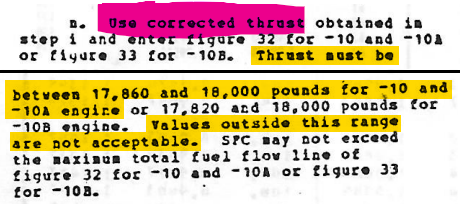
Please look carefully at the highlighted red… Corrected thrust means all correction factors are applied my dear brother in Christ… Google what corrected thrust means & what are correction factors.
Corrected thrust MUST BE 17,860 & 18,000lbs…. That is the INSTALLED THRUST as stated the entire time, It has been CORRECTED. Lol the manual is literally telling you what the installed thrust must be and even going so far as to say that any value outside these ranges is not acceptable…
Why is it not acceptable? Because that is the manufacturer’s guaranteed baseline thrust that is DoD certified & regulated… Pilots/operators need reliable operational numbers available to safely operate the aircraft during critical phases of flight such as take-off.
My dear beautiful friend from the old forum, you do not understand what corrected thrust means??? Cmon!! You got to give me a little credit for once lol…
In propulsion and airworthiness certification, corrected thrust is the measured engine thrust
mathematically adjusted (normalized) to the conditions of a standard
atmosphere—specifically, static, sea-level conditions with standard temperature and pressure.
Corrected Thrust Purpose
● Standardization: This correction eliminates the effects of varying altitude, temperature,
and pressure on engine performance, allowing engineers to consistently compare the
thrust of an engine across different flight and test conditions.
● Certification: For airworthiness certification (e.g., under 14 CFR Part 33 for engines and
Part 25 for transport category airplanes), engine power and thrust ratings— like rated
takeoff thrust—must be defined and demonstrated at standard sea-level conditions.
Corrected thrust is used to ensure the engine meets these established ratings regardless
of the actual test environment.
● Performance and Noise Modeling: It’s also a crucial parameter for calculating aircraft
performance (takeoff, climb) and predicting aircraft noise levels, as noise is often
correlated to the engine’s corrected net thrust.
The correction involves a formula that typically divides the measured thrust by the pressure ratio
relative to the standard sea-level pressure etc.
just add F15E Golden Eagle at this point 🥀
ChatGPT ahh argument
3 Likes
Gemini to be exact. Look, y’all aint paying me and you guys are nothing but a pain in the butt every time I try to improve your beloved fighters anyway.
But hey, it’s better than writing a 4 page, 1,500-word essay just to be grossly mistaken, isn’t that right, @Master_Teaz ?
I am not about to educate basic aerospace engineering terminology in my own written hand that they all should have known sitting on this forum for how many years now???
PS. lets play sim I am so over RB or you still mad about something?
Do you know if the f14’s is missing installed thrust by chance? Because I look at the manual and it seems like it is unless I’m mistaken.
2 Likes
This, this is the correct use of AI, monitored results, use of own personal sourced data, and is primarily to set the format to be readable, efficiency for the product is improved, nothing else is affected. So many people literally just give a short sentence to GPT or even dot points plus a single Wikipedia source, and ask it to create the entire thing and sometimes even generate sources.
do want to note maybe as a edit at the bottom of the post say that you used AI to format your own sources and text just to be upfront, cause like FeetPics (what a name, lol) replied" ChatGPT ahh argument" idiots who don’t focus on the sources being analyzed themself will just dismiss you which kinda sucks.
5 Likes
Drinks a lot of beer
4 Likes
Except it’s not any kind of coherent argument if you actually read it.
Take for instance the following statements;
This is simply untrue as pointed out by Flame. Uninstalled static values are far more common in flight manuals than installed values.
And the conclusion in the first bit feeds into this conclusion.
At this point I have done hours of testing and cross referencing War Thunder flight models vs available historical documentation. Generally speaking, War Thunder flight models will match most available performance metrics when possible within the parameters of the game.
1 Like
lol
1 Like
There’s a trend to that i assume?
(Rough example. F-15A/C/E manuals featuring uninstalled thrust)
Or is it on a case-by-case basis
The trend is that Ziggy is feeding garbage into an LLM and it’s spitting out nonsense. It is not radically different when people cope about the Fw-190 flight model and ask an AI to spit out a concise and well pointed post; it reads like a coherent argument except some of the fundamental facts are wrong.
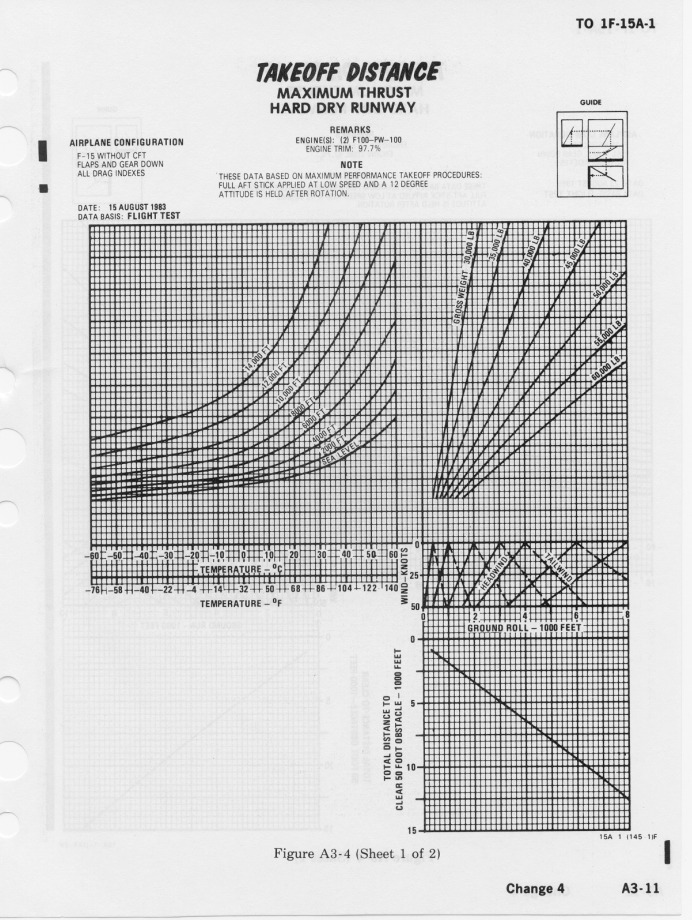
The F-15A flight manuals are publicly available. As far as I can tell just by skimming them, there is no mention of installed engine thrust values and they are not used to calculate takeoff or landing distances. Yes…the installed thrust values are baked into the chart but knowing the specific number does not seem to be present anywhere in the flight manual.
Here is an example of one of the charts used by pilots to calculate takeoff distance. Note that no thrust value is given.
More to the point though; the underlying theory that ZiggyGPT is suggesting is that all American planes are grossly underperforming due to erroneous installation loss values implemented by Gaijin. This is fundamentally untrue as a broad conclusion and may only be partially true in a few edge cases.
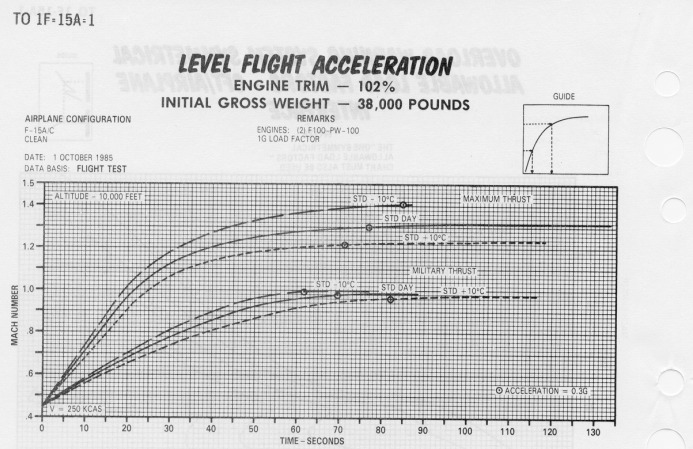
This chart from the manual provides acceleration figures for the F-15A with the engine settings used in the game. There are multiple charts for multiple configurations.
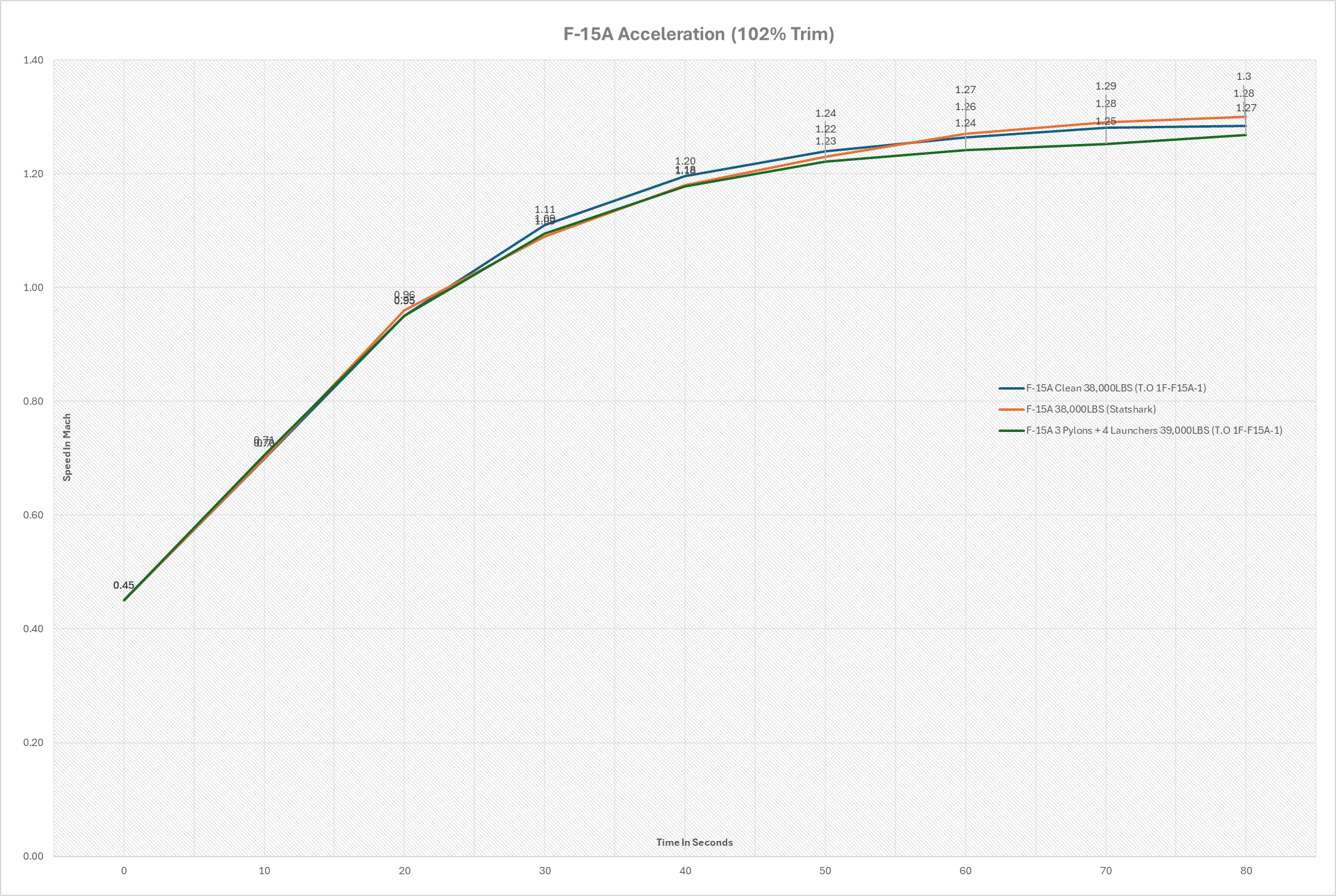
And this represents a comparison between the values found in the manual and those calculated by Statshark. It should be noted that War-Thunder only partially implements pylon / stores drag, so fully loaded airplanes will tend to overperform their book values by greater margins. It should also be noted that I did not include the Statshark values for a 39,000lb gross weight F-15A because the difference in acceleration is .01 mach at the maximum difference.
2 Likes
I will interject that it is extremely disrespectful to take @Flame2512 whole argument throw it into an LLM and use that for rebuttal.
You didn’t take the time to read and refute the broader claims. Then felt his time and effort in responding to you was only worth an AI slop response from you, to which I would argue he could’ve just put his whole argument into said LLM and had a more cohesive back and forth…
Major L

14 Likes
Thanks for the informative, not AI generated response
1 Like
tbf there is this

this section might have thrust values, but ive not see a copy that actually has it (appendix A2)
but yeah, because the engineers who wrote the manuals dont really trust pilots, they just leave stuff like that out and bake it into the charts
1 Like
You must have missed the section of my post where I explained in lots of detail what the corrected thrust value means, and included the entire relevant section of the manual. Corrected thrust in that context means uninstalled thrust that is corrected to match standard atmospheric conditions. It says as much here:
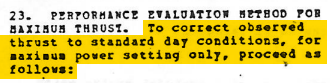
Let’s break the entire procedure down step by step. You can let me know exactly where the correction to installed thrust occurs (hint: it doesn’t). If you want access to the full pages then go back and look at my other post.
- The engine is installed into test bench. Notice how there is no intake representative of the F-4J’s intake attached to the engine. There is simply a bell mouth and an optional FOD screen (the effect of which is cancelled out later). Therefore the raw thrust measured by the bench will be representative of an uninstalled engine, and higher than that of the engine when installed in the aircraft.
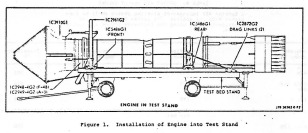
-
The operator records the thrust as measured by the test bench, and any non-zero value the bench reads with the engine switched-off (the tare value).
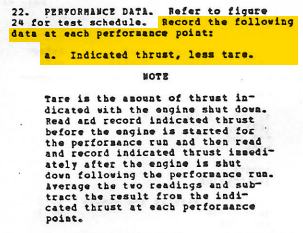
-
The operator subtracts the tare value from the measured thrust, in order to correct for any inaccuracy due to the test bench.
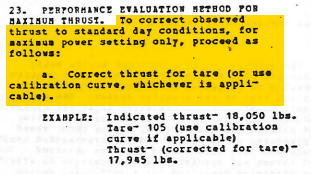
-
If an inlet FOD screen was used the operator corrects for the thrust loss it causes, and corrects for any losses caused by the test cell. Notice how these are both correcting for losses caused by the test setup and result in the corrected thrust being higher than the measured thrust. That is because this whole procedure is about determining the thrust produced by the bare engine, without any external influences.
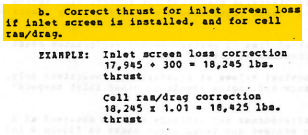
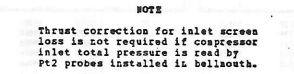
-
The operator corrects the thrust value for any difference between the humidity at the time of testing, and that defined in standard atmosphere.
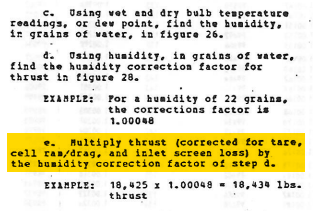
-
The operator corrects for any difference between the atmospheric pressure at the time of testing, and that defined in standard atmosphere.
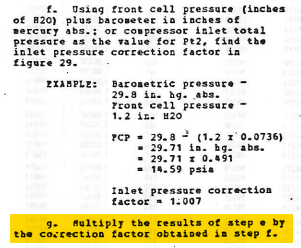
-
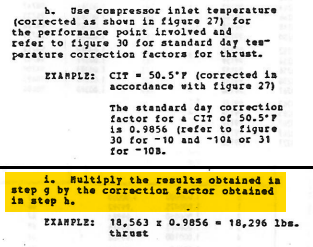
The operator corrects for any difference between the temperature at the time of testing, and that defined in standard atmosphere. This is the last correction applied to the thrust, and is the “corrected thrust” referred to later on. But for completion we’ll keep working our way through the manual until we get there.
-
The operator corrects the fuel flow indicated by the test bench for various factors (meter calibration, specific gravity, humidity) and uses it to calculate specific fuel consumption (SFC). SFC is then corrected to bring it in line with standard atmosphere.
Spoiler
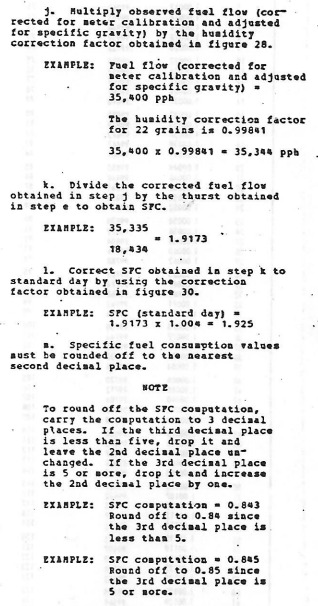
- Now here’s the key part: the operator takes the corrected thrust value achieved at step i in the manual (step 7 in our little walkthrough) and confirms that it is between 17,860 - 18,000 lbf.
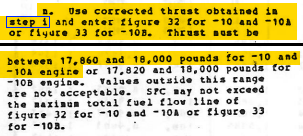
So the corrected thrust referred to in the manual is that calculated at step i of the manual (step 7 of out walkthrough). And we know exactly what the value at step i is:
It is the raw uninstalled thrust, measured by the test bench, corrected for:
- Test bench inaccuracies (tare)
- Losses caused Inlet FOD screen (if fitted)
- Losses due to the test cell
- Any humidity difference between the test run and standard atmosphere
- Any pressure difference between the test run and standard atmosphere
- Any temperature difference between the test run and standard atmosphere
Notice how contrary to your claims NONE of those corrections account for installation losses. They are purely about cancelling out any influences on the measured thrust to ensure the final value is representative of purely the bare uninstalled engine under standard atmosphere conditions.
Seems pretty clear cut to me:
without regard to installation effects or limitations
7 Likes
Look, I like flame & I don’t know how long you have known him, but I have been interacting with him for a long time. Since the last forum. We have agreed strongly on underperformances and disagreed on other random crap. He has outright proven me wrong before & I admit when I am wrong no matter how sarcastic I am about it.
I haven’t said he was wrong once here & only mistaken as above in this case. You see I tailored my comment specifically because yes, he was mistaken. Not even really that, just overlooked the subtle wording though the manual said from the gate "installed thrust". So yeah I think I can be a little hard on my boy for that.
I am a little upset with him because I feel he has shifted from once investigating a matter and pushing for realism to almost serving as a deterrence against it. My comment you replied to was aimed at cheer leaders.
Additionally, I am trying to get my life in order on a Monday night so unfortunately, I did not have a chance to fully read everything, but I did come back here and there, and he does kind of understand the concept of corrected thrust and mentions it. Yes, he overlooked the subtle wording.
If I may say one last thing regarding “disrespect” toward flame & the true perspective of how I view him. I am confused how he still isn’t a tech mod at this point. Regardless of this interaction here and who is “right or wrong” the dude has demonstrated & long established that he is cool headed in fierce, even disrespectful debate, articulate & able to sift through mountains of information on these technologies without being biased for any one particular tech tree or the other. Maybe he never cared to be staff at this point, I don’t know, but that is my thoughts on that.
Why are you a little hater all of a sudden?
Do you want to see more? Shall we take a walk to the MiG-29G & I show you why the thrust rating applied is 100% installed thrust? That is my next puppy you know I have much more. The MiG-29 is 100% ICAO compliant.
1 Like
Yes, I have unsent reports on all these fighters (including Soviets).
Even the Iranian tomcat does not even have to correct engines though differences are slight.
Matter of fact there is a lot on the tomcat performance. We can start a DM convo to get something rolling
1 Like
Appreciate this, I was literally on my phone smoking a cigarette in the backyard and wanted to simply describe the concept for those unfamiliar & asked Gemini lol. I never used ChatGpt in my life.
Lol but feety swears I need to get on my desktop, open Theory in Aerospace Propulsion (real textbook btw) and spoon feed it to him when he is a big boy & has access to the internet himself.
To obsess over that as feety is doing is simply a tactic to obscure and divert from any productive discussion into the matter. I have no idea why he is having a tantrum right now & for some reason thinks I am going to pay attention now.
I will post pages and sources to back up what I say moving forward to best of my ability.
I am a lazy though & sometimes I feel those who I am speaking with are not worth my time.
(Oh & thank you for the suggestion regarding future utilization of AI descriptions & explanations, will do)
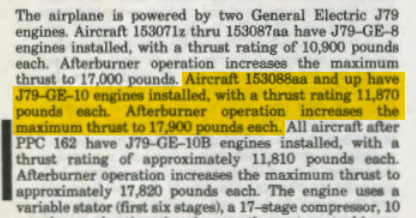
Brother, it tells you what the installed thrust is in the beginning & tells you again.
You highlighted it…
You are arguing that because you do not understand what installed thrust is (static @ sea, standard day AKA take-off thrust) that is quoted by the manufacturer & since that rating is identical with the final, corrected thrust another unknown… (which quite literally means thrust that has been corrected & adjusted with all installation effects applied) You therefore conclude it is all uninstalled thrust by default…
That is essentially what you are bending over backwards trying to say.
look, I am going to shift over to the MiG-29 but it is related to the subject. I want to highlight how its the most fictional aircraft in all of war thunder starting with the thrust. I want to do this before Christmas. We can continue there or DM me so we productively go over documents etc. too & this matter as well because I do have some questions.
Oh btw team, look into the variable geometry nozzles found in the F-15E, They GREATLY minimize the installation loss & achieve very near perfect ideal thrust. We can hit this from so many angles these jets are straight up underperforming. But we need to research together.
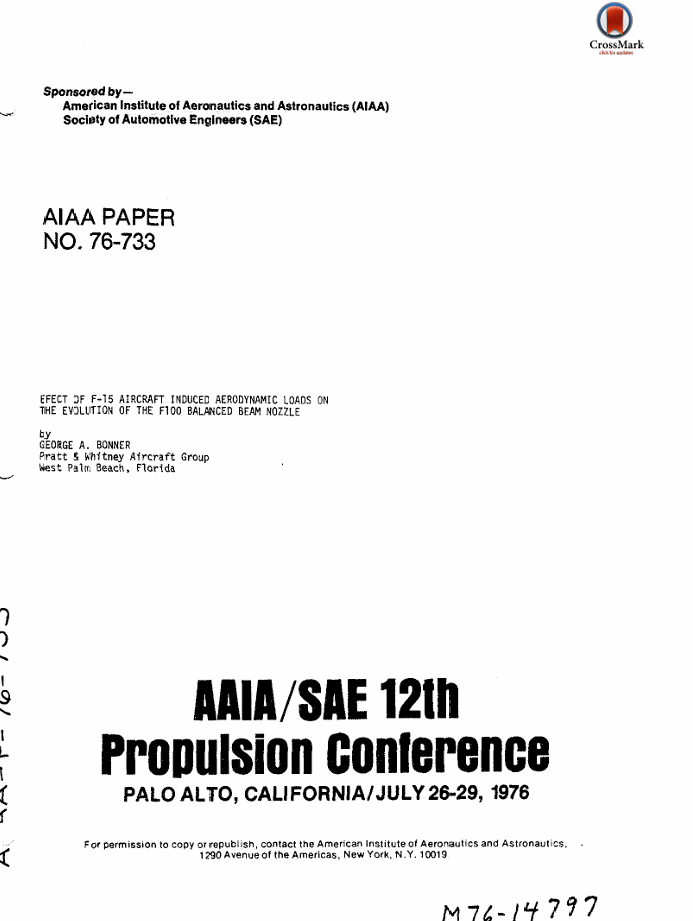
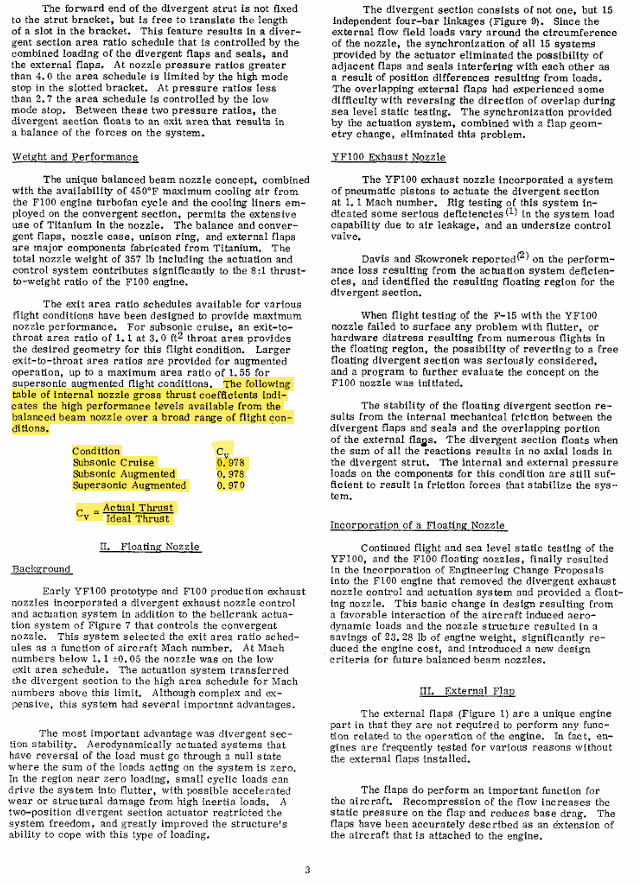
In propulsion, installation penalties are the losses in thrust or efficiency when an engine is mounted in an aircraft versus tested in isolation, factors like:
- External aerodynamic loads (pressure distributions around the nozzle and flaps).
- Structural weight added by nozzle hardware.
- Drag from external flaps and fairings.
- Flow distortions at the nozzle exit due to aircraft geometry.
The balanced beam nozzle was designed to minimize these penalties by using external flaps shaped for recompression reducing base drag. Allowing the divergent section to float, so aircraft-induced loads naturally balanced instead of requiring heavy actuators. Achieving thrust coefficients of 0.97–0.98, meaning only 2–3% loss compared to ideal thrust, a very small installation penalty.
this paper demonstrates that the balanced beam nozzle delivers near ideal thrust efficiency (97–98%) across subsonic and supersonic regimes. This technology is modelled in-game but have zero effect competitively.
1 Like