So just so we can understand this correctly.
You are saying that the installed thrust loss of the F-15 engine should only amount to 2 percent? And you are sure about that?
So just so we can understand this correctly.
You are saying that the installed thrust loss of the F-15 engine should only amount to 2 percent? And you are sure about that?
Installation loss is not the only loss applied to the aircraft sweetie pie.
PS. I would like to correct this comment. I am not sure. because I have not pulled up the F-15E manual, isolate & compare the balanced beam to earlier engine models of other variants. Remember thrust can be ideal depending on certain flight conditions etc. This is modern engine design after all. Just do some damn research & stop being a darn Negative Nancy.
what I do know is that the Americans are kind of the best at nozzle design and achieve very minimal installation losses in their engine design in the newer fighters…
The variable geometry nozzles & balanced beam are present in game they are modelled & even have sound effects as well, but zero performance effect in-game. It is worth researching my friend.
Yet we are here stuck arguing one’s long drawn out interpretation on a F-4J manual that already states what the installed thrust is in wording that even a child can understand as well as in engineering terminology.
You’re so close to getting it.
This is just deflecting from overall point that I made about acceleration performance in-game and the fact that I showed the F-15 is accurately modeled in this metric. In fact it is technically overperforming.
My apologies, but I honestly haven’t read anything you have said on the subject.
I just do not have the energy right now kiddo. But we can play sim later when I get on if you like?
But hey, do cheer up buttercup, acceleration can be talked about while the thrust can still be underperforming. There are several aircraft that have concerning acceleration performance with low thrust output that never were adjusted. GJ seems to like to offset lack of thrust by increasing aerodynamic efficiency in models they need to compete. Sometimes more than appropriate. That’s why you exist I suppose.
can you give examples?
I want to clarify some things & show you I did read your step-by-step process. Well, most of it & its missing things besides not being whole pages.
Yes, you are correct. But it is more than that.
NO, Its not “bare” because it already been corrected… It is the theoretical engine performance under standard conditions… per DoD, FAA & ICAO airworthiness certification:
At Sea Level, Standard Day…
The corrected thrust is the engine’s ideal, standard-day performance & is the input element in the final installed thrust calculation, and you apply installation correction factors (Remember I mentioned those) which are usually multiplicative ratios or factors for intake drag, bleed air loss, etc. to get the final installed thrust.
You have none of those elements to complete the final installed thrust calculation because It is standard protocol (Airworthiness Certification) that the detailed correction factors needed to convert corrected thrust to final installed thrust are not typically included in a flight manual.
This is where your confusion lies…
Or… It is entirely possible you do have them, but have left them out here…
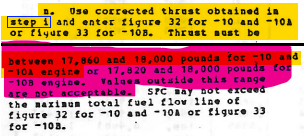
It doesn’t matter, because the manuals do provide (Per DoD Airworthiness Certification) the final certified installed thrust to give us the target range for such calculations, ensuring our engine performance and installation match the aircraft’s certified limits. Anything outside of these ranges is NOT ACCEPTABLE.
as you see here:
& this…
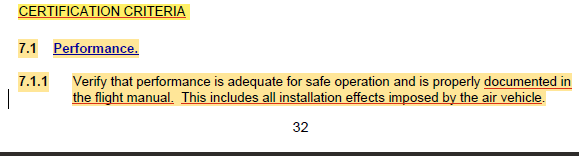

Is why you see this from the get-go leaving ZERO room for interpretation though you STILL managed to do it:
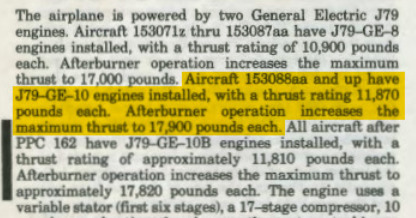
I am sorry, bro. It is wild to me that instead of back tracking your steps to consider the possibility that you may be mistaken/missing some critical elements in this formula of yours, you decide to assume & conclude confidently that none of this actually means installed thrust, though it declares it repeatedly. Even for several serial produced batches of the aircraft…
Installed thrust is an aircraft-specific value, accounting for losses from the inlet, nozzle, bleed air, and other aircraft systems, which varies by airframe design and is usually only provided in the form of performance charts or data specific to that aircraft model, often calculated by the aircraft manufacturer, not the engine manufacturer.
The flight manual focuses on parameters the pilot uses to set thrust like RPM or engine pressure ratio and the resulting performance data for the aircraft (takeoff distance, climb rate), which already incorporates the installed thrust.
The actual calculation details are usually found in engineering data or engine models used for performance analysis, not operational documents.
Oh look more AI slop.
Nah just copy paste from these.

Look, I understand you have a YouTube podcast or whatever, but the world does not revolve around you. I honestly never read a thing you said prior to my first post on the subject a couple days ago. Remember I’ve been gone all year.
Look at all your post the last few days. You are seething & they are all about me. I was nice, even asking to play sim regardless of how negative you are. You are now starting to creep me out.
The F-15 accelerates too fast, there I said it. Can you leave me alone & stop trolling? You have been on my bumper non-stop demanding my attention the second I came back. I would like you to stop & give me a some space.
No not AI, I worked hard to tailor my post repeatedly as not to be rude to Flame but you continuously set the atmosphere purely to negative & I kind of lose track of who I am actually speaking with.
that would change horsepower per ton or in this situation thrust to weight, not the thrust which we are talking about…
what do you think the F-15’s variable intakes do?
Yeah. Variable are more capable at supersonic & over wider range of regimes than the S duct. Able to fine tune accordingly. They have their drawbacks like weight etc.
F-15 is still the fastest fighter in US service correct? Highest top speed, right?
Too bad the yf12 didn’t enter service supposedly it tested aim47 successfully
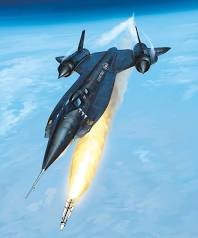
YF-12. YF-17 was the predecessor to the F/A-18 that competed with the YF-16 for the LWF program and lost
not supposedly, it did, multiple times
Oh yeah typo my bad
Kicks in at about mach .5 and decreases loss significantly
But kinda bad at takeoff
There were probably later minor tweaks to the intakes after modeling to optimize thrust. The math’s all in here for calculating intake pressure which can help with calculating overall thrust.
I have explained in detail why I believe the thrust given for the J79-GE-10 in the F-4J Flight Manual to be for an uninstalled engine. How about you answer me this:
As you stated yourself “Installed thrust is an aircraft-specific value”. The J79-GE-10 is used in multiple different aircraft, so:
Or on second thoughts maybe don’t bother. Here is J79 page from a General Electric Aircraft Engines brochure. Notice that thrust rating for the J79-10: 11,870 lbf at military thrust and 17,859 lbf at max afterburner, and that it states the J79-GE-10 is used on both the F-4 Phantom and A-5 Vigilante. Interesting how the listed thrust values exactly match the previous US navy datasheet I shared for the engine, as well as the SAC document, and the and the static test bench results listed in the maintenance manual isn’t it?

Now at this point we could engage in a long debate about whether those thrust values are installed or uninstalled; and if they are installed which aircraft they relate to, or whether the F-4 and A-5 happen to have exactly identical installation losses despite completely different intake designs. But how about we avoid that and instead consult the RA-5C flight manual:
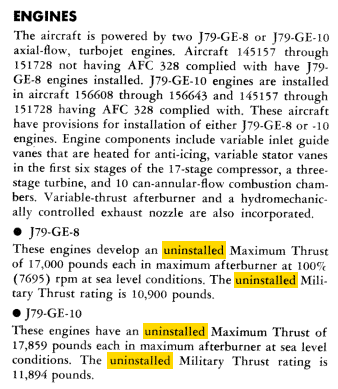
So there we have it in black and white: 17,859 lbf at max afterburner is the uninstalled rating of the J79-GE-10, just as I’ve been saying all along. Also notice how the J79-GE-8 thrust ratings match those listed in the F-4J flight manual as well.
So either the F-4J has literally zero installation losses (making the installed thrust equal to the uninstalled thrust) or maybe, just maybe, the F-4J flight manual (like many others I have seen) is using the uninstalled ratings.
Ok fine.
Just let me know when your pride has been sufficiently restored, Ok?
When it is, maybe we can simply go over airworthiness standards and why all these engines have regulated certification.
Yes, but if the installation & take-off thrust rating falls within the same target range of the previous certified baseline thrust of the aircraft that the engine was originally/predominately designed for the manufacturer will just list that.
Remember, the installed/take-off thrust is to serve as the manufacturer’s certificated baseline.
To verify that our engine (all our engines) & installation meets the certified limits.
Additionally, per airworthiness certification the applicant (aircraft manufacturer) must chose the lowest thrust rating that all engines of the same type will reliably produce installed… The DoD & FAA requires that it be reflected in the flight manual per airworthiness certification & is a standard that the International Civil Air Organization has adopted as well.
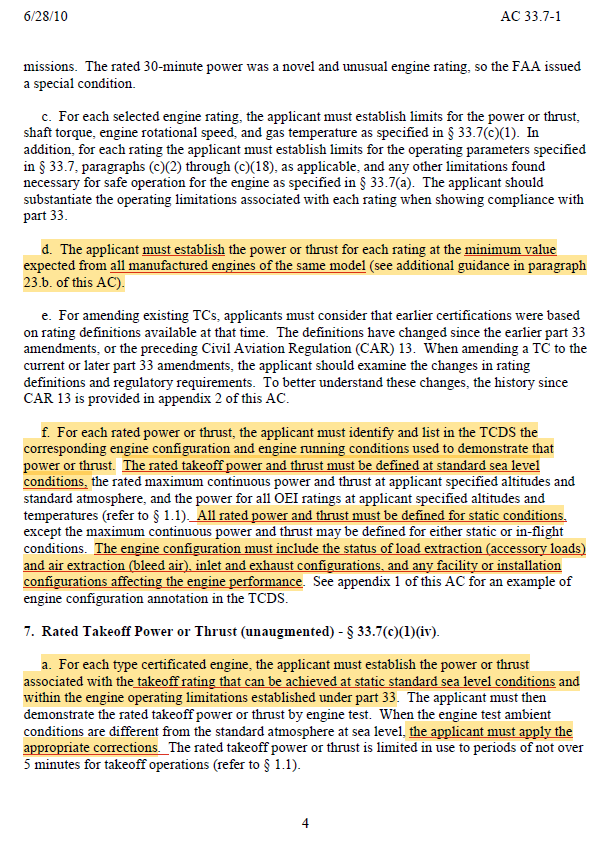
In the top highlighted section. The others were regarding another discussion elsewhere. But do feel free to explore the page above in its entirety. Note how the applicant must apply corrections for Rated Take-off power not the operator.
All of these engines installed in these aircraft produce more than the stated thrust. Especially when ram effect and mass airflow take place. They should NEVER fall under it. This is to establish a guaranteed baseline that aircrews can trust their lives in during take-off under any gross weight.
It is better to understate the maximum possible thrust at take-off than to ever overstate. You do see the logic in that, right?
It is better to mandate that the aircraft manufacturer establish a guaranteed baseline installed thrust (static @ sea level, standard day) than to only provide their engine vendor’s raw thrust to air crews in a flight manual.
You do see the logic in that, right?
The Soviets do not mess around either & you will see the same exact thing with engines like the RD-33.
How about no, bro. I do not have the energy or interest in jumping around small cutout sections of other flight manuals all in a effort to restore forum prestige. Conversing with you is cool & sometimes edifying, however, I am losing my patience because you are far more intelligent & far more capable than this.
The YF-12 is my favorite interceptor.
I am heading to Edwards Airforce base the 21st and will stop by the Blackbird parking lot. I will share some pics.
The jet can take off like a fighter & seeing the MiG-25 gives me hope…
Absolutely correct.
It should be noted that the YF-17 was the aircraft far better than the F/A-18A-C model we have here in terms of dogfight ability as it had far better vorticity generated in its hallmark “Cobra Hood” LERX and vorticity generated in the nose like the MiG-29 (still nerfed like hell in FM). The NAVY version removed these high lift technologies to cut production cost & made it heavier in effort to make it carrier capable as result.
there’s absolutely 0 way the yf-12 was a better dogfighter than the fa18