What Caused War Thunder's Shift Away From Free Tech Tree Vehicles?

Looking at the War Thunder subreddit discussions and the original article, it’s hard not to be shocked by how much the game’s update philosophy has changed.

Back in the early years, the overwhelming majority of new vehicles were tech-tree additions. Now, every update seems increasingly focused on premiums and event vehicles, with only a handful of regular vehicles added alongside them.

People often argue that Gaijin has run out of unique vehicles to add, but that doesn’t really hold up when you look at the huge number of historical vehicles, prototypes, and variants that are still missing from the game.

The graph makes the trend pretty clear: tech-tree vehicles have dropped from around 94% of additions in 2013–14 to just 67.5% in 2025–26, while premium/event vehicles have climbed from 6% to 32.5%. That’s not a small change… It’s a fundamental shift in how content is being delivered.

Obviously Gaijin is a company and making money is part of the equation, but this feels like a significant overcorrection. The game increasingly seems designed around selling vehicles rather than expanding the progression trees that most players actually spend their time grinding through.
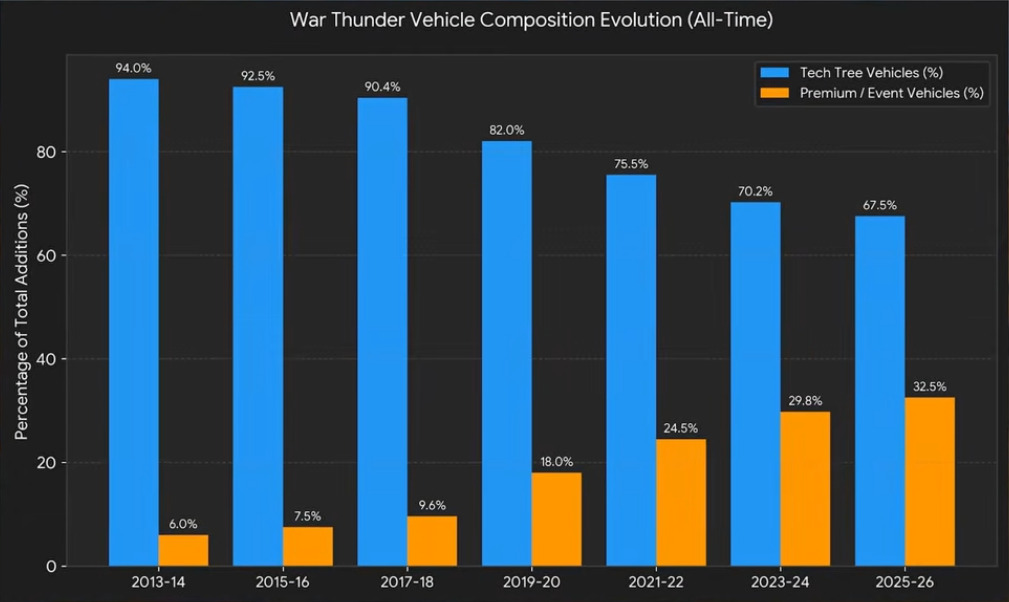
Additionally what happened within the company for such a heavy shift and reduction of Unique Teach tree vehicles added each year.

The 2019-2022 pandemic was a economic boom year for the gaming market so why did production and creation of more vehicles nation specificdecrease instead of increase
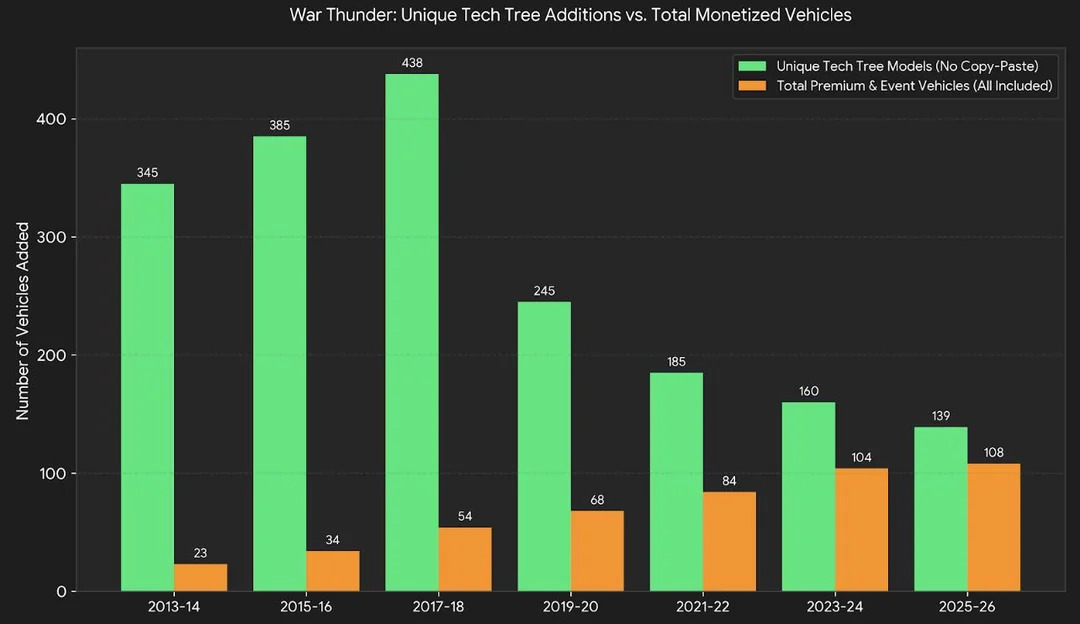

So why did the opposite appear to happen? Why did the number of unique tech-tree additions decline while premium and event vehicles became a larger share of new content? Was there a change in company strategy, development priorities, staffing, production costs, or internal resource allocation? Did the focus shift toward features, graphical upgrades, and monetized content because those offered a higher return on investment than expanding nation-specific tech trees?

As a player, I obviously don’t have access to Gaijin’s internal data, and there may be factors the community simply doesn’t see. But from the outside looking in, the trend is difficult to ignore. The game continues to receive new mechanics, maps, visual improvements, and other features, yet the rate of meaningful tech-tree expansion appears to have slowed considerably compared to its earlier years.

Maybe there are good reasons for that shift. I just find myself wondering what those reasons actually are, because from a player’s perspective the change has been dramatic.
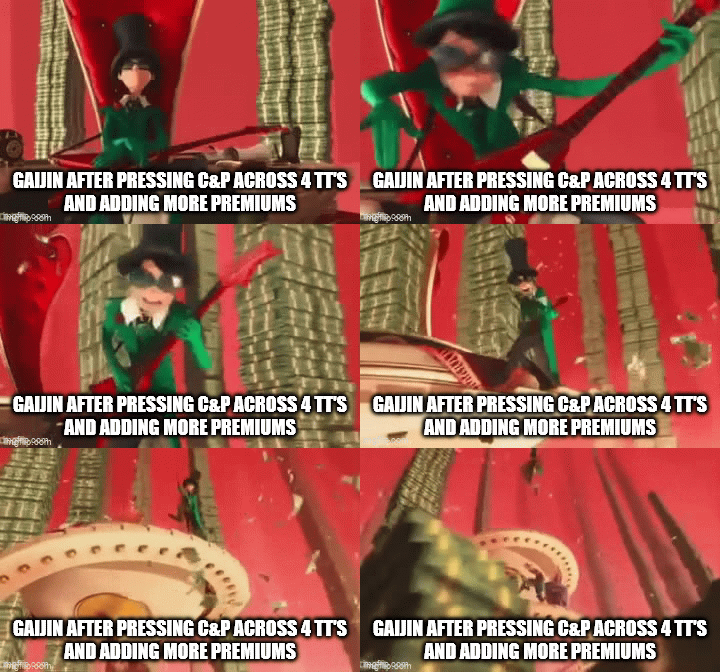

Or is this just a confirmation of what every player says about war thunder summed up into one meme:

atrn4l

9 Likes

They saw people are eager to buy premiums and decided to cash in on that.
Less unique TT vehicles and more copy and paste means less work spent overall.

They’ve cracked the code.

Capitalism and the infinite growth imperative.

1 Like

The game is free and have Insane amount of details for a free game.

Wont bother me, even less when i know they keep their word to put them on 50% sale 4 times a year.

They need a little something for themselves too, unless ofc if you want 80$ games like we are living it right now

1 Like

In theory, yes. But if we’re comparing a premium vehicle to the price of a full game, the value proposition matters too.

A €40–80 game is typically expected to fund the development of an entire title: the campaign, multiplayer, art, audio, programming, testing, marketing, post-launch support, and often years of updates. Even when DLC exists, you’re still purchasing access to a complete product.

By comparison, a €50–80 premium pack is usually one vehicle, some premium time, and currency. The amount of content you’re receiving is much smaller, even if the game itself is free-to-play.

That’s why saying “the game is free” doesn’t automatically justify any price point. Players naturally compare what their money can buy elsewhere. If a discounted premium pack costs the same as several highly rated games during a Steam sale, it’s reasonable to question whether the pricing reflects equivalent value.

More importantly, my argument isn’t even primarily about price. Gaijin can charge whatever the market is willing to pay. The interesting part is that as premium vehicles have become a larger source of revenue, they’ve also become a larger share of vehicle additions. The data suggests monetized content is receiving a greater proportion of development attention than it did a decade ago.

Whether that’s good or bad is subjective, but it’s a measurable shift, and that’s what I’m discussing.

In my personal opinion with my current facts it seems scummy at best.

2 Likes

But then again i keep playing the game so i am obviously in denial or just addicted to the game lol

1 Like

tbf they’ve added more tech trees/nations and vehicle classes (Helicopters/Boats/Ships), with it being F2P I’m not outraged by Gaijin adding more premiums as the game increases in scope (even if I do think the pricing is getting absurd).

Its because they realized that a large portion of the community will drop $70+ for a single vehicle everytime they release one.

1 Like

The community is what’s to blame. They put out the premiums, and we bought them. They simply saw that they were doing well with premiums and kept releasing more. We’re to blame for their greed.

2 Likes

Although then i would have expected each year to add more vehicles across the game and for premium to increase in scale with the free vehicles added, not for total vehicles to shrink and scale to premium

Hey. This is actually not correct.

There is a number of errors and issues with this graph that, when factored in, actually significantly change a lot of the context here.

A big one that skews things here is for the second graph, “Unique Tech Tree models (No Copy - Paste)” has been a factor in removing elements from the tree numbers, but the same rule and logic has not been applied to the premium Colum too. Which makes it look like the number of premiums has grown whilst tree content has overall decreased. But holding both to entirely different standards of how that number is arrived at. This inflates the premium number but decreases the tree number at the same time.

A few other elements of consideration that also skew things:

  • “Unique Tech Tree models (No Copy - Paste)” - Its not really clear how this is has been defined or calculated. As you will see just by going around the forum or any WT platform, people have very different opinions on what a “clone” or “copy paste” is. Some people call unique variants of a vehicle already in game a “clone”, when its actually often a unique model or has multiple core changes. Its more than likely the case here that several unique variants have been “fobbed off” so to speak as “copy paste” here either due to personal opinion or misunderstanding, whereas in the earlier numbers, this likely hasn’t been done. As its become more common recently to make such claims without delving too deep into the facts. Its not uncommon now for people to discard new unique vehicles as a “copy paste” before investigating deeper into the details and facts.

  • Modern vehicles sharing multiple trees - Similarly linked to the above, has this graph accounted for the fact that in the modern world, countries co-develop vehicles as a group or partnership more than they did during WW2 or the cold war? For example, when looking back to the larger numbers on the second graph in 2013 - 2017, the game was mostly focusing around the WW2 and post-war areas. Where nations generally had their own singular vehicles like a Spitfire, Zero, Yak, Bf 109, P-51, Mb 157, C.205 etc. Fast forward to modern times, and most nations across the modern world have used an F-16 or MiG-29 during their history. In other cases, something like the Eurofighter, jointly developed by 4 nations and going to 3 nations in game as their leading primary fighter. Whereas in the past, they would have each had their own designs. This context is all very significant to look and when put into the perspective of what eras the game was mostly focusing on during 2013-2017 and where we are now.

  • Regarding the first graph, 2013-2016, this was the period the game was in open Beta. During this time, the game was developing and expanding from an aircraft game, to a full combined arms game. Entire ground trees that didn’t exist were introduced at a time after years of internal development. Naturally these early tree introductions are generally when the most vehicles are introduced at a given time, as that is the bulk of the trees vehicles coming into the game before its later expansion. Germany, USA, USSR, Britain and Japan all got their initial ground trees launched during this period. France and Italy joined the game, with the French air and ground trees making it by 2017 and the Italian Air tree. So these years where typically when the largest nations were added to the game and the most initial expansion has taken place. But even since then, new additions, new nations and new vehicles have continued to flow. As well as vehicle variants from existing families too. Since then, we have also introduced entirely new types. Helicopters, Bluewater and Costal Naval Forces, Infantry testing and much more in the way of other features, massive developments to the game and expansion across the board.

I hope this has clarified a little bit and provided some additional details and context.

4 Likes