- Yes
- No
- Tech Tree
- Premium
- Event
- Battlepass
- Squadron
- I said no
- 1.0
- 1.3
- 1.7
- 2.0
- Other (comment)
- I said no
Westland Lysander Mk I (20mm) - Beachheads Beware!
History:
For a more detailed look at the history of the Lysander, please check out my suggestion for the standard model, which can be found here.
During the interwar period, a new type of aircraft emerged as strategies and tactics shifted and evolved to meet the needs of the modern battlefield: the army co-operation aircraft. Envisioned as a light and fast aircraft which could perform multiple tasks, such as liaison, reconnaissance, artillery spotting, and occasionally light attack/close air support, the army co-operation aircraft concept became extremely popular during the 1920s and 1930s. In the UK, several were developed over the course of the two decades, with the majority of them being biplanes. At the start of the 1930s, the primary plane in this role was the Hawker Hector. A decent plane when it was introduced, but by 1934 it was getting old and needed replacement. For said replacement, the Royal Air Ministry issued Specification A.39/34 and invited Hawker, Avro, and Bristol to compete. After some discussion, Westland was eventually invited as well.
Westland’s entry, initially dubbed the P.8, was developed by Arthur Davenport and William “Teddy” Petter, two of the most prolific British aircraft designers in history. Petter took the time to interview dozens of RAF pilots to find out what would make the ideal aircraft for this role. After this extensive campaign, Petter came up with three primary characteristics which he believed must be incorporated into the design: wide field of view, excellent low-speed handling, and most importantly, STOL capabilities. All of these aspects would be considered when putting together the P.8 prototype, creating a high-wing monoplane powered by a Bristol Mercury radial engine. Primarily constructed of duralumin and stainless steel, the wings were fabric covered and both them and the wheels were supported with Elektron magnesium alloy tubes. This made it extremely light and nimble, important for its role.
The P.8 faced stiff competition from the Bristol Type 148, with these two being selected as the final contenders for the specification. In the end, the Westland P.8 was selected, entering production as the Lysander in September of 1936. It would enter service in June of 1938, with the first examples being used primarily for artillery spotting and message dropping.
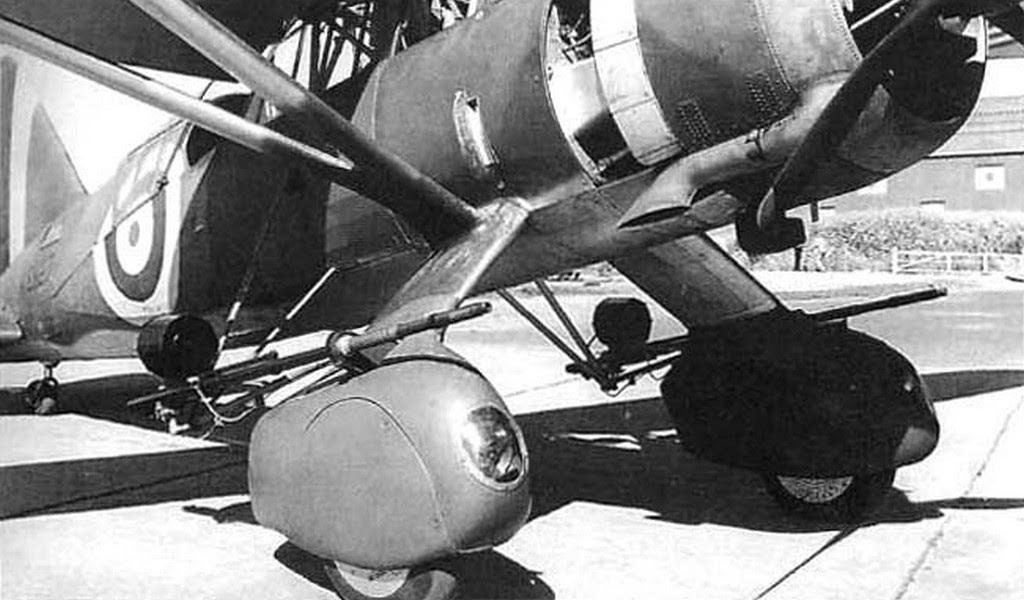
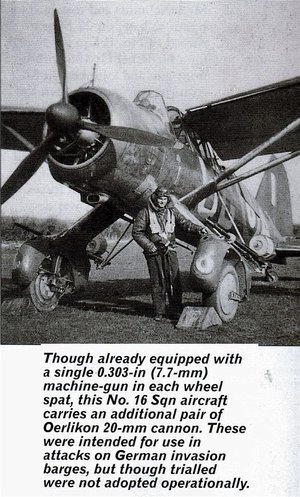
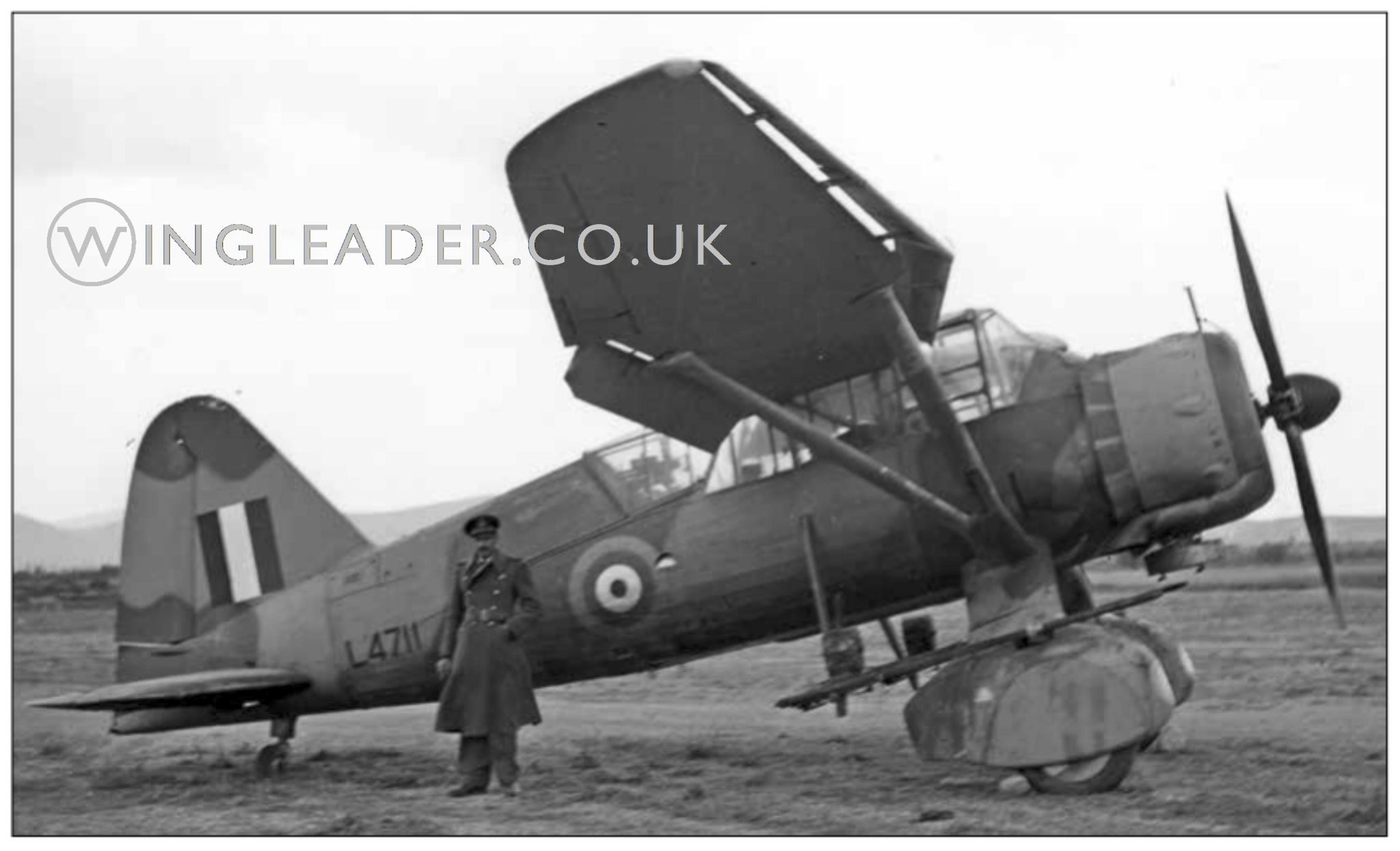
The Lysander would spawn several experimental variants, with many being tested on early prototypes and pre-production airframes. One of these experiments was a kit which attached a pair of 20mm Hispano Mk. I cannons to the wheel fairings as a way to boost its firepower. The idea was to take advantage of its maneuverability, low stall speed, and loiter time to create a plane capable of strafing beachheads made by a potential German invasion of the United Kingdom. This was initially tested on one of the Lysander prototypes, K6127, but it was later expanded to include the airframes L4673, L4674, and P1687. There is also evidence to suggest that some kits for this conversion were shipped to the Middle East, as one photo purports to show airframe L4711 in Egypt with this conversion. One source also mentions No. 4 Squadron receiving some in France. The veracity of these claims needs more research, but it did not see widespread use and was cancelled relatively quickly. K6127 was converted back into a regular Lysander and would go on to be converted into another, even stranger vehicle: the Westland Wendover.
Description:
This version of the Lysander is based on the Mk I, which is essentially the same as the later Mark III but for two major respects: the engine and the defensive armament (setting aside the 20mm cannons). It retains the same construction of duralumin, steel, and magnesium with fabric and wood wings. It possesses the same high-mounted wings with full-length leading-edge slats for extreme maneuverability at low speed. It also has the same large, high-visibility two-seat canopy, with the pilot in the front and a defensive gunner/observer in the rear. The first difference is here, with the defensive gunner only having access to a single 7.7mm Lewis gun. The second major difference is the engine, being a slightly more powerful 890 hp Bristol Mercury XII. This will provide slightly better overall performance than the Mk IIIA, but not by a significant amount.
What makes this particular Lysander special is, of course, the forward armament. Along with the standard wheel-mounted 7.7mm Browning machine guns, there are two 20mm Hispano Mk. I autocannons, one on the outside of each wheel fairing. These will add significant weight to the aircraft, affecting its performance somewhat, but the more powerful engine should offset this a little. Because of these cannons, this CANNOT equip the bomb stub wings, but it theoretically should still be able to carry the four 20 lb HE bombs on the fuselage rack.
This aircraft will likely play similarly to the French D.371 H.S.9. A lightweight late-30s monoplane with two guns much bigger than it is used to carrying. They hit hard but have a small ammo pool, meaning you will have to pick your shots carefully. Thankfully, only one or two shells will be needed to take down most aircraft this is likely to face, and you still have your machine guns if need be. The defensive armament is less capable, but at least it still exists. Whether or not Gaijin chooses to give it the fuselage bombs is up to them, as the Mk I could carry them but none of the available photos of this modification show them, though that doesn’t explicitly exclude them, particularly if the kits were distributed to field units as some sources suggest. If so, it would give a bit of extra punch against open-topped vehicles, albeit VERY minimal.
Specifications:
Spoiler
General Characteristics:
Length: 9.3 m (30 ft 6 in)
Wingspan: 15.24 m (50 ft)
Height: 4.42 m (14 ft 6 in)
Wing Area: 24 m2 (260 sq ft)
Airfoil: Modified RAF 34
Empty Weight: 2,066 kg (4,554 lb)
Max Takeoff Weight: 3,008 kg (6,631 lb)
Engine: 1x 890 hp Bristol Mercury XII 9-cylinder air-cooled radial engine
Propeller: 3-blade fixed pitch
Crew: 2 (Pilot, Rear Gunner/Observer)
Performance:
(NOTE: These are the numbers for the Mk IIIA which has 20 fewer horsepower. I could not find exact information on the performance of the Mk I, but if someone else does, please let me know and I will update it. This will also be impacted by the added weight of the guns.)
Max Speed: 341 km/h (212 mph)
Stall Speed: 105 km/h (65 mph)
Rate of Climb: 7.1 m/s (1,410 ft/min)
Service Ceiling: 6,600 m (21,500 ft)
Range: 970 km (600 mi)
Armament:
Offensive: 2x 20mm Hispano Mk. I autocannons (attached to wheel fairings) - 60 rpg, 2x 7.7mm Browning (forward-firing in wheel fairings) - 500 rpg
Defensive: 1x 7.7mm Lewis gun - (unknown ammo count)
Suspended (theoretical): 4x 20 lb HE bombs on rear fuselage rack
Gallery:
If there is anything I have missed or gotten incorrect, please let me know! I hope you enjoyed reading this, and I hope you will also check out my other suggestions! Thanks, and have a great day.
Sources:
Spoiler
Westland Lysander - Wikipedia
Westland Lysander G-CCOM — European Airshows
The Westland Lysander – The IAF’s first monoplane bomber – Indian Air Force
https://www.key.aero/article/busy-lizzie
Redirecting...
Lizzie with an attitude - Aircraft WWII - Britmodeller.com
Vintage Aeroplane Writer: Modified Hurricane