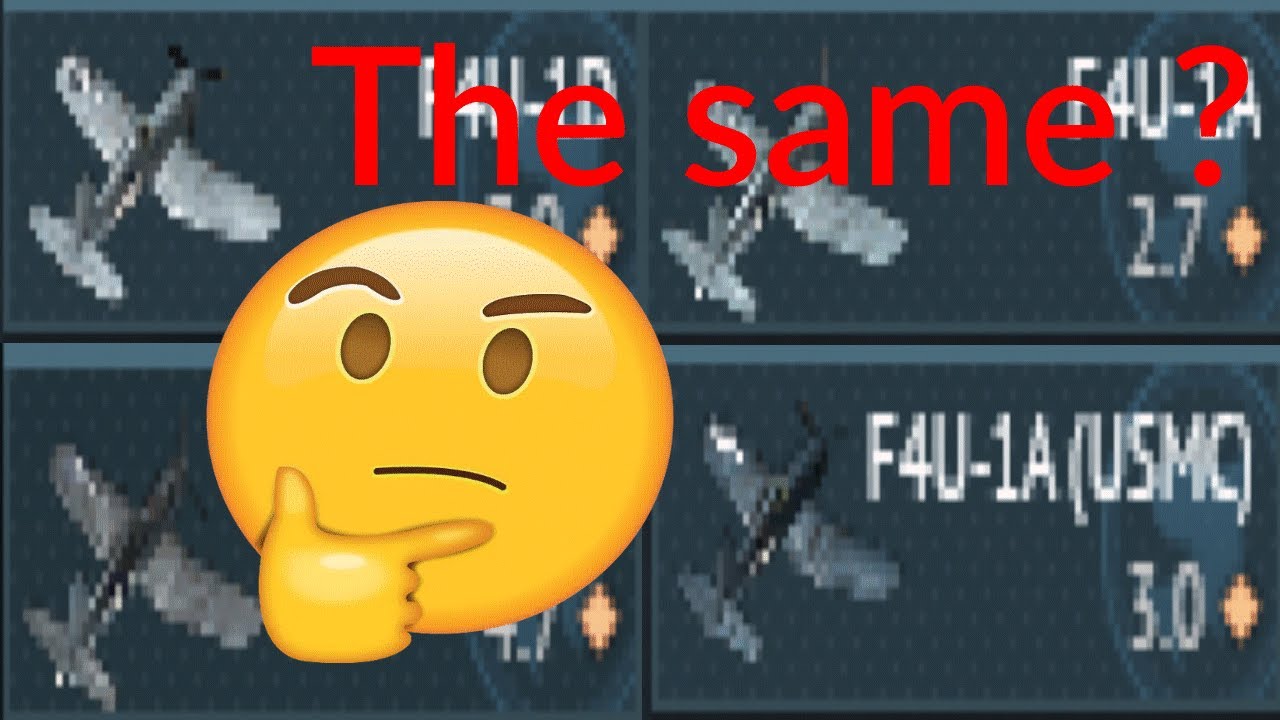
F4U-1s are amazing, especially after they buffed elevators to historical levels.
Its only issue in sim is the lack of rear visibility which is a non-issue in RB.
P38s are great climbers and with flaps turn incredibly well. Their issue is a super recognizable silhouette and fragile damage model.
Bearcat is great. It keeps up at 6.0 in sim quite well, it’s 4.7 in RB.
1 Like
Sim performance and RB performance have almost nothing in common. P-38s have below average climb rate, and the only good F4U-1 is the 1D.
Bearcat is just massively overhyped.
The F4U-1D is the lightest -1 Corsair (~50kg at min fuel) because of no wing fuel tanks but it is the one with most drag due to the suspended armament pylons. Therefore its actually the slowest one and its at 3.0. The other -1 Corsairs are faster by around 8-13kph but the A gets to sit at 2.7 and the USMC is also 3.0. Their flight performance are near identical yet you think the one with the very slightly worse one and higher BR is the best one.
Video with some testing:
2 Likes
P-38s (at least the J and L) have VERY good climb rates (on par with similar BR 109s…and they get airspawn!). Both are one of the few TT aircraft that let you have superior alt to 109s. They have good speed, great firepower and insane flaps which let them out turn many straight up turn fighters in certain envelopes. The L gets boosted ailerons which lets you out roll a lot of other planes and airbrakes to deal with compression and can be used as an added trick in maneuvers like reversals.
Watch some videos on how to use these planes, they are very potent and very fun to fly when you get things right in them.
In general, I think that only some US aircraft, given how most players play (mowing grass quickly to the ground) and the nature of the game map, have the prerequisites for aerial dogfights …
And of course those that have airstart are at an advantage.
I initially saw the recent larger installation of airstart negatively, but if players learn to work with it, it will be to the advantage of the game. The point is that most US aircraft do not have the character of interceptor and ambush aircraft, they simply need a longer time to gradually climb.
The point is to learn to play at altitude in an area where there is airspace above, airspace on the sides and airspace below.
So far it is clear that for many players the safe airspace is above, airspace on the sides and land or water below.
Only a few US aircraft are built for dogfights at low altitudes, it is about using BaZ, BaR techniques, simply tiring the opponents in the fight and imposing your way of fighting on them… Horizontal dogfights in tight turns are a quick end for US aircraft.
No matter how well I play with a certain planes, the win rate will still be lower than 50%. With a stock plane I can score the most kills in the team…and still lose. It is frustrating! This problem becomes more noticeable at BR 9.0 and higher, with the team getting stomped within two or three minutes. I developed the Soviet line to modern jets, and the German and U.S. lines to jets, and yes: the U.S. line is the worst—and it’s not because of the planes. US planes are reasonably good.
The higher tiers have few level bombers; most are fighter-bombers, and many of them end up suicide bombing. They fly straight to the base, bomb and die, or die before they can bomb. It is a plane lost for the team. Why not have some patience? Why rush into certain death? Why not wait, flank, then bomb, and then help the team instead of being the first to die? Where is the imagination, the instinct for survival? Or it is like a daily job: headphones on with music and start grinding again and again. Always the same. Quantity over quality. Work on conveyor belt…