At everyone’s request, reposting it here.
the total mass of the prefabricated fragments of the new missile (105kg) has far exceeded the total mass of the warhead (32.5kg), and it is obvious that Russia does not need to comply with the law of conservation of mass…
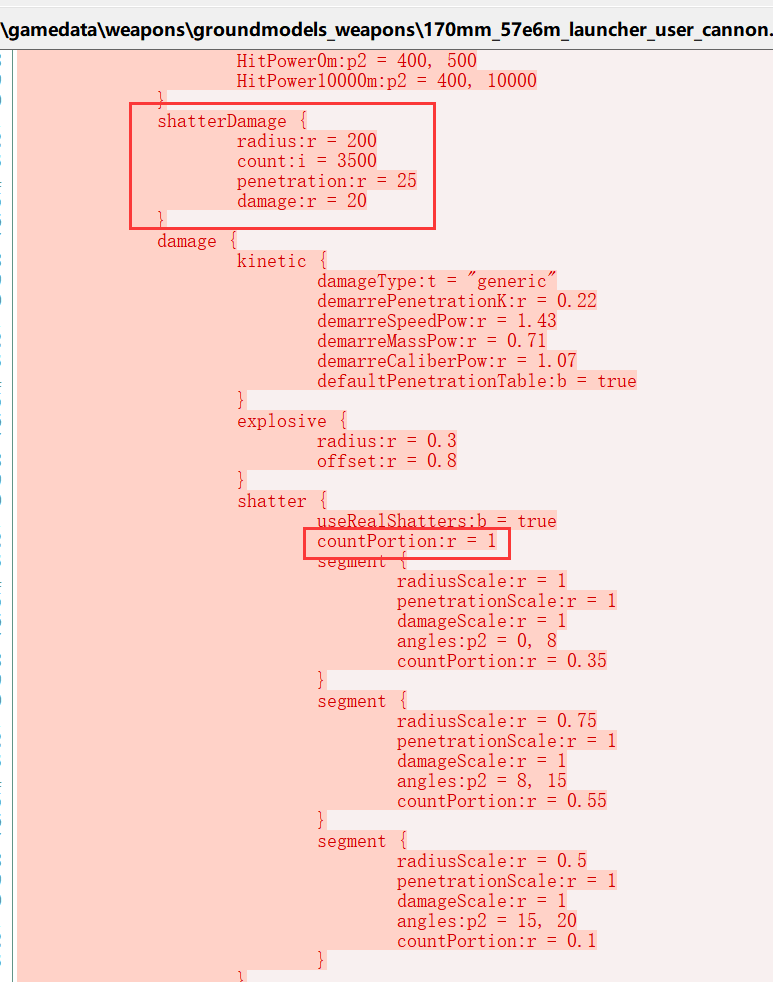
The extra AHEAD pre-fragmented section of the 95ya6m directly provides 3,500 fragments, with a fragment range of 200 metres, single fragment penetration of 25, damage 20, and single-shot fragment damage of 70,000. The fragment quantity coefficient is directly set to 1 (Figure 1).
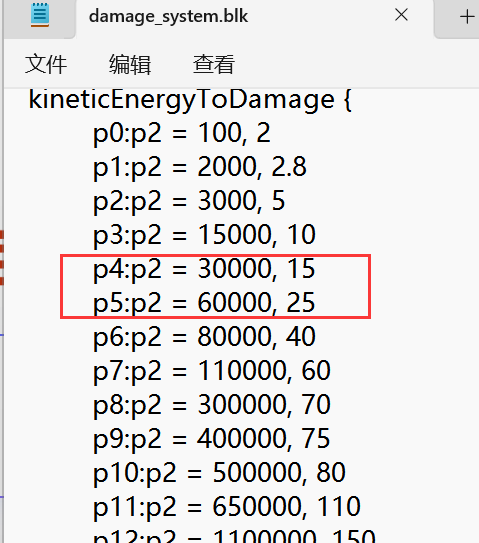
What level is 20 points of kinetic damage? According to the in-game kinetic-damage conversion table (Figure 2), 20 points of damage corresponds to 45 kJ of kinetic energy, which is already at the level of a 20mm gun. Assuming all pre-fragments fully inherit the missile’s maximum speed of 1,700 mps, in order to produce 45 kJ of kinetic energy, the mass of a single fragment would need to be around 30 grams. 30 grams, 3,500 fragments—this is already very inconsistent.
Comparing with a normal high-explosive fragment warhead: the theoretical fragment count of the 95ya6 is 2,560, fragment theoretical penetration 8mm, damage 14.2, radius 45.9 m. Since the total quantity coefficient for the generic air-defence missile fragment template is only 0.505, even using parameters from the sector with maximum side energy (1.5 times radius, 1.5 times damage) to estimate the total damage of all fragments, it only reaches 27,600 damage, radius 69 m, penetration 12mm.
In terms of fragment damage projection, one 95ya6m round is much stronger than two older rounds, and even Buk (total fragment damage 56,812) is far from its match.
Theoretically, remote detonation at 50 metres is not ideal for maximising fragment power, but because the fragment range reaches 200 metres, fragments can still retain most of their damage and penetration when reaching the aircraft, meaning the values are very sufficient.
Additionally, with 50 metres plus a maximum fragment cone angle of 20 degrees, when the fragment cloud reaches the aircraft, it effectively achieves an 18-metre damage radius (50×tan20°). Even if manually fired inaccurately, it is sufficient most of the time to shred a fixed-wing aircraft.