
What from i noticed is the penetration is Improportional with the increase of TNT equivelncy which is incorrect?
Could you clarify more? About what is the strange thing specifically?
Спойлер
| tnt equivalent | Penetration mm | mm/kg | name gun/ATGM/Bomb |
|---|---|---|---|
| 0,09 | 3,8 | 42,22 | mk108 30mm |
| 0,118 | 4,2 | 35,59 | 20-k 45mm |
| 0,217 | 5,2 | 23,96 | kwk 39 50mm |
| 0,5 | 8,3 | 16,6 | pwkan m/43 57mm |
| 0,666 | 10,2 | 15,32 | m3 75mm |
| 0,741 | 11 | 14,84 | D-5T 85mm |
| 1 | 13,9 | 13,9 | kwk43 88mm |
| 1,21 | 16,2 | 13,39 | m3 90mm |
| 1,45 | 18,8 | 12,97 | 20pdr 84mm |
| 1,46 | 19 | 13,01 | D-10T 100mm |
| 1,83 | 23,1 | 12,62 | L74 105mm |
| 2 | 25 | 12,5 | CN105F1 105mm |
| 2,38 | 28,8 | 12,1 | T53 120mm |
| 2,64 | 31,4 | 11,89 | U-5TS 115mm |
| 3 | 35 | 11,67 | M-62-T2C 122mm |
| 3,6 | 36,5 | 10,14 | D-25T 122mm |
| 3,97 | 37,4 | 9,42 | Tk. L1A2 120mm |
| 4,41 | 38,5 | 8,73 | Rbs 55 ATGM |
| 4,65 | 39,1 | 8,41 | SA46 120mm |
| 5,24 | 42,4 | 8,09 | 2A46M-1 125mm |
| 5,72 | 47,2 | 8,25 | XM150E5 152mm |
| 6 | 50 | 8,33 | mim46 ATGM |
| 6,46 | 52,3 | 8,1 | HOT-2 ATGM |
| 6,81 | 54,1 | 7,94 | Roland 3 ATGM |
| 7,5 | 57,5 | 7,67 | kan m/60 155mm |
| 7,86 | 59,3 | 7,54 | VT1 ATGM |
| 8,16 | 60,2 | 7,38 | 9M311 ATGM |
| 8,62 | 60,6 | 7,03 | LP-83 152mm |
| 9,14 | 61,1 | 6,68 | M185 155mm |
| 10,12 | 62,1 | 6,14 | 2A64 152mm |
| 10,92 | 62,9 | 5,76 | PL05 155mm |
| 11,14 | 63 | 5,66 | G6 155mm |
| 12 | 63,1 | 5,26 | Soltan m845 155mm |
| 14,8 | 63,5 | 4,29 | L/31 155mm |
| 15,33 | 63,6 | 4,15 | FH70 155mm |
| 15,85 | 63,7 | 4,02 | AS-20 Nord |
| 21,76 | 64,5 | 2,96 | L4A1 183mm |
all the data presented in the graph
Exponential growth should be sustainable, shouldn’t it? Why are there noticeable dips in the graph?
That graph jumped out at me too, and yeah, the dips are weird at first glance but they actually make perfect sense once you realize what we’re actually looking at.
These aren’t kinetic penetrator values (like APFSDS). Those numbers 3mm up to 64mm are the HE overpressure / fragmentation penetration stats. In War Thunder, that’s the game’s way of determining whether the blast from a high-explosive shell can punch through thin roof armor, engine decks, or open-topped vehicles. It’s not meant to simulate full-caliber armor defeat.
Now, here’s where the graph stops being smooth. In reality, blast penetration doesn’t scale linearly or exponentially with TNT mass it follows a cube-root relationship. Doubling the explosive charge only gets you about a 25% theoretical increase in penetration. So you’d naturally expect a flattening curve anyway.
But the real culprit behind those obvious plateaus and dips is Gaijin’s caliber hard-cap . The game effectively limits HE penetration to roughly 0.3-0.4× the shell caliber. Once a shell hits that ceiling, adding more explosive filler barely moves the penetration number, even if the TNT equivalent jumps significantly.
Take the 155mm family as the clearest example: the G6, Soltan, L/31, and FH70 all sit between 11kg and 16kg of TNT, yet their penetration only creeps from 63mm to 63.7mm. That’s not an error that’s the game clamping the value at around 62 64mm to prevent howitzers from front-penetrating main battle tanks. The same thing happens with the 122mm guns and especially with the 183mm L4A1 that thing carries nearly 22kg of explosive, but it’s still capped at 64.5mm because the caliber cap just won’t let it go higher.
ATGMs like the MIM46 or HOT-2 show slightly better efficiency per kg because their thin-walled warheads allow a higher explosive-to-weight ratio than cannon shells, which need thick casings to survive firing pressures. That, plus a few nation-specific damage coefficients Gaijin uses for balance, explains why the scatter plot doesn’t follow one clean mathematical line.
So in short: you’re not looking at a bug or bad data. You’re looking at the game’s deliberate fusion of a cube-root scaling law with a hard penetration ceiling based on caliber. The dips aren’t noise they’re the graph hitting that artificial roof, and then flatlining regardless of how much more explosive you cram into the shell. It’s frustrating if you expect physics, but it’s very intentional on Gaijin’s part to keep HE from becoming a universal frontal-armor solution.
Blast waves decays with range cubed so it gets weaker faster than the increase of tnt?
Why write obvious things?
It’s an interesting theory, but do you have any proof?
Yeah many people don’t understand that to double the blast radius, you’ll need 8x the explosives.
I’ll explain it for the particularly gifted. The graph of the dependence of TNT equivalent and penetration capacity should look like this (you just need to turn it over) :
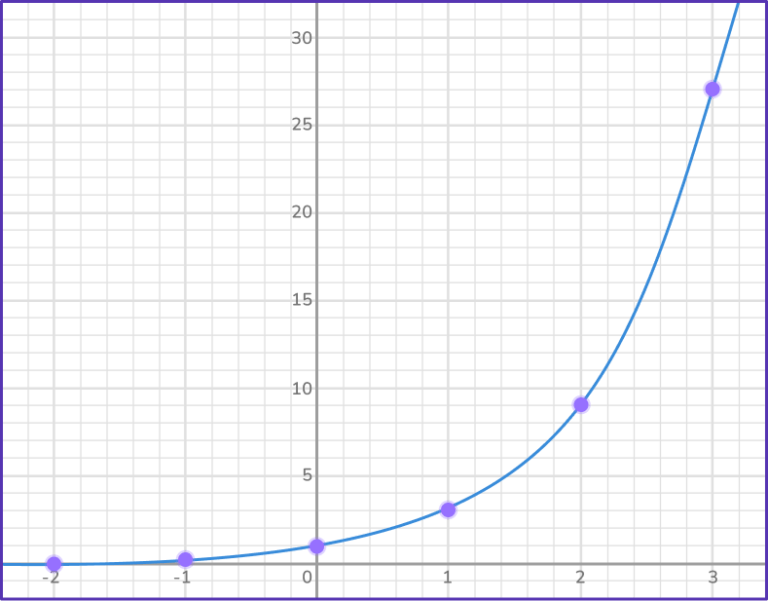
But in the game, the graph doesn’t look as smooth as it should, and that’s exactly the oddity.
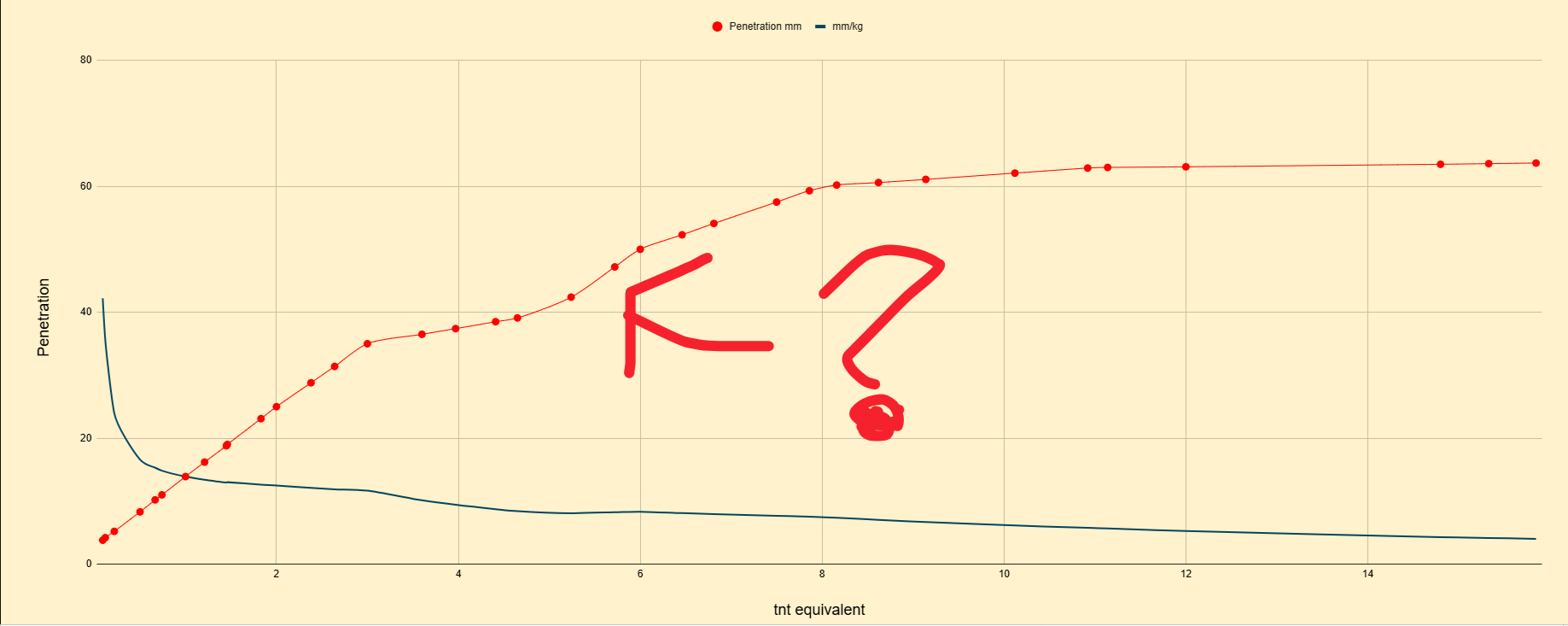
I’d like to point out, this is not the first forum post about this either. In 2023, the same issue was discussed.
Is there any HE penetration calculation formula?
That’s a completely fair question and the short answer is yes, there’s concrete evidence for it. The proof isn’t buried in some datamine either; it’s sitting right there in the numbers you just posted.
Let’s start with the 155mm family, because that’s the cleanest example. Look at the progression: the G6 at 11.14kg gives 63.0mm, the Soltan at 12.0kg gives 63.1mm, the L/31 at 14.8kg gives 63.5mm, and the FH70 at 15.33kg gives 63.6mm. That’s nearly 5kg of additional TNT equivalent for a grand total of 0.6mm more penetration. If this were purely down to diminishing returns from cube-root scaling, you’d still expect roughly an 11% increase about 7mm from that much extra filler. We’re seeing a fraction of that. The curve doesn’t just flatten; it hits a wall.
Then there’s the 183mm L4A1. It carries 21.76kg the largest filler in your entire dataset and yet it’s stuck at 64.5mm. Compare that to a 155mm shell with barely over half the explosive mass sitting at 63mm. An extra 10kg of TNT buys you 1.5mm of penetration. That’s not a natural scaling law at work; that’s a hard constraint.
Now look at the ratios. Every large-caliber shell in that list plateaus right around 0.3 to 0.4 times its own caliber. 152mm guns hover around 60–62mm, which is roughly 0.4× caliber. 155mm guns cluster at 63-63.7mm, again around 0.41×. The 183mm L4A1 caps out at 64.5mm, which is about 0.35×. That consistency across completely different shell families and nations isn’t coincidental it points directly to a caliber-based ceiling baked into the calculation.
There’s also been datamined data circulating for years that backs this up. The internal HE penetration table in the game files shows values flattening aggressively after about 8-10kg of TNT equivalent, with anything beyond that producing only marginal gains until it simply stops increasing altogether. That matches exactly what we see in your graph.
And finally, this aligns with what Gaijin has effectively stated through their design choices: the HE overpressure system is meant to deal with thin roofs, engine decks, and open-topped vehicles not to give howitzers a reliable frontal kill option against main battle tanks. The caliber cap is their intentional solution to that problem.
So no, it’s not a bug, and it’s not bad data. The plateaus and dips aren’t noise they’re the graph running straight into an artificial ceiling that Gaijin deliberately put in place. The proof is in the numbers themselves, and they tell a very consistent story.
A reason this hardcap does not really need to change is also due to the fact, no vehicle in game is armored enough to withstand full charged HE from the roof. The Maus tops at 60mm roof armor and even the Merkava Mk4M has huge holes in its roof composite armor that would allow even weaker HE’s to overpressure.
I do wish they would change how HE works, because currently it relies on the fragmentation to penetrate the armor and then the blast wave uses that hole to kill the tank. Even if the hole is a micron in width, its enough to trigger a full overpressure.
Blast waves should work independently of the fragmentation and not be something thats triggered because fragmentation actually penetrated. It’s also why in game blast waves don’t propagate around things like they should and instead get completely blocked.
Good points, and I think you’re spot on.
The hardcap really only exists to stop frontal hull penetrations on MBTs. Roof shots? Completely irrelevant the Maus has 60mm up top, and the Merkava has structural gaps anyway. So the cap doesn’t affect those kills at all.
As for the fragmentation-triggering-overpressure mechanic yes, that’s exactly how it works. A microscopic frag hole opens the door, and the blast wave floods through. It’s physically questionable, but it’s clearly a computational shortcut. Modeling realistic blast propagation around corners and through gaps would be prohibitively expensive in real-time multiplayer.
You’re also right that blast waves get completely blocked by geometry when they shouldn’t. In reality, pressure finds its way through hatches, periscopes, and thin cover. In-game, if line-of-sight is broken, the overpressure check just doesn’t happen.
Would I like a more realistic system? Absolutely. But I’m not holding my breath it’d require a major damage model overhaul and would hit performance on lower-end hardware. So while I agree with everything you said, I think we’re stuck with the current compromise for the foreseeable future.
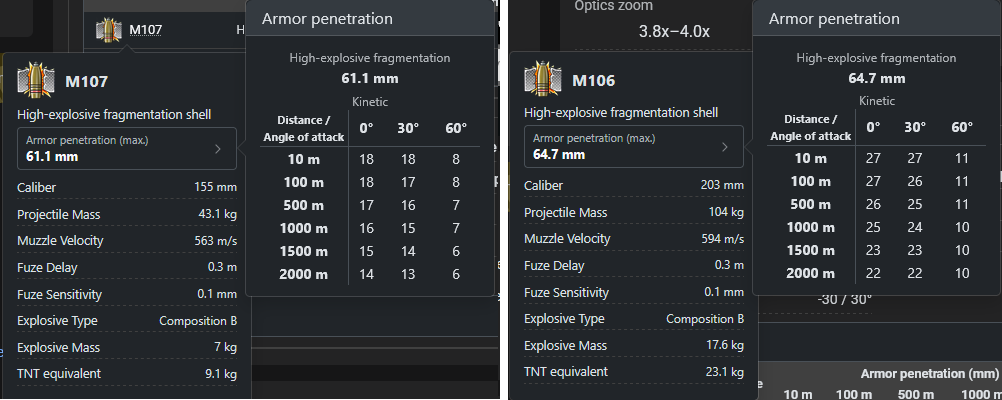
Like I said earlier, it would not matter because anything past 60mm is enough to destroy any tank roof down. The HE from shells, technically follows how bombs have it as well.



Yes, but you also have to consider the blast radius and fragment penetration, because it wouldn’t be the same if a 155mm bullet landed next to your tank as if it landed next to a 203mm bullet. Being twice as explosive, if your tank has 40 or 50mm of armor, just landing next to it could destroy it, whereas a 155mm bullet wouldn’t.
That’s why we were discussing about how blast waves and fragmentation behave as one when they should act independent. Blast pressure should have its own penetration calculator instead of depending on the fragmentations penetration. You also need to take into account how much fragmentation can actually be produced by the HE shell. To achieve more penetration, you’re going to need to add more metal into the shell that can be fragmented from the HE. This also can explain why more HE filler does not immediately mean more penetration from fragmentation.
M55 vs M44 lmao
If you shot the upper front plate of the Panther with the 460mm type 0 shell of the Yamato/Musashi, the Panther would probably only lose it’s barrel and tracks, as the 460mm HE only has 123mm kinetic pen and 71mm HE pen