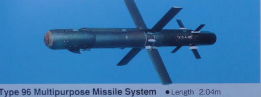
The Type 96 Multi-Purpose Missile System (MPMS) is a fiber-optic guided, man-in-the-loop missile system developed by Kawasaki Heavy Industries for the Japan Ground Self-Defense Force (JGSDF), designed primarily to engage armored vehicles, landing craft, and low-altitude airborne targets such as helicopters with high precision and minimal collateral damage.[1][2]
Development of the Type 96 MPMS began in Japan’s fiscal year 1990 as a heavy medium-range anti-tank system, marking the nation’s first missile platform featuring fully digital control for guidance, command, and control functions.[1] Practical testing was completed by the GSDF in August 1995, with initial procurement funded in fiscal year 1996 under the designation “multiple target guided missile system.”[1] The system utilizes an infrared imaging seeker connected via optical fiber cable, enabling operators to receive real-time video feeds for target acquisition and mid-flight corrections in a track-via-missile (TVM) mode, which enhances effectiveness against obscured or fast-moving threats like air-cushioned landing craft or hovering aircraft.[1][2]
Key technical features include a vertical launch capability for improved concealment of firing positions, integration with company-level combat command systems, and deployment on highly mobile 4x4 high-mobility vehicles that are air-transportable for rapid positioning.[1][2] The missile itself measures approximately 2 meters in length, 160 mm in diameter, and weighs 60 kg, with inertial navigation guiding it to the target area before switching to operator-controlled TV and infrared imaging.[2] Operational since the late 1990s, the Type 96 has been fielded in sets of six missiles per launcher to bolster island defense and anti-invasion roles, though it is slated for gradual replacement by the advanced Multi-Purpose Missile System Kai (MPMS Kai) starting in 2026.[1][3]
Development
Background and requirements
In the post-Cold War period, Japan’s defense posture evolved to prioritize the defense of its remote islands and maritime approaches against amphibious incursions from potential adversaries, including the Soviet Union during its final years and, increasingly, China. This strategic emphasis stemmed from vulnerabilities in archipelagic territories like the Ryukyu Islands, where rapid landings by enemy forces—via hovercraft, landing ships, or armored vehicles—could disrupt key sea lanes and national sovereignty. The Japan Ground Self-Defense Force (JGSDF) recognized the need for versatile coastal and inland defense tools to deter or repel such threats, moving beyond purely territorial air and sea denial toward integrated ground-based countermeasures.[4][5]
Existing anti-tank systems, notably the wire-guided Type 79 Jyu-MAT introduced in the early 1980s, proved inadequate for these expanded roles due to their limited range, susceptibility to terrain obstacles from wire spools, and primary focus on direct tank engagements rather than multi-target scenarios. These shortcomings left gaps in addressing dynamic threats like fast-moving landing craft, low-flying helicopters, and fortified positions amid smoke, foliage, or low visibility, prompting requirements for a heavier, more adaptable guided weapon system. The desired missile needed to support man-in-the-loop operation at medium ranges while engaging armored vehicles, amphibious vessels, rotary-wing aircraft, and static targets in contested environments.[1][6]
The Type 96 multi-purpose missile system was conceptualized in fiscal year 1990 (FY1990) as a heavy multi-purpose anti-tank (MAT) solution specifically to bridge these deficiencies in the JGSDF’s medium-range guided munitions inventory. This initiative aligned with broader efforts to modernize ground forces for hybrid island defense operations, incorporating vertical launch capabilities for better concealment and deployment flexibility in rugged terrain.[1]
The Japan Defense Agency (JDA, predecessor to the current Ministry of Defense) was instrumental in outlining the program’s technical needs, mandating fiber-optic guidance to mitigate electronic jamming risks inherent in radio-based alternatives and to surpass the accuracy constraints of wire-guided predecessors like the Type 79. This technology facilitated real-time video feedback for precise targeting in obscured conditions, marking a significant advancement in Japan’s indigenous missile development.[1]
Research, testing, and adoption
Development of the Type 96 Multi-Purpose Missile System (MPMS) began in Japan’s fiscal year 1990 (FY1990), initiated by the Japan Ground Self-Defense Force (JGSDF) to meet requirements for a versatile guided weapon system. Kawasaki Heavy Industries served as the primary contractor responsible for overall system integration, testing, and support.[1][2]
In FY1996, the Japanese government allocated budget funds specifically for the “multiple target guided missile system,” marking a significant milestone in funding the project’s transition from research to procurement. This allocation supported the integration of advanced features, including Japan’s first fully digital command, control, and guidance systems, which presented key research and development challenges such as ensuring reliable real-time data transmission and operator interface stability. Additionally, the system was designated as Japan’s inaugural fiber-optic guided multi-purpose missile, requiring innovative solutions to maintain guidance integrity over extended ranges in complex environments.[1]
Practical testing was completed by the JGSDF in August 1995, encompassing field trials that evaluated vertical launch capabilities and infrared imaging guidance across diverse terrains, including coastal and rugged inland areas, to verify performance against simulated landing craft and armored targets. These trials confirmed the system’s concealability enhancements through its novel vertical firing mode and the effectiveness of man-in-the-loop control via fiber-optic links.[1]
The Type 96 MPMS was formally adopted and entered service with the JGSDF in 1996, with its designation reflecting the fiscal year of initial procurement. Early production emphasized improvements in operator control through digital interfaces, enabling precise adjustments during engagements and setting the foundation for company-level deployment.[1][2]
Design and components
Missile structure
The Type 96 missile features a compact and robust physical design optimized for portability and long-range engagement. It measures 2 meters in length and has a diameter of 160 millimeters, with a launch weight of 60 kilograms.[7] These dimensions enable easy integration into man-portable or vehicle-mounted launchers while maintaining structural integrity during sustained flight.
The missile’s forward section incorporates an infrared imaging seeker, which facilitates target acquisition in low-visibility conditions such as smoke, fog, or nighttime operations.[1] At the rear, a spool deploys an optical fiber tether that connects the missile to the launch unit, transmitting real-time video imagery for man-in-the-loop guidance.[7]
The missile is equipped with a warhead designed to defeat armored vehicles like tanks and engage landing craft.[8]
Propulsion is provided by a solid-fuel rocket motor, supporting ranges exceeding 10 kilometers.[9] This motor’s design supports vertical or angled launches, contributing to the missile’s versatility in varied terrains.
Guidance and control systems
The Type 96 multi-purpose missile system employs a fiber-optic guided mechanism utilizing track-via-missile (TVM) technology with infrared imaging for precise target engagement. An infrared seeker mounted in the missile’s nose captures real-time imagery, which is transmitted through an optical fiber tether to the operator’s control station, allowing direct visualization and manual corrections during flight.[1]
This man-in-the-loop operation integrates full digital control across guidance, command, and control functions, enabling the operator to steer the missile dynamically against moving targets. The non-radio frequency link provided by the fiber-optic tether confers high resistance to electronic jamming and countermeasures, making it effective in environments with intense electronic warfare.[1][9]
The system’s effective engagement range extends beyond 10 km, supported by vertical launch capabilities that allow firing from concealed positions with minimal signature exposure.[9][1] Image transmission equipment processes the infrared data into a clear feed on the operator’s screen, facilitating targeting of dynamic threats such as hovering helicopters or air-cushioned vehicles, even in smoke-obscured or terrain-challenged conditions-