- Yes
- No
 T-34-88 (k20)
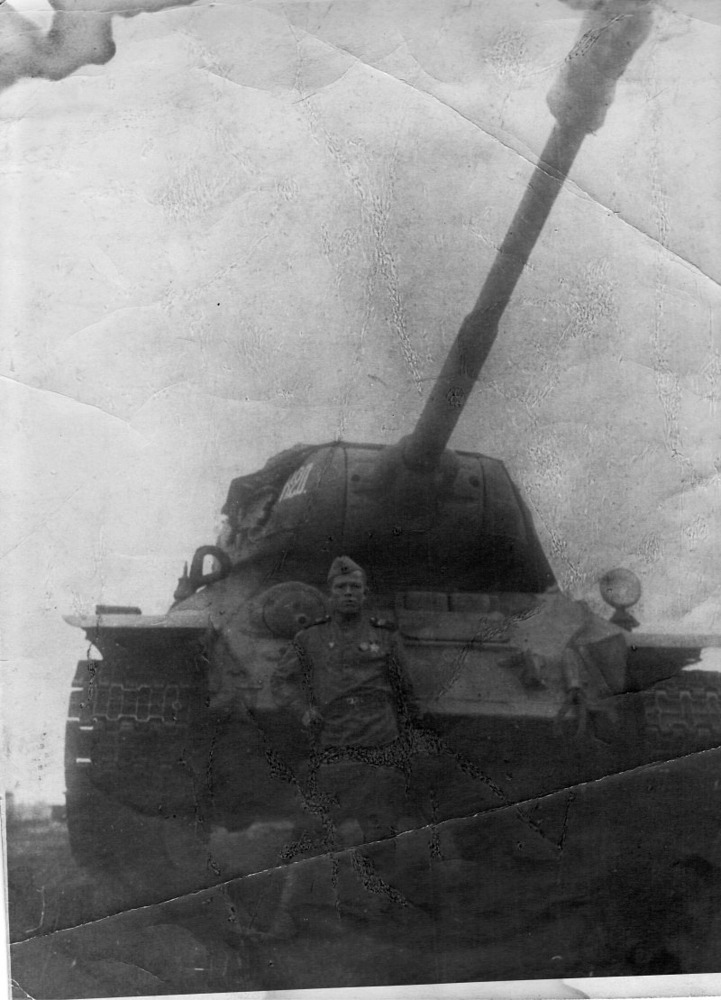
Leonid Vasilyevich Yegoshin in front of the repainted T-34-88 (K20) in Soviet Service
T-34-88 History
In May 1945, as World War Two came to an end, German forces in the Courland Pocket of Latvia surrendered to the Red Army. Among the vehicles handed over at Stende Station was a T-34-85 that had been modified by the Germans to fire 8.8cm shells.
The tank was inspected by the 51st Army, which confirmed it was a captured Soviet vehicle that the Germans had rebuilt for their own use. Instead of scrapping it, the Soviets transferred it to the 174th Evacuation Company, where it was repainted in standard Soviet green and marked with the tactical number K20.
Following its recovery, the Red Army logged the vehicle in official records. By early 1946, it appeared under a special entry labeled “T-34 88 millimeter”, separate from the standard T-34-85 category. This indicated that the Soviets recognized it as a distinct and noteworthy variant.
On June 15, 1946, the tank’s classification was formally updated in military records, and it was transferred to Plant Number 27 in Leningrad, a facility responsible for repairs and testing. There, engineers examined the unusual modification and likely assessed the condition of the German-made gun and its mount.
Later, documents show that the 73rd Tank regiment listed the T-34-88 in its inventory, despite the unit primarily being equipped with heavier IS series tanks.
By restoring and recording the T-34-88 instead of dismantling it, the Soviets demonstrated genuine interest in the German conversion. It became one of the rare examples of a captured Soviet tank returning to service, this time back under Soviet control but still carrying a touch of German engineering.
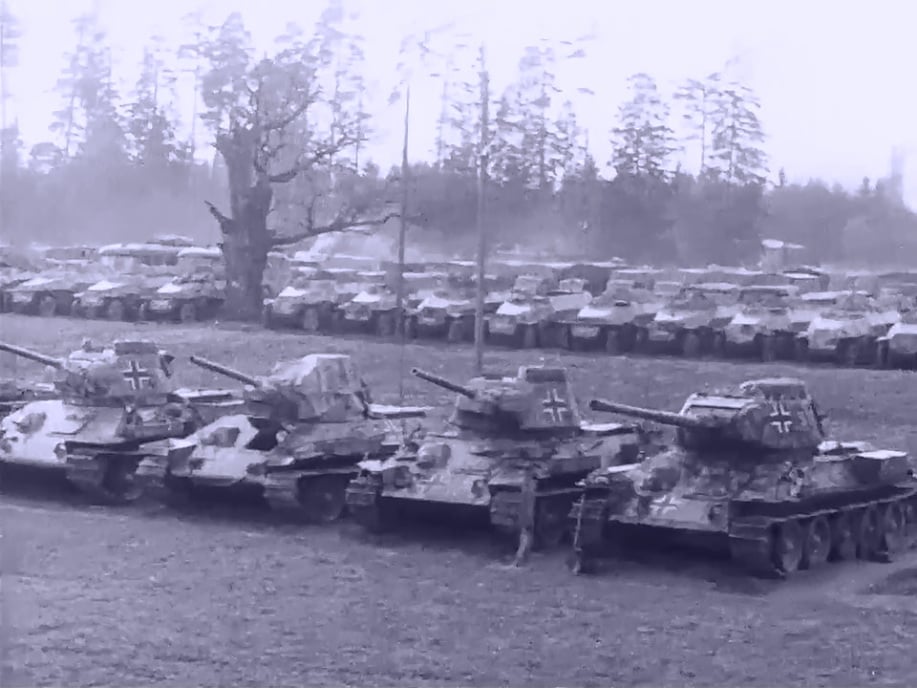
T-34-85 on the very right is the T-34-88 in Latvia during the surrender.
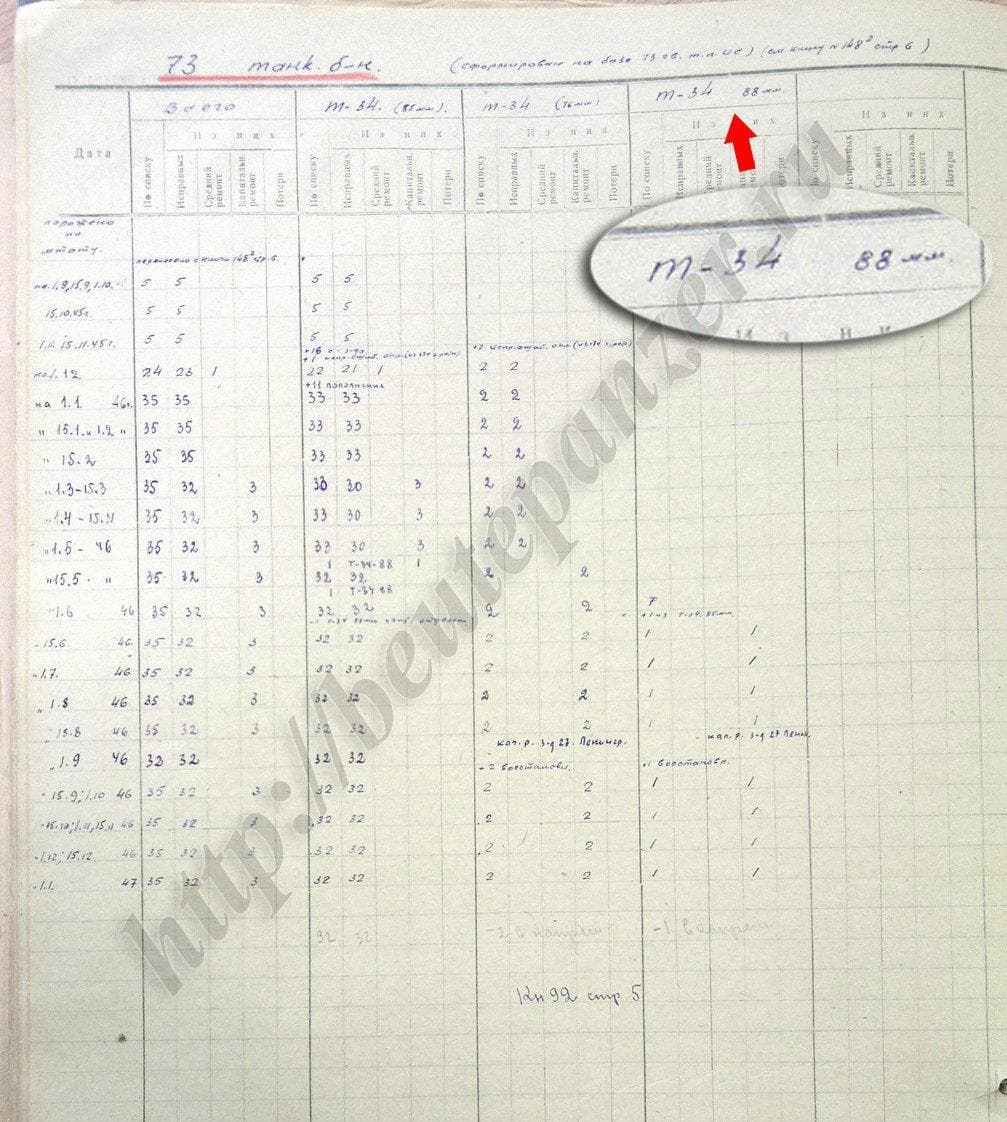
A Document confirming the T-34-88’s existence
it’s important to add the History of the vehicle the T-34-88 is based on.
T-34-85 History
The T-34-85 was a Soviet medium tank that represented a major upgrade from the earlier T-34 model. Development of the T-34 began in the late 1930s, but by 1943 Soviet engineers realized that the original T-34, armed with a 76.2mm, was struggling against newer German tanks like the Panther and Tiger. To meet this challenge, the T-34-85 was designed with a larger turret and a more powerful 85 millimeter gun.
The new turret allowed for a three-man crew inside, including a dedicated commander, gunner, and loader, which improved battlefield efficiency. The 85mm gun could penetrate the armor of most German medium tanks at typical combat ranges, giving the Soviets a better chance to compete on the battlefield. The armor was also increased, especially on the front, to help withstand hits from German weapons.
Production of the T-34-85 began in early 1944 at Soviet factories including Factory 183 in Kharkov and Factory 112 in Gorky. The tank quickly became a mainstay of Soviet armored forces and was used extensively in major operations such as the push through Eastern Europe and the final assaults into Germany. Its combination of mobility, firepower, and relative simplicity made it highly effective in both open terrain and urban combat.
After the war, the T-34-85 continued to see service around the world. Many Soviet allies and client states received the tank, and it was used in conflicts throughout the 1950s and 1960s. The tank’s design influenced later Soviet models and proved the value of balancing armor, firepower, and mobility in medium tank design.
The T-34-85 was praised for its reliability, ease of maintenance, and ability to operate in harsh conditions, from mud and snow to the wide open plains of Eastern Europe. Its influence extended well beyond the war, and it remained a symbol of Soviet armored strength for decades.
Specifications
General Information
- Origin: Soviet Union (Modified by Germany but recaptured by the Soviets)
- Crew: 5
- Weight 35 tons
Dimensions
- Length: 8.15m
- Width: 3.00m
- Height: 2.45m
Armament:
- 8,5/8,8 cm L/56 cannon (S-53) (~55 rounds)
- 2x 7.62 mm DT (1,890 rounds)
Armor-Piercing Rounds
-
- APCBC (Pzgr. Patr. 41)
-
- APCBC-HE (Pzgr. 39)
High-Explosive
-
- HE (Sprgr. L/4.5)
-
- HE-TF (Sprgr. Patr. L/4.5 (Kz))
Rare / Specialized Round
-
- Incendiary Shrapnel (Gr. Br. Schr. Flak.)
Source: Op 1666 Volume 2
Recently came across this source for the ammo on another forum post which allowed me to finish this post. Thanks to @Kefal_Bravo_690
Armor:
Hull Front (Upper Glacis): 45mm angled at 60 degrees (approximately 90mm effective)
Turret Front: 75 to 90mm, cast armor
Rear Armor: 40 to 52mm
Hull Sides: 45mm, vertical
Roof/Floor: 20mm / 15 to 20mm
Turret Sides: 75mm
Engine:
- V-2-34 V12 Diesel
-
- 500 hp
- Transmission: 5-speed manual
- Maximum speed: 61 km/h
- Power to weight ratio: 16.25 hp/ton
- Range: 450 km
T-34-88 and T-34/85 747(r) in War Thunder
Similarly to the Pz.Sp.Wg.P204(f) KwK 39/1 and AMD.35 (Pak) it would go into both trees. Due to it being in service with both Soviet Union and Germany, it would be a fun vehicle event vehicle you can unlock for both countries, in addition they would both have unique camouflages so getting them mixed up would be difficult.
Be sure to check out @Kefal_Bravo_690 post on the German variant the T-34/85 747(r) a lot of relevant information there.
Sources
https://www.dailymotion.com/video/x8avdv9
Video may contain nsfw so be aware.
Галерея фото Т-34-85 * T-34-85 tanks photogallery
https://stephentaylorhistorian.com/wp-content/uploads/2020/09/op-1666-german-explosive-ordnance-volume-2.pdf
https://spbarchives.ru/infres/-/archive/cgakffd/1-photo/1AR-8/14306
51-я армия - страница клуба "Память" Воронежского госуниверситета
Сборник боевых документов/27/27 — Викитека
T-34 - Wikipedia