So basically why does the M1A2 Sep V2 not have spawl lining even though the T-90 gets spawl lining, bags, ERA etc. I call BS on gaijin cause im tired of getting one shotted crews, just ad the kevlar before documents get leaked baby girl.
4 Likes
Because the spall reduction mechanism in the M1 isn’t an independent final liner placed on the inside of the fighting compartment. So it doesn’t meet Gaijin’s arbitrary definition that they use for “spall liners”
It’s part of the actual NERA array.
1 Like
how would it stop the last layer of steel from generating spall?
3 Likes
It doesn’t, he has no clue what NERA is.
4 Likes
Yea I agree
Yeah, even ignoring the fact that it’s the spall from the last layer of armour that is detrimental to crew health, those armour diagrams have the plastic on the outer side for shockwave refraction, not the inside for spall reduction.
1 Like
This car’s tire is made of rubber! That must mean that the seat is protected from static buildup!
1 Like
It’s not intended to stop it entirely, but reduce the mass of ejecta entering the fighting compartment, failing that reduce the impacted volume as best it can, and failing adjust the mass ratio of the spall to favor larger (lower velocity for an equivalent energy) fragments. so it’s more like a few chunks than a shotgun blast.
The backing layer is a dual-hardness Steel, not typical Armor RHA, so is optimized to produce less small fragments comparatively.
More can be read about it in the following papers;
Where did I claim that it stopped it entirely?
So why include, plastic at all?
Yes, and what does reflecting the shockwave do, if not reduce net stresses; by diverting the shockwave at a boundary?
So would you expect such a design to produce less than a similarly effective monolithic block of RHA under the same conditions?
We know that the exemplar “Green Grape” array is proof against 115mm APFSDS (?3BM-21?), I’m not making any aspersions that the Baseline M1’s arrays are kinetically underperforming.
1 Like
To cause shockwave refraction
Refracting, not reflecting, It redirects the shockwave into the backing plate to cause it to deform and either deflect the round or even break it apart.
Yes. However ERA tends to be bad for nearby troops (hence why you don’t see Russian soldiers providing close in screening for their tanks the way NATO troops do), and each block is destroyed after a single impact. NERA has much better multi-hit survivability.
But neither ERA or NERA reduces internal spalling from a pentation as the spalling into the crew compartment is from the last layer of armour, that armour will stop everything from the outer layers, that’s why a spall liner has to be on the inner face of the armour.
Now there are types of metal as you mentioned that are soft on the inner face to reduce spall. but that was not what we where talking about. and if you have and UNCLASSIFIED info on the Abrams using such material than I’m all for it getting a spall liner.
1 Like
Well, I’d point to the fact that MIL-A-46099C is still classed as “active”. and with the Bradley and Stryker’s not being constructed using Steel, but aluminum there are few other options to keep it active.
And besides very little is actually known about the composition of the M1 anyway, let alone the structural components and their certifications.
Which is a problem for all top tier vehicles in the game, which is why for better or for worse you need publicly available photos that show anti-spall lining. There are also a lot of references to the 2S38 being built from anti-spall aluminum alloy, yet that is not implemented in game either.
But regardless anti-spall either as a separate material or a deferentially hardened metal must be on the back of the armour to catch spall while not producing it’s own fragments.
One thing I think should be implemented is ballistic vests for the Abrams crews to increase their “HP” against spall, there are plenty of public photos of them wearing them.
1 Like
“Where did I claim that spall liners stop spall?!?!?” is quite possibly the most idiotic response I’ve ever received.
Believe me, I’ve dealt with some absolute troglodytes.
As an absorbent layer backing a hardened plate that prevents said plate from shattering? Do you have any idea how unbelievably thin those HHRA plates are? What might you imagine would happen if two plates placed extremely close to each other were to be hit by 7MJ of depleted uranium?
No? The primary generator of spall in the array is the backing plate, which itself is an extremely brittle 570HB in the HAP packages.
Compared to RHA, this would spew debris like no tomorrow.
It isn’t “proof against” any ammunition but domestic 829. At most it was projected to protect against 3VBM13, and none of its design choices have any influence on spall generated in the crew compartment.
That’s uh… Sort of what body armor is for.
Can you point it out please, I have a feeling your not exactly reading what has been written. nor being very constructive.
Yes and so reduces the quantities of produced spalling vs a similar plate sans backing.
If pixel measurement is to believed somewhere between 1/4 and 1/2", sans liners.
I would only have to ask, how close, abutting one another or a short distance.
You got a source for this?
I’m not exactly sure how an amour array is supposed to be proofed against ammo that didn’t exist at the time, the FSD XM-1’s testing regime began in '75, 120mm M829 only begins validation & testing in late '79(FY’80), with the conclusion of the final set of the series of Tri-partite gun trials, which concluded with it’s selection over the Tungsten variant (M827) in '84 and subsequently entered production alongside the production of the 120mm M256 cannon beginning on US soil.
“Protection of the crew compartment against the Soviet 115mm FAPDS at 800~1200 meters”
“Its frontal armor would be defeated at all battle ranges by the current 125mm Soviet FAPDS. This round is assessed as being capable of of penetrating 445mm of solid rolled homogeneous amour (RHA) at normal at 1000 meters (Tungsten penetrator) and 460mm (Depleted Uranium penetrator) at the same range where as the XM1 is protected against a round assessed as being capable of penetrating 325mm of solid RHA at the same range.”
Also see “table three” mentioned in the first excerpt for the 105mm surrogate rounds (XM579E4 & XM744) used as threat simulators and their performance.
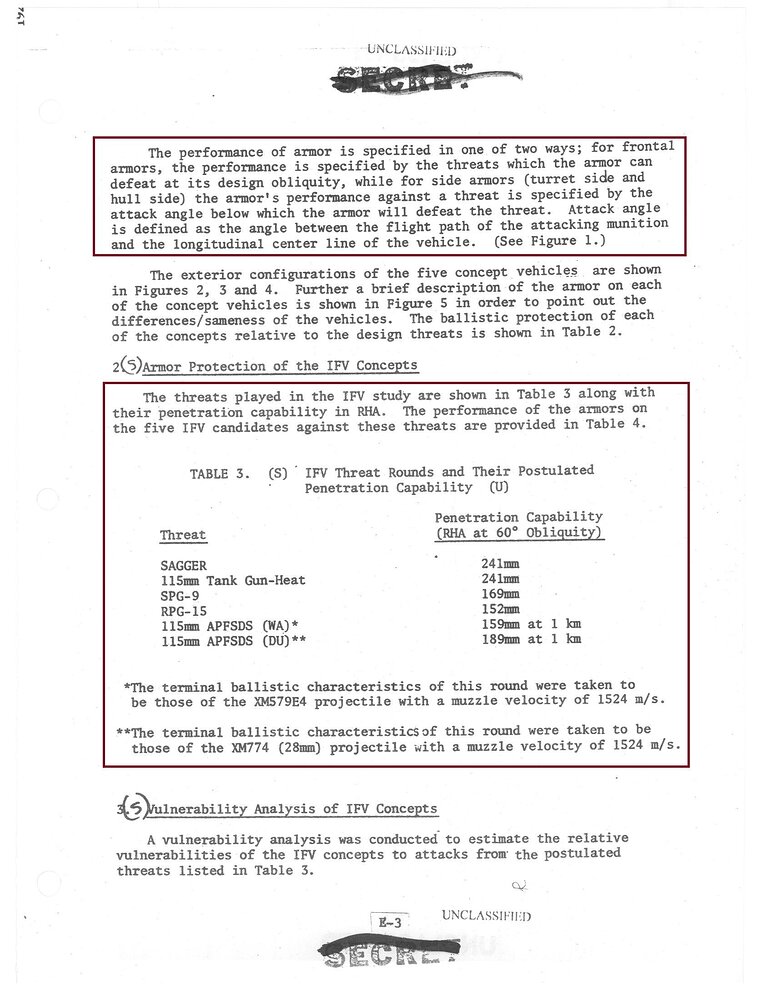

It’s not like a bespoke PPE system was issued to tankers, and injuries to limbs and extremities will take a station out of the fight just as easily as those to the vitals. As it’s fairly hard to grasp things if you are missing fingers(grip strength drops significantly), or manipulate hand controls missing an arm for example.
It’s why the M1IP was spun off as a pre-planned product improvement since the baseline array was overmatched by emerging threats and so backported the array of the M1E1, which is very likely to be better proofed against 125mm threats, but then there is still the HA & HA+s’ arrays.
USA suffers once again