History
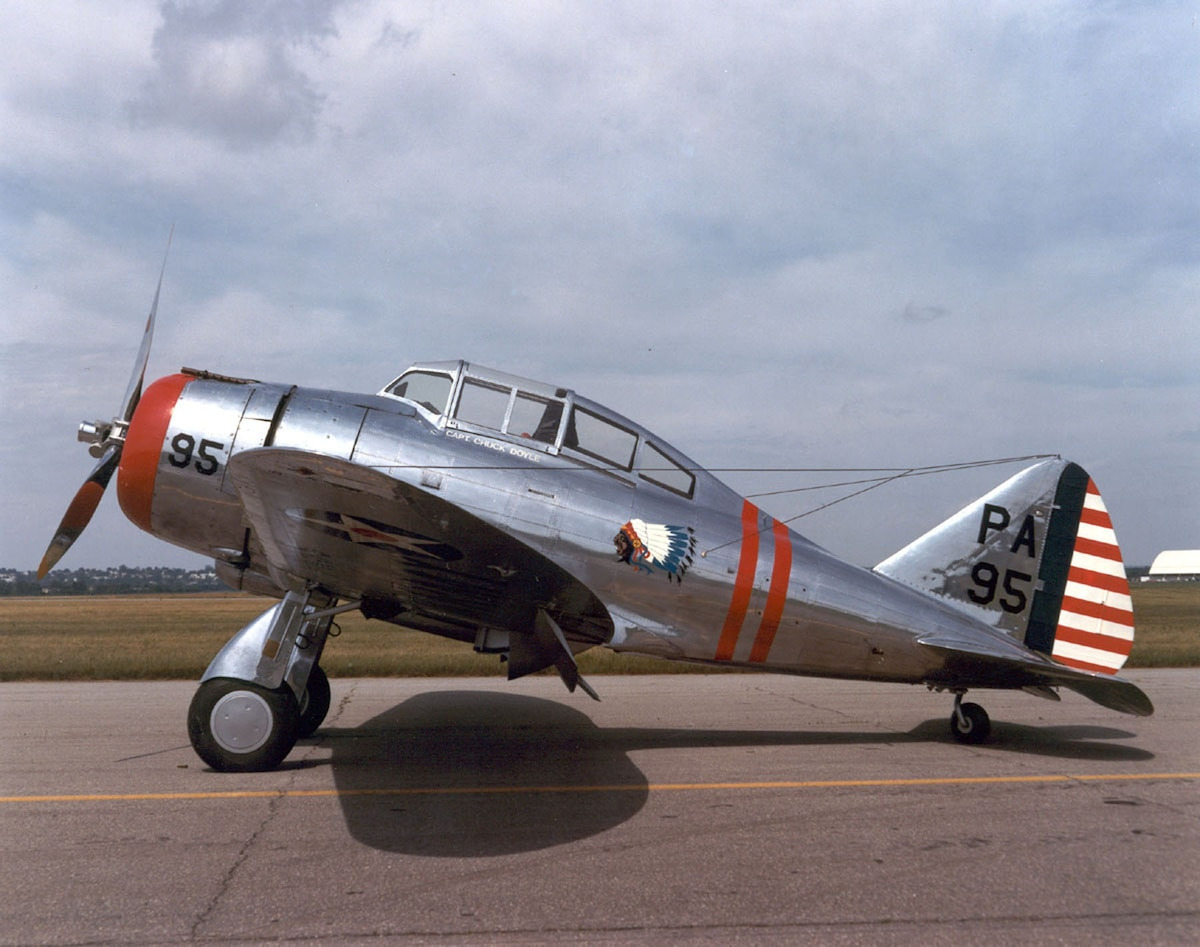
The Seversky P-35 was the first combat fighter aircraft designed by the Seversky design team, led by Russian immigrants Alexander de Seversky and Alexander Kartveli, which would later become Republic Aviation, famous for its P-47.
The P-35 design was based on the Seversky SEV-3 amphibian aircraft, a three-seat, all-metal, low-wing monoplane fitted with floats and wheels, introduced in June 1933. It was further developed into the Seversky BT-8 basic trainer, 30 of which were ordered by the United States Army Air Corps in 1935 and delivered in February 1936. These were phased out in 1940 and replaced by the North American BT-9.
The second prototype SEV-3 was developed into a land-based, two-seat fighter derivative, the SEV-2XP, fitted with a more powerful engine. When the USAAC announced a new competition in May 1935 for a new single-seat monoplane to replace the Boeing P-26 Peashooter, Seversky sent the SEV-2XP with confidence that it would win despite being a two-seater. It was damaged en route to the 1935 Pursuit Competition at Wright Field, and the Army postponed the competition.
The competitors, Curtiss and Northrop, unveiled their Model 75 Hawk (eventually known as the P-36 Hawk) and Model 3A, respectively. Both competitors’ designs featured fully retractable undercarriages. Seversky’s SEV-2XP was returned to the factory for an overhaul. It was rebuilt into the single-seat SEV-1XP, with a single-seat cockpit with a razorback spine and a rearward-retracting landing gear system. It returned to Wright Field in August 1935, ready to compete against the Curtiss design.
The SEV-1XP and Curtiss design, using their new power plants, both failed to meet the guaranteed speed. Thus, neither competing aircraft actually met the Army’s design requirement of a speed in excess of 300 mph. Seversky lost the contract bid, being outbid by Curtiss, so the Army awarded Curtiss a contract to build 200 aircraft under the designation P-36. In June 1936, Seversky was awarded a contract to build 77 production versions of the SEV-1XP prototype under the designation P-35.
The P-35 was powered by the Army-required 950-hp P&W R-1830-9 radial engine with a reduced-diameter engine cowling. The fully enclosed landing gear fairings were replaced by partial fairings to save weight. The bulged canopy of the prototype was redesigned with a pointed windscreen to improve the aircraft’s overall aerodynamics. The armament consisted of a single .30-cal. machine gun and a single .50-cal. machine gun mounted in the upper engine cowling, firing through the propeller arc.
The first production P-35 was delivered to Wright Field during mid-1937, and the remainder of the production run was delivered to the 1st Pursuit Group at Selfridge Field between July 1937 and August 1938. They got into operational service first before the first production P-36As were delivered to the 20th Pursuit Group at Barksdale Field in Louisiana in April 1938. The P-35s were the first USAAC aircraft to be delivered in a natural-metal finish and featured retractable landing gear and an enclosed cockpit. The performance of the P-35 was much greater than that of previous fighters such as the Boeing P-12 and P-26 and was about equal to that of the Curtiss P-36 Hawk, but it was 10 mph slower and had a slower climb rate than the P-36. The only upper hand over the P-36 was that the P-35 had a greater operating range, in excess of 1,000 miles, over 400 miles more than the P-36 thanks to the P-35’s larger fuel capacity.
The P-35s equipped all three squadrons of the 1st PG: the 17th, 27th, and 94th Pursuit Squadrons. Ironically, all three squadrons were also equipped with P-36 Hawks and P-40 Warhawks. It was not uncommon for a USAAC pursuit group to have four or five different fighter types, from P-26s to P-40s, in its inventory, with pilots being trained on multiple fighter types.
During the early stages of World War II, the P-35 was obsolete and relegated to training roles for future fighter pilots and maintenance schools. The last P-35 in Army Air Forces service was scrapped in April 1946.