In what situations would an increase in speed not allow for higher altitude operations for ramjets?
2 Likes
Yes
Spoiler
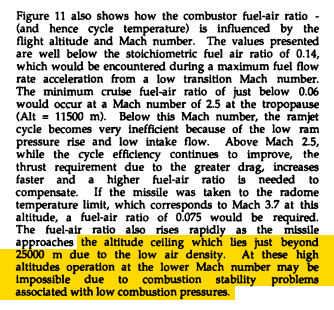
The paper does talk about the problems caused by low altitude drag. While it does not explicitly compare the drag of the proposed missile to a non-ramjet missile it is clear they conider it in all thier simulations. At the end of the day this isn’t a paper written by a bunch of students, it’s written by engineers from the Air Vehicle Performance Department of the Defence Research Agency; who’s job is to accurately simulate aircraft / missiles.
The paper is about the performance of a hypothetical TDR ramjet powered BVR AAM, designed under the constraints that it must be pretty much the same length / diameter as the UK’s existing BVR missiles (i.e. Skyflash & AMRAAM). And it is written by people from the DRA, which would go on to be involved in the development of Meteor.
Meteor is a TDR ramjet powered BVR AAM which was designed in part by the same people, and with those same design constraints and performance goals. In addition the general design and layout of the missile they propose very closely marches Meteor. And many of the data points they use in their proposed missile closely match what is known publicly about Meteor and it’s prototypes (such as A3M). For example:
- The booster ISP they use pretty much matches that of A3M (well is actually a little low)
- The booster burn time they used almost exactly matches A3M
- The ratio of boost to sustain fuel appears to match Meteor pretty closely based on the cross sections we have of Meteor
- The turn down ratio they propose (10) pretty much matches Meteor (albeit Meteor is a little higher)
So it seems likely that the missile described in the paper is probably the best declassified approximation we have of Meteor’s performance. And that Meteor likely exceeds the performance described in the paper, for the reasons noted in my previous comment.
5 Likes
things like intake design and the ramjet itself limit altitude, and vary between missiles/aircraft. for example, the cruising altitude for the Kh-31 ramjet missile is only 15km.
fair enough. would you say meteor can do 20-30km better than the 220km at .9 6000m, just as a estimate?
The improvement from this analysis to the real meteor would likely be higher than 20-30km thanks to even further developments and optimisation as well as the boron loaded fuel that Flame also mentioned in an earlier post.
Yes? that i don’t dispute. Higher speeds do still result in a higher possible altitude ceiling (of course there is an inherent design limit on top of that).
Cruising altitude is not the same as max, long range missiles are designed to operate optimally at specific speeds and altitudes to achieve max range. if that missile moved faster it could go higher. It wouldn’t be as optimal but it could.
I personally don’t doubt that it could. Released at like 10km alt and at Mach 2 it doesn’t need to waste as much fuel to get up to Mach 4 and doesn’t need to waste energy to climb. If i don’t misremember those numbers were also with the premise that it should arrive at the target still going Mach 2 at impact. Add to that a few decades of development, research and testing.
1 Like
only up to a point, and the missile is already meant to go to its limits to squeeze out as much range as possible.
yeah, with improvements since the 1990’s with boron propellant and other things, 20-30km should be added onto that scenario just as a personal guess. but i do think its worth considering the limitations in simulation when this paper was made, which is why that number isnt higher than 30km
For reference here is the paper in full (the discussed parts begin at page 30):
Obligatory front page with de-classification (@Flame2512 you should include this EVERY TIME you post about a document that can reasonably be thought to be (or have been) classified, i’ve flagged posts of yours for not including this in the past):
( Client Challenge )
4 Likes
Good talk there. I enjoy reading these
1 Like
I’m following these kinds of posts about missiles and jets for 7 years now and it is interesting. Though it gets heated sometimes when certain people’s beliefs come in.
1 Like
Look everyone it’s John MICA.
1 Like
I agree on this, the Aim-174 is into the area of atmospheric skipping for more range, not really able to be put in the same boat as stuff like the meteor
IMO that is because the meteor (or airbreathing missiles in general) fills a niche that those countries dont have.
For medium/short range, the cheaper solid fuel missiles are significantly better if you compare price to performance.
For medium/long range, the TDR provides the advantages in range and high energy at the end of the burn, but at a higher cost.
Meanwhile for very long range missiles a conventional solid fuel motor makes sense again, as you want it to fly an almost ballistic trajectory to get max range out of the missile.
I would argue that European airforces can not justify the cost of researching and producing two seperate missiles (even more so in the early 2000s), but still dont want to be stuck at a range disadvantage of only having medium range missiles.
The US, China and Russia already have the very long range capability, as well as the cheap medium range, meaning they simply dont have any need for a more expensive TDR missile, hence why none of them actually have it.
At least that is my theory.
6 Likes
but there is a bottlenect, meteor accelerate very slowly to conserve fuel so at ranges where amraam can reach optimally the amraam will get there quicker than meteor, meteor tops out at 40km+shots because the evarage speed diff between amraam or any solid motor missile and meteor become huge, sorry for the bad explanation, but shortly meteor at 35km+ wins against every solid missile, we are kinda ready for it if 250km maps become standard at 15.0
I think this is what you mean:
AMRAAM accelerates faster at the start making it top out above the Meteors cruising speed before going back down below it.
6 Likes
yes so in principle at short, initial acceleration phase meteor would have one of the worst impact times, i kinda look forward to it, and might come in november
2 Likes
i think that graph might not be fully accurate with how the meteor behaves in reality, theres enough evidence to believe that it should accelerate faster than that in the first 2.5 - 2.0s seconds of flight when the booster is active, possibily accelerating faster than the amraam in that part of the flight
I mean, it’s a graph from MBDA, i don’t think we’re going to find anything better than that.
3 Likes
Of course they fix the Mig 35 MAW right away but still leave us hanging…
4 Likes
Really starting to be hard to pretend it isn’t malice.
3 Likes
we’ll see in 5 weeks what gaijin plans, but in ny opinion in current gameplay new fox 3s eouldnt be any broken, fox2s instead would be a nightmare