Friend who works at Saab Scania says according to company history this plane was equipped with air brakes, just like the standard version, for its role as heavy ground attack plane. Could you guys check further and turn on the air brakes if you confirm this?
3 Likes
Hmm- From what i know the airplane that was tested with the 57mm Didnt have them for some reason- But if there was other testcraft with the Gun you could argue it should get them-
I recall there was a changelog in WT where the B18/57 was equipped with airbrakes but had them removed for some strange reason.
I’m also curious as to the identity of the cannon used - how does it relate to that of the Pvkv III? If it is in fact the same cannon, then why doesn’t it get the Pvkv III’s APHE?
I wonder if it can use 40mm as well, according to some documents it has tested 40mm guns as well
It did and it caused shattering in the glass and frame of the aircraft. The 57mm Akan m/47 was somehow better-? potentially lower kick?
Not the same chell. Very little information about the ammunition as even the Airforce museum in Sweden lists the incorrect information and instead of the 57 mm Akan m/47 // 57 × 230 mm R It list ammunition for the 57 mm Lvakan m/54 // 57 × 230 mm R
-
57 mm Akan m/47
– 57 × 230 mm R (Projectile)
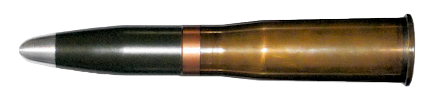
Its very short. -
57 mm pvkan m/43
– 57 × 230 mm R (Projectile)
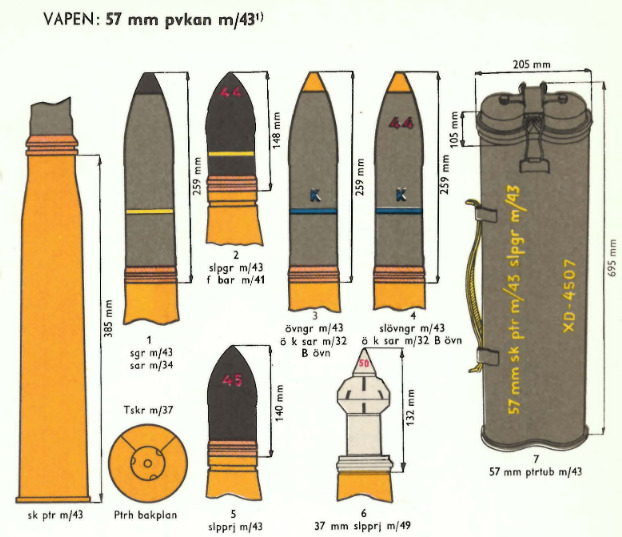
If it is 40/L70, then yes, but I can’t find any document(maybe due to language difference)
The T 18B, which was primarily intended for use against naval targets and maritime units, was given considerable firepower. Its armament consistently consisted of two 20 mm autocannons rigidly mounted in the nose, as well as rocket and bomb installations. In addition, a number of T 18Bs were equipped with a 57 mm cannon manufactured by Bofors, also nose-mounted along the aircraft’s centerline. The cannon, designated L/50 (military type designation m/47), had a total weight of 735 kg and its rotating magazine held 40 rounds plus one projectile in the chamber. Each projectile weighed 2.5 kg, and the weapon’s total length was just over 5.3 m. The cannon was suspended in the torpedo or mine bay, and this procedure took approximately two hours.
Akan m/47 – Bofors 57 mm cannon L/50.
Photo: Stahlkocher (CC BY-SA 3.0, Wikimedia, cropped)
The cannon was electrically fired with pneumatic feed. Reloading could not be carried out in the air. The ammunition consisted of high-explosive shells or, alternatively, armor-piercing projectiles, and the cannon’s rate of fire was 180 rounds per minute. Accuracy was good at firing distances of up to 2,000 meters. The recoil force was up to 6 tons but did not have a particularly great effect on the aircraft during firing thanks to an excellent recoil-brake design. One of the aircraft that carried this 57 mm akan m/47 was the former prototype 18164. This weapon was without doubt one of the heaviest aircraft-mounted cannons in aviation history and constituted an alternative armament on the T 18B aircraft.
In 1949, a new installation consisting of two 40 mm autocannons mounted under the nose was tested. However, the pressure shocks associated with firing were so great that the plexiglass nose shattered, and the trials were therefore discontinued. Largely in parallel with this, a sea-attack missile designated RB 302 was also tested at FC on the T 18B aircraft. Although the aircraft type 18 did not ultimately become a missile carrier, the experience gained led to the development of the RB 04 anti-ship missile, which was later used on the A 32A Lansen and the AJ 37 Viggen aircraft.
The majority of Sweden’s historical military documents are stored only as physical copies in Sweden’s stadsarkiv. Very few images or documents from Bofors, Saab, or Landsverk have been digitized. Access to these materials requires an in-person request for on-site reading, as they are restricted from being loaned or copied outside the archive due to preservation policies.
As a result, nearly all publicly available information online is based entirely on individuals who have personally visited the archives to read and manually copy the relevant material.
Ergo: If you aren’t from sweden its quite difficult, lucky for me i am from this country of cold and darkness. But on the other hand im still a student so i dont have unlimited funds or time to travel to stockholm.
Off-topic: But sweden did have a HE-AP-F-I-T And HE-AP-F-I 12.7mm for the J26 mustangs and J21R’s we had.
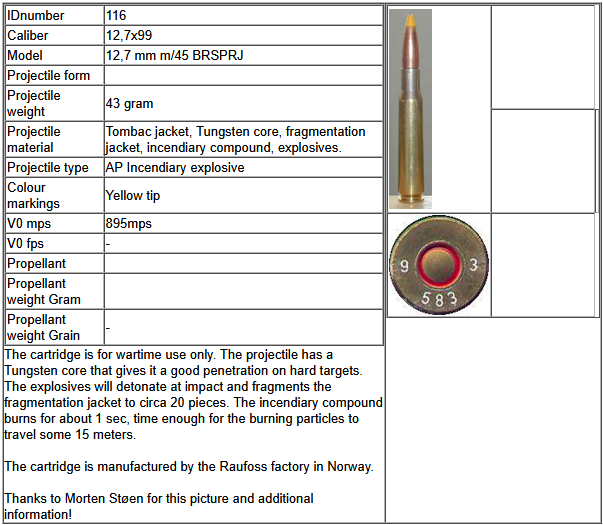
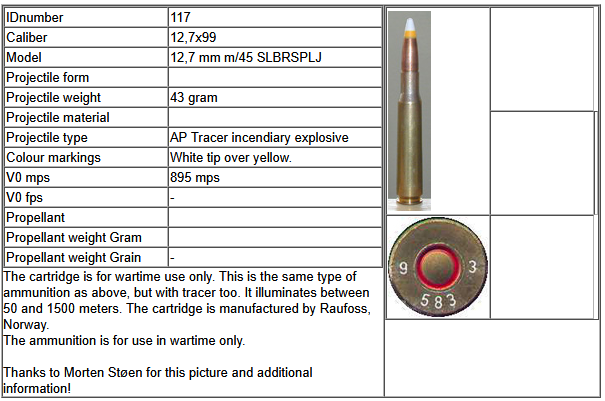
You thaught just because we got rid of the 13.2mm we would return to the standard mid APIT-? nonono lol
Wait…I don’t quite get it - both projectiles you specify have the exact same dimensions of 57x230mm. What exactly is different about the rounds used by the Pvkv III that would render those incompatible with the T-18B(57)? You say the round is “very short” but those dimensions seem the exact same - is it a smaller propellant cartridge that isn’t part of the 230mm length or something else?
Because if we have 45mm APHE rounds that only plausibly work for the Yak-9K, TIS-MA, Su-8, and Tu-1, why can’t the Pvkv III’s 57mm APHE plausibly work in the T18B(57)?
WE NEED THIS GODDAMMIT!
And corresponding bullets should really be added for all late-war or postwar .50cal belts. Technically also the M1 and M23 pure incendiary bullets should have a strong explosive effect equivalent to about 0.5x TNT equivalent. Aircraft incendiaries burn so quickly and furiously to ignite aviation fuel that they almost are explosives when you stop to think about it. The same should likewise apply to any other nation’s pure incendiary bullets for any autocannon with them (Finnish 12.7mm MGs, German 20mm FI-T bullets, German MK103 incendiary-tracer bullets, German MK108 pure incendiary bullets, to name a few).
In fact, there is suspicion that Soviet 45mm APHE rounds for aircraft never existed…
1 Like
Yes- This
Its a different propellant
If u were to just insert the Pvkan m/43 rounds into the Cartridge i suspect it would get a lower pen.
I suppose the question then becomes how much lower? I’d guess it would still be about as much as the Yak-9K, right?
With the addition of some more HE filler yes