So, you expect people to read this for 5 minutes for what? You do realize DCS is a videogame as well, right? If it was a real flight sim for military aircraft, it’s very unlikely you’d ever have access to it. Like it or not, but WT is a videogame, and DCS, no matter what its own name says, is yet another videogame, period.
Good, you do realize this is still a game, don’t you? Who has 104-0 KDR on the F-15? As much as I’d love to have some mechanics (specifically multipath) removed from the game, this is still a videogame, and some things like MCM aren’t all that bad, if your missile gets intercepted, too bad, get closer and fire another one, wanna be sure? Fire 2 from different angles. WT isn’t a simulator of real combat, you ain’t going into a 16v16 clash magically appearing in the air 100 km away from the enemy team irl, you ain’t going blind with your own radar either. Complaining about something that’s quite doable, especially considering a lot of air to ground munitions, guided or unguided, have been intercepted by SAM systems of different types. Those chances might be right, but not for every single missile, we do have other ARHs that can actually intercept munitions in real life too, specifically shipborne SAM systems which are found in the toptier SPAAs. However, for the aerial MCM tactic, complaining simply because someone intercepted the missile instead of notching it is quite a stupid complaint. From my own experience, 99% of the players that MCM’d me only did it because they didn’t see them confident enough to notch my missile, but they did notch my missiles before, I’ve only seen 2 or 3 players who would MCM all the time as a “”“replacement”“” for multipathing. Not to mention the accuracy improves when Phased Array Radars are added into the equation adding faster DL updates to the missile in case it loses it, and the missiles themselves are usually only locked on at like 5 km by another ARH, showing a lower RCS on the missiles than on the planes themselves.
TL;DR if you see a player MCMing you, just fire 2 from different angles from very close range (1 into him, the other one while moving into the notch), and you’ll almost certainly shoot them down. Skill issue :)
You are absolutely right to distinguish between systems simulation and environmental simulation, but there is a profound reason why DCS remains a more truthful experience when it comes to air combat. In DCS, every module is a universe unto itself, where the radar isn’t a “magic eye” that sees everything that moves, but a complex instrument with real physical limitations. The reason why you see missiles intercepting other missiles in War Thunder, while in DCS and in reality this is nearly impossible, lies precisely in the fidelity of sensor physics. A fighter’s radar is designed to lock onto an aircraft, which has a reflective cross-section of several square meters, whereas an air-to-air missile is a thin, fast object with a tiny radar signature. In reality, radar sidelobes and range cell resolution would almost never allow for a stable lock on such a small object traveling at three times the speed of sound.
For this very reason, Gaijin should learn and take a leaf out of DCS’s book, eliminating once and for all this absurd, completely unrealistic, and skillless mechanic of air-to-air missile interception. In War Thunder, sensors are often simplified to make the game more fast-paced, allowing the radar to see and lock onto projectiles or missiles as if they were standard targets. In DCS, the calculation logic is much more restrictive: the mathematical probabilities of a missile seeker seeing and accurately guiding toward another missile are close to zero. It is a matter of energy and proximity fuse precision, which is calibrated to detonate near a metallic mass the size of a fuselage, not against a thin tube only a few centimeters wide.
One must also consider that intercepting a missile is an extreme technological challenge that requires massive, dedicated ground-based or naval radars, such as those used in S-400, Patriot, or Iron Dome systems. These systems use AESA radars with power and processing capabilities that a small radar in the nose of a fighter can never match. It is physically impossible for an aircraft’s radar to simultaneously manage target tracking and the firing solution for a minuscule object rushing toward it at Mach 4.
Therefore, while War Thunder creates a scenario where everything interacts with everything else in a chaotic way, DCS reflects the pilot’s reality, you don’t shoot down an incoming missile with another missile because current technology was not built for that. You have to jam its signal, dive below the horizon, or defeat it kinematically. The absurdity of certain mechanics seen in War Thunder is the very proof of how much DCS remains anchored to what is physically possible in a real cockpit, and therefore, to reality.
2 Likes
You are not taking into account radar energy and power. The radars mounted on aircraft are designed to detect and shoot down planes, not other missiles; they simply lack the necessary power to correctly detect and lock onto another missile. Just consider the fact that even dedicated surface-to-air systems have their own difficulties, and it often takes more than one missile to intercept just a single target. These are radars with massive computing power, far greater than anything an aircraft can produce. Consequently, being able to intercept missiles with the ease currently seen in the game is completely unrealistic, and the actual probabilities of doing so are near zero.
1 Like
Both DCS and WT use liftarm based flight performance modeling? DCS’s is actually a bit more of a list of database parameters at base, as it relies on manual rotational dampening by default, whereas WT uses input force dampening, and… anyways, to get to a part of this discussion relevant to the topic at hand.
Radar sidelobes do actually produce clutter in warthunder. However warthunder’s doppler and angular filters means that they’re not really an issue on 4th generation aircraft. However if you’re on earlierthird or late second gen aircraft, you can occasionally see interfearence from it.
WT radars also have PRF modeling, just on the user end its simplified down to depending on the search/track mode you’re in, or on more modern systems automatically swapped between depending on lock stability.
Yes, user interface is the one thing that DCS does more realistically than WT. And while it could be argued that easier interface selection is part of why missile interception is so viable in WT. Its important to note WT is a very casual facing game, even if it has borderline sim internals. So I dont really see this changing. Also as radars have to be operable in third person in WT.
Also, neither DCS or WT use full simulations of “electromagnetic waves”. Thats basically impossible to run in real time, onky game ik of that even tried that was Flyout, and it got single digit FPS there so it wasn’t used. Both games use approximations, which while roughly accurate to IRL, aren’t perfect.
So overall, I dont really think modeling accuracy is enough of a thing to solely be responsible for how missile interception is in warthunder. IMO its much more likely to be due to match / player density.
P.S. not only have i looked through many flight manuals and such, i’ve also read flightmodels and such from both games, so I do firmly know what im talking about.
1 Like
These considerations were discussed in a prior post, the problem isn’t whether or not high powered radars can detect things with a small RCS (which they can). Its that the missile seekers are limited in how well they can track small targets at certain distances.
I’m talking more so about Flaring in dcs, and RCS is simplified to just a sphere in that game, regardless of aspect. I still think they handled modeling better though. Was just saying.
1 Like
to your point about it being a game: MCM is a terrible game mechanic as it furthers the propagation of furballs and lowers the skill celling of the game just like multipathing although to a lesser extent. Point being it is both unrealistic and bad for the gameplay experience and should be removed or made realistic by modeling missiles RCS.
5 Likes
this is quite far in the conversation but lately ive seen more and more people manage to literally gun down incoming missiles and i wonder if they did any changes with hitboxes of missiles because doing this basically impossible
I know this thread is talking about air sim but I am seeing a limited (I’ll explain) spread of missile-missile intercepts in air RB as well. Obviously in a 16v16 environment that top tier air RB is currently, picking out one guy and then intercepting every missile is borderline griefing yourself, however I am seeing some (with varying degrees of success) using intercepts in the early game “BVR” to get a closer position before shooting off their Fox 3s.
The other phase of the game that I’ve been seeing intercepts being used more often is during later game scenarios where the numbers on both sides have been reduced to <4. This is where it gets quite similar to the air sim experience of Su-30SM2s, F/A-18Es and other higher missile count planes just flying straight in and shooting everything down. I’ve personally been caught off guard by other players using missile intercepts despite playing the poster child (Su-30SM2) of iron dome gameplay because I was unaware of how reliable it is. When I tried it out myself in some late game scenarios, none of my missiles failed to intercept and I managed to get overwhelming positional advantage for free.
Personally I think the possibility of missile intercepts should still exist, but the reliability of it should be toned down to an extent where properly defending via notch and other methods will take priority over what should be a last ditch effort to survive.
8 Likes
This is becoming the new “multipath meta” like multipath was, cost like spending 1 extra missile or have to fly low, but the outcome is you get to close the distance without leaving attack position.
1 Like
well gaijin heard you all
and now even an ai controlled shilka can shot down your missile
even brimstones can be used for ARH inteception
1 Like
and not even that. you can almost do backflips in the JF-17 and the flightmodels can generally do things they’d never do irl.
i’d dare say, digital cockpit simulator’s only good edge above every other game is the… cockpits…
Hahaha, literally
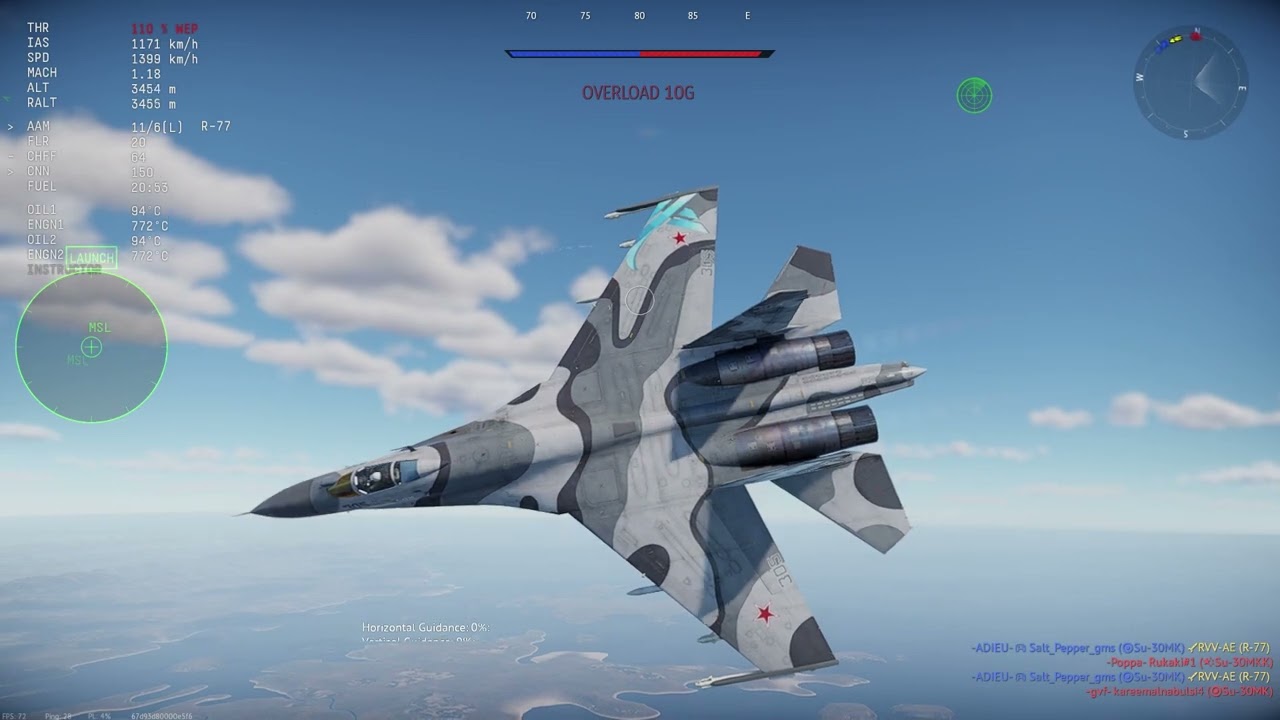
1 Like
i liked that euro fighter vs Rafale video way more
first time ever i feel sorry for a rafale
I hate how accurate this Meme is
My Tiger Shark Sparrow was shot down by an SD-10, and my Mirage 2000 530D was shot down by an AIM-120—where am I supposed to vent this anger??