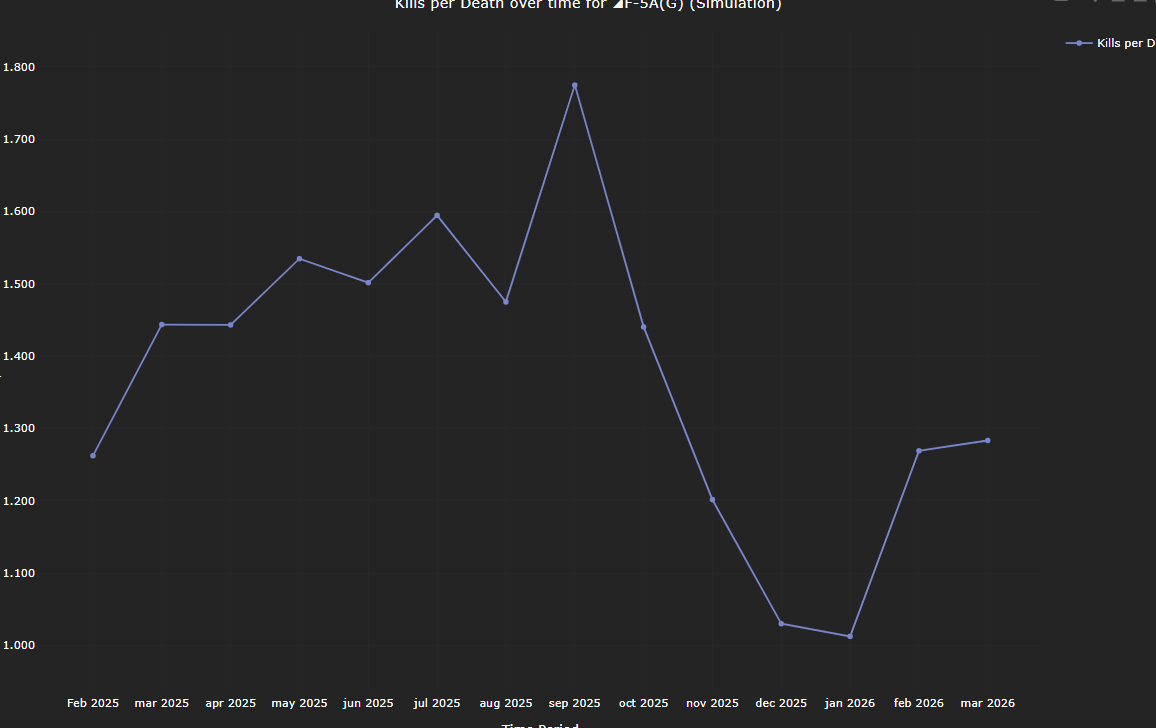
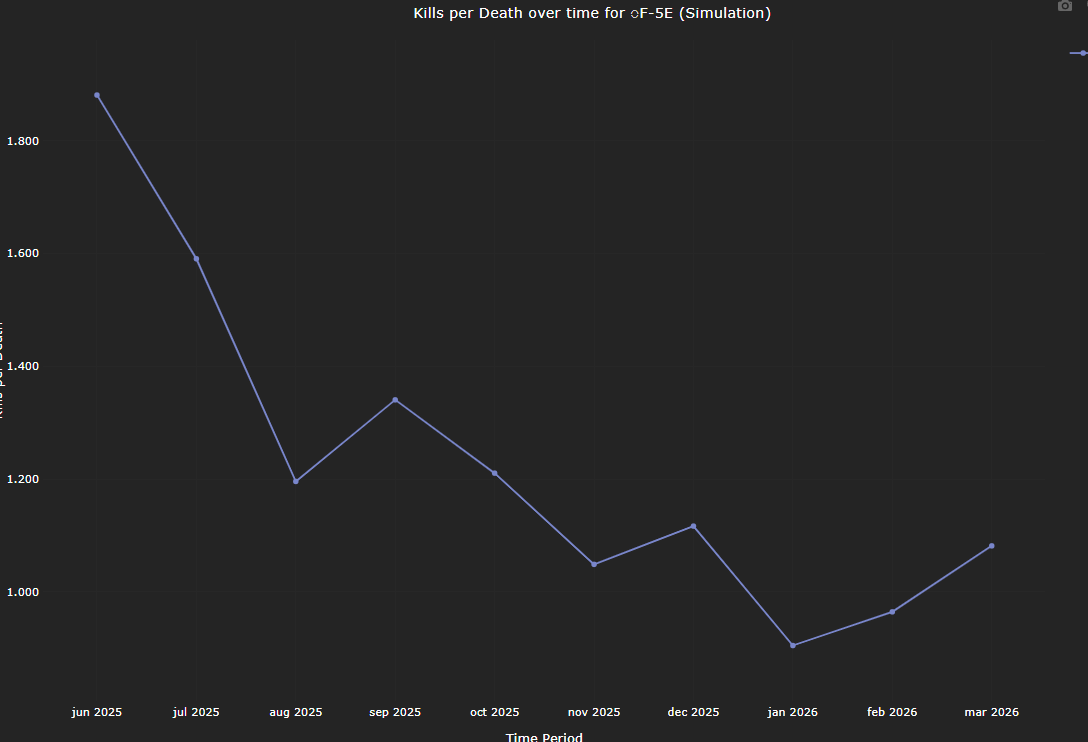
In any case, this is the only F-5 with a decent radar plus, that doesn’t change the fact that the Swedish F-5 has a low BR.
And yeseven the F-5E, with its decent radar, has a lower K/D or kill-per-spawn ratio than the Swedish F-5, which lacks a radar entirely even though, by your own logic, a radar is supposed to be an advantage, regardless of its quality.
And please, don’t cite the “clones” as examples claiming the statistics aren’t objective because these are two truly unique aircraft among all the F-5s.
an American vehicle having a lower K/D is hardly new, that is pretty standard actually.
Though I would also argue that, if we stick to a purely SB context, the issue isnt necessarily the F-5A(G) or the F-5E, but rather the fact that 11.3 is just stupidly compressed, with the F-5E pretty much exclusively fighting significantly superior aircraft like the Mig-23MLD.
Reason:
For the few that have the vehicle it is a monster to use, with a K/D of 2.2 it is sitting far too low especially compared to that of the Spitfire Mk 24 and how that is now a higher br than it with a lesser kill per death by over 1.0
Not only that but in Squadron battles it is a meta that has been standing for years and is generally ruining that br bracket as very few things can compete in such a small area to fight in
In a lot of cases if you meet a BI and dont have one on your team in SQB, you have lost air. Though at times that doesnt happen due to user error or some other stuff.
For general enjoyability and should go up to at least 7.3 or higher as there is also the german equivalent Me 163 at a much much higher br
We are talking about vehicles located in different tech trees—specifically, outside of the USA. And, as I mentioned, the lack of a radar doesn’t bother me personally.
Yes, but I am speaking exclusively about the Swiss variant, for which this radar is indeed an asset—and not about other F-5E. And yes, he is wrong in claiming that any radar is better than no radar at all; he didn’t say a single word about the Swiss option.
Air Realistic Battles BR: May warrant an increase in BR
Give Q-5L its missing PL-5 air-to-air missiles(Bug Report)
Reasoning: As it stands, the Q-5L offers little over the Q-5A in air battles, aside from expanded CAS weaponry and smart bomb capability, while both share the same BR and nearly identical flight performance. A bug report has indicated that the Q-5L may be capable of carrying two PL-5 air-to-air missiles.
I recommend giving the Q-5L its missing PL-5 air-to-air missiles to better differentiate it from the Q-5A (Late), while the Q-5A (Late) should be moved to a BR of 9.7, as proposed by Ion_492:
Turms III: 8.3->8.7
Reasons as to why I’m saying that is it’s because it’s lighter than the leopard 1 with a more powerful engine, a stabilizer on a gun that reloads in 5 seconds with a co-axial 30mm cannon. the only downside is it’s lack of armor but even then the “downside” works in favor of it as any shot that isn’t near pixel perfect would not generate lot spalling; honestly it’s a bloody miracle that this vehicle keeps evading BR changes
reasoning : the aircraft is extremely slow and has poor acceleration compared to every aircraft it faces at the 5.3 bracket, its only upside is the ability to turn extremely well, players who face this vehicle need to learn its weaknesses, the vehicle shouldnt suffer due to that
Ground RB needs decompression between 8.0 and 9.0 as a whole. This area is the worst for Ground compression and has not been fixed by the rise in the BR ceiling over the past 2 years.
This overall problem of compression is caused by two factors: 1) The transition from unstabilized to fully-stabilized tanks happens way too quickly compared to how much stabilizers improve a tank’s effectiveness. This is also compounded by other improvements to tank fire-control systems, namely laser rangefinders. 2) The transition from APDS being tanks’ primary (kinetic energy) round to APFSDS also happens way too quickly compared to how much APFSDS rounds improve upon APDS rounds, broadly.
A lot of yapping
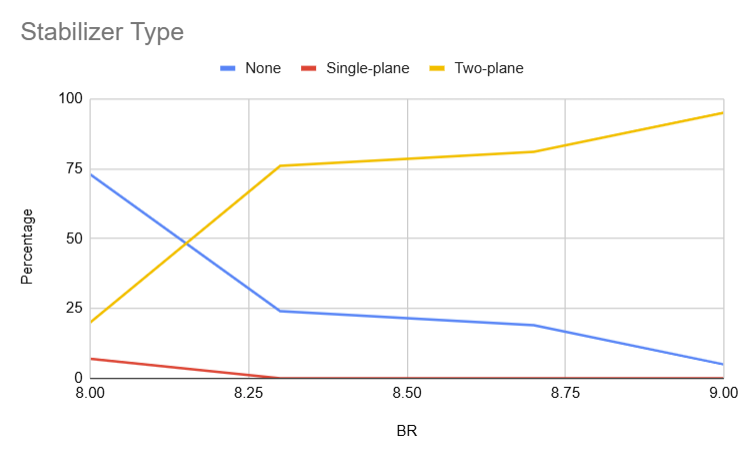
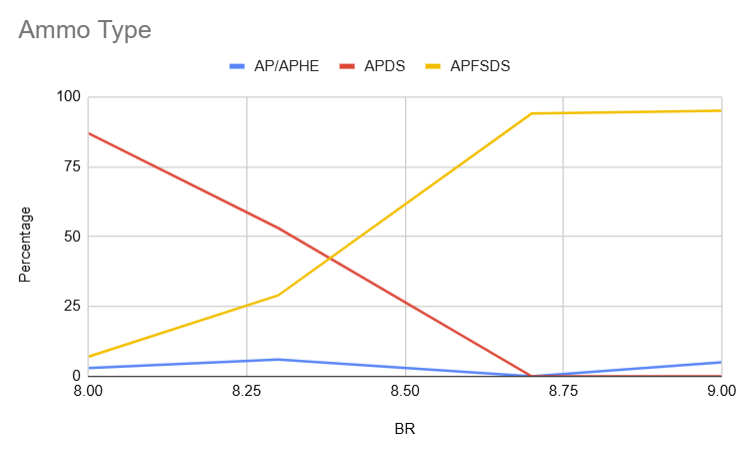
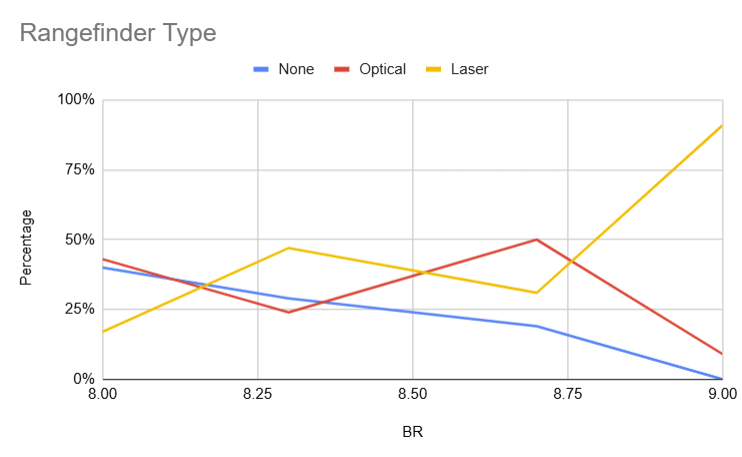
The tables below show the rapid advance in fire-control systems and firepower (in loose terms) between the 8.0 and 9.0 range. (Light tanks are excluded since they tend to be more modern compared to their medium and heavy counterparts at the same BR.)
It should be evident that the transition from unstabilized to two-plane stabilized tanks is extremely rapid. The vast majority of 8.0 tanks are unstabilized, while almost every tank from 8.3 and above has a two-plane stabilizer. Two-plane stabilizers are a gigantic upgrade to a tank’s capabilities, as they define the transition from the slower, more methodical “WWII” gameplay (where tanks need to stop and aim carefully) from the fast-paced, high-intensity “Modern” gameplay (where tanks drive at full speed and fire on the move). The fact that this change happens within just a 0.3 BR range is terrible for compression, as it means the vast majority of 8.3/8.7 tanks wield an enormous competitive advantage over 7.7/8.0 tanks, far greater than a similar gap at other BRs.
The transition from APDS rounds to APFSDS rounds is also very dramatic, with near 0 tanks at 8.0 with APFSDS but literally all except one at 8.7 having APFSDS. Although most tanks that have APDS also have access to a good HEAT round, APFSDS rounds are simply the superior choice for almost every vehicle with access to them.
Rangefinders , meanwhile, experience a gradual transition, with the majority of 8.0 tanks having either none or only optical rangefinders, while by 9.0 that has shifted to almost exclusively laser rangefinders. This change is spread over a much wider BR range (starting from ~7.0, where almost no tanks have rangefinders of any kind) and is thus much less of an issue when it comes to the rapid technological change between 8.0 and 9.0.
Slightly less yapping
A lot of 8.3 and 8.7 tanks are way too advanced to be regularly facing 7.3-8.0 tanks primarily due to the prevalence of two-plane stabilizers and APFSDS. Two-plane stabilizers transition from almost 0 tanks at 8.0 to almost every tank at 8.3, while APFSDS sees a similar rapid ‘proliferation’ with few 8.0 vehicles and almost all 8.7 vehicles being equipped with it.
Tanks like the M47 or IS-3 at 7.3 stand no chance against an 8.3 opponent like the T-55A, Type 69-IIA, or M60A1 AOS, which can completely outcompete them without any chance of fighting as they have access to fully-stabilized guns firing high-penetrating subcalibre rounds. The same issue occurs when comparing 7.7 tanks against 8.7 tanks, with the latter being stabilized and firing APFSDS. This is worsened even further by the fact that many tanks in the 7.0-8.0 range are heavy tanks and dependent on their armour protection for performance.
TL;DR - spread the 8.0-9.0 range out so that 2-plane stabilizers and APFSDS rounds are introduced more gradually. Tanks with those features have enormous competitive advantages over their older counterparts, and yet are still grouped closely in BR.
Reason : these aircraft are all incredibly slow for their current battle rating, theyre slow enough that if you climb at a 15 degree angle your team will typically have killed 1/4th of the enemy team, 3 of these aircraft are also some of japans ONLY rocket carrying propeller fighters, raising their battle rating will damage the already few line ups they slot into, the rockets they carry are also quite weak, needing direct hits to the top of most vehicles for kills.
Gaijin, I want to more thoughtfully leave my feedback regarding these BR changes. As a Japanese main, especially one who plays a lot of low/mid-tier, I will admit I have a certain level of bias. However, I think I could be forgiven for stating that there is just an extreme level of disconnect between BR changes and the actual performance of the vehicles.
N1K1-Ja, KEEP AT 5.3
Why???
For the eight years I’ve been playing War Thunder, I’ve only seen Japanese planes continually get placed in higher and higher BR brackets. While early on this may have made sense, this is now just ridiculous in all measures. BR changes are supposedly made to improve the playability and health of the game, but these BR changes just discourage newer/inexperienced players from trying out the Japanese air tree, leaving only experienced players. This, in turn, further disincentivizes Gaijin from fleshing out the Japanese TT. Furthermore, the possibility of these planes being potentially uptiered to 6.7 is crazy to me; in no way do these planes offer performances that can rival superprops or early jet fighters. Yet, to me, it seems that all Gaijin does is see that only experienced players are playing these planes, and decides to kick it up in BR AGAIN. They don’t bother to look at the numbers contextually, or even offer a small explanation as to why Japanese WW2 planes continue to face only BR increases. Are we going to see the A6M5 at 6.7 next year?
At its BR bracket, the N1K1-Ja will have an engine performance that is inferior to commonly played vehicles like the Mk 24, P-51H, and BF-109K