very low drag and body lift.
they also add a healthy amount of extra closed off area just to be completely safe
very low drag and body lift.
they also add a healthy amount of extra closed off area just to be completely safe
How about we debate with meaningful numbers rather than speculation. So far you have provided a bunch of different delta-v numbers for CAMM with no explanation of where they come from. And you’ve made various claims about ASRAAM which basically amount to “it’s not possible because I say so”.
There’s really not much point in speculating about what the test conditions were, when you don’t even know if those test conditions are what the claimed Mach 3 speed relate to. The default in aviation is that values are assumed to be ISA unless specified otherwise.
Just the Mach 3 speed in m/s for temperatures that could be seen at that test range. Then later added on 100m/s to account for other factors in a vertical launch
Top speed mach numbers for some jets are not the ISA values
And that’s not how delta-V works. Delta-V is a measure of motor performance; it does not account for things like drag. So if the missiles achieves a speed of Mach 3 it needs a motor with a delta-v a fair bit above the equivalent of Mach 3 in m/s.
Got any examples to hand?
which is why i added 100 m/s to the delta v.
F-15 mach 2.5
And you still haven’t explained why you are so sure that the Mach 3 number for CAMM must be for freezing cold arctic conditions.
The AIM-9’s speed is up to Mach 2.5 above launch speed not Mach 2.5 absolute max speed.
Which none of them get in game because thye only could at ISA -15, I’m assuming that’s what you mean?
Visdel was the primary test location for the land based CAMM, using winter numbers would be beneficial for the manufacturer and pleasing politicians, with what ive heard about British defence spending the second part is especially important
not just that, Boeing list its top speed as 2.5. so does USAF https://www.af.mil/About-Us/Fact-Sheets/Display/Article/104499/f-15e-strike-eagle/
F-15EX
You linked to F-15EX… the F15 with the most powerful engines? It’s likely F-15EX CAN reach Mach 2.5 ISA.
it did 2.497 to be precise
but if you look at F-15C and F-15E charts you will see both are around the same top speed even with -229 engines
Also, a cold day increases air pressure does it not?
Which would reduce thrust and increase drag… not including any propellent related temperature variation.
So although Mach 3 is achieved at a lower speed, it’s harder for the missile to get there.
And the F-15EX uses -129 engines.
Anyway this is getting sidetracked
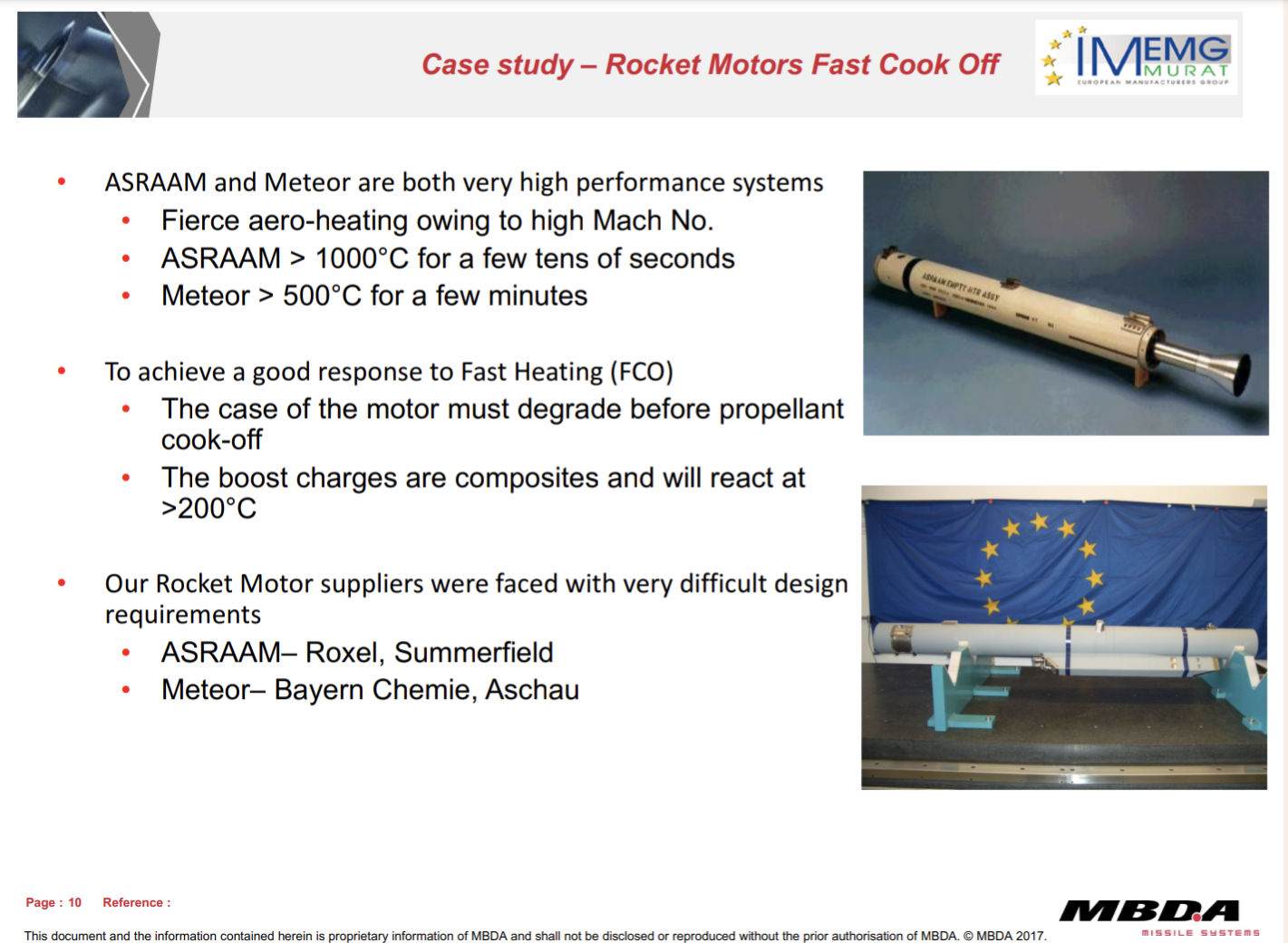
And if we circle back to ASRAAM: the manufacturer states the missile’s skin experiences over 1,000°C of aerodynamic heating during flight. It is pretty much impossible to achieve that level of heating unless you are traveling in the vicinity of Mach 5.
So what evidence do you present, other than vibes, to support your claim’s about ASRAAM’s speed?
you shouldve just led with that, fair enough
though delta v might still be not quite as much, since that could be in very optimal conditions for such speed
Not CAMM/ASRAAM, examplary thrust curve (MICA, i just have it on hand), yes it does
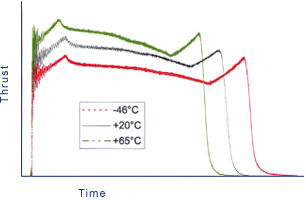
Lower temperature decreases thrust, but increases burn time.
I do not have the full source, i lost it somewhere, but here it is

for air breathing engines it increases both thrust and drag
but thrust more than drag, causing planes to go faster in cold weather
That was about solid propellant rocket.
Yeah, topic went off course a little.