huh? LoS for a plate at 60 degrees is twice the plate’s thickness. a 350mm plate at 60 degrees has an effective thickness (ignoring material modifiers) of 700mm.
sticking purely with in-game values, M829A2 can penetrate a 629mm plate at 0 degrees point blank. it can also penetrate a 364mm plate at 60 degrees point blank. 364 x 2 is 728mm, so in-game it can penetrate 728mm LoS thickness on a 60 degree plate. this is ignoring material modifiers and composite arrays, and other factors. it’s not as simple as you’re trying to make out.
anyway sticking with an in-game perspective, gaijin could probably just give anti-ERA darts a section of code that tells them to ignore ERA. nice and simple, job done.
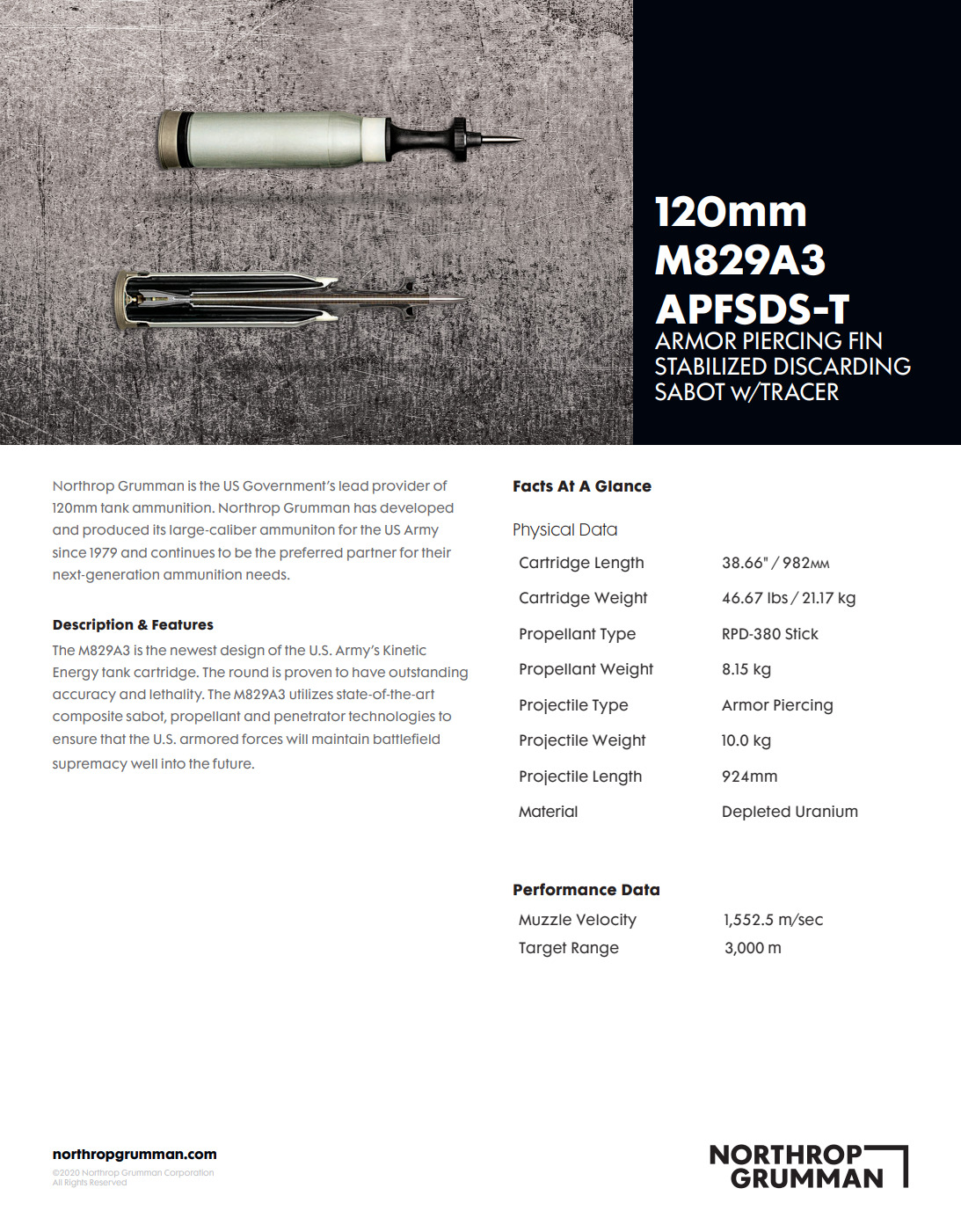
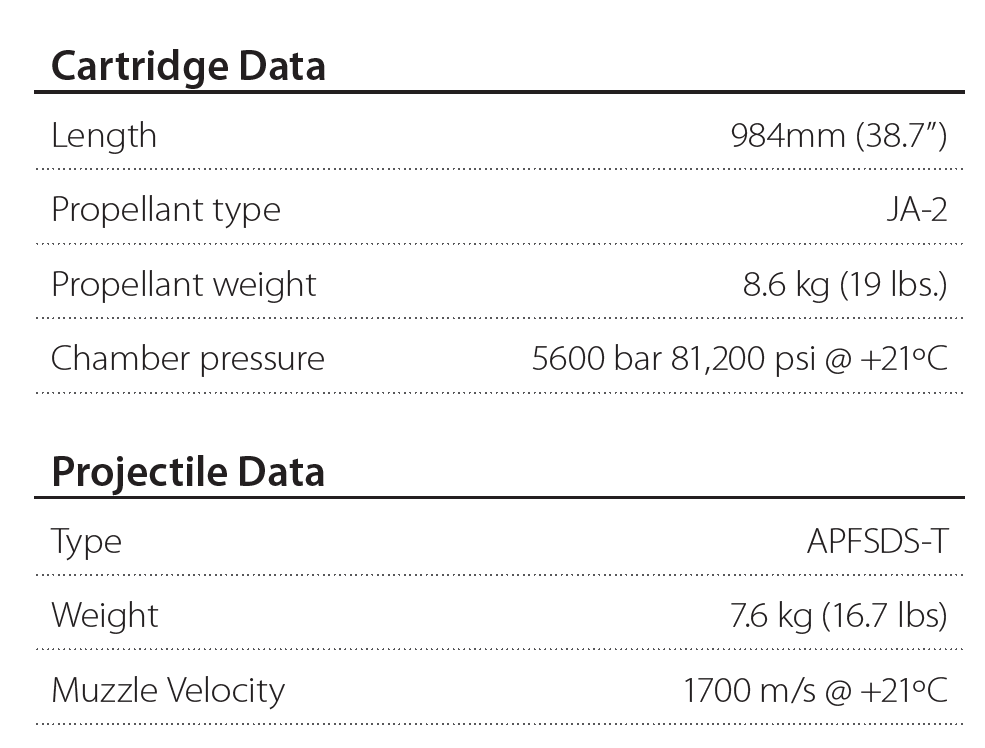
Well to put it this way. From what I found the a2 is roughly 780mm long the entire cartridge, while a3 is 924mm long, I noticed your picture earlier says the round is 930mm long.
Anyways interestingly if you do the math using the lengths this puts it at 144mm of difference or exactly 150mm of difference in length between the two rounds which also happens to be the exact supposed length of the penetrator, which means the two rounds would have the exact same length in for the DU penetrator. Other notably changes to the a3 are that its thicker and uses a better propellant to provide higher velocity so if you are using the propellant of the a2 to calculate its velocity you now have a wrong number that is probably much lower than its actual value. Maybe I’m schizo though who knows.
292 has a T-80U UFP without ERA, and the 292 was brought up earlier
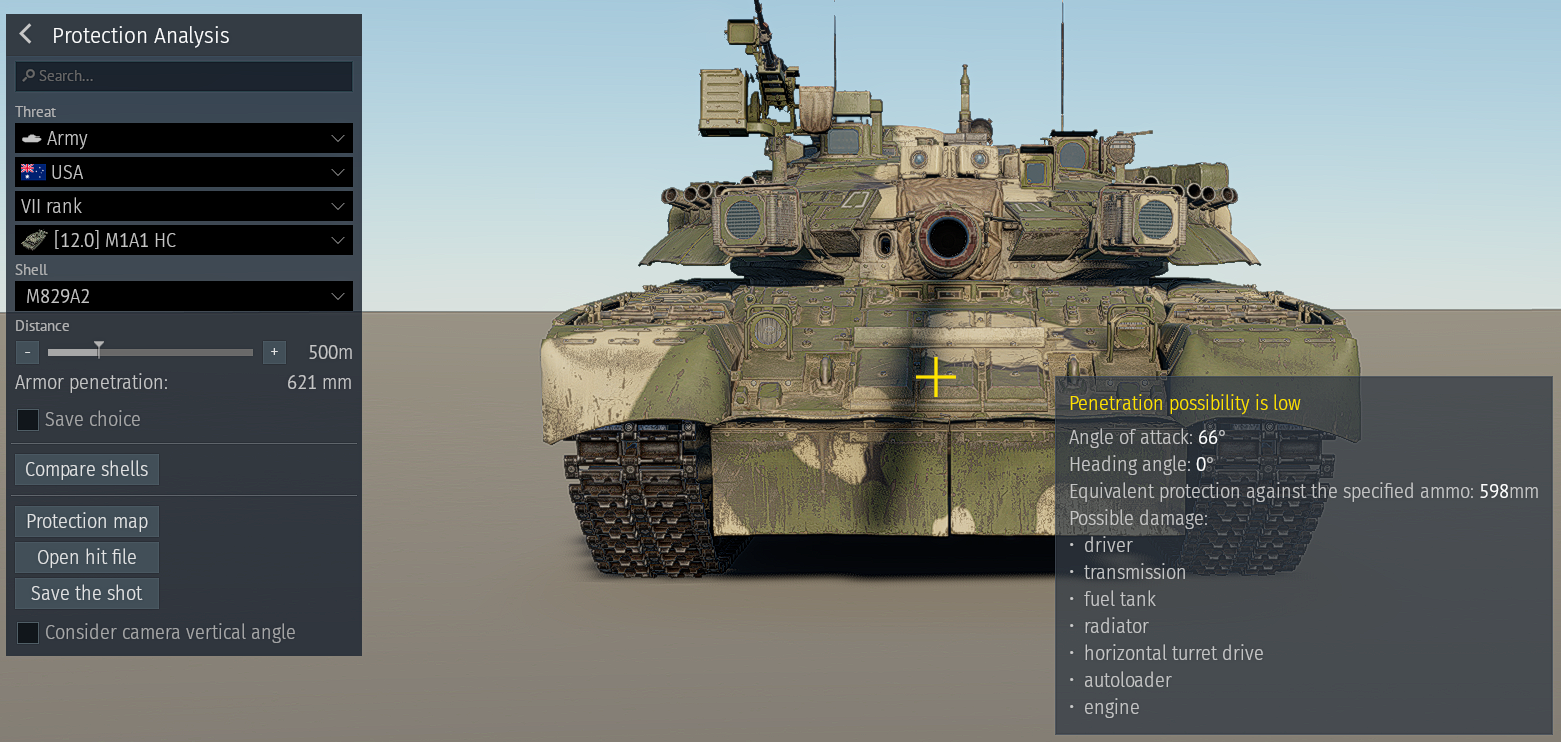
as you can see, M829A2 has a chance to pen the UFP even with ERA in place. any implementation of anti-era tips in-game will make this penetration easier. the game has much simpler implementation of, well, everything compared to irl performance.
The best edge case to look at if you want to figure out the tradeoff is likely L27A1, it also has an anti-era tip while being shorter than the 1pc NATO equivalents, meaning it would have more of an impact on performance.
to the extent tandem ATGMs do i.e enough that actual testing against T-80U’s turret clad with K-5 at a range of 4km’s at the thickest parts and it perforated
additionally, they constantly improve the mechanical properties of the tungsten so that it can withstand the shearing force of the thrower plate without disintegrating
This is about as much as I can share without posting DM53/63s blueprint.
Incorrect angle. You should measure at an angle of 68 degrees. Then the protection will be 640 mm.
The problem is that, according to the formula, the 829A3 will have less penetration than the 829A2 in the game.
It may be comparable if a metal pin is taken into account, but I don’t know how to simulate it in the calculator. Well, it won’t have a noticeable effect on rough penetration, since it is segmented and will chip off when it hits armor, rather than wear down.
Well, again. There is no such thing as ignoring, because even if the K-5 has no explosives (i.e., it is just a 17 mm steel plate), it will add 50 mm of armor due to its angle and hardness.
And the tip cannot completely negate the ERA effect, especially if it is very short, as in the DM53. There, it is not even close to 150 mm, as in the 829A3.
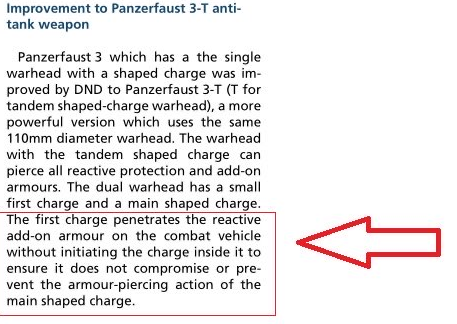
When I talk about a KEP ignoring ERA, it’s always in terms of the “explosion”, yes it still has to go through the plate itself (fyi, DM53s primary mechanism is preventing the ERA’s detonation, rather sacrficing a part of itself forcing a way apart, that’s how PanzerFaust 3-IT works, and RHM states that’s what DM53/63 do as well). The projectile itself, in real life at least, is also vastly more potent when it comes to semi-infinite RHA performance, but it is impossible to have it fixes without again… posting the blueprints :(
I do not have data on the other ERA’s, I can only really talk with confidence about how DM53/63 perform against Kontakt-5.
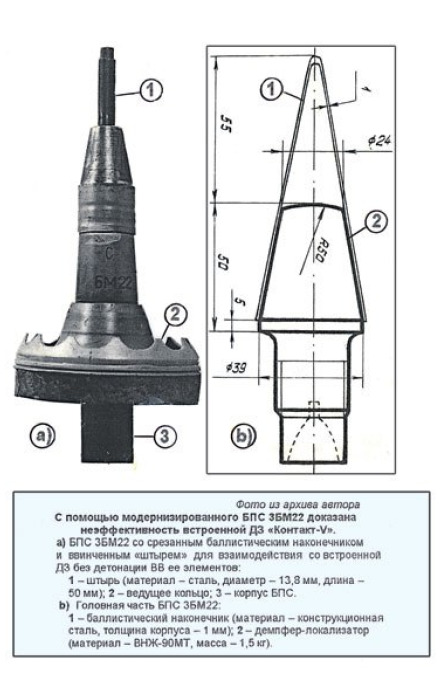
As far as I know, the Soviets performed their own trials of Kontakt-5 in the mid-1980s against a modifed 3BM-15(?) with a smaller stepped tip design, and the projectile perforated the ERA without initiating a reaction, that is due to Kontakt-5 being in a sense “insensitive” to smaller calibre projectiles, and that’s what Tandem ATGMs, and anti-ERA projectiles rely on (some of them).
Yeah but with the round being 924mm long and the a2 being around 780mm long this means effectively there is no difference in the DU penetrator between rounds so the steel head is not taking away from the DU Penetrator. You also once again do not take into account the fact that The DU tip of a3 won’t be damaged when hitting the armor of the tank nor are you taking in the fact a3 has an upgraded propellant giving it a better velocity over the a2 despite being a longer round or that’s its denser giving it better penetration as well.
There is, if the inertia transferred is less than that required to set of the explosives(such as to avoid the potential for “raking fire” to be a viable counter-action, as was discovered with K-1 where HMG’s would set off tiles allowing subsequent RPGs an easier time. Where K-5 at least was made inert enough to not action on 25mm NATO AP / APFSDS hits)
The K-5 tiles was made more inert in order not to action for threats the side armor could deal with, thus it is possible with a sufficiently sharply angled penetrating tip to avoid imparting too high a radial velocity to the explosive layer and avoiding the tile functioning.
17mm/cos(68) = 38mm
The Non-flier plate steel is only sheet steel, it’s not HHA, it doesn’t use an RHAe value of ~1.3. I don’t know otherwise how you are getting 50mm otherwise?
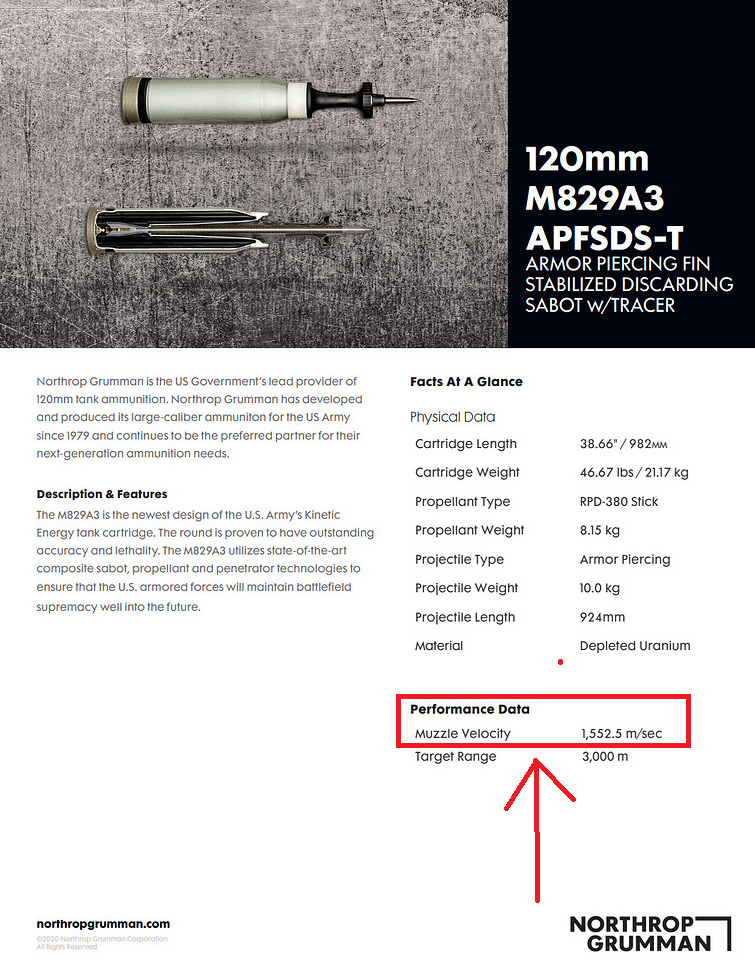
A3 is a stated velocity by Northrop, A2 is the upper range of a guess of its velocity from what I understand. Prime points of the A3 was a better propellant to allow for a higher or equal velocity despite the rounds size.
Unfortunately I couldn’t find the M829A2s datasheet that quickly so I used KE-W A2’s which is just a Tungsten version of M829A2, as you can see, the velocity is much higher.