The M829A3 is often mentioned on the forum in the context of “ignoring ERA.”
The questions are as follows:
What kind of ERA does it ignore?
How does it ignore it?
To what extent does it “ignore” it?
The answers seem obvious, but as soon as you start to answer them specifically, a lot of problems arise. So I suggest we discuss it here. I’ve already had a conversation about this, but I’m curious to hear what people here will say and what responses there will be to what I say.
A large part of the protection against APFSDS that Kontakt-5 and Relikt provide is from guillotining 5 to 6cm of the tip off the penetrator rod removing the sharp point, a blunt point loses around 20 to 30% of its penetration due to the energy required to reshape itself and begin penetrating to begin the ablatic shear phase.
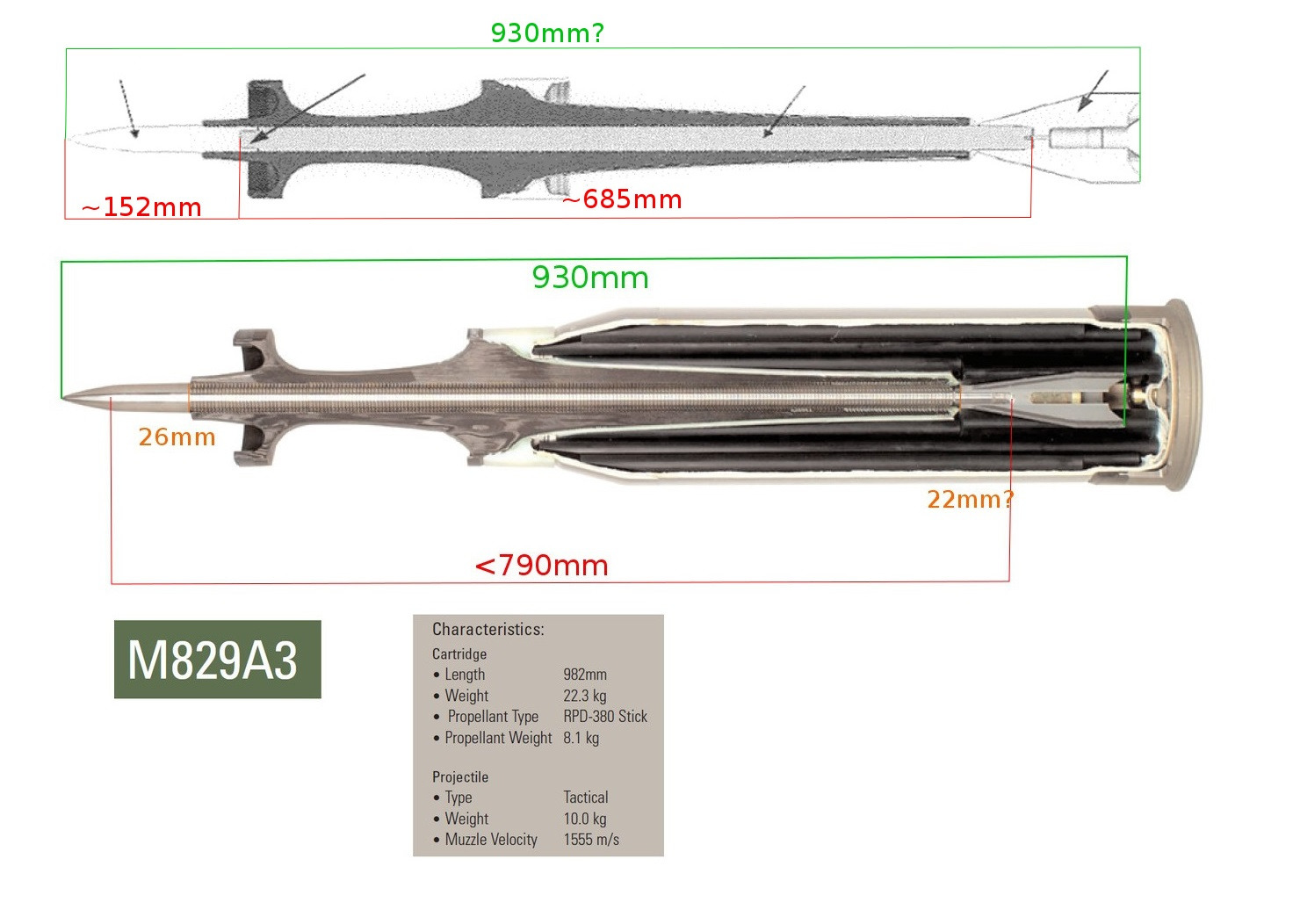
Tipped APFSDS like M829A3 have a 10cm long sacrificial tip that is sheered off leaving the point on the actual penetrator intact and sharp.
There are also other factors but that’s the main one.
To put it simply, the penetrator essentially brute forces it’s way against ERA.
In the case of M829A3, the round has a 100 mm long steel tip which essentially acts like a Tandem-warhead. The penetrator diameter was also increased from 22 mm to 25mm to improve the penetrator’s strength.
It doesn’t fully “ignore” ERA and instead mitigates (or lessens) the effect of ERA designed against KE rounds.
So yes, I know about that. However, questions remain:
If the projectile has a steel tip (pixel measurements indicate 150 mm, but that’s not so important), then the length of the uranium penetrator is reduced, which decreases the overall penetration. Is the 100-150 mm penetrator really worth it?
In addition, yes, ERA will activate earlier, but it will still work and part of its effectiveness will remain. This is not “ignoring” as many people think.
The relict consists of two 20 mm plates. On their own, they provide 120 mm of effective resistance to APFSDS, even if the explosive does not detonate at all.
Contact-5 has one 17 mm thick plate. It provides 50 mm of effective armor.
That is, in the best case scenario (if the explosives simply do not detonate or are not present), Relikt provides 120 mm of armor, and Kontakt-5 provides 50 mm. And we know that ERA will have some effect, even if it is worse than intended, meaning that these figures will be higher.
Wouldn’t it be easier to simply make a longer penetrator for these 100-150 mm?
What about FY-4/5, Nizh, Duplet, SLERA? It turns out that this M829A3 will also penetrate them with “ignoring.”
Many APFSDS have a thickness of 25 mm+, even the Soviet 3BM46.
However, no one claims that ERA is “ignored.”
At the same time, ERA was developed specifically for thick DM23/33 (they were available at the time of the creation of the K-5, for example), so it obviously works correctly against them.
I understand. But this is a superficial answer that raises many questions.
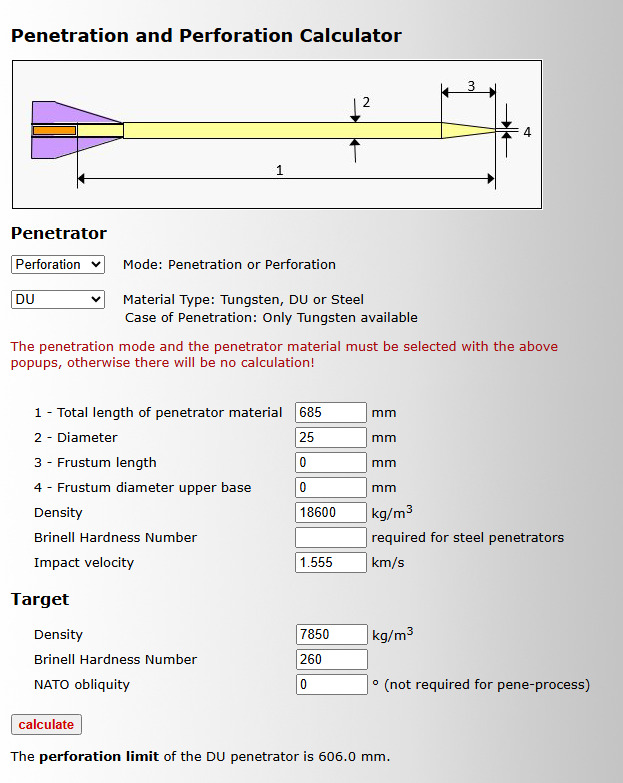
If the 829A3 has a 685mm uranium penetrator at a velocity of 1,555 m/s, it still won’t reliably penetrate the T-80U, as it will have 606mm of penetration, while the T-80U has 520+(60-70)=580-590mm of armor.
Not to mention the penetration of tanks with Relikt.
In fact, it would be more effective to simply make the penetrator as long as possible.
While I can only speculate due to these being in service rounds an classified, I would have to assume that the loss of the sharp tip is more impactful than than a shorter penetrator, reforming that tip is at minimum a 20% loss how much pen dose the shortening the penetrator cost? then there are a bunch of secondary effects, dose the tip reduce yawing in the round on impact, how much dose the loss of mass from the tip affect penetration, what’s the difference in the structural integrity of the tipped vs non-tipped round after hitting the ERA. dose the ERA plate still impact the penetrator? and if so what effect dose it have.
Unfortunately we can only speculate.
well there are practical limitations to how long you can make them, even in manually loaded tanks, they still have to fit behind the blast doors and be able to be maneuvered inside the turret, I think they are pretty much at the limit for length with out completely redesigning the tanks
That would be my guess too, you could also argue the ERA is having an effect by forcing the use of a shorter penetrator to begin with.
I don’t know enough about them to speculate, but it dose raise an interesting question on how multilayer ERA would affect it.
606mm – penetration of a 685mm-long uranium shell at 1,555 m/s
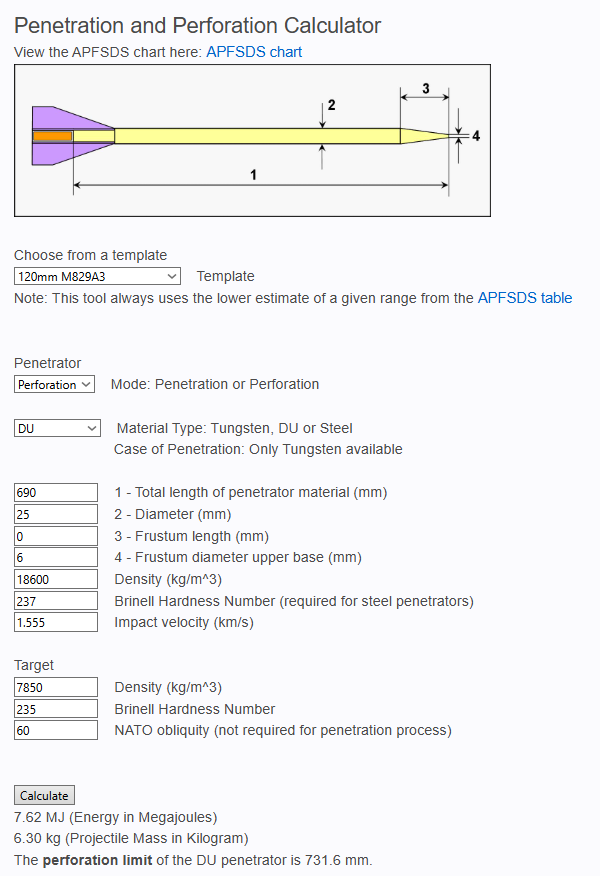
520mm – base armor of the T-80U without EPA. 60-70mm – K-5 effectiveness, taking into account the attenuation from 829A3 (50mm due to the simple sloped steel and 10-20mm due to the weakened EPA).
This is the most optimistic estimate for the 829A3, where I reduced the effect of the ERA to 15-30% of the full effect.
I suppose the point is. Is whatever pen that is left enough to deal with the armour underneath?
Is say a T-80BVM with no ERA vs a 400-500+mm pen round still gunna die or not? Might vary slightly on where it was hit, but I think in most places it would pen and thus do major damage
At the moment, hititng the ERA jsut stops the round dead in its track (litereally, it has code that basically just deletes the dart when hit)
Hey so kind of read through the forums basically what allows these rounds to be era defeating is the tip put on the edge of them that gets blown away by the blast of the era, this tip getting destroyed protects the main penetrator of the round from being deformed so even though you’ve made the main penetrator smaller by adding the tandem tip, you still end up with more round hitting the the tanks armor not to mention its head isn’t deformed as its hitting the armor which is going to provide a better effectiveness at penning the armor.
Just a quick unrealistic example for easy understanding. If the round is 100mm long and it hits the era it will blow off lets say 50 mm of the rod meaning you have a deformed head with 50mm left hitting the tank.
Now lets say we make a tandem tip to defeat the era and make it a different material so its providing protection against the blast of the era but it only needs to be 20mm long to do this task. So our 100mm round will now hit the tank but the era will only destroy the 20mm tandem tip leaving us with 80mm of round left and a fresh penetrating head on the round. This means it will perform better against the armor.
They should also decrease the performance of those era, segmented penetrators should be more effective in general than monolithic penetreators against era, for example on the duplet the segmented core of the 3bm42 seem to outperform the much longer 120 mm ofl f1