They are talking about the tip design, they claim that the tip is designed on such a way that they will not trigger the explosives, so at the very least against kontakt 5 it should ignore it.
I can’t find anything for the M829A2 I ran into the same issue as you there I actually used that Northrop sheet earlier to show the projectile length, but KE-W A2 might be using a newer propellant as well as the round itself appears to be lighter than M829A2 with more Propellant as well, so it’d make sense if it had an even higher velocity. I just think its more likely that the M829A2 speed being that high might just be a bad guess and it probably hovers much closer to the velocity of the A3 round. Even then all this debate is pointless as this man does not understand literally anything. He can’t even understand why a blunted round would penetrate less than a pointed round.
- What is the source of this photograph? I don’t think any written source mentions it.
- A very thin rod is used here, while the M829A3 has a thick rod.
- Are you aware that the composition of the Kontakt-5 explosive has been modified? For what type of explosive is this relevant?
It’s just an amateur picture from the internet.
“Boom-boom, it ignores it, trust me.”
1 Like
Can you provide a source for your claim that a blunt 840 mm long projectile penetrates less than a pointed 690 mm long one?
It seems like you are just guessing.
Remember how we talked about the pencil experiment? go try it.
2 Likes
In my opinion, you should prove your words yourself.
I am waiting for confirmation that a pointed 690 mm shell will penetrate more than a blunt 840 mm shell.
If we were comparing penetrators of the same length, then of course you would be right. But the lengths are very different.
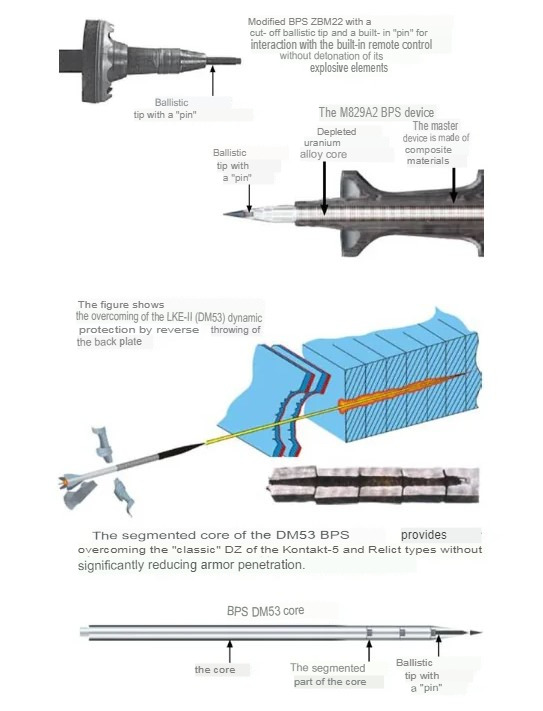
Вместе с тем установленная на танках Т-90 динамическая защита (ДЗ) «Контакт-V» надежно преодолевается БПС 829А2 и DM43 благодаря остроконечной конструкции их головной части без инициирования детонации ВВ в ЭДЗ. Это было подтверждено результатами экспериментальных исследований, проведенных в НИИстали в конце 80-х годов, но по каким-то причинам оставшимися без внимания. Тогда ведущий инженер Петр Паластров модернизировал отечественный БПС 3БМ22 путем установки в его головной части «штыря» (рисунок 1а), диаметр которого составил 13,8 мм. Предполагалось, что при взаимодействии штыря с 15-мм стальной плитой встроенной ДЗ будет образовываться слабый осколочный поток, неспособный вызвать детонацию ВВ в ЭДЗ. Стрельба этим снарядом подтвердила упомянутое предположение – детонация ВВ в ЭДЗ не состоялась.
НИИ стали в основном вел отработку встроенной ДЗ «Контакт-V» с помощью БПС 3БМ22 «Заколка», головная часть которого представлена на рисунке 1b. При взаимодействии БПС с 15-мм плитой после смятия баллистического наконечника (1) пробивание плиты осуществляется демпфером-локализатором (2), диаметр которого увеличивается с 24 до 39 мм. Эти размеры и определяют создание мощного осколочного потока для возбуждения детонации в ЭДЗ. Созданию мощного осколочного потока способствует также материал 15-мм плиты – броневая сталь высокой твердости, которая обладает повышенной хрупкостью.
Какой же вывод следует из этого? Принятая в 1985 году встроенная ДЗ «Контакт-V» не пригодна для защиты от зарубежных БПС, имеющих остроголовые головные части. При взаимодействии таких головных частей образуется маломощный осколочный поток, который в результате гидроудара образует зоны, свободные от ВВ в ЭДЗ, что является одной из главных причин отсутствия детонации. Таким образом, ДЗ «Контакт-V» может работать только против отечественного БПС 2БМ22 «Заколка».
Не менее интересны результаты опыта (рисунок 2), проведенного в конце 1985 года Петром Паластровым. Встроенная ДЗ в этих опытах состояла из четырех ЭДЗ. Мощный осколочный поток от 15-мм плиты, образованный от соударения с БПС 3БМ22, инициировал детонацию в ЭДЗ (1), которая передалась всем последующим (2–4) благодаря их взаимному контакту. Разгон 15-мм плиты происходил под действием удара пластин ЭДЗ и расширяющихся продуктов детонации ВВ. Воздействие 15-мм плиты на боковую поверхность БПС явилось причиной его рикошета с образованием в бронеплите воронки глубиной 50 мм. Такой результат получен при детонации 1 кг ВВ и массе 15-мм плиты 7,6 кг. Опыты Паластрова дают представление об особенностях возбуждения детонации в ЭДЗ и об энергетических возможностях воздействия ДЗ на БПС.
Во встроенной ДЗ «Контакт-V» под одной 15-мм плитой (размеры 500х260 мм) размещаются четыре секции, в каждой из которых уложены по два ЭДЗ 4С22. Секции отделены друг от друга стальными перегородками для непередачи детонации. Сравнивая конструкцию ДЗ «Контакт-V» с условиями опыта, можно отметить ее меньшую эффективность, которая определяется детонацией только двух ЭДЗ.
Таким образом, в оценках Виктора Степанова не использованы характеристики поражающего действия зарубежных противотанковых средств, которые надежно поражают танки Т-90А и Т-90АМ, что привело к завышению оценок защищенности наших бронемашин.
Встроенная ДЗ наших танков «Контакт-V» преодолевается: с вероятностью 0,8–0,9 современными зарубежными ПТУР малой дальности с тандемной БЧ – «Eрикс»; средней дальности – «Джавелин», «Дракон-2», «Милан-2T»; большой дальности – «Хеллфайр», «Бримстоун» и другими; зарубежными гранатометными выстрелами с тандемной БЧ; зарубежными БПС М829А1, М829А2, М829А3, DМ43, DМ53, имеющими остроконечную головную часть, позволяющую преодолевать ДЗ без детонации ВВ. Другими словами, наша встроенная ДЗ может бороться только со старыми боеприпасами, имеющими один кумулятивный заряд, или с отечественными БПС.
- A very thin rod is used here, while the M829A3 has a thick rod.
I’m using this as supporting evidence for DM53’s mechanism of defeating K-5.
Are you aware that the composition of the Kontakt-5 explosive has been modified? For what type of explosive is this relevant?
For the Kontakt-5 that Germany acquired between ~1985 and ~1993 most likely, but that assumes the composition was modified to make the explosive “more reactive”, which would’ve gone against the primary reason of why it was made less reactive in the first place.
3 Likes
Against what threat?
So then why does 829A4 claim the ability to defeat 3rd gen ERA?
4S20>4S22>4S23
It’s probably not, HHA would shatter due to the high brisance of the explosive.
2 Likes
This is just a copy-paste from a website on the internet. It is not a source. I’m not very interested in reading someone’s baseless guesses.
I saw this a long time ago.
Can you send the source for this?
Is there a thin rod? Do we have a photo of it?
In that case, the length of the DM53 penetrator in the game is greatly exaggerated, since the rod should significantly reduce the length of the penetrator.
The K-5 has been made “more reactive” than the K-1.
Buddy you can’t prove anything at all everything you are talking about is your own calculations based on guesses from values you took from a video game. 840 mm of blunt object wouldn’t penetrate as much due to the head not being able to pierce through or separate the armor its the entire reason why everything uses shape heads to begin with if 840mm could penn through more than 600mm with a penetrator then why are we not making 1000mm long blunt head projectiles instead of trying to make these fancy shorter projectiles.
2 Likes
There’s a blueprint :)
In that case, the length of the DM53 penetrator in the game is greatly exaggerated, since the rod should significantly reduce the length of the penetrator.
It is by about 3mm’s, but what’s also greatly underexaggerated is its density as the penetrator is 5kg in weight, while having a thickness of around ~21.5mm :)
Meaning the penetrator should be much denser in the game and should perforate more at the end of the day ;)
This is just a copy-paste from a website on the internet. It is not a source. I’m not very interested in reading someone’s baseless guesses.
And it shares the sources used.
I already shared the snipet from how Pz-3(I)T works, and it works to this day, so DM53/63 that use the mechanism will also work fyi :)
1 Like
Oh, so a 5mm round penetrator will penetrate more than an 840 blunted penetrator?
Or perhaps I shouldn’t take my thoughts as absolutes?
This is a debatable question, and I would like to see a reasoned answer.
The answer may lie in the excessive increase in shell weight, the complexity of manufacturing a long uranium monoblock, restrictions on shell size in the tank compartment, etc.
He called your stuff a baseless guess, and fyi all of his information is literally values he took from the x ray view in war thunder and either ran through a simulation on the internet or did the calculations himself for.
1 Like
He’s not the author of the simulations, I know that much.
Or that shaped heads penetrate better than blunt heads and require less length and energy to preform similar feats of penetration. Source all of human history its why typically the end of spears are pointy, it why arrow heads are pointy its why anything that has literally ever been designed to penetrate something is pointy and not blunt. Something you can prove in the comfort of your own house with a pencil and old shirt if you’d like. and btw newer much smaller 90mm and 105 rounds have about the same penn or more as older 105 and 125mm rounds solely because of improvements to the shape of the head and structural shape of the round.
2 Likes
Will you show me?
Bruh.
And get perma-banned in the process? Can you personally guarantee that Smin or other CM’s and admins won’t nuke me? IT’S A LITERAL BLUEPRINT OF THE CONSTRUCTION OF THE DM63 MATE.
:D
1 Like
That’s true, I’ve never argued with that. But it seems to me that you can hit harder with a blunt club than with a sharp needle.
This absurd example is needed to show that you have no data to claim that with a 150 mm shorter penetrator, a “sharp” projectile will penetrate better than a “blunt” one that is 150 mm longer.
Blunt clubs don’t penetrate armor they work by breaking the things on the inside without going through the armor kind of like HESH.
Also where are you getting the 150mm shorter tip they have the exact same DU penetrator length.