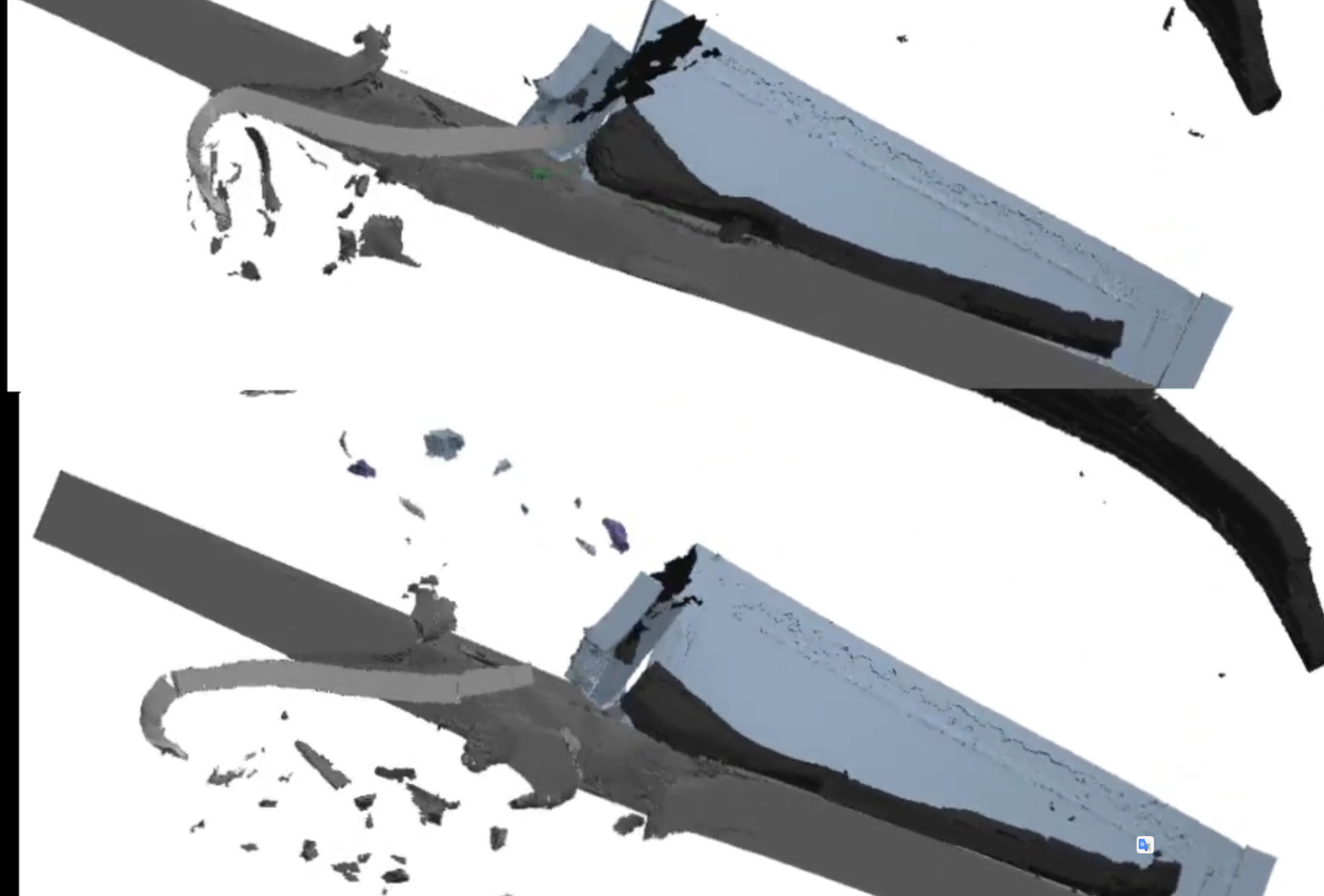
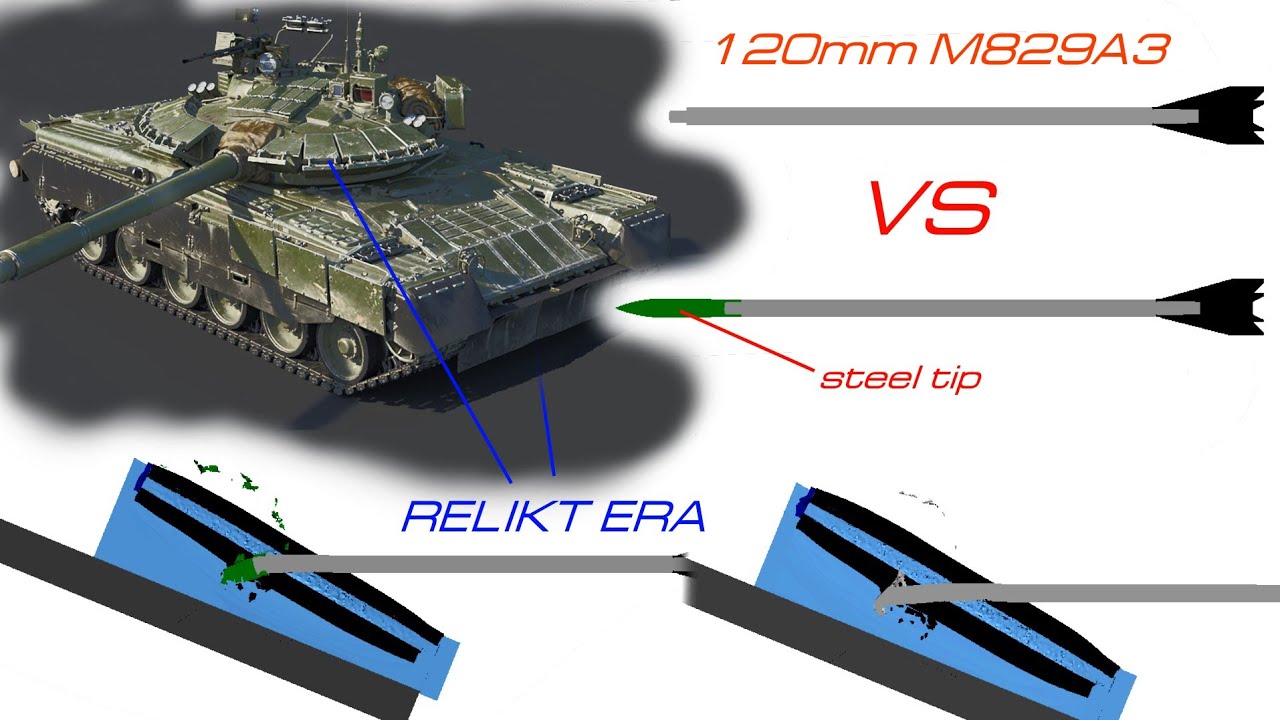
The point here is that if a uranium penetrator were used instead of a 100-150mm steel tip, the crude penetration would be more effective than the “anti-EPA effect.”
You’ll reduce the Relikt’s protection to ~150-160mm at best if you use a steel tip, but you’ll lose about 70-80mm of penetration according to the formula, since the penetrator is significantly shorter than it could be.
I’ve already written that Relikt or Kontakt-5, even without the explosives inside, are still just sheets of highly hardened steel.
The problem is that for this tip to be effective, its length must be significant.
According to the diagram, it’s 150 mm. You sacrifice 150 mm of penetrator length and get a reduction in EPA efficiency.
The problem is that the resulting effect doesn’t outweigh the losses from a shorter penetrator.
If its sacrificing a 150mm of the tip to defeat era then the era was stopping more than 150mm of the round. Even if its stopping exactly 150mm to begin with you are retaining the form of the penetrator on the main round as well as the integrity of the round which will allow it to penn more armor than a blunted or damaged round hit by era.
Its also possible keeping in mind that you and this internet simulation are not as qualified or knowledgeable on the subject as the thousand people who hold masters degrees in this field of study and get paid a ridiculous amount of money to ensure things both work and provide a dead enemy, and therefor you might be working on entirely wrong presumptions about the round to begin with considering it is still heavily classified material.
Once again. Even if the Relikt doesn’t contain any explosives at all or if they don’t detonate, two 20mm plates will give a 120mm equivalent damage from the shell.
For Kontakt-5, it’s 50mm.
Considering that we’ve already established that the tip can only reduce the effect of EPA, not completely neutralize it, then at best you’ll get a reduction of 150-160mm for Relikt, and 60-70mm for Kontakt-5.
Essentially, it would be more cost-effective to have a 150mm longer penetrator than to make a tip.
This doesn’t even mention that, in terms of armor without EPA, such a shell would be inferior to the 829A2.
The hidden lie is that the duplet is massively underperforming, should at least 400mm which is the penetration reduction that the 3bm42 experienced which should be more if we uses the same standard as with the russian era, but duplet is not your everage era, afterall they are 3 layers of era that operates on a completely different principle than the russian era, and even then the m829a3 probably also decreases the performance of the duplet to some extent even if it is stopped.
Its like the idea of round integrity or penetrating tips escape you entirely and you are basing all values of penetration of the length of the rod alone. The reason why this isnt adding up in your head and the reason why the pentagon isn’t hiring you for out thinking everybody involved in the development of these rounds, is your lack of understanding on how a deformed penetrating head will hamper the performance of the round even if its longer than the the shaped head.
Here’s a simple test for you go sharpen a pencil poke it into your bed it will go through the fabric into the bed, because of the sharp point. Now take a pencil you haven’t sharpened and press the flat tip into the bed it wont go through not without an extreme amount of force. Now take the first sharpened pencil slam it 3/4th of the way off the desk so it breaks and try to push it through the mattress again it shockingly wont go through well.
Here’s another issue all the values you keep bringing up are guess work and basically all you’re doing is talking out your rear end about this. You are talking guess work done through what is assumed about something on the internet, in fact not just one thing but on three separate different objects and using a simulator that somebody made which could be wrong in its values, to try and prove that the people who built the rounds and tested them on live targets and have the actual results of these test wrong.
I do not know how to hammer the idea of round stability and integrity along with penetrating tips any better to you, if you fail to understand what I have said at this point you are just going to continue to fail to understand why and how modern rounds work. Don’t be the modern rounds version of that tiger guy and his tiger tank.
This isn’t the topic of this discussion; I think it’s best to move this question to the Oplot/Duplet thread. However, the gameplay value is consistent with what was seen during testing. This has been demonstrated repeatedly in responses to player reports.
Does Relikt have two 20mm plates? Yes. Do they provide 120mm of APFSDS resistance even without explosives? Yes.
Does Kontakt-5 have one 17mm plate? Yes. Does it provide 50mm of APFSDS resistance even without explosives? Yes.
Does the 829A3 completely negate the effect of ERA? No. So at least 10-30% of the additional protection provided by ERA will remain. (We are talking about the effect of additional protection, in addition to the 120 and 50 mm protection from a literal sheet of steel, which I indicated above.)
Will the penetrator be shorter if 150mm is taken up by the steel tip? Yes.
perforation limit increases with angle. assuming you’re talking about hits to the UFP of T-series vehicle you need to include the angle. using the M829A3 preset with your 685mm penetrator length gives 725mm perforation limit at 60 degrees.
taking your 590mm effective UFP at face value, that same calculator shows that M829A3 can lose up to ~150mm of length before it hits a 590mm perforation limit.
The game does not indicate the actual thickness of the sheet, but rather the equivalent protection recalculated to the normal.
Therefore, the same DM33, which penetrates 481 mm, penetrates 600 mm at an angle of 68 degrees, but cannot penetrate the UFP at 292 objects.
That’s true, but the problem is that when you hover over the T-80U’s armor, you see the strength recalculated for easier understanding, not the actual thickness of the armor.
To penetrate the T-80U’s armor, a shell must have 640 mm+ penetration at an angle of 0 degrees, not 60 degrees.
Sure were are you getting any of the number about the effective use of these era plates? what official document from the Russian mod that is a technical manual or operator manual or otherwise primary source about this era are you getting these values from? Where are you getting the 10-30 percent figure from what official documented source does this number come from. Provide the actual document stating this for us please.
Next you once again can not understand why a formed penetrating tip will provide a better performance against armor even if its shorter than a deformed tip.
I took the thickness of the sheets, multiplied it by the sloped armor coefficient, taking into account the slope effect, multiplied it by 1.1, since the armor is of increased hardness, and by the coefficient for multi-layered combined barriers.
That’s how it works in the game.
This is the most optimistic assessment for the “anti-ERA effect.”
Everyone here agreed that 829A3 does not “ignore” but “reduces” the effect. I gave this the most optimistic assessment—a 70-90% reduction in the effect. Better yet—complete ignorance.
So you don’t have an official source then? there is no source anywhere that you have for the values you are using. The values you are using to try and disprove real testing is a value from a video game?
I’m not mixing things up. You started claiming that if a shell has an angle penetration of, say, 700 mm, it will penetrate armor in the game where it says 600 mm.
It won’t.
590 mm for the T-80U’s main gun was given from game data. The point was that the 829A3 does not seem to be what is expected of it at all.
The penetration will not be higher than that of the 829A2 due to its lower velocity and shortened penetrator for the steel pin, and “ignoring ERA” means “reducing the effect of ERA,” which will still remain even in the best case for the 829A3, so that it will not significantly affect the result.