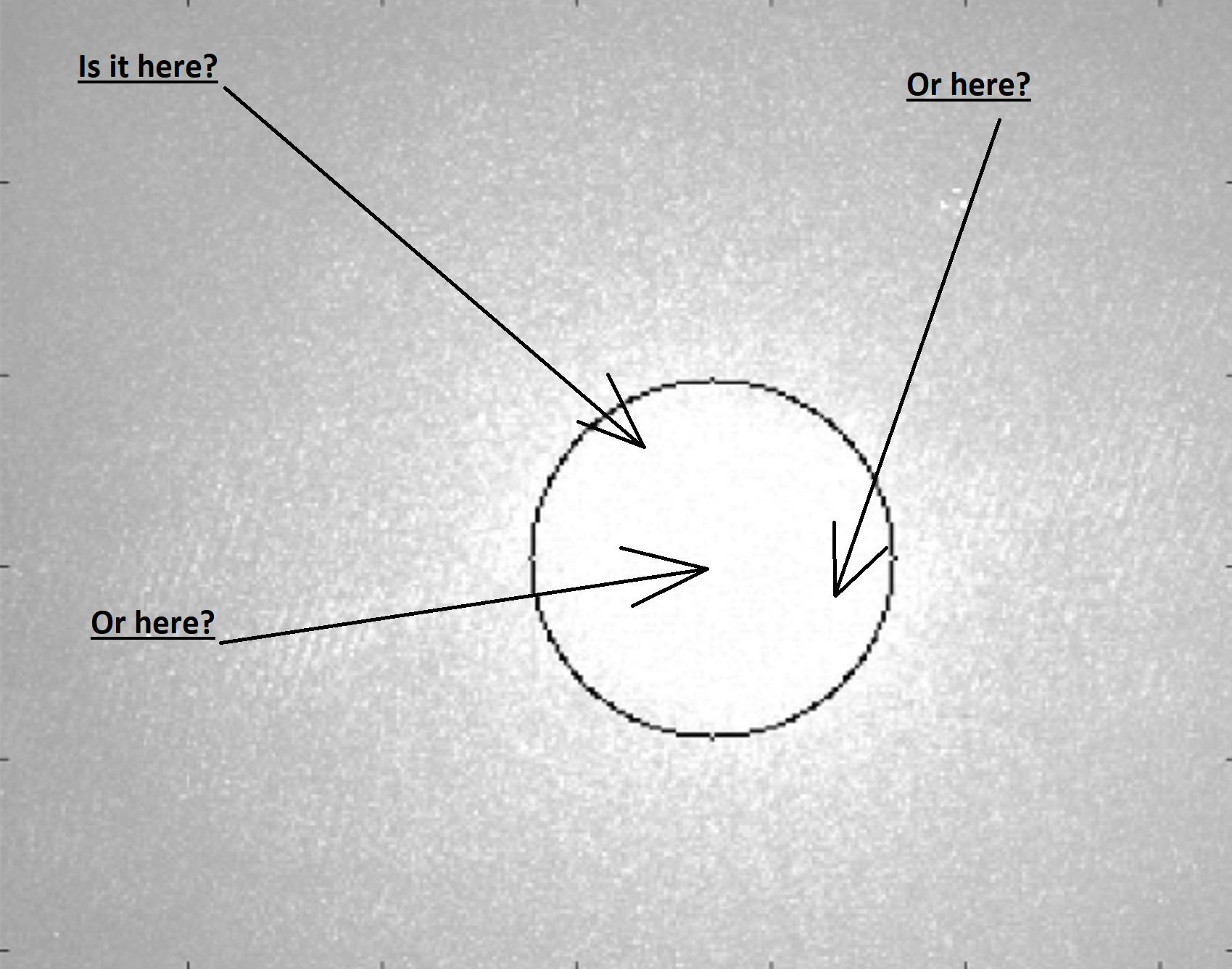
LDIRCM (and DIRCM) can involuntarily affect multiple missiles at the same time

All laser beams have some degree of divergence due to Difraction.

Also you cannot be hoping to hit an incoming missile’s seeker with a beam spot of few milimeters.

And one more thing, which is very important:: The laser’s divergence cannot be arbitrarily small because diffraction sets a fundamental limit proportional to the wavelength divided by the beam diameter.

Modern LDIRCM systems operate in the near-IR, typically around 1–2 µm wavelength.
At Turret exit Aperture of 20mm, and Divergence of 0.1mrad, (which is quite conservative, but still achievable):
The spot diameter would be ~200mm at 2 km distance.
(The minimum physicaly possible Divergence at this wavelength would be 0.03mrad)

I personally think this is unrealistically small. I assume most systems can produce a spot with diameter up to 500mm at 2km range, to be able to reliably illuminate the missile. As the missile closes in, the spot would be less in diameter obviously, but higher in intensity.

Good luck hitting an incoming missile with a small beam 5-10 mm in diameter for any reasonable amount of time.

Neither is LDIRCM and Gaijin’s implementation is complete fantasy.

As I already answered to another person: currently it is not properly modelled ingame. It is completely static and simply covers the port and starboard hemispheres of the helicopter. (For Mi-28NM).

If they implement it correctly, ingame we will only see difference when multiple missiles approach from vastly different angles, or when missiles that acquire image of the target before launch are used (for example R-74, R-74M2 and AIM-9X.
Are there even any example of what constitutes a DIRCM, system that isn’t based on a Laser? But a Reflector. I’ve never heard of one that isn’t. So the specification of Laser seems redundant to some degree.

So then why the move to the POST seeker for the FIM-92, clearly if an IR only Rosette scanner was sufficient to deal with all forms of jamming & countermeasures they wouldn’t go to such efforts or be able to justify the expense to include a surplus UV channel even though the IR handbook clearly makes obvious that an waveform effective for use against Rosette seekers exist (after all it is just a Conically scanning, Conical scan seeker at differing rates).

How would they go about achieving this without modulation? or actually being an offboard system.

So how would this impact dual band (IR/UV) seekers like that of the FIM-92B and later considering it can rely on the UV channel for guidance and it’s fairly obvious even if it was able to shift it’s characteristic frequency to such an outlandish degree, or be broadband there is no visual report. none of these systems even operate in the UV band (except maybe the latest Revisions to the President -S system).

1 Like

Are there even any example of what constitutes a DIRCM , system that isn’t based on a Laser? But a Reflector. I’ve never heard of one that isn’t. So the specification of Laser seems redundant to some degree.

You are right. With the advancements in Laser technology you will probably not find such modern system. Early Russian DIRCMs used high intensity lamps mounted in turrets.

Plus they have become obsolete due to missile advancements.
From what I can find at first glance, L418-5 uses SP3-1500 lamp. It can produce modulated IR and UV light.

Early AN/AAQ-24 Nemesis also used lamps and later switched to laser diodes.

So then why the move to the POST seeker for the FIM-92, …

Because it was not sufficient.
The POST seeker is resistant to modulation jammers, plus it has dual band discrimination and imaging capability.

How would they go about achieving this without modulation? or actually being an offboard system.

A bright spot is enough. You have already shifted the Centroid. If you want to move it without modulating the Intensity, you can simply move the beam around (Beam Steering, aka Jitter).

So how would this impact dual band (IR/UV) seekers

The UV channel in modern dual band POST seekers is there mainly for flare discrimination.

I really doubt companies that manufacture these systems would deliberately omitt protection from such old missiles from the 80s and 90s like the FIM-92B.

Additional clarification about Jitter.

Imagine you are driving at night, and your windscreen is dirty. Headlights from oncomming traffic make a bright patch on your windscreen that covers large portion of it, making it difficult for you to see. As your vehicle and oncomming traffic steer along the road, the angle at which that light hits your windscreen changes and the spot can move around.

Not in game, yet. Still waiting by the way.

Contrast range extension for POST seeker FIM-92 var.

Would the turret & MAWS sensor even have the requisite pointing accuracy to keep the optical aperture illuminated?

Short of an active Radar detection system, optical sensors probably wouldn’t have the resolution required.

No, it is fully capable of providing Guidance, in fact it is preferred to the IR seeker where needed;

As per the referenced Patent in the above report

“In difficult weather conditions, against low-flying targets and at night, guidance in infrared mode is used, and when launching from a long distance and against weakly emitting targets, photocontrast mode is used.”

3 Likes

no kidding

i never said that.
i explicitly stated

you are making one very big assumption here.
that a DIRLCM system CAN do that. while individual seeker specifications vary and determine the exact affect, an imaging IR seeker does exactly that, makes an image.
a laser fired directly into the seeker (assuming seeker perpedicular is directly in line with the DIRLCM) will cause the immediate center of the seeker to becoem saturated (in case of no protective films) and the surrounding seeker elements to suffer from source blooming

image

more often than not, this is not just a big “IM HERE” sign for an IIR seeker but also, with a polariser filter, blooming can be stopped almost entirely and the rest of the usable image can be utilised in order to maintain track on target using a vairety of methods such as Feature tracking, Home-on-Jam.
Hell, even IR missiles with “Push-Ahead” or more commonly known as Suspension tracking can keep guiding themselves in via IOG. DIRLCM wont cause missiles to veer off course as they do in game.

secondly, a fast moving SAM is not going to be affected for as long a duration as compared to, shall we say a PARS 3 LR which travels at a maximum of 0.9M.

this is so absurd its kinda sad

IRIST contains a dataset of targets. the imaging IR seeker cannot use feature tracking:

image

if it cannot recognise those features to be of the target itself.

so your assumption is horribly wrong

wrong

size, and type are already identified by the launch platform, being SLM, it has NCTR and even Typhoon has NCTR, especially well using PIRATE but also with ECRS.

wrong. dazzling will only cast a big light source in the center of the seeker. the missile, especially IRIST SLM receives tracking data from the following:

Datalink: it can guide itself all the way in using DL, unlike in game
Standard IR Track: tracking an IR signature
IIR track: using IR tracking of a target image
Feature tracking: part of Standard IIR track
HoJ: by placing the center of the targets emitted radiation in the center of the seeker, it can simply guide itself in a similar manner to a SAL munition
Suspention tracking: the main form of tracking based on IOG in missiles such as 9M.

Dazzling wont do you any good against IRIS-T

and i havent even mentioned the specific seeker type of IRIS-T being different from other IIR SAM/AAMs AND having a two color seeker.

3 Likes

@Armen_Lozone

You and some others in different topics have been copy pasting bunch of images without context. If you don’t provide the original source for the image so we can see under what conditions it was taken how can we draw any conclusions from it?

Provide exact sources for the images so we can see at what distance they have been captured, and with what equipment.

Dazzling will only cast a big light source in the center of the seeker. the missile, especially IRIST SLM receives tracking data from the following:

The topic is about LDIRCM, not about redundant guidance channels and data links.

the imaging IR seeker cannot use feature tracking, if it cannot recognise those features to be of the target itself.

Exactly.
That is what I’ve been trying to tell you this whole time. You are contradicting yourself.

If you don’t see any features or outlines of such, how can you tell with certainty what you are looking at?

A rhetorical question.

@tripod2008

Not in game, yet . Still waiting by the way.

I don’t really believe this (imaging) can be simulated or even modelled in game anywhere near the way it works in real life.

Would the turret & MAWS sensor even have the requisite pointing accuracy to keep the optical aperture illuminated?

That is exactly why Divergence matters. You cannot use a miniature beam with Width of few milimetters and hope to be able to move it in relation to an incoming missile at ranges of few kilometers. That is why I gave the Headlight example above.

“In difficult weather conditions, against low-flying targets and at night, guidance in infrared mode is used, and when launching from a long distance and against weakly emitting targets, photocontrast mode is used.”

Photocontrast has nothing to do with an UV channel and is something different. It is basically optical tracking based on brightness contrast against background.

you are new here arent you…

im the author of the topic Proof of LDIRCCM capability in IIR against Laser DIRCM

if you actually want to attain knowledge, i suggest reading it up. i have attached all sources and proofs of claims

those topics are entirely relevant to tackle people who beleive DIRLCM can be used to effectively mislead or dazzle IIR seekers. not to mention the scenario you speak of is an exception. not the norm.
only in VERY optimal circumstances can this even be utilised.

far from it. you are digging yourself into a deep pit of misunderstandings. A bit far from your dishonest and incomplete referencing of my words, my original quote is:

This is in no way affirming your stance, but rather pointing out that IRIST and modern IIR missiles in general posses, as i so CLEARLY stated:

however that seems to have escaped your understanding

IF an IIR missile cannot see features of the target due to DIRLCM then it simply applies HoJ or suspension tracking or literally any of the other tracking methods.
it doesnt need to see the features.

2 Likes

Once again, the mirracle ‘HoJ’ to save the day.

When the algorithm cannot determine a reliable silhouette or parts of silhouette to use for target discrimination, it will simply fall back to tracking the strongest energy source in the band, or even use the saturating point to acquire a valid Centroid if filtering fails. (what you call HoJ)
The document 'Requirements for laser countermeasures against imaging seekers
William D. Caplan" that you provided

Does not mention anything about Bright spot moving. It assumes the spot is static in relation to the aircraft.

Let me ask you something:

In this image: https://www.researchgate.net/figure/Dazzle-against-HgCdTe-FPA_fig3_284156197

Where exactly is the aircraft?

When the algorithm has switched to ‘HoJ’, the Optical Centroid (in this case Intensity Centroid) becomes the Track Point.

Now what will happen to the steering input when that bright patch starts circling and moving upon the seeker, even growing in size or shrinking?

The answer is:
Guidance output is proportional to Centroid displacement from Boresight.
If the motion frequency is within the guidance loop bandwidth you will get steering command oscillations, which will lead to further tracking instability and increased Miss distance.

Of course the oscillatioins will not be so abrupt as in early generation missiles that lacked adequate temporal filtering and control-loop BW limitations.

But the difference versus a Lamp based DIRCM is obvious.

Needless to say, this is exactly why modern LDIRCM systems have to rely on Micro Jitter and Intensity modulation in order to achive a non static dazzling of the seeker.

???

Did you even read the report.

The First link in the report is to the Dev Blog announcing it’s implementation, the Stinger was for some reason not included in the list of missiles. When it is well known that it incudes a Dual band (IR/UV) seeker.

Optical Contrast Mode


" As we mentioned in the TAN-SAM-1C dev blog, we’d like to talk about photocontrast mode! This means today we’ll be talking in detail about some of the upcoming improvements to IR missile functionality in War Thunder and what this means for IR missile gameplay."

Even if not it’s full capability it would be hard to argue that it’s not closer to what the POST seeker is capable of, it would be a serviceable interim measure. Because at the moment the UV channel is not represented in any form of IRCCM that is unique to the POST seeker.

And it would be a start to redressing the issues with the current Stinger implementation that impacts many nations.

And if you didn’t want it to maintain A BR, the FIM-92A is still there, as a non POST equipt variant, that retains the Redeye II Formfactor.

Again did you look at the patent? The UV has the same “mapping” capability as the IR channel, and it’s not like a Difference couldn’t be generated from the IR & UV rosette mapping to get a Contrast map. Especially with the subsequent deployment of AUR’s with Flashable EEPROM’s (Type clasified as the Stinger Reprogrammable Micro-Processor Block I, FIM-92C) to permit updates to onboard software at a unit level in response to novel Threats & Countermeasures.

Besides PtSi / p-Si detectors retain responsivity below .750um+ (See Figure 5). and it’s not like an IR filter of some to remove the PbS detector’s bandwidth would be some novel approach to segmenting the apparent bandgap of the detectors.

Spectral response

How is it doing so if it doesn’t have the pointing accuracy to make such small adjustments, or perfect knowledge as to where the missile is in space?

It seems like it wouldn’t do much against a Quadrant (or 8 sector) seeker built for HOJ. because Net energy would still balance out in the direction of the target.

I was talking about implementation of IIR ingame by Gaijin.

The UV has the same “mapping ” capability as the IR channel, and it’s not like a Difference couldn’t be generated from the IR & UV rosette mapping to get a Contrast map.

It may have the same mapping capabilities, but the target does not iraddiate the same way in the UV spectrum as it does in the IR. The main guidance channel is still the IR one.

No;

“Preferably, the seeker will initially operate in the visual contrast mode until an adequate IR signal is available to home the missile. If a sufficiently IR radiating target is present, the seeker may select and receive in the IR mode.”

Already mentioned that above: Beem Steering, (Jitter) or Micro Jitter or Modulation of the Laser beam itself.

You don’t oscillate the turret itself to modulate the beam. Instead, you use fine steering or modulation inside the optical train itself. Small, rapid adjustments can be done internally using fast steering mirrors, electromechanical mirrors, acousto-optic or electro-optic beam deflection methods,(for example piezo driven optics), and direct intensity modulation in the laser source.

“Preferably, the seeker will initially operate in the visual contrast mode until an adequate IR signal is available to home the missile. If a sufficiently IR radiating target is present, the seeker may select and receive in the IR mode.”

The way it works currenly ingame is incredibly basic and stupid to say the least. Basically it checks distance to target, Temperature of the engine and few other parameters (how ‘big’ are the engines, planes with huge engines like the MiG-25 can be ‘seen’ from further away…)

Don’t be naive to think the game has some sort of realistic simulations of such complex systems.

This topic came onto IIR, so after looking around, I found none of the biggest companies in this sector (Kret, Elbit, Northrop, Leonardo) claim effectiveness against IIR missile, all of marketing and test are performed using MANPADS. Why is that?

1 Like

Game checks airframe heat, calculated from speed, engine heat, calculated from thrust, and afterburner, idk what it is calculated from. It takes the biggest.
But what he describes is how Photocontrast works in game, you have a longer in most cases range contrast mode, that works during the day, and IR mode, that works at all times.

If the plane flies low it will be hard to lock in photocontrast mode. That is how it currently works with the Strela for example. If the plane has the sky as a background (is high above the ground) then you have a lock immediately, as long as you are within range…

Yes, i do know that.
I am responding to what you are saying.
tripod cited the patent saying, that Contrast mode is used, untill there is a adequate IR signal. To that you responded that the game simulates IR signature in a very simple way, not adressing his point, so I was trying to guide you onto what he meant.

First he started talking out about dual band capabilities of FIM-92B’s seeker. Then he started talking about FIM-92C.

None of the two missiles have real Photocontrast guidance capability.

Addition:

In both missiles, the preferred guidance channel remains the IR one. The UV channel has a supporting role, to help discriminate flares. The UV channel itself cannot independently be used for missile guidance on its own.

Bottom line: For these missiles once the IR channel is supressed, the missile is defeated.

Second addition:

Even in his original bug report (link: Community Bug Reporting System )

tripod2008 has shown gross misunderstanding of the term Photocontrast against simply “contrast”.

All seekers use some sort of contrast based algorith to determine Target Centroid.
For the last time:

The Term PHOTOCONTRAST is used to describe seeker that works in the visible spectrum, and has nothing to do with Contrast based operation of IR seekers!

Contrast in the context of IR guidance means:
** the difference in brightness between the target silhouette and the background.**

That is not what the patent says

As described, the target tracking seeker of the present invention includes both IR and UV seeker elements. Accordingly, where a target may not be irradiating sufficient infrared energy to be engaged by the missile operating in its normal IR mode, the target may be tracked by the UV mode. The missile electronics can select the mode offering the best tracking information and are capable of switching from one mode to the other. As a result, cold targets or head-on targets can be successfully tracked. Also, countermeasures against one mode will not normally affect the operation of the other mode. In addition, discrimination against multiple targets and decoys with improved range and with a higher degree of background rejection achieved.

Targets which are clearly visible are detectable by a seeker operating in a visible UV mode regardless of IR target energy. The detected signal may be negative (a nonradiating target seen against a bright background) or positive (a radiating or reflecting target seen against a dark background).

Preferably, the seeker will initially operate in the visual contrast mode until an adequate IR signal is available to home the missile. If a sufficiently IR radiating target is present, the seeker may select and receive in the IR mode."

2 Likes