Still does not make any sense, since at UV wavelengths thermal emission from jet engine exhaust plumes is negligible compared to IR one, typically thousands to millions times weaker.
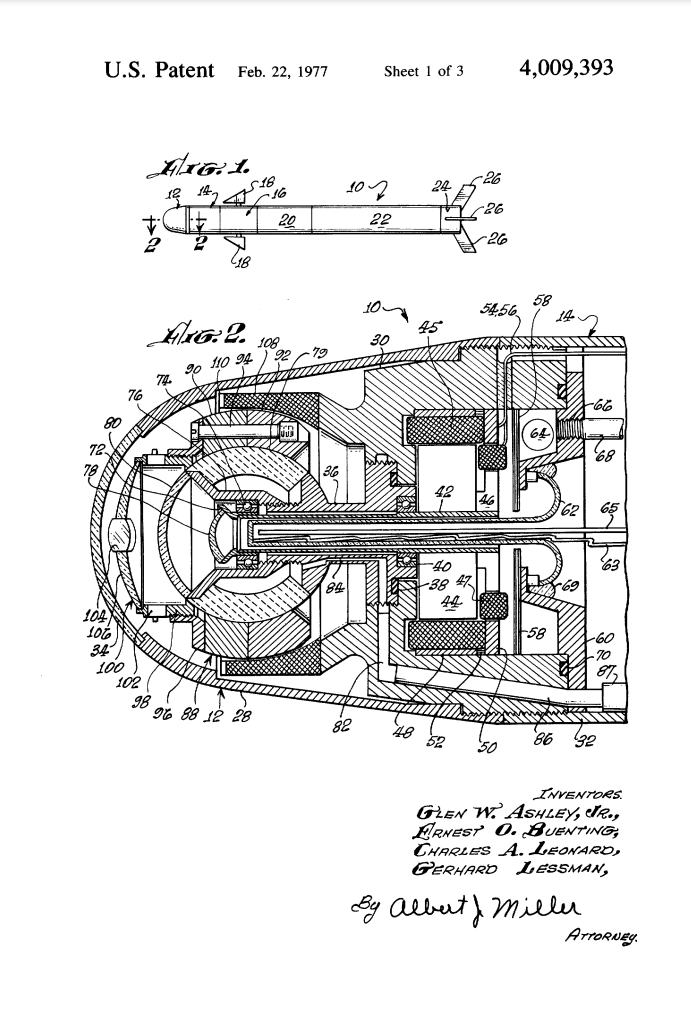
That is exactly the reason why the “visible UV contrast mode” described in US Patent 4 009 393 was not used in practice in the B or C variants of the FIM-92.
Unless, of course, you can provide any authoritative sources that can prove the opposite.
Sources on guidance principles in early MANPADS:
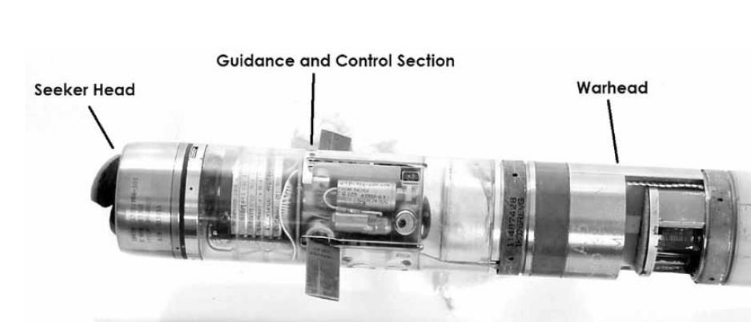
Jane’s Land Based Air Defence
Marine Corps Low Altitude Air Defence
Air Defence Artillery Reference Handbook
If you think HOJ is miraculous… you are not worth talking to in a scientific debate.
Smh
That is your assumption.
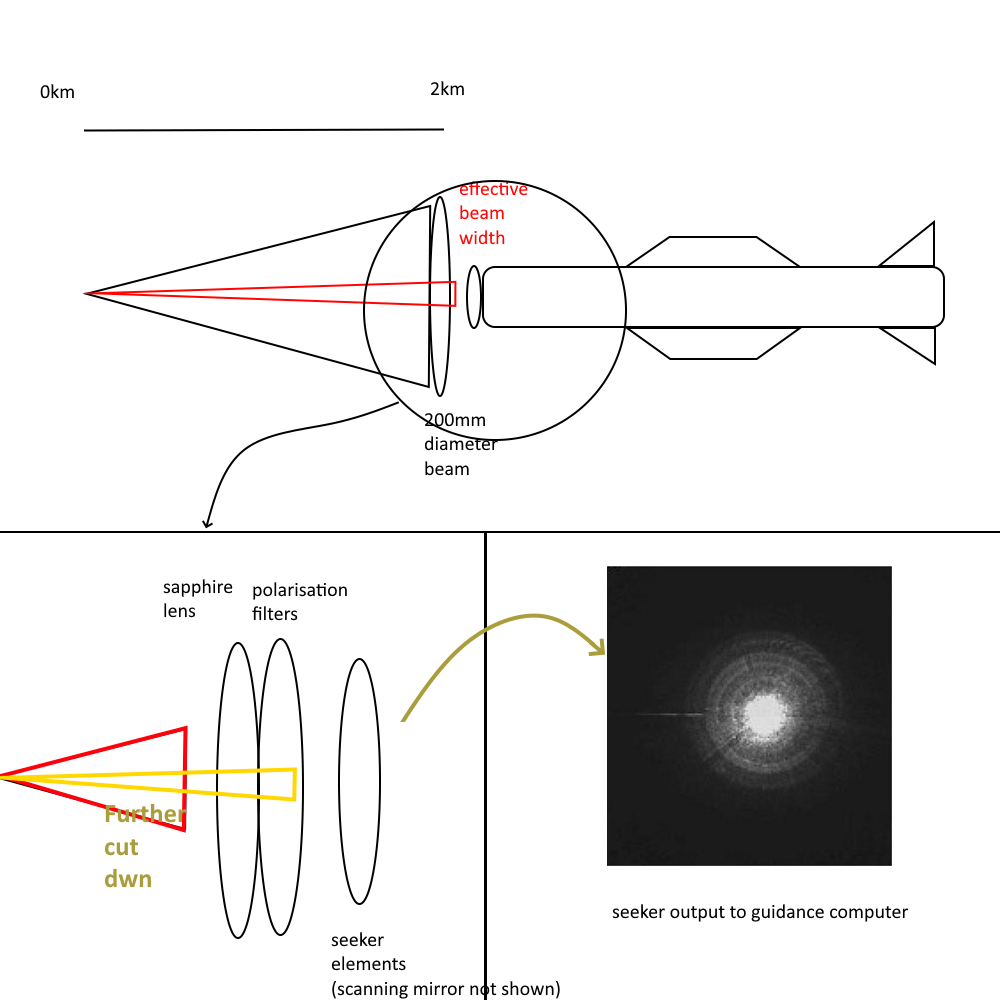
The spot only exists on the seeker surface. While even you must admit no Countermeasure system can accurately aim a precise laser into the small seeker of an incoming high speed (upto Mach 2) missile.
The laser reflector constantly attempts to aim the laser at the seeker of the incoming threat. Hence, the spot on the seeker is EXPECTED to be imprecise, inconsistent and pulsing.
OH I DON’T KNOW MAYBE…
Let me explain a VERY simple analogy.
A laser beam diverges from its point of origin. Not a lot. But not negligible.
A seeker at 2km is keeping the beam centred in its FOV.
Now slowly and consistently move that seeker closer and closer to the laser’s point of origin.
Since, as above, divergence is proportional to distance, the divergence DECREASES as the seeker is brought closer.
The guidance error DECREASES with decrease in distance.
As does divergence.
Quite a disingenuous representation. I’m sure readers can agree.
The original image has a circle drawn around the spot as everyone can see. That circle is from the seeker algorithm. It doesn’t take much to calculate the radius and pinpoint the center.
The very same jitter that modern IIR missiles can overcome right?
The very same modulation that will provide IIR missiles pulse separated imagery?
Oh… did i mention (i know I’ve said this way too many times it’s kinda ew now) IRIST has a two colour seeker.
So if one band is completely overwhelmed (big IF, unlikely to begin with), it can just shift over to the other color.
And this doesn’t justify the fact that gaijin is dishonestly keeping EO seekers (non IR band) as victims to DIRLCM despite those seekers literally not being able to see IR.
While TV seekers are unaffected. Which is realistic but unfairly implemented.
The way it works is, quite simple, it is even explained in the patent.
It uses the “Negative signal” . Aircraft emission is indeed very low, basically 0, whatever is reflected from the aircraft body, and maybe some from the engine/afterburner. However, relying on the fact it is done during the day, the plane is a non emitting shape on a gaint source of UV, coming from the sun. That creates needed contrast.
Another way to look at it is similar to optional White Hot, or Black Hot modes for a Thermal or Electro-Optical seekers. It doesn’t actually change anything to do with the tracking algorithm, it just inverts the polarity of the display.
Also as a “GreyBody” emissions will still occur at night though very weak in the UV band so could still be used as a Countermeasure discriminant. As even at the low end of VMT flares 2000~3000 Kelvin ( 25 degrees C, is ~ 77 F, is ~300 K) Wien’s displacement, would very much give away which elements in a scene are much hotter than ambient since with a dual Band seeker Relative emissions in each band can approximate real temperature, thus as a useful discriminant as their ratios obey known physical laws.
@DevilO6@tripod2008
US Patent 4 009 393 was issued in 1977 and is a broad patent that specifies a general, dual spectrum IR + IR seeker concept.
There is no information inside the patent to support a claim that this specific seeker operation principle is the one used in the Stinger missiles.
I am still waiting for you to provide an authoritative source to support your claim.
The laser reflector constantly attempts to aim the laser at the seeker of the incoming threat. Hence, the spot on the seeker is EXPECTED to be imprecise , inconsistent and pulsing .
And that is your assumption.
We don’t know that. We dont even know how big the spot is since there is no reliable sources that state the exact Divergence of modern LDIRCM systems.
We dont know how big the spot will actually be on any specific missile, is it going to cover whe whole seeker or not. Nobody releases such information.
A laser beam diverges from its point of origin. Not a lot. But not negligible.
A seeker at 2km is keeping the beam centred in its FOV.
‘Not a lot’ and ‘negligible’ are not exactly accurate terms are they? I made several example calculations of expected divergence by taking into acount physical limits based on wavelength and other aspects of laser optics.
I demonstrated you an actual video where you can see what happens when laser is pointed directly at camera and moved around. Did you watch the video?
Did you see how the bright spot moves around, changes shape, size and intensity and is not always centered around the emitter’s point of origin?
UV does not operate in the thermal band.
It’s on the other end of the spectrum.
The engine generates heat. Heat emits a thermal signature. That signature can cover multiple spectrums. Lets not nitpick on semantics.
or should I have said:
‘A jet engine produces hot exhaust gases and heated engine components; these emit thermal radiation primarily in the infrared spectrum, forming a detectable thermal signature that can span multiple wavelength bands, including IR.’
I maintain the following claim: The laser beam that comes out of the turret is not as concentrated as most people think, and does not rely on precise mechanical steering of the turret itself in order to produce a bright patch of specific size and shape upon the seeker. Instead, a wider beam is used, in order to make it possible to keep the missile illuminated at all times, and modulation of the beem itself is used in order to introduce error in the perceived target silhouette, thus constantly shifting the Centroid with such frequency, that introduces constant guidance algorithm adjustments that in turn are fed as steering commands, alltogether creating erronous feedback loop which makes target tracking more and more difficult as the missile nears the target. That is unless of course a full or large enough dazzle has be created in order to completely break the tracking.
Of course there is no way to know for absolute certain without delving into obviously either classified or at a minimum material that would be considered a Trade Secret.
But circumstantially;
Is the issuing date of the patent (1967), contemporary with the development of the FIM-92B which started in 1977. So it did, sort of. The POST seeker is partially an outgrowth of one of the Studies for the Redeye Block III(FIM-43C) to redress the Rear-aspect only seeker of prior Redeye variants.
and was put aside for refinement due to incumbent technical risk as it matures as a growth option for eventual reintegration, with later developments of the Redeye II (aka. Stinger) leveraged due to retaining the same diameter as the earlier Redeye.
Who owned the patent? It was issued To General Dynamics Corp. The same people involved in Redeye and Stinger development until the Production line and associated IP are bought by Hughes, during divestment and then subsumed by Raytheon.
I’d pose the question, why spend money on acquiring, and transferring the ownership of a Patent if it wasn’t at all relevant to any developments?
What other Dual band, let alone"A target tracking seeker for a rolling missile comprising" missiles (as the claim states) do they produce that it could apply to, only one other I’m aware of, the RIM-116. They really are not a common design at all.
And why do the figures align with that of the Stinger / Redeye?
@tripod_2008 I dont see your point. All sources I could find on the B and C variants say basically the same: the UV channel is used only for flare discrimination and cannot be used on its own for guidance.
It seemed to me tht earlier you tried to build a point where older dual channel variants of the Stinger would be somehow resistant to LDIRCM because “LDIRCM would suppress only the IR sensor and not the UV one”.
I believe companies like Leonardo, Northrop, Elbit and others would make sure that the systems they sell nowadays would be able to affect seeker designs from few decades ago.
Could you point me towards them? I’d be pretty hard to countermand something explicitly stated in a patent.
And of course sources would be fairly limited it’s discussing how it works internally, there is little reason to have the operator know if the missile is doing things automatically.
But you would agree on it’s face that An IR laser doesn’t operate in the UV band, yes?
Could future systems systems include a UV band laser, yes. It’d be much more expensive due to the higher shorter (much higher power draw for a given irradiance), and would need completely revised optical trains (since you either duplicate optical trains or work really hard on creating one that works in both frequencies).
And besides, going forward there is the NGSRI program with entrants like Quad-Star that are more able to deal with novel threats since it’s intended to be a Drop in replacement for the Stinger, like the Redeye was.
Also double the range puts engagement out to ~12km
Could you point me towards them? I’d be pretty hard to countermand something explicitly stated in a patent.
When you prove using an authoritative source that the guidance principle presented in US patent 4009393A is the one actually used in the Stinger B and C variants, I will start digging through publicly available sources.
Besides, I already gave you 3 sources above, you can try looking there first.
Once again, that patent seems to describe a true dual-mode seeker with selectable independent guidance mid flight. This was not used in production Stinger missiles for obvious reason (that I already mentioned):
UV contrast silhouette is much weaker than IR plume one and UV is less useful as a primary guidance source against most targets, due to the low sensor sensitivity and low radiance of the target in the UV spectrum.
So you need to provide documentation that in the Stinger B and C variants the UV channel on its own can provide steering centroid, which contradicts all publicly available sources.
And besides, going forward there is the NGSRI program with entrants like Quad-Star that are more able to deal with novel threats since it’s intended to be a Drop in replacement for the Stinger, like the Redeye was.
What does that have to do with Stinger B and C variants?
If you haven’t started looking, your prior claims are Apropos of Nothing? While I on the other hand can point to the patent, and assorted brochures as the basis for my argument.
Can you at least link them in the reply, as its a fairly lengthy discussion, with many sources raised as is, it can difficult to locate which specific ones you may be referencing for any particular claim.
Which are? The patent clearly declares that it is possible, if not warranted in some situations. And what other IR/UV seeker could possibly be used?
Obviously not otherwise you wouldn’t need to disregard the plain wording of the patent’s claims out of hand, by attacking its provenance.
Was this not you?
The same thing that these yet to be implemented systems have to do with the systems implemented in game. By the time a vehicle carrying one is, the candidates for NGSRI may well be, as well(e.g. Sgt. Stout, aka. M-SHORAD Increment I), considering they are backwards compatible with SVUL form factor it’s a drop in replacement, so in a sense provide access to a contemporary system to account for said advances to lessen the burden on balance.
And besides with reprogrammable AUR’s, Threat indexes and responses to jamming, and Rosette patterns can be updated as needed. And it’s not like the FIM-92B or -92C are in inventory anymore since their production for all clients has been ceased for decades and high performance motors don’t have that long a service life;
-92B production cut into exist A model lines and ran between 1983 though 1987 producing 16,000 AURs (ratio of launcher & supporting equipment is 1 for every 4 missiles & 6 Argon bottles + spares) between them.
The “C” then cut in, after that hardware changes with the “-E & -F” created a production line that ran alongside the -92C.
Also it’s fairly safe to assume that OEM revised CCM programs is what is responsible for the out of sequence -“D” &“G” designations, similar to why the the AIM-120A has 12 alpha codes, to keep pace updates rolled out to the -120B by re-flashing their EEPROM’s)
Also the FIM-92J &-92K SLEP programs began in 2014,so it’s safe to say that the missiles in the baseline POST and RMP configuration, missiles are no longer a consideration.
It’s not like Hardware in the Loop facilities don’t exist for the Stinger, so many novel threats and their impacts can be characterized and Counter-Countermeasures developed and disseminated, It’s not like DIRCM was a foreign concept. After all what exactly is a collimated source of light anyway? It’s certainly not an arc lamp.
have you seen modern target tracking technology?
do not extend your ignorance onto others.
Spoiler
This is the level of accuracy and stabilisation when TGPs track STATIC targets.
just multiply the stability inaccuracies to a smaller servo and a mach 2 target. https://youtu.be/Yi9d8bstWsE
any form of servo or rotational system has accuracy limits and, irl, has miniscule vibrations in between every turn of the gears
a spot larger than the diameter of the original reflector plate is proof of divergence, BUT, also of blooming. this means that the majority of energy WILL be directly in the center of the beam with reducing levels the further out you go in the radius of the beam propoertional to distance from original reflector plate.
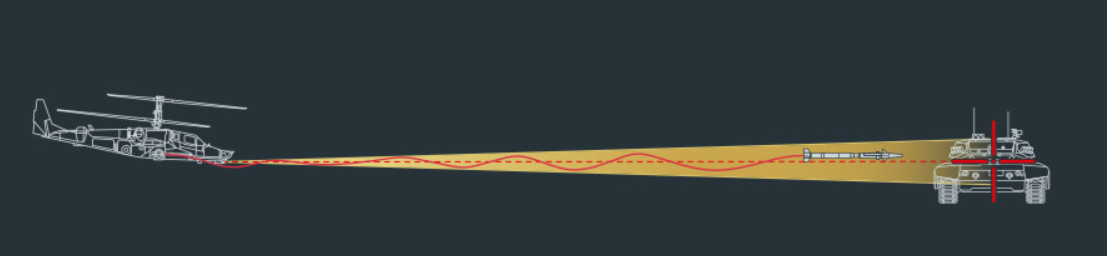
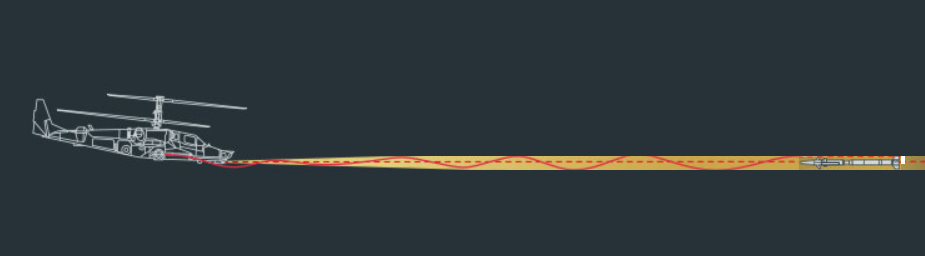
this is a section of a demonstration about how beam riding missiles function. if you inverse the direction of the misile and give it an IIR seeker, its a pretty realistic and accurate example.
so, in this scenario, the laser beam is being shined directly into the seeker. but, as you can see, it diverges from the original point of origin (irl point of original reflection). this means that the dotted line you see in the center is the point of maximum energy. while the energy density falls off with deviation from that line.
as explained in the laws of physics, no object may change direction of motion unless a force acts upon it. since there is no force acting upon the laser beam, every photon diverging from the center of the beam remains diverging in a straight line.
What does this mean?
those photons that are not on a path of intersecting with the seeker OBVIOUSLY do not cross into the seeker. hence we can confidently ignore them. only those photons with about 1 degree of divergence or less will enter the seeker.
the photons entering the seeker themselves are not all parrallel. meaning the centeral beam is shining directly into the seeker while every other photon is entering at an angle.
this causes blooming. what that means is that regardless of the actual size of the beam at that instant in time and distance from origin, it will APPEAR to the seeker at roughly the same size assuming a constant size of the original reflector plate.
keeping in mind realistic limitations of laser beam width and peak power generation capability on “small” mobile platforms, we see that we cannot realistically expect the beam width at origin to be too large yet still remain powerful enough through reflective transfer, atmospheric dampening and glass pass through and still blind an IR or IIR seeker.
this further gives weight to a practical maximum spot size that can be present on a seeker detector surface
oh sure, get stuck on the one part that didnt need explanation AND by the way you agree with.
ive scanned the whole thread… youve made a grand total of zero mathematical calculations and 1 reference to beam divergence in your opening post.
they are exactly a few milimeters wide at point of origin in the scenarios being discussed.
please dont bring your pseudo science here.
even in your intro post you tried to misconstrue YOUR OWN ARGUMENT by arguing that the very thing you labelled
in the post title can somehow
when in reality, the case of a single reflector/emitter affecting multiple missiles would be the rarity.
you have not attached or linked any video in this thread. it seems you are confusing even yourself. you linked a video of a TV REMOTE shining its IR LED into a standard CAMERA lens AT POINT BLANK RANGE.
You are attempting to argue that the circumstances of this demonstration are the same as for an infrared LASER beam attacking a dedicated IMAGING INFRARED SEEKER with polarisation filters and as tripod mentioned, sun shade films and in case of IRIS-T, scanning mirrors and staggered photodetector arrays.
so its okay or you to do it but not for others. perfect double standards
i dont think you understand that your initial assumption of “most peoples understanding” was probably whats wrong as well about your entire charade of ill-sourced arguments.
why are you assuming that eh?
what else do you think happens? it IS precise (to an extent) mechanical steering in tandem with beam width that is INTENDED to counter IR guided missiles by dazzling their seekers.
so you maintain a false claim despite being proven that your arguments are weak if not totally bogus?
thats it man. bro you come in here spewing lies and despite me and devil06 and tripod nuking each one of them you keep on this farce. its over man
@tripod2008 How many times do I have to repeat myself? Just because something is described in a patent does not meat it is actually used in a specific production revision of a product. If I show you a patent of a nuclear warhead, does it prove that such warhead is in fact used in specific ordnance?
Also once you modify the Stinger (for example variant B) it is no longer Stinger B, is it? It is a modified, aka upgraded version of said weapon, with its own nomenclature.
If you think specific weapon is modelled wrong in game you have to compile a bug report and provide specific sources (ask Gaijin what sources are accepted).
why are you assuming that eh?
what else do you think happens? it IS precise
It is, but how realistic is it that it can keep constant track on an incomming missile so that a tiny beam spot (as you claim it is) can be precisely pointed while the missile begins oscillating due to induced errors in the guidance command loop?
There is no reliable public information on either LDIRCM or your precious IRIS-T. Only advertisement brochures. There is no reliable source or specific case study that shows actual results of specific LDIRCM dazzling, fully blinding or even damaging actual missile’s seeker.
All we can use at this point is Beam propagation physics to try to determine approximate beam width at specific distance.
so you maintain a false claim
Lets see, for a spot with diameter of 5mm, if you want to precisely keep it on missile seeker with diameter of 100 mm, at distance of 2km:
The required Angular size would be Target Size / Range
meaning
0.1/2000 = 0.00005 radians
if we convert that to degrees, that is ~0.003 degrees, which is extremely tight considering the missile is moving, and will begin oscillating along its trajectory once successfull guidance disruption is achieved.
it IS precise (to an extent) mechanical steering
Precise to ‘an extent’ is not gonna cut it. Because if the missile briefly veers off where you are shining that (presumably) tiny laser spot, it will reacquire the target and correct itself back on course. The missile needs to be constantly illuminated, in order to prevent revealing target extremities, or target silhouette as a whole, like you said yourself earlier.
So yes, I do maintain the claim that the laser spot it as least 100 or even 200 mm wide in diameter at 2km distance, just to ensure the missile can be reliably illuminated at all times.
i have also explained how that video is not applicable.
re read my post if you are still trying to justify your stance with that “evidence”
im not the one whos trying to claim a disingenuous statement. the burden of proof is on you. i have done my research. its time you do yours
question is are you? iirc it wasnt me who said this:
i linked a video of a TGP tracking a ground target. if you want i can even give you a TGP tracking a fast moving jet in reheat. Precision does not mean perfection. understand the difference.
a machine can be precise yet still have small scale errors. how else do you think the DIRLCM system even tracks the incoming missile?
you think its a big ahh 5m wide laser beam aimed in the general direction of the threat?
please ask yourself that man…
this part is assumption so keep the results out of the equation until you can prove the effect dude.
so now you will disregard all those studies i have linked in the other thread just because they dont suit your agenda.
very shallow man… very shallow
“i cant prove my stance with peer reviewed articles so ill resort to my own (unproven) theories and mis-judgements”.
so youd rather choose to beleive in some magical rotational technique that allows for such precision rather than science and mechanics? if i could face palm for you i would.
do you know this lil thing called… gear ratios?
i thin kitll help answer your burning question.
IF*
well too bad because technology is good but not that good yet. face it, tracking errors, especially in such high stakes, high speed and high delta scenarios are to be expected. thats why DIRLCM systems CLAIM to OFFER protection. not GUARANTEE it.
the laser beam being 100-200mm wide at 2km =/= spot diameter being 100-200mm wide
You are free to make claims about whatever you wish, but if you can’t actually substantiate it with even circumstantial proof, why should I believe you. Just because you repeat yourself?
So why trust brochures or manuals? By that standard then they could just as easily get their numbers wrong or imply that things function in a specific way when they don’t, or omit things for a multitude of reasons, least of all being confidentiality.
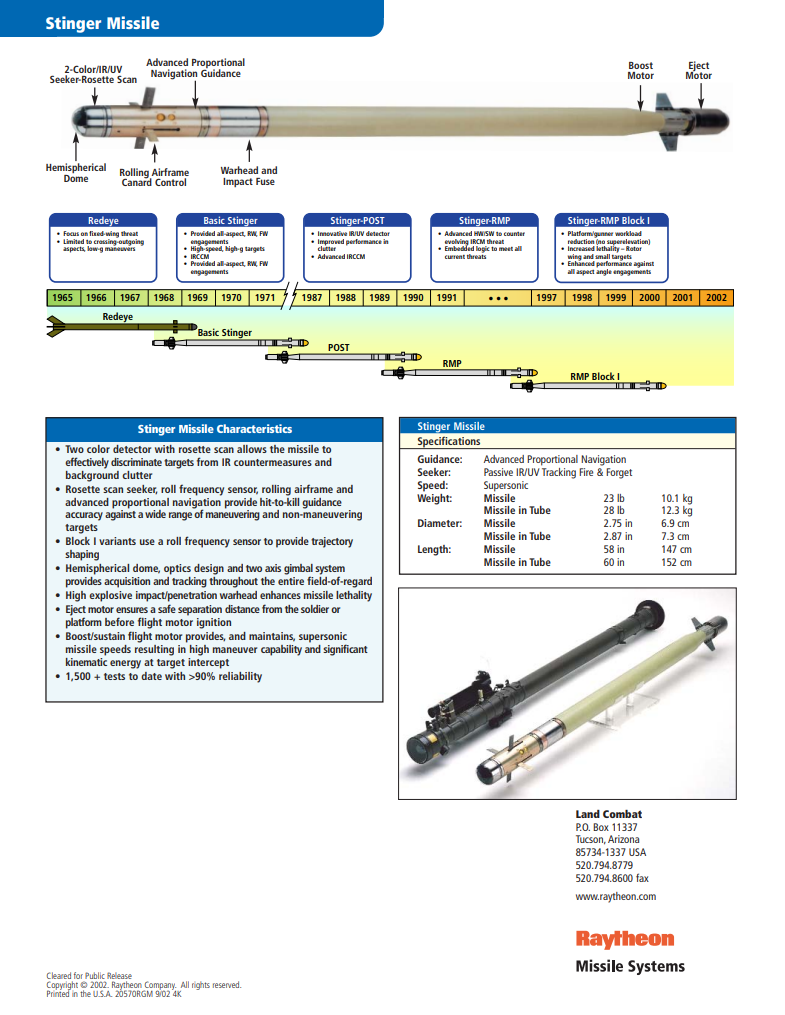
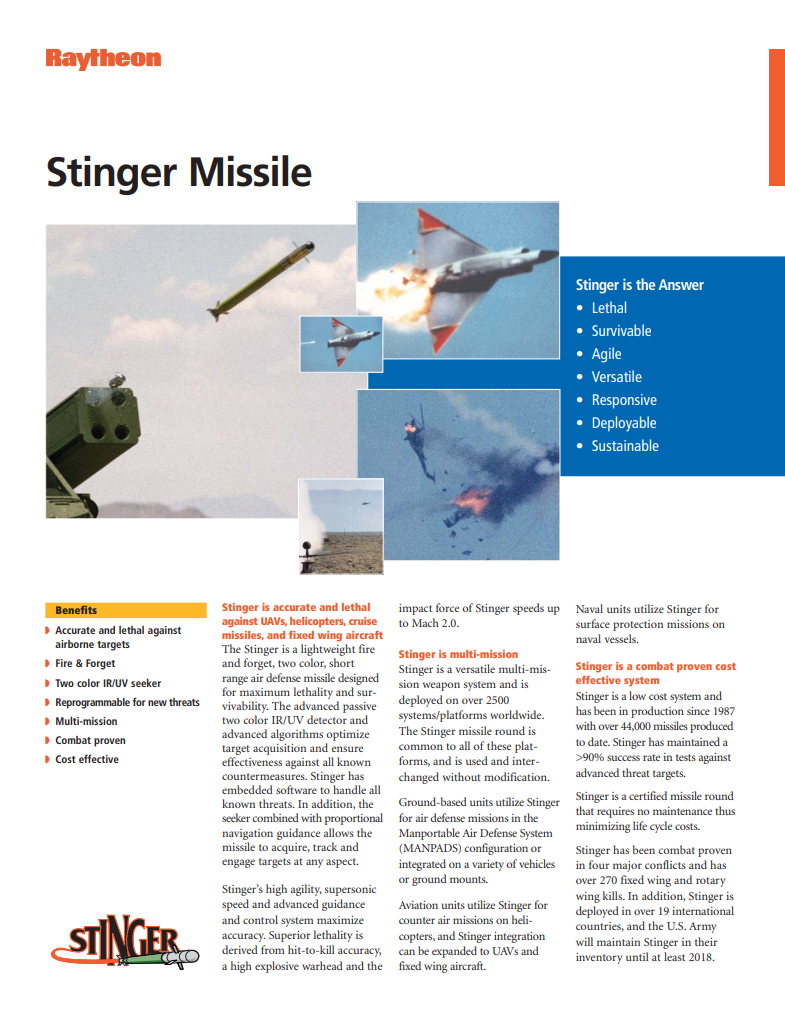
“The advanced passive two color IR/UV detector and advanced algorithms optimize target acquisitionandEnsure effectiveness against all known countermeasures, Stinger has embedded software to handle all known threats”
is in the brochure seems pretty iron clad, and align with claims made in the patent doesn’t it, lets flip to page two to see which variants have this “Advanced passive two color IR/UV detector”
Oh wait it’s the Stinger POST (FIM-92B), that’s weird. It’s almost like I’m not solely relying on the Patent to support said claims, just that the patent details them best.
I’ll get right on that Oh wait, It was Accepted A year and a half ago and I’ve already linked in in this thread.
I’d need that baseline report implemented before I can go further about reports for DIRCM proofing (and assorted smaller changes) the later Stingers, don’t forget the variants that are implemented in game are the FIM-92A / ATAS, -92C, -92E & -92K. The -92B is only the earliest that uses the POST seeker.
And do you know how changes, that do not impact the ordnance technician / pilot are notified? With subvariants. Just because the Designation is the same between two missiles doesn’t mean that they will perform identically, it never has.
Is an;
AIM-7E-2,
AIM-9M-5
AGM-45A-3
AIM-120A-12
going to to perform differently to an;
AIM-7E-4
AIM-9M-8
AGM-45A-10 or AGM-45B-10
AIM-120A-6
This isn’t only constrained to Missiles and rockets either;
Was the F-86D still a Saber?
The F-102B not and F-102?
F9F-3 similar to the F9F-9?
F-84F not similar to the F-84G
*F-35B the same aircraft as the F-35C?
There are many reasons to do either, and it mostly has to do with how the funding was acquired.
@tripod_2008 Lets make a new topic about your stingers because this topic became a mess.
Also in your bug report the sources you provided are not visible. You can post those sources in the new topic you create, yes?
You can send me a PM with the link to the new topic. Also if you need some specific book I will try to find them for you, PM me the name of the book and author.
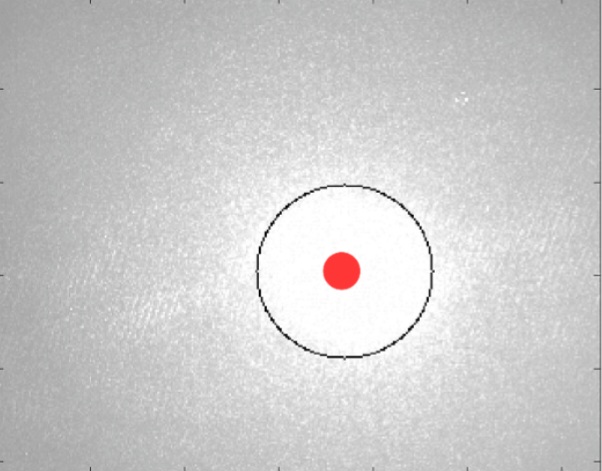
@Armen_Lozone You post the same picture with the partial dazzle. I want to know: From what seeker output is this image taken and what LDIRCM was used to illuminate it?
When I asked for a case study I mean this. (when a specific piece of equipment hjas been tested).
The example video was just to show that it is possible to achieve very large dazzle, which prevents you from seeing where the beam originates from.
this part is assumption so keep the results out of the equation until you can prove the effect dude.
It is how the system has to be designed to work from the beginning. What is the purpose of having if it cannot reliably illuminate the incoming missile throughout the whole trajectory?
The missile has to remain illuminated even after initial disruption of guidance is achieved. According to public information available, the system actively tracks the trajectory even after counter measures have been applied, in order to determine if the supression of guidance is successful or no. (it says so in the brochure for the President-S you provided.)
So the question (you make me repeat myself again but what can I do) is not about tracking the missile while it approaches (the trajectory will be quite stable), but tracking it once it begins oscillating.
Lost a nerve there? Not amusing to call someone who will soon be in his 40s this.
I checked the link. I saw advertisement brochures and links to manufacturer’s website claiming “state of the art this, state of the art that”.
If you go to any manufacturer’s website you will see similar claims.
From both brochures (CIRCM and President-S), the only usefull information we can use is the approximate output power.
Also I just noticed the President-S brochure says that the system is effective against multiple threats (6th line from the bottom).
If there is only a single turret, how can that be achieved with a narrow beam?
Again, a rhetorical question.
And last but not least, the President-S brochure says that the system is effective against 3rd generation missiles. IIR missiles are 3rd generation missiles, aren’t they? (8th line, when you count from the bottom).
If we gonna use brochures, lets use them for all systems in question, shall we?
The injected waveform induces optical break lock once this occurs the missile can then be disregarded (a basic angular rate test can be perform due to the use of Proportional Navigation any missile with a non zero angular rate is not a threat since it is no longer on a trajectory that will result in an intercept.), also it says nothing about simultaneous jamming of threats, only that multiple threats can be handled.
ah boy here we go again, throwing shade at sources while providing none of your own meanwhile being proven wrong and not knowing it.
because its the exact same phenomena. all IIR missiles will see a similar image simply because of physics (as long as they have at least 1 polarisation filter) and the original beam width is not 50mm wide or something (absurdly high power requirement).
already explained how its a faulty showcasing of the phenomena. i can see you are scrambling to hold onto your one example. but its not applicable here brother.
designed and expected. not guaranteed.
to try and protect from incoming threats of the IR guided type (by the way the vibetsk-s/president brochure only states IR not IIR). in the case of technology, reliability is a score. NOT a 100% guarantee.
the system tracks the incoming threat yeah. thats all it says. doesnt provide the beam width or anything. and yet again it was ME who provided the source.
IF the missile oscillates, the SAME method used to track the missile when it is in stable trajectory will be used to track it if and when it is oscillating. you really dont have faith in tech OR just dont know how it works… proably both.
either you are lacking mental maturity or you are losing it with age because this concept (my argument) SHOULD not be that hard or you to understand my guy.
so… did you check the brochure? for CIRCM???
it was in the link by the way.
regardless, what a shrewed way to approach a source. youre instantly doubting capabilities without scientific backing… shake my head indeed.
yeah… it can have multiple emitter reflector pairs on a single aircraft.
i bet you ALSO dont know that the peak and nominal power draw listed on the president-S brochure is not for the emitter reflector pair but rather the ENTIRE vibetsk-5 sytem which comprises of the RWR, MAWS, LWS and a bunch of other computers and sensors.
if you read my comment above:
the meaning of which is, that while your BASIC argument is CORRECT, it is an anomalous case. only if the incoming missiles are within a few degrees of seperation from each other WITHIN the DIRLCM beams FOV then it can happen to affect both. thats why it says that it can affect 2.
you tried to argue that overwhelming it would be a rare case but its the opposite. DIRLCM being able to affect more than 1 missile is the rare case. even you wouldnt try to argue that a beam will point in two directions at once.
definitely your least strong argument.
it says its effective against 3rd gen missiles, while most of the modern world considers IIR missiles to be 5th generation missiles. look it up.
however this convention is not standard between east and west.
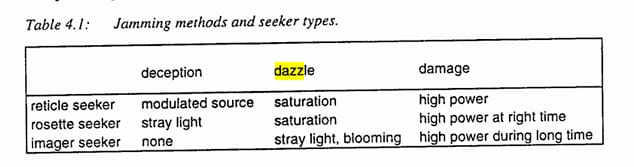
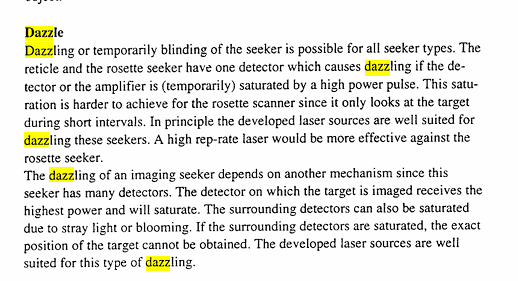
oh by the way, this is an excerpt from a document i do not have the full of, currently looking for it but it is trustworthy.
notice how it does NOT mention saturation for imager seekers specifically?
a big IF mentioned lol
oh and a little brain opener for ya, if and IRIS-T is launched from an aircraft, it can track AND HIT incoming missiles. source. i say this because you seem to find it hard to beleive technology can do that.
you still have not countered (or frankly even begun to try) any of my arguments.
aside from the DIRLCM on the Z-10ME which is classified for now, i can provide all brochures.
i have already provided the one for President-S (Mi-28NM), for CIRCM (AH-64E)
by the way for president-S: 4th point under key benefits
meaning there is also possibility of failure. we have seen videos from the ukraine war, Mi-28NMs have still been shot down from IR guided missiles. (i cannot attach such videos without getting banned, please search online yourself)
here they are for IRIS-T:
IRIST: all are links to various official brochures