Is it working?
Actually looks to be.
Yes, all laser bombs are working as they should now. Gszabi’s datamine also confirms this.
Oh my goodness, I was waiting for your report to see if they finally got fixed!
They seem to be terrible with actually updating reports these days. Though another, slightly older russian report did get updated
Some new bug reports, not sure if these are detailing new issues, but going to post a quote from @sυρεrβυsτεr . Also, sυρεrβυsτεr I would recommend posting any updates or further info you get here so that more of the people tracking and reporting this issue see your info as well 👍
@Morvran pinging you to double make sure you see this post 👇
Going to ping everyone from the other thread about Laser Bomb issues, as this thread is the more active one now @ww2planes @XItsBalanceX-live @J-16D_PLA @onefineman @Elijah1573 @Flogger_cbs @Kdesmo
Ive not done extensive testing, but was working a week or so ago. I’ll keep an eye out
Since they released the patch its been working correctly here
I don’t use laser GBUs much, so I’m not sure, but it still hasn’t been fixed?
Maybe it’s broken again, who knows?
Schrödinger’s GBU…
Another report about the Skippers:
A-6E TRAN has what should be some good missiles . AGM123 skipper I grt my plane up to 4 or 5 kl Then drop a missile about 7 kl out from target Then I pull off a little ,change direction keeping my scope on the target and laser indicator is viable on the target .but waiting for the bomb to hit ,well it never happens .some times short some times long and no obvious reason Missiles have 20 kl locking range and 70 sec guidance time it should work .If you can tell what I’m doing wrong would be a big help
@sυρεrβυsτεr thanks for pointing them this way 👍
@CalvinAz quoting it here for you friend 👍 (Send me a DM again if anything needs to be edited or updated.)
@sυρεrβυsτεr @zapchenk7 check out this info from @CalvinAz 👇
Message I wanted to send:
Is this just about laser guided weapons not tracking when designating from long ranges? Because afaik that’s not a bug, and this has been the case for at least years now. I found out, with in-game testing, laser acquisition ranges of LGWs drop with longer Laser Target Designator to Target (LTD-TGT) ranges. This is to simulate Laser energy dropping off over distance.
This I made using in-game tests like 1-2 years ago now?
This means for instance that roughly speaking, if your weapon has a 4.5km seeker range in the weapon file (I call it the nominal acquisition range), it means that it can only pick up a laser spot from up to 4.5km if and only if you are designating from 4.5km as well, but if you’re say 9km away, the laser seeker range drops to ~2.25km. Seeker range bottoms out at roughly ~700m or so, it never goes lower than that, but unless you’re pinpoint accurate with your drop, you usually need like 2-3km of laser tracking range for a hit, on the higher end if the target is also moving.
I’ve tested a bit again and behavior of this is still the same:
Spoiler
GB1000 has 6km seeker range:
Test 1: Seeker goes to TRK at ~8.3km with a designation distance of ~4.3km
According to expected 1/x graph: 1/(4.3km/6km) * 6km = 8.3km
for some reason I am not getting distance to my own aircraft in sensor view.
Also I noticed that the missile spreadsheet mentions a hard limit on seeker range too, that’s not correct afaik, because as you can see here, it can be exceeded (wildly impractical however).Test 2: Seeker goes to TRK at ~3km (I mistimed the pause, but it was at ~3km first) with designation distance of ~11.8km
According to data: 1/(11.81km/6) * 6 = 3.05km
So everything still seems to work properly. I’ve looked at the footage, and it’s clearly user error:
CCIP already tells you the missile will be falling way too short, the missile in this case isn’t able to track right off the launch, which was done at like 8km. In the video the A-6E didn’t even get within 4.8km to the target (before the restart), so in all cases LTD-TGT was > 1, hence LGW-TGT was < 1, or less than 4.8km, which the Skipper never reached either. This allowed the Skipper to stay unguided for long enough to essentially be just an unguided bomb. Even if allowed to continue further, and the A-6E to get within LTD-TGT < 1 range, the Skipper was already nosediving, so very unlikely that the laser spot was still within FOV.
Whereas in the second try, he is diving on the target at close range (about 5km) compared to the seeker nominal acquisition range (4.8km), so of course it tracks, it essentially has no time to pull off the target whilst still in SRC mode.
It seems to me that, in that case, the in-game data about the range of this type of ammunition is heavily exaggerated, if we assume that this is only Gaijin’s projectile flight simulation.
- The game displays kinematic range, not tactical engagement range
In War Thunder, the displayed “range” value represents how far the weapon can theoretically fly under ideal ballistic and aerodynamic conditions. It does not represent the real effective guidance or employment range of the weapon.
In reality, for systems like Paveway II and AGM-123, effective engagement range was primarily limited by laser geometry, seeker field of view, and designator performance — not just by flight kinematics.
- Gaijin separates flight physics from seeker logic
WT simulates missile/bomb flight and laser seeker behavior as two separate systems:
one models boost/glide and aerodynamics,
the other applies an artificial laser acquisition scaling model.
As a result, a weapon may be able to physically reach long distances, while being unable to acquire or maintain laser tracking — even though the stat card still shows a large “range” value.
This creates a mismatch between hangar statistics and actual in-game combat performance.
- Real military documentation does not define a single fixed “range number”
For Paveway II-class weapons, there is no single official “seeker lock range” value. Instead, real documentation describes employment envelopes that depend on:
release altitude, attack geometry, designator type and power, atmospheric conditions.
WT reduces all of this into a single static number, which is inherently an oversimplification.
If we accept the current WT model as a simplified simulation, then the “range” values shown for laser-guided weapons are primarily kinematic marketing numbers, not realistic combat-effective engagement ranges.
This is not necessarily a bug, but it is a UI/stat presentation problem, because it implies a level of real-world accuracy that the underlying guidance model does not actually support.
Reply from @CalvinAz :
I do want to say that while statcards are often quite misleading, and that’s nothing new really, the ranges presented in the example video of the bug report don’t exactly show a fair representation of the range either. IRL too, LGWs like the Paveway II or Skipper (essentially the same) are not guided throughout their entire flight, and so most of their (max) range does come from their ballistic trajectory. So you have to account for the time/range it is unguided by tossing the weapon to ensure it lands roughly (without guidance) at the desired target area. The laser seeker part is only there to make corrections in the terminal phase, like other LOAL weapons. At short ranges, it’s (almost) essentially LOBL, so you don’t have to worry about all that.
Paveway IIs and Skipper, when used properly, can have considerably extended effective ranges of up to about 10km give or take (personally speaking). Further at 15km is quite hard, and 20km is almost impossible, though that is only when you assume you maintain that same distance as designation range (but I guess that’s the only real reason why you would launch from that far anyway).
10-11km designation range example:
Spoiler
This is more or less the intended way to achieve extended ranges, and hopefully sketches why that launch range on the statcard has some merit, although still a bit too generous in this case. But it would be nice to have the seeker range included as well, to give some measure of how much you need to take launch parameters into consideration.
But in the end, while the statcard may show quite an exaggerated figure, it’s not as bad as the initial report shows at ~6km vs ~20km, you can more or less get ~10km vs ~20km, with more accurate drops able to achieve 15km probably (though less and less practical the closer to 20km designation range).
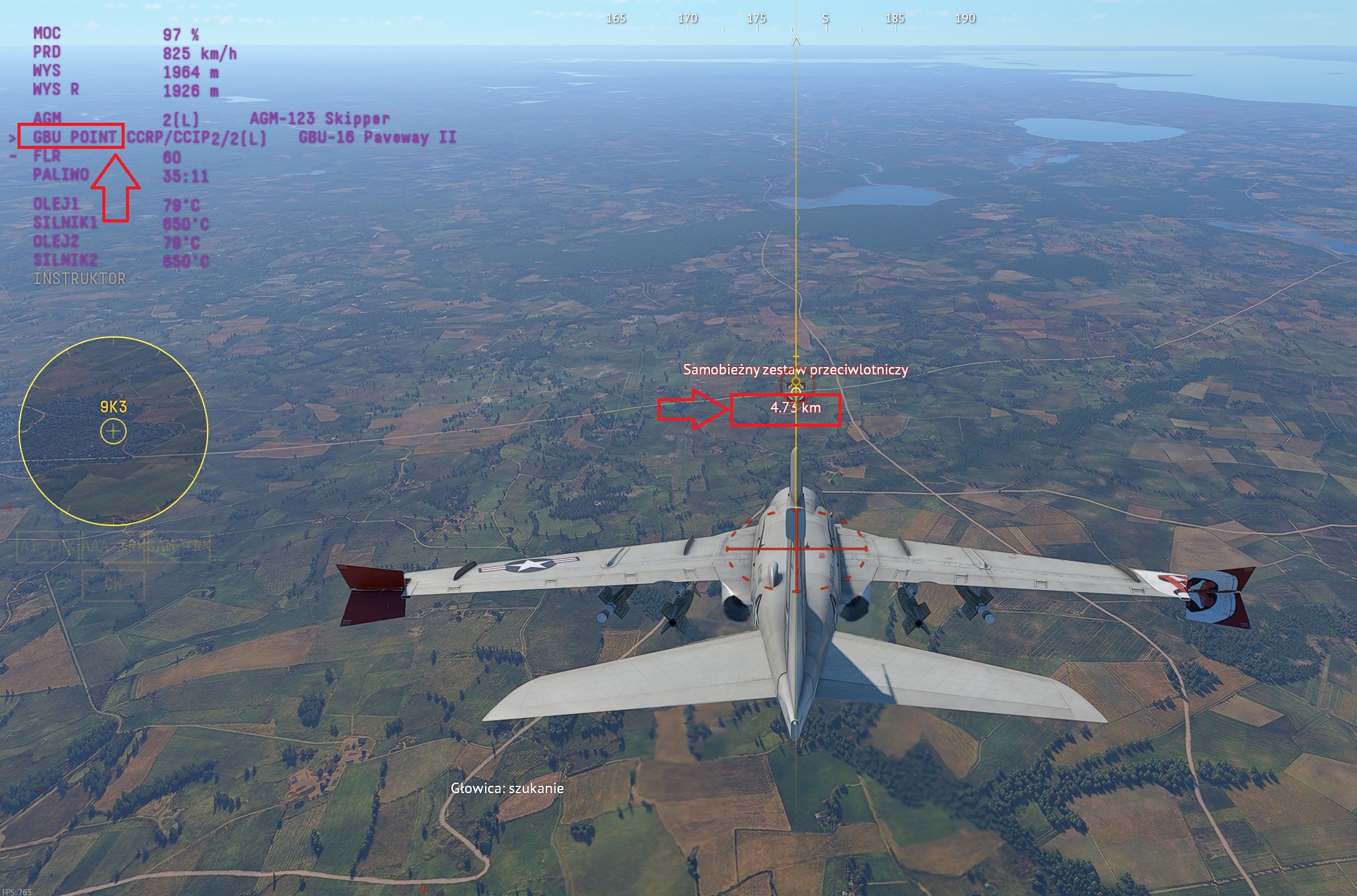
The point is that the POINT cue does not appear for the selected missile or bomb at distances greater than 5 km from the target. As a result, the dropped bomb or Skipper does not even start guiding toward the target.
That’s why I tried doing it in a dive. But I also wasn’t sure whether the Skipper should also be able to “acquire” the “POINT” cue.
The same happens with the Skipper.
Reply from @CalvinAz again:
I see, this is intended and realistic, and also not new behavior. It switches to POINT when the seeker can acquire the laser spot, and thus track the laser spot. It’s about ~4.8km for Paveway II and Skipper where the LTD-TGT and LGW-TGT range coincide. That’s just how it is, LGWs usually have seeker ranges much lower than their kinematic range (or rather, laser designation power is limited, as it scales with the inverse square law), so the use of LOAL for terminal guidance only is expected if you want to use them beyond their “POINT range”.
Idk if this part is necessary:
Spoiler
They can still switch to tracking mode in-flight when used without POINT lock on launch (so, LOAL). You can imagine a sphere is created wherein a POINT lock can be achieved by the LGW, with the center being the the designated point. The further you designate from this point, the smaller this sphere. At ~4.8km (for PW2 and Skipper) the sphere radius is the same as the designation range, so that’s why you can see POINT. Anyways, in all cases, if the LGW enters this sphere, it is eligible to track the laser spot. So the trick is, at longer ranges, is to make your LGW enter this sphere at a good orientation (laser spot within seeker FOV) in order to still get terminal guidance.
But the opposite is also true. This sphere’s radius grows over this baseline ~4.8km value if you designate from closer than 4.8km yourself. It’s pretty irrelevant now, but maybe in the future with buddy lasing, it may be. So technically, say, the Skipper can track from much longer ranges if you outrun your own bomb (that’s how I got those datapoints in my graph anyway), but that’s highly impractical as you can imagine.
In the first launch in the video, the one from 8km or so, the Skipper dropped like a brick, I guess due to very low launch speed, so it fell outside this sphere (which at any point of time in that video was <4.8km radius in size). So it never could get to switch to tracking mode, maybe even if it did enter, it was pointing downwards so likely not within seeker FOV either.
So in any case, when used without POINT lock during time of launch, it doesn’t mean the weapon can not work at all anymore, you just have to use them differently.
Ok, I think I got it. At least in air RB. I switched to air SB some time ago.