I don’t use laser GBUs much, so I’m not sure, but it still hasn’t been fixed?
Maybe it’s broken again, who knows?
Schrödinger’s GBU…
@CalvinAz quoting it here for you friend 👍 (Send me a DM again if anything needs to be edited or updated.)
@sυρεrβυsτεr @zapchenk7 check out this info from @CalvinAz 👇
It seems to me that, in that case, the in-game data about the range of this type of ammunition is heavily exaggerated, if we assume that this is only Gaijin’s projectile flight simulation.
- The game displays kinematic range, not tactical engagement range
In War Thunder, the displayed “range” value represents how far the weapon can theoretically fly under ideal ballistic and aerodynamic conditions. It does not represent the real effective guidance or employment range of the weapon.
In reality, for systems like Paveway II and AGM-123, effective engagement range was primarily limited by laser geometry, seeker field of view, and designator performance — not just by flight kinematics.
- Gaijin separates flight physics from seeker logic
WT simulates missile/bomb flight and laser seeker behavior as two separate systems:
one models boost/glide and aerodynamics,
the other applies an artificial laser acquisition scaling model.
As a result, a weapon may be able to physically reach long distances, while being unable to acquire or maintain laser tracking — even though the stat card still shows a large “range” value.
This creates a mismatch between hangar statistics and actual in-game combat performance.
- Real military documentation does not define a single fixed “range number”
For Paveway II-class weapons, there is no single official “seeker lock range” value. Instead, real documentation describes employment envelopes that depend on:
release altitude, attack geometry, designator type and power, atmospheric conditions.
WT reduces all of this into a single static number, which is inherently an oversimplification.
If we accept the current WT model as a simplified simulation, then the “range” values shown for laser-guided weapons are primarily kinematic marketing numbers, not realistic combat-effective engagement ranges.
This is not necessarily a bug, but it is a UI/stat presentation problem, because it implies a level of real-world accuracy that the underlying guidance model does not actually support.
The point is that the POINT cue does not appear for the selected missile or bomb at distances greater than 5 km from the target. As a result, the dropped bomb or Skipper does not even start guiding toward the target.
That’s why I tried doing it in a dive. But I also wasn’t sure whether the Skipper should also be able to “acquire” the “POINT” cue.

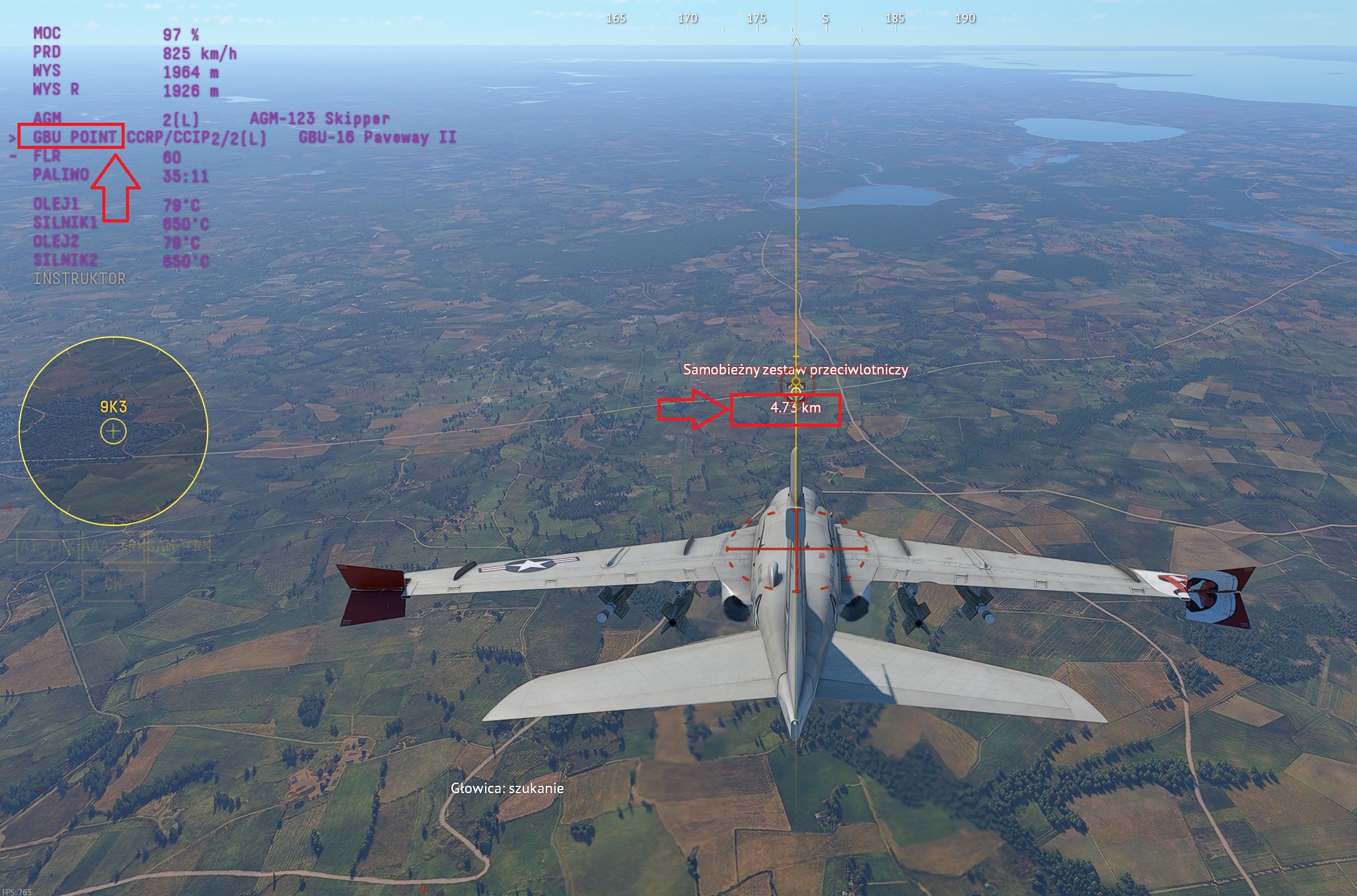
The same happens with the Skipper.
Ok, I think I got it. At least in air RB. I switched to air SB some time ago.
So, i found this on reddit, just the datamines:
https://www.reddit.com/r/Warthunder/comments/1gkzevn/240047_240051_part_2_20241105/?utm_source=chatgpt.com
- laser seeker:
- range: 4572 → 4876.8 m
- FoV: 20° → 32°
You can see all the laser seeker ranges in the guided weapon spreadsheet
But do note again that technically all those range values, vary with designation range and are also not actually capped at that value either.
EDIT: idk why, but when I follow this link up here, the spreadsheet has less tabs than the full document… not sure what’s going on okay fixed or something, the automatic embedding of the spreadsheet broke it or something
I found a document that could be a very interesting source of techniques and procedures used when employing laser-guided weapons.
Here, it’s interesting:
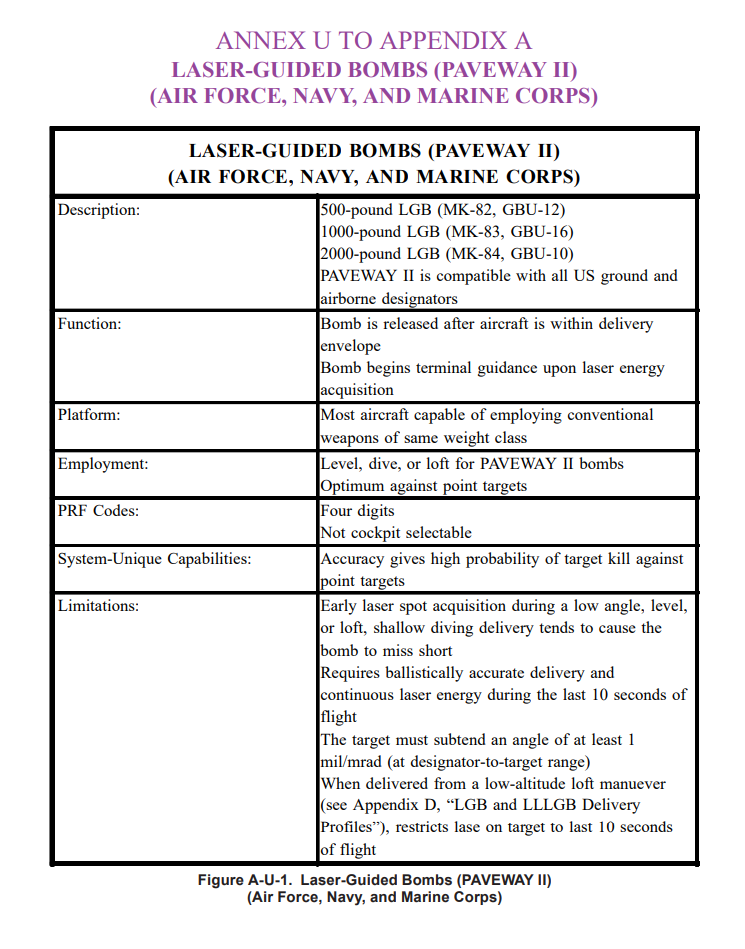
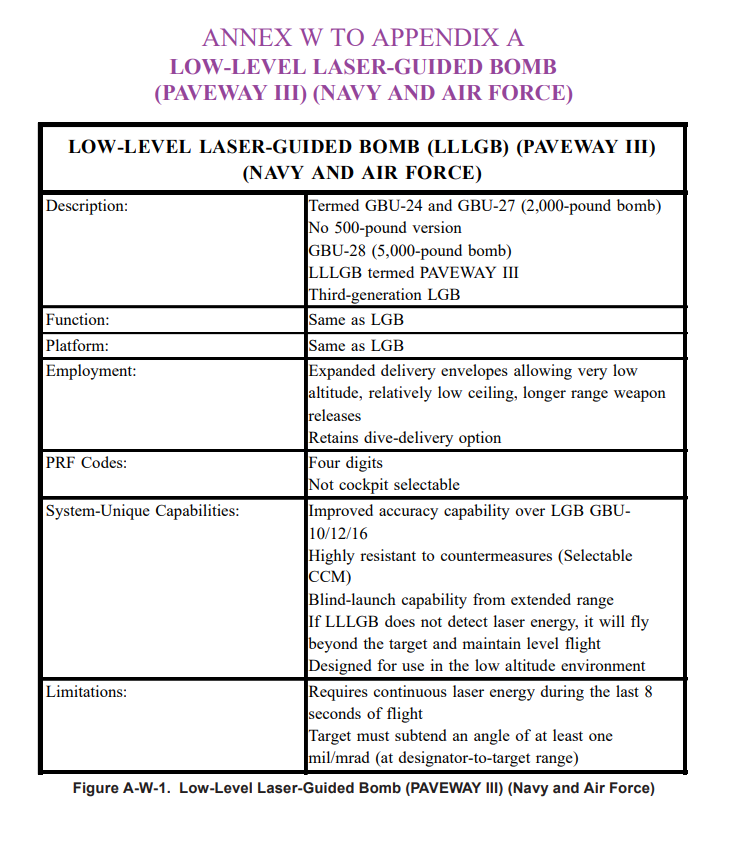
Problem is that the there is no Trajectory Shaping (adaptive midcourse guidance) nor release dependent scan pattern selected on the Paveway III & IV, etc. like there should be.

I miss the IOG that the PW3 used to have, even though it shouldn’t have it, it at least allowed it to behave more realistically than now. Bug report on this missing feature is over a year old now, and I feel it won’t be fixed anytime soon anyway regardless. Though we are seeing more sophisticated autopilots now with AShMs, the scanning seeker would be a completely new feature afaik.
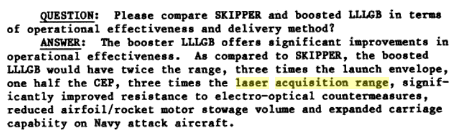
Besides that, seeker performance of the PW3, although better than PW2 already in-game, is probably still underperforming. I only could find that the seeker should have 2.5-3x the acquisition range over PW2/Skipper. There was also a table with redacted pieces of information about acquisition range at some designation range. Anyway given how laser acquisition range works in game, this means that PW3 seeker range currently of ~6.1km is underperforming, and needs to be ~7.7km to ~8.4km (I should probably update my report on that, but not like it hasn’t been forgotten already…) That would extend the designation range, to achieve ~3km of acquisition range, from 12.5km to about 23.7km, and would at least allow some significant long range use of it. Though anything now is much better than the dreaded time most LGBUs were nerfed to a mere ~3.6km/12k ft seeker range, I remember seeing many reports on people saying laser seekers just stopped working because of it.
Not really the Conical scan could easily be approximated by simply (re)using the existing Field of View narrowing IRCCM mechanic, to cut the Field of Regard down by about a half after it locks on.
The bar scan would need more work to be done but radars already use a bar scanning, (Vertical ACM mode, so it should be possible in engine. Not that it would be easy to do but is definitely possible.
Only thing I’ve seen is that baseline PI kits are 10kft[~3km], where PII are 16kft [~4.8km]
https://community.gaijin.net/issues/p/warthunder/i/VhIrxRZCcS46
Do you actually happen to know what they mean exactly with nominal range. I guess how Gaijin interprets it, and how I’ve been calling it, is the range at which designation range = seeker acquisition range (using some standardized designator power under standardized conditions, we also have in game).
For PW3, the seeker info I got come from DoD approppriations for FY 1984 and 1985. Technically they were talking about a rocket-boosted PW3 in comparison to the Skipper, which is just a rocket boosted PW2.