Personally I would like to hear the communities thoughts as I believe its time that we take these aircraft, probably one of the worst fighter aircraft BR for BR and considering taking them to 10.7 where they might be somewhat usable and enjoyable to fly, here’s my reasoning.
These 11.0s have one of the worst radars around this BR and no access to ACM mode, making it the worst MiG-23 radar available. If your radar doesn’t see the enemy or scan quickly enough, you’re not getting a lock. Abysmal radar missiles, R-23Rs these missiles are not only incredibly slow and have a very high drag, they also have a 1.7 second guidance delay. Almost a full two seconds before they will guide themselves into the target making the actual window of opportunity you have to launch the missile is less than ideal.
A kilometer too soon and it will be slow, unable to pull G’s and very easily notched/multipathed or simply rolled given an agile enough aircraft. A kilometer too late, and your target will fly right past the missile before it even has time to start guiding itself. So you will likely be relying on a combination of R-60M(x6 max), R-13M1(x4 max), R-23T(x2 max) and it should be mentioned that this aircraft is unable to take R-23T and R-23R at the same time unlike the later MiG-23s that can take x1 R-24R and R-24T along with the additional x4 R-60M or x2 R-13M1.
Typically its not even worth using the “Long range” R-23T, they are heavy, slow and easier to flare than the R-13M1 from rear aspect as they need to stay in the air longer to hit optimal speed and have a seeker FOV of 2.6 degrees compared to 2.5 on the R-13M1. Both the R-13M1 and R-23T have 20G max overload, but the real issue is the 23T has a 35 second guidance time compared to the 13M1 that has a 60 second guidance time. So firing this missile on a enemy that is 8km+ away while you are above them rear aspect as they are flying away from you will almost always results in a miss due to the missile not having enough time to guide itself, and this missile is only “all aspect” within a distance of 2km. If you are going to start firing from even 5km or closer you may as well be using the lighter, faster to accelerate, harder to flare R-13M1 especially as you get closer as you are only more likely to give away your position resulting in them noticing your launch and flaring your missile.
One of the biggest issues at the BR of 11.0 with an airframe and weaponry this weak is the limit of twelve large countermeasures that must be equipped via a external pod mounted under the fuselage, a majority of the time its best to just take all flares, hug the deck and pray a SARH missile doesn’t track.
To top it all off it has the worst airframe and engine out of the MiG-23s having almost the identical R-29-300 engine as the 23BN(R-29B-300), and only slightly beating the turn radius of the 9.7 23BN by only a degree or so at almost all speeds.
Keep in mind that’s if both jets are at 100% fuel and no payload, and again the engine performance on the 11.0 M/MF is only slightly better than the 23BN, something to the tune of .3-.4 meters a second of higher acceleration and 200-300 more kg of thrust due to the more aerodynamic airframe, but the 29B-300 engine has more thrust and the 23BN has a slightly heavier, less aerodynamic airframe leading to a overall net negative in performance.
This is the end of my personal experience i’ve collected from spading the aircraft in Air RB, the next segment will be raw data about the aircraft flight performance calculated using Statsharks FM calculator to give readers an unbiased look at this 11.0 aircraft comparatively to the other MiG-23s based on its airframe and engine performance alone. Thank you if you have read this far and please consider leaving a comment on why or why not you believe the aircrafts BR should remain at 11.0 or reduced to 10.7!
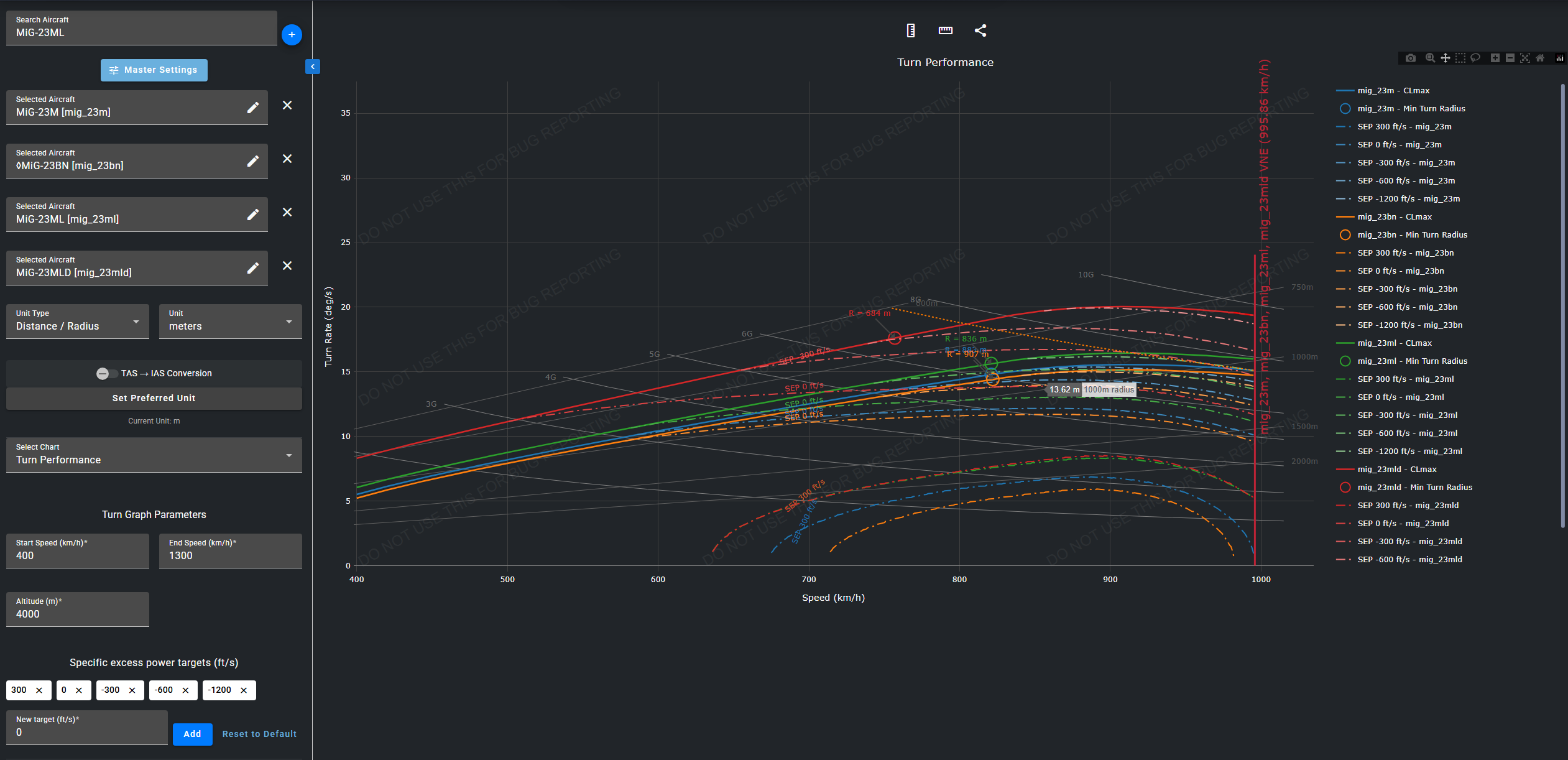
For reference: Orange line is 23BN, Blue is 23M, Green is 23ML and Red is 23MLD
SEP stands for Specific Excess Power, which describes how much extra energy the aircraft has available at certain speeds and turn conditions.
SEP = 0 ft/s the aircraft is in an energy-neutral state.
- It can maintain that speed and turn rate indefinitely without speeding up or slowing down.
SEP > 0 ft/s the aircraft is gaining energy.
- Can accelerate, climb, or tighten the turn while still building speed/energy.
- This is “sustained turn condition”.
SEP < 0 ft/s the aircraft is losing energy.
- It may achieve a higher instantaneous turn rate, but it’s bleeding speed and cannot sustain it.
-
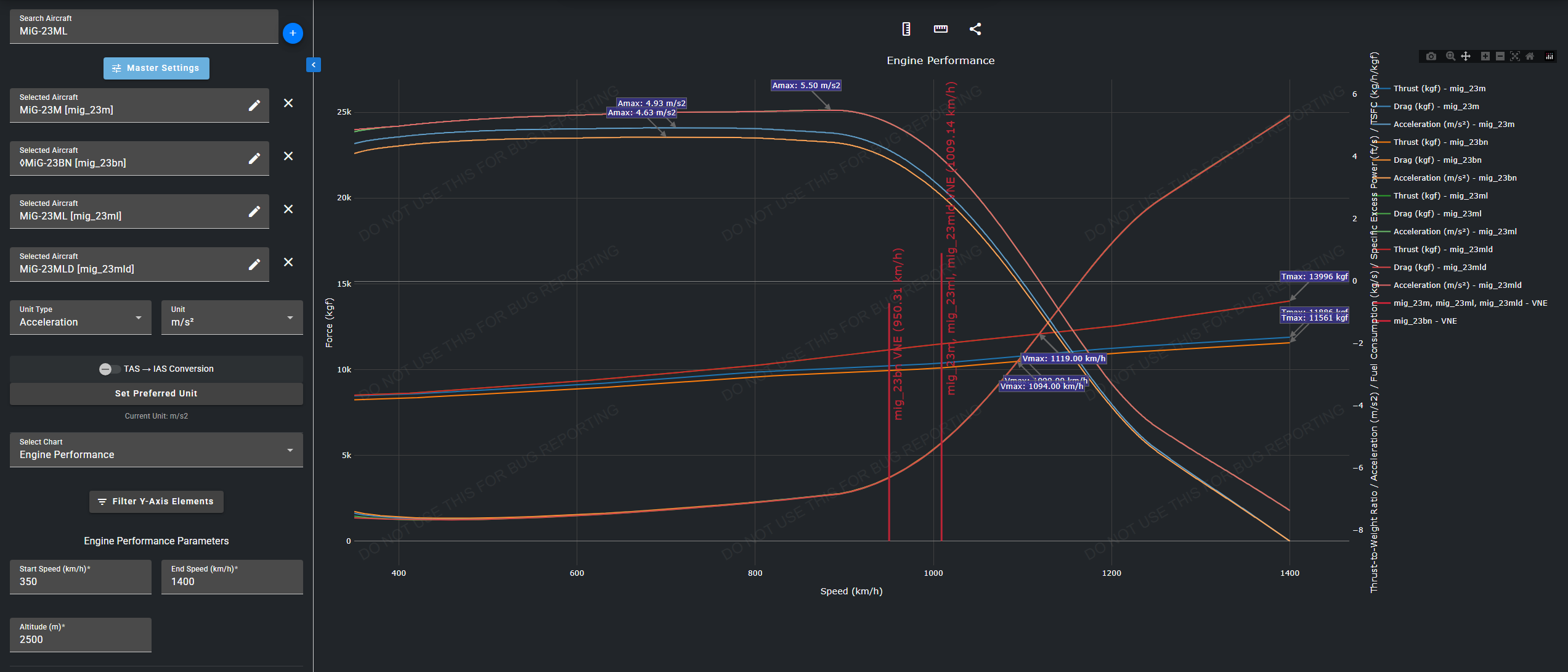
The fastest the MiG-23M can accelerate while at 100% fuel and no payload at 2500m is 4.93m/s² roughly around the 765km/h~ range
-
The fastest the MiG-23BN can accelerate while at 100% fuel and no payload at 2500m is 4.63m/s² roughly around the 755km/h~ range
-
and finally the MiG-23ML/MLD can accelerate 5.50m/s² while under the same conditions roughly around the 840km/h~ range.
-
23BN: 950.31 km/h TAS at 2500m
-
23M/ML/MLD: 1009.14 km/h TAS at 2500m
-
23ML/MLD maxes at 1119 km/h at 2500m
-
23M topping out at 1099 km/h
-
23BN at 1094 km/h