While the Ho-Ri II never saw the completion of even a single prototype, we can state that the addition of this vehicle to War Thunder would be more grounded in reality and history than the current two Ho-Ri vehicles in the game. Both the Ho-Ri Production and the Ho-Ri Prototype, despite popular misconception, are ahistorical, being falsehoods that have gone on to regrettably further muddle the development history of this fascinating tank destroyer. As such, I have dedicated a section below to dispel much of the misinformation regarding the Ho-Ri project.
Clearing the Air: The Ho-Ri, Fact vs. Fiction
First and foremost, yes, the Ho-Ri II, as here suggested, is historical. It just simply wasn’t completed, although its guns were built and tested. But as I have argued before, the addition of this vehicle would be far more historical than what currently exists in War Thunder. The so-called “Ho-Ri Production” and even the “Ho-Ri Prototype” are indeed both fake. They are unfortunate, ahistorical abominations that have been amalgamated from half-truths and different stages of the Ho-Ri design. The sloped design we have in War Thunder shouldn’t even be termed “Ho-Ri III”, as some websites have noted. Simply put, what we have in War Thunder would have never appeared in reality, under any circumstance.
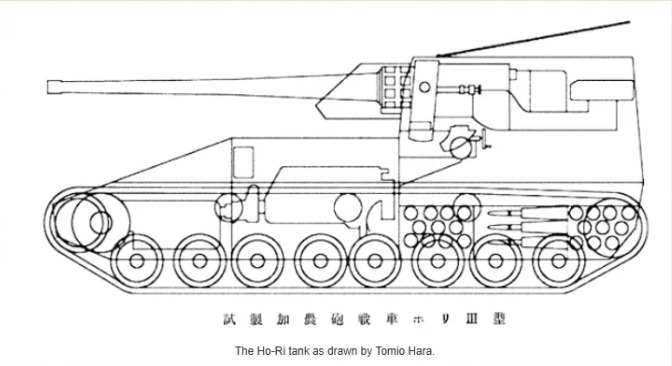
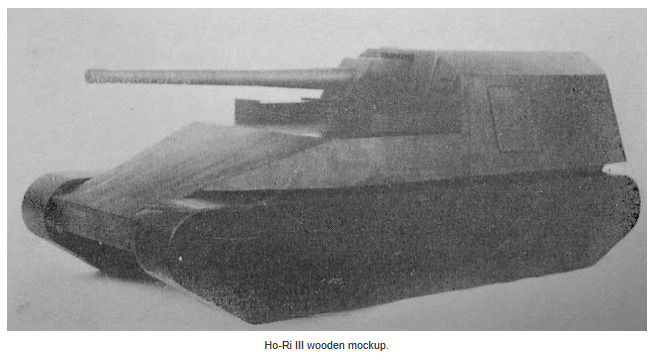
The above sketch is a manufactured hybrid of the two Ho-Ri variants that were in Akira Takeuchi Tomio Hara’s 1978 book. For convenience, I have added the image below:
The Actual Drawings
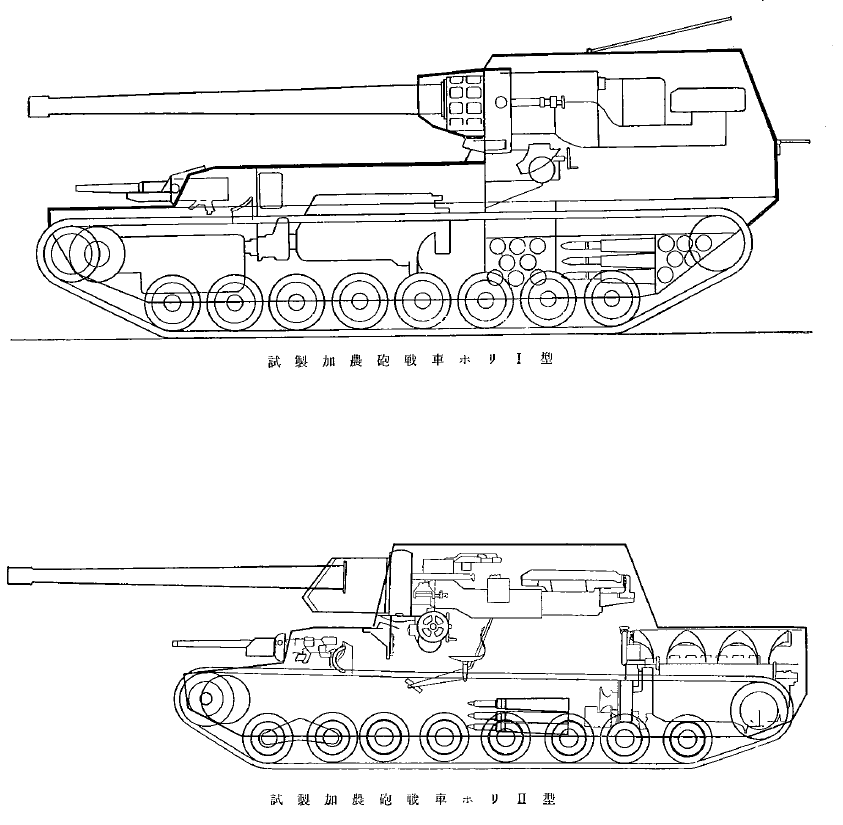
This drawing supposedly shows the Ho-Ri as it would’ve been built, but image doctoring aside, this supposition is completely at odds with how the Ho-Ri came to be developed. Note that the angular mantlet from Ho-Ri II has been transplanted over the breech of Gun I. This drawing also retains Gun I’s shorter loading mechanism, which is not at all what was built; instead, the longer loading mechanism derived from the Type 3 12 cm AA gun was used. Furthermore, the drawing incorporates an artificially lengthened hinged roof plate from Ho-Ri I, and also, for some weird reason, shortens the superstructure considerably. With how close the back of the casemate is to the loading mechanism, it would be impossible to operate. In War Thunder, it’s clipping into the superstructure itself:
With that matter aside, we can now discuss the erroneous features of the Ho-Ri tank destroyers featured in War Thunder. I welcome any input that will add to this list:
1. The names themselves are wrong. There is no such thing as a Ho-Ri “Prototype” and Production, as there were instead three proposals that differed quite strongly from the design that was likely to be constructed. The words “Prototype” and “Production” imply that the Ho-Ri I (Inclined Armor Type) was the intended design from start to finish, incorporating improvements as it went along its development cycle. As I discussed above, this was never the case; the design proposed by the wooden model was dropped early in the Ho-Ri’s development. Considering the Ho-Ri was never actually completed, the names are just irrespective of reality. The door is open for Gaijin to implement the Ho-Ri I (Inclined Armor Type) correctly, but that will have to be another suggestion, albeit with significant guesswork.
2. The armor is completely wrong for both vehicles. Utilizing calculations done by @_qaz , we are able to state with reasonable confidence the correct values of the Ho-Ri II:
- Superstructure Front: 125 mm,
- Superstructure Sides: 25 mm,
- Hull Front: 75 mm
- Hull Sides: 25 mm
- Gun Trunnion: 250 mm
- Armor Type: Class III (surface-quenched armor)
The hull front plate is a known value, as it was of the same thickness as the Chi-Ri from which it was derived; thus, a value of 125 mm for the superstructure front plate was calculated.
3. The engine is wrong. A value of 1,100 hp for the Ho-Ri production is completely ahistorical. It should instead parallel the values of the Type 5 Chi-Ri engine. Below are the correct engine values:
- Engine: BMW Modified Water-Cooled V12 Gasoline
- Cylinder volume: 160x170
- Gross power output: 700 PS at 1800 RPM
- Net power output: 550 PS at 1800 RPM
4. The gun mantlets for the Ho-Ri Prototype and Production are swapped and have fake barrels. The most important part of the tank destroyers, the guns, are modelled incorrectly. “Production” implies that it is the final state of the vehicle, but in War Thunder, the Ho-Ri Production incorrectly features the Experimental 10 cm Tank Gun (Long) Early, as evidenced by the angular mantlet. Likewise, the Ho-Ri Prototype incorrectly features the Experimental 10 cm Tank Gun (Long) Late, seen by the rounded mantlet. The length of the barrels is not correct, either, as will be demonstrated by the next point.
5. The chassis of both vehicles is too short. To further compound the unhistoricity of the Ho-Ri Prototype and Production, the chassis themselves are too short. Taking into account that the Ho-Ri I (Inclined Armor Type) would’ve actually used Gun II, its casemate would’ve required significantly more space to operate the gun and loading mechanism. The drawing below by @Davidnjk is a much more faithful recreation of what the Ho-Ri I (Inclined Armor Type) would actually look like. Comparing it to War Thunder’s model, we can see just how stunted the superstructure is. Furthermore, you can see just how short the gun is, compared to what it should look like.
6. The crew layout is incorrect The Ho-Ri I (Inclined Armor Type) would’ve featured all its crew in the superstructure. Looking at the wooden model, there is a complete lack of optics for the driver, as well as hatches for entering and exiting the vehicle. For the sloped Ho-Ri to actually have two crew compartments and to have a middle-mounted engine, it would need to be significantly lengthened.