History
Design and Development
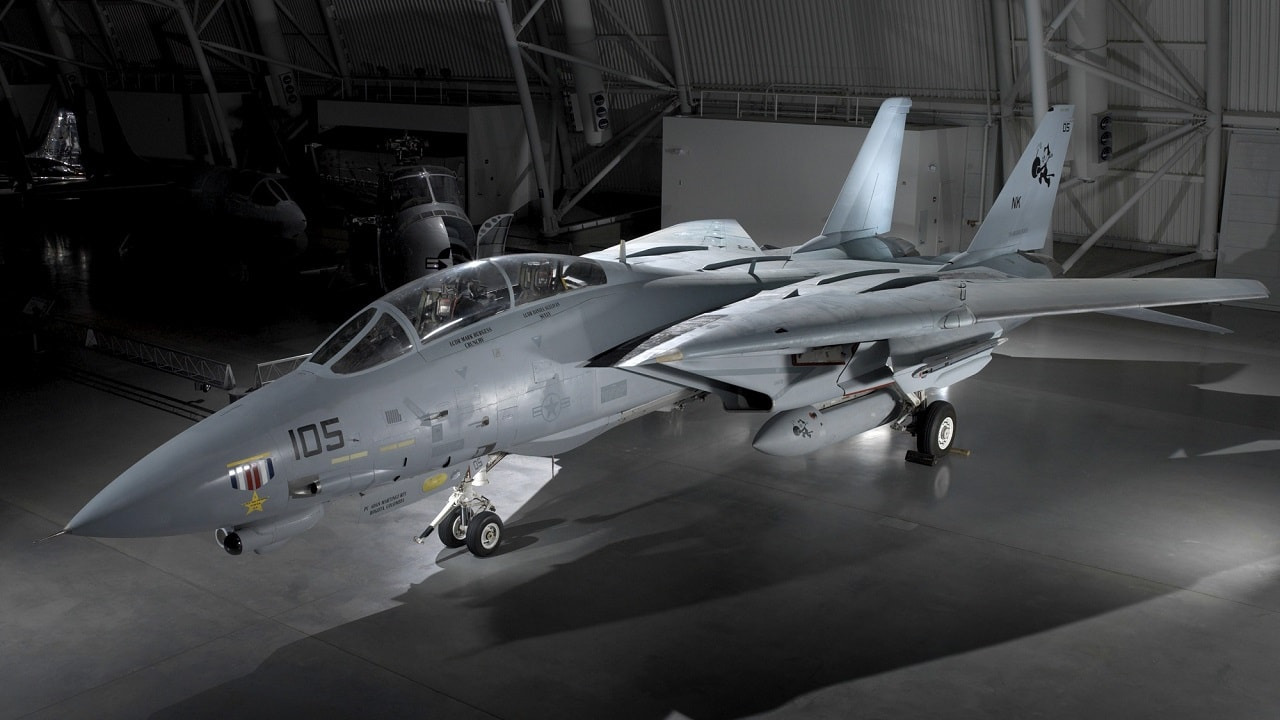
The F-14D was the final variant of the Tomcat, introduced by Grumman in the late 1980s to modernize the F-14 fleet and counter emerging Soviet threats. Earlier F-14A/B models featured analog avionics and radar systems that lacked modern capabilities such as high-speed multiplex digital data buses, multifunction cockpit displays, and head-up displays. Those features that had become standard in contemporary aircraft, like the F-15 and F-16. Grumman wanted to digitize the F-14 platform and extend its service life, encouraging the US Navy to continue its operational use.
Avionics upgrades in the F-14D included new MIL-STD-1553G data buses, an ASN-130 digital inertial navigation system, an ASN-139 laser inertial navigation system, dual AYK-14 standard airborne computers, the Joint Tactical Information Distribution System (JTIDS), an AN/APG-71 radar, a dual chin pod under the nose, an Itek ALR-67 radar warning receiver, and an AN/ALQ-165 Airborne Self Protection Jammer.
The AN/APG-71 radar was derived from the APG-70 used in the F-15E Strike Eagle and shared many of its features. It was a digital multimode radar capable of non-cooperative target identification, incorporating low sidelobe techniques and enhanced frequency agility. While it theoretically had an acquisition range of up to 400 miles and the ability to track more than 24 targets simultaneously, the design limitations of the F-14’s radar antenna restricted its practical range to approximately 230 miles. Still, the APG-71 was significantly less vulnerable to jamming and could process data six times faster than its predecessor, the AWG-9. Additionally, its data link system enabled two or more F-14Ds to operate cooperatively, allowing one aircraft’s radar to hand off targets to another.
The F-14D was fully compatible with the Joint Tactical Information Distribution System (JTIDS), a secure, jam-resistant communications system that integrated data sharing among cooperating air, ground, and naval units.
One of the F-14D’s most distinguishing features was its dual chin pod, which housed both a Northrop AN/AXX-1 Television Camera System (TCS) and a General Electric Infrared Search and Track (IRST) system. Previous F-14 variants carried one or the other, but not both simultaneously. The IRST used the frictional heating of an aircraft’s skin for passive target detection at ranges up to 115 miles. Together, the IRST and TCS allowed the F-14D to identify targets and relay that information through JTIDS.
In the cockpit, analog instruments were replaced with advanced HUD and multifunction display screens. The new HUD was similar to that found in the F/A-18, while the rear cockpit included a single multifunction glass display along with several smaller screens. These upgrades enabled combined optical and infrared views of targets, showing skin temperatures and exhaust heat at distances of up to 100 miles.
All F-14Ds were wired to carry the Tactical Airborne Reconnaissance Pod System (TARPS), which was mounted slightly off-center on Phoenix station number five. TARPS contained a KS-87B forward or vertical frame camera, a KA-99 low-altitude panoramic camera, and an AN/AAD-5 infrared line scanner.
Powering the F-14D was the 27,600 lb-thrust General Electric F110-GE-400 turbofan engine, which resolved the compressor stall issues that plagued the earlier TF30 engines. The F110 allowed catapult launches without afterburner, saving fuel and increasing operational range. Despite being slightly smaller in diameter than the Pratt & Whitney engine, it required no airframe modifications.
A modified F-14A outfitted with the F-14D’s electronics and the original TF30 engines first flew on November 23, 1987. This aircraft was used to evaluate the AN/APG-71 radar, communication systems, navigation systems, and data links. Other modified F-14As tested the F110-GE-400 engines, environmental controls, TARPS, ECM systems, sensors, and weapons integration.
The final prototype focused on testing JTIDS, radar warning receiver functions, and live weapons firing. It completed its flight tests on September 21, 1988.
The first production F-14D flew on February 9, 1990, and was publicly unveiled at a ceremony at the Calverton plant on March 23, 1990. It was delivered to VX-4 at Point Mugu, California, in May 1990 for comprehensive evaluation, including carrier operations. Testing demonstrated enhanced performance: the F-14D’s range increased by 60%, and its climb rate improved by 61%. A typical mission profile included a 150-mile radius sortie with a two-hour loiter time and sufficient fuel reserves for several landing attempts. The GE F110 engine’s performance received widespread praise.
F-14D(R) Production
Originally, 127 new-build F-14Ds were planned for production. However, due to budget cuts pushed by Secretary of Defense Dick Cheney, the program was significantly reduced. As a result, only 37 of the planned 127 F-14Ds were built from scratch, with the last new-build F-14D delivered to the Navy on July 20, 1992.
In addition, 18 F-14As were selected for remanufacture to the F-14D standard, including the installation of F110-GE-400 engines and the full avionics suite. These refurbished aircraft were redesignated F-14D(R). A total of 104 conversions had originally been planned, but the program was again curtailed by budget cuts, leaving only 18 completed. The final F-14D(R) conversion was delivered in November 1994.
Altogether, the Navy operated 55 F-14Ds, enough to equip three frontline squadrons: VF-2 “Bounty Hunters”, VF-11 “Red Rippers”, and VF-31 “Tomcatters.”
Thirteen F-14A-85-GR Tomcats were converted to the F-14D(R) standard:
- 159610 (DR-02)
- 159613 (DR-04)
- 159600 (DR-05)
- 159629 (DR-07)
- 159628 (DR-08)
- 159619 (DR-09)
- 159592 (DR-10)
- 159595 (DR-12)
- 159603 (DR-14)
- 159635 (DR-15)
- 159633 (DR-16)
- 159618 (DR-17)
- 159630 (DR-18)
Five additional F-14A-110-GR Tomcats were also converted:
- 161159 (DR-01)
- 161158 (DR-03)
- 161166 (DR-06)
- 161163 (DR-11)
- 161154 (DR-13)
There was effectively no major operational difference between the F-14D(R) and the factory-built F-14D, as the remanufacture program replaced the engines, avionics, wiring, and other systems to bring the aircraft up to full F-14D standard. Only a handful of structural elements may have remained from the original F-14A airframes.
F-14D(R) in Combat Service
F-14D(R) aircraft were distributed among VF-2, VF-11, and VF-31. Like the new-build F-14Ds, they did not participate in the Gulf War of 1990–1991. By 1996, VF-11 transitioned back to the F-14B due to the limited number of F-14Ds available. Both the B and D/D(R) variants later received Block I upgrades, which added GPS, a digital flight control system, AN/ARC-210 radios, and LANTIRN integration.
In 1997, the reduction in Tomcat squadron sizes freed enough F-14Ds for VF-213 “Black Lions” to transition to the type. VF-213’s F-14Ds saw combat during Operation Desert Fox in December 1998 aboard USS Carl Vinson (CVN-70), delivering GBU-24 Paveway III laser-guided bombs against Iraqi targets.
The earliest clearly documented combat use of an F-14D(R) occurred on January 5, 1999, when two F-14Ds, one factory-built (BuNo 163903) and one F-14D(R) converted from F-14A BuNo 159619, were scrambled to intercept Iraqi aircraft violating the no-fly zone. During the engagement, each aircraft launched one AIM-54C missile at a MiG-25, but improper pre-launch procedures caused the missiles to fail to ignite, plummeting to the ground.
Another notable aircraft was F-14D(R) BuNo 161159 (DR-01), converted from an F-14A-110-GR. Assigned to VF-213 aboard USS Carl Vinson, it flew reconnaissance missions during the opening hours of Operation Enduring Freedom on October 7, 2001, using TARPS. This same aircraft later flew the Tomcat’s final combat mission from USS Theodore Roosevelt on February 8, 2006.
Eventually, during Operation Iraqi Freedom in 2003, F-14D(R) aircraft of VF-2, VF-31, and VF-213 flew alongside factory-built F-14Ds in a combined total of 2,547 combat sorties, primarily in the strike role. That same year, the aircraft were modified to carry JDAMs.
F-14D(R) Survivors
The US Navy officially began to retire the F-14D and F-14D(R) fleet in early 2006. The last known F-14D(R) was retired in April 2006, while the final factory-built F-14D was retired on September 22, 2006, and made its last flight on October 4, 2006.
One particularly notable aircraft was F-14D(R) BuNo 159600 (DR-05), nicknamed “Christine.” Originally delivered as an F-14A on July 16, 1975, it was later remanufactured into an F-14D in 1994. Serving with VF-2, VF-101, and VF-31, it became the longest-serving F-14 Tomcat in US Navy history and completed its final combat deployment over Iraq in early 2006. The aircraft then arrived in Fort Worth aboard a Lockheed C-5A Galaxy on March 3, 2007, for static display at Fort Worth Aviation Museum.
Of the 18 F-14D(R) aircraft produced:
- 3 were lost in crashes.
- 1 was written off after an engine fire.
- 7 survive today in museum displays.
- 7 were mothballed, demilitarized, and ultimately stricken.