they are more energy dense for sure, mass efficient i’m not fully sure about
That as well obviously.
The be all of rocket propulsion is metal hydrogen, which would bring the « solid » energy density with the energy output of the overall best fuel for rockets.
Tho, I believe that as of now it’s more theoretical than anything else, with maybe only a few samples produced in extremely small quantities (?).
Anyway, is there an actual meteor thread ? We could move there
There is not, only british weapon systems.
2 Likes
i’ve been wishing there was a dedicated Meteor thread for a few months lol
I meant to reply to @kizvy since he was saying the 7000-10000m/s Isp made no sense by refering to the 500-700s Isp for the R-77PD
2 Likes
welp, there is now…
Idk enough about ramjet. But for rockets, for example, liquid systems have ISP of around 350-500. Solid have ISP of around 250-300, so we are quite close to that « halfing »
I would guess the exact same reason as to why the minuteman missiles, but also all nuclear sub missiles are solid boosters. It’s overall a nuisance to fill up a missile every time you might want to use it. It’s also pretty annoying to keep it cool (so as to not expand and explode) during flight.
The ASMP uses liquid fuel because it’s not meant to be flawing every few days. Only during critical times. And there the drawbacks of liquid fuel are outnumbered by the benefit of stricking deep in enemy territory.
I can ask the same question but in reverse. If solid fuel is indeed better than liquid fuel for ramjet, why does the ASMP uses liquid fuel ? It’s much more of a nuisance to deal with
Edit : your paper also uses a lot of theoretical. Basically no loss and perfect motor is highly unrealistic. You can probably easily drop 10% or even more to its values for a real life motor
when i get back home i’ll share some useful files i have
4 Likes
Perfect, thank you.
Anyway, going back to that, are you sure about this value ?
R77 is a solid rocket booster, no ? 700 seems like a lot actually
Indeed, it is just a start for things to look at to answer these types of questions.
I’ve been corrected by mythicpi, was comparing 2 different units.
Disregard my previous messages lol
2 Likes
I would expect that liquid fuel in the same manner as large rockets, requires serious pipework and containment that only makes it efficient for larger rocket motors, it probably does have a higher ISP, but i do still doubt its anywhere near 1/2.
Solid fuel is much better for being able to use it whenever iirc
I’m confident that unless Gaijin do their normal nonsense Meteor will be a really good missile. But I do agree on the comments about notching and chaffing. What’s the point in a 100+km missile if the enemy can just go into a notch and/or chaff and defeat it even at sub 20km range.
1 Like
The advantage Meteor will have imo is that in basically any shot made on current WT maps (barring the NT event map which was 4x bigger than all current WT maps), the meteor (if modelled correctly) will be going active while above M3.5, and will likely be intercepting you above M4.0.
This is MUCH faster than anything else fired by air to air platforms in-game, and maneuvers likely wont slow it down much, since it’ll have the ramjet to power through energy losses. For comparison, this is like trying to dodge an 8km head-on shot from an R-77-1, but instead of it being at 8km when you can see the enemy jet and shoot back, its anytime they fire a missile at you and guide it to pitbull.
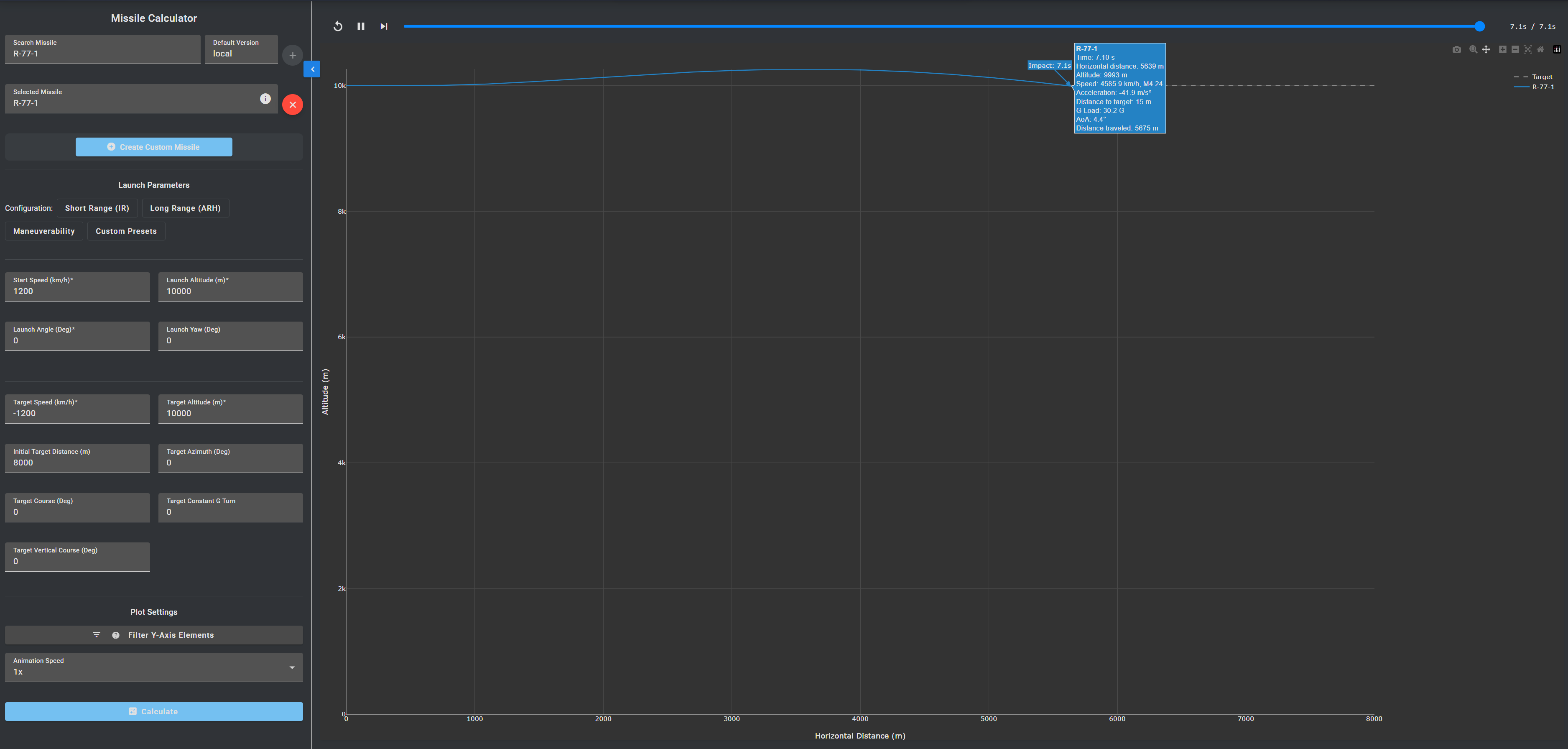
So now, lets say its avg speed from lock at 16km to theoretical intercept is M4.0, at 6km alt, that’s ~4560kph (1267m/s). If you’re flying at it at M1.0, when it goes pitbull, you’re dealing with a closure rate of ~1584m/s, which means you have between ~10.1-12.63s to react to the lock, turn into the notch, and chaff the missile off before it impacts you. Shot from basically anywhere on the current 126x126km map.
Like, yes, if you’re already practicing good BVR tactics, you’re already near the notch when it arrives, then sure, it’ll be easy to just notch and chaff. But there is effectively nothing you can do to change the “danger” of the shot. At basically any range, and any alt, from lock to impact you have a touch over 10s to defend once the missile locks you.
7 Likes
an almost 24/7 fakour-90 in terms of terminal speed, but it has a mica like seeker, 1/2 of the nations will have access to it and all of them will have 4-7 of them. yikes
1 Like
My intuition;
Your Maths;
My feels;
Spoiler

8 Likes
That is true. The issue with ARH missiles is that you can’t change the target size for the missile. So for example for Phoenix had a mode for small, medium and large RCS targets so taking arbitrary numbers 10nm, 15nm and 20nm the time from Pitbull to impact gets significantly increased depending on the target.
The ability to change the target for the missile should change with the NCTR where it will tell the missile “Hey that’s an Su-30” or other and then the missile will switch on closer to the target than say a Tu-95.
Anyone want to make a suggestion for this?
that is even a thing for SARH missiles
the Mig-29 and Su-27 have a control knob for target size and i think even the Mig-23 has (not 100% sure on that one tho)