Perhaps, but i would have expected a boron loaded ramjet to have a slightly higher ISP than 1000s, deltaV seems to work well within that range using speculative values.
What I can find is that the ASMP nuclear missile from France, which uses boron enriched fuel, has an ISP of around 600-800s at a maximum (obviously no concrete source tho). For reference, when the French gov tested normal solid fuel they achieved around 300s
Also, if I where to take your hypothesis of it being a DeltaV, with a typical 3:1 ratio of propellant to structure of the motor, then I’d stil get an ISP of around 1000, so Ve of 10000.
Edit : I’ve actually been surprised looking into them just now how inefficient they are. They actually gain their efficiency through the fact that they don’t carry the oxidizer, not through the efficiency of the engine itself
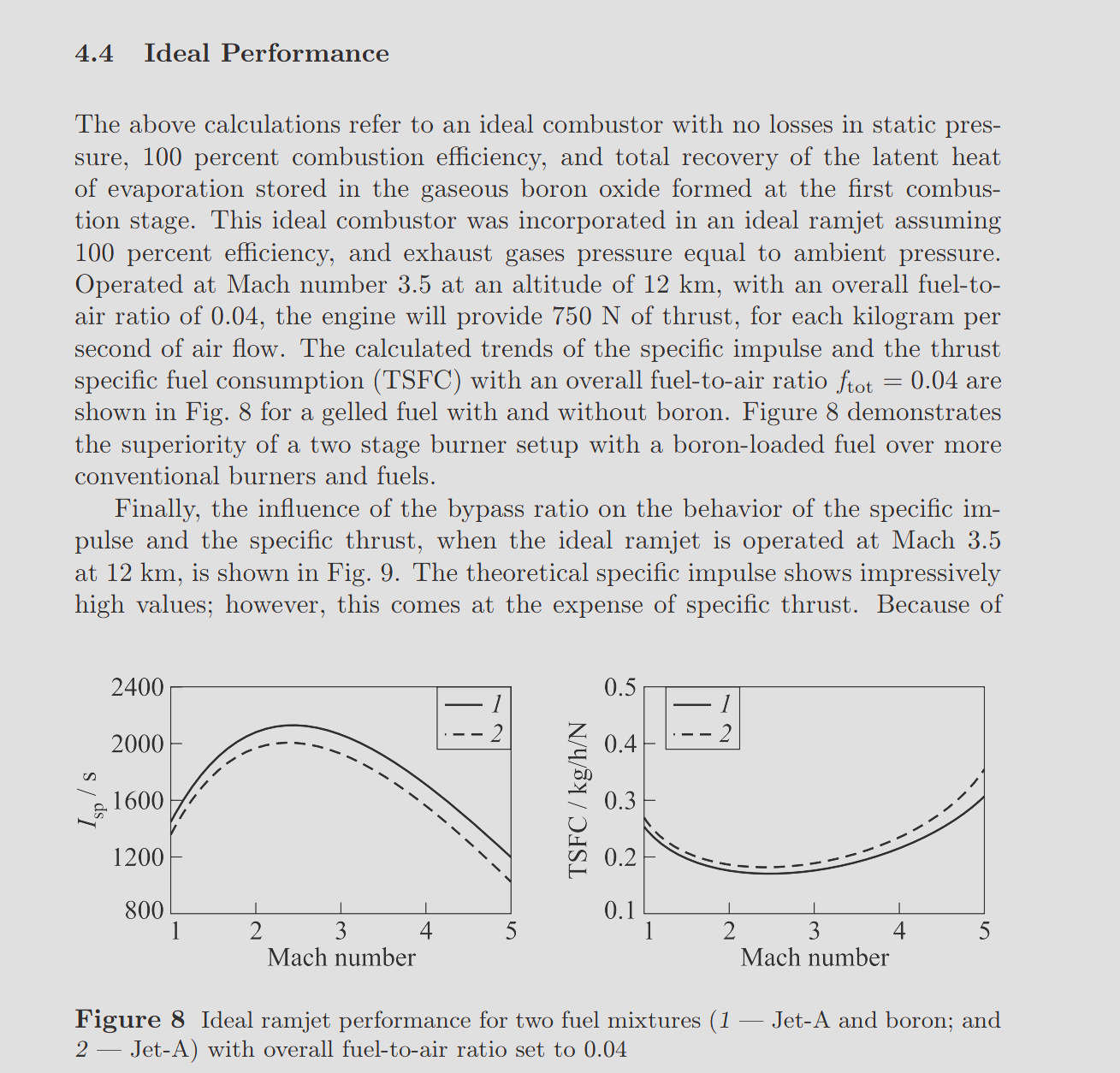
This is using liquid fuel, which we found out to be more efficient as I shown in the research I showed above
Assume thats 1:3, which is probably broadly accurate because the ramjets we are looking at for meteor require a booster.
boron enriched fuel? i thought the asmp used kerosene, since it’s a liquid fuel ramjet
It is liquid. From what I’ve seen it also looks like it’s also boron enriched ?
I do have literally 10 minutes of research experience on the subject, so obviously take it with a rock of salt.
Maybe it’s just the latest variant ASMP-A as well. I’ll need to check to more carefully
Its not the same Isp, you’re comparing apples to oranges.
This is an Isp defined in m/s (specific impulse)
This is an Isp defined in seconds (normalized specific impulse)
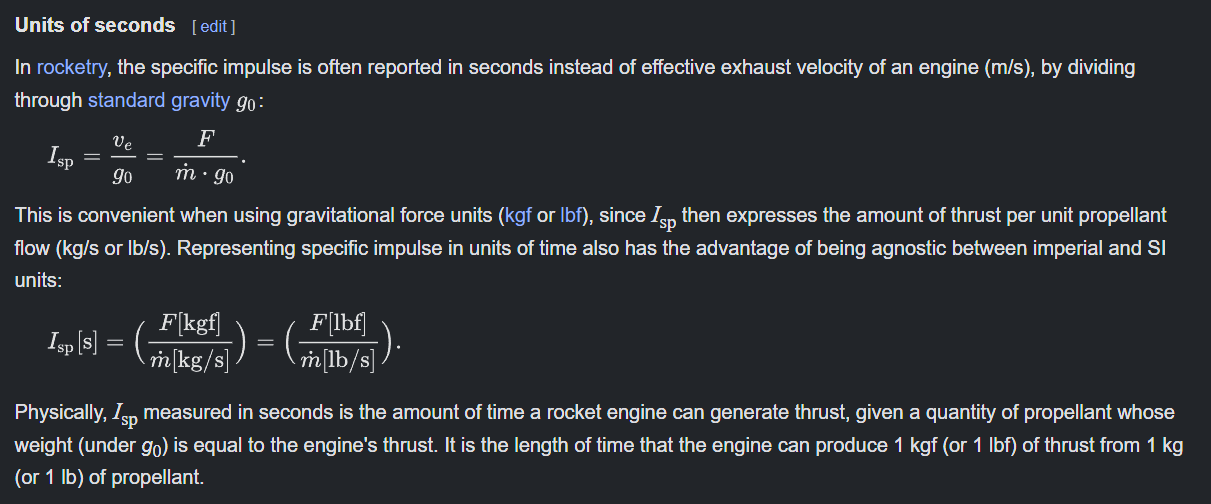
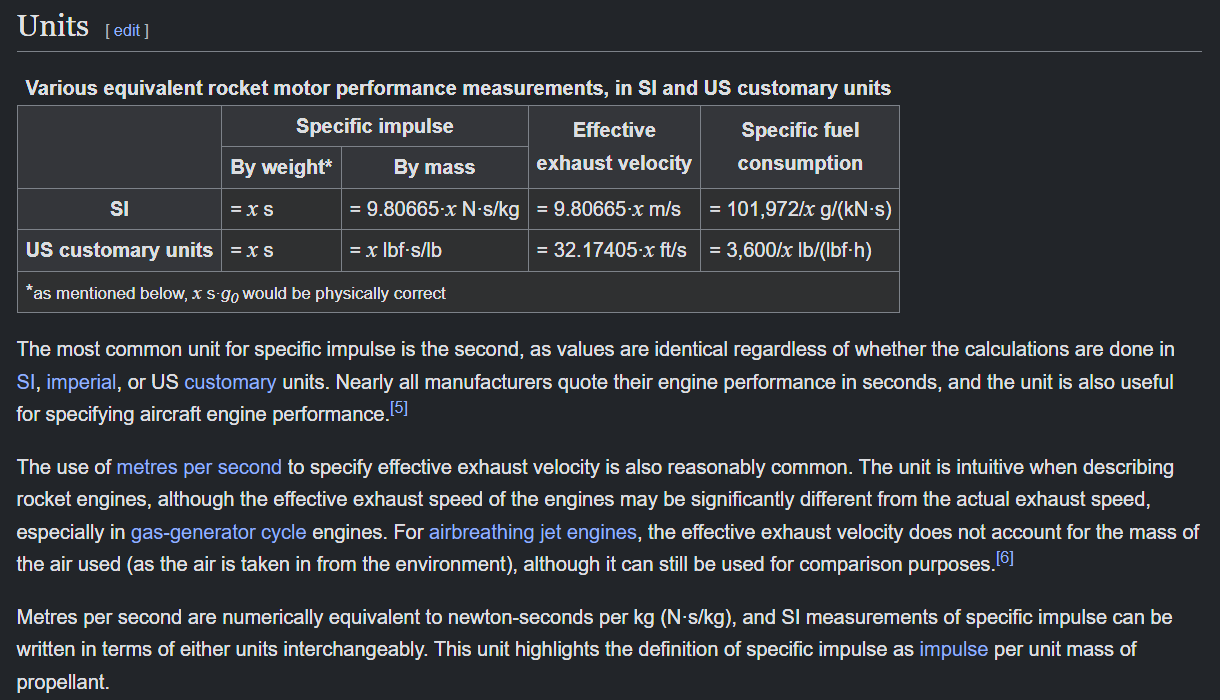
If I’m understanding it correctly, the conversion from the specific impulse to the normalized specific impulse would be
Isp(s) = (7000 - 10000m/s)/9.80665(m/s^2)
Isp(s) = ~713.8 - 1019.7s
1 Like
Solid fuels should be more energy dense/mass efficient?
That’s my current belief as well. The Specific Impulse (m/s) is actually a loose definition and is actually the gas exhaust Ve, as defined : ISP = Ve/because
yep, i corrected myself a couple of posts later with the proper isp values
1 Like
Counter example : solid rocket booster are so much less efficient than liquid rockets.
Obviously, this is very different, but solid doesn’t necessarily means more energy dense. You need a lot of compounds to keep the mixture in shape, meanwhile a liquid propellant is 100% pure energy availability
Surely this is because we can chill specific elements into a liquid state but not a solid state, thus liquid O2 is still better than a solid fuel X? Lets say a solid fuel ramjet is less energy dense, but by over half?? surely not. If an ISP of >2000s is possible with liquid fuel, why would you opt for a solid fuel which is at best able to achieve 1000s(supposedly).
they are more energy dense for sure, mass efficient i’m not fully sure about
That as well obviously.
The be all of rocket propulsion is metal hydrogen, which would bring the « solid » energy density with the energy output of the overall best fuel for rockets.
Tho, I believe that as of now it’s more theoretical than anything else, with maybe only a few samples produced in extremely small quantities (?).
Anyway, is there an actual meteor thread ? We could move there
There is not, only british weapon systems.
2 Likes
i’ve been wishing there was a dedicated Meteor thread for a few months lol
I meant to reply to @kizvy since he was saying the 7000-10000m/s Isp made no sense by refering to the 500-700s Isp for the R-77PD
2 Likes
welp, there is now…
Idk enough about ramjet. But for rockets, for example, liquid systems have ISP of around 350-500. Solid have ISP of around 250-300, so we are quite close to that « halfing »
I would guess the exact same reason as to why the minuteman missiles, but also all nuclear sub missiles are solid boosters. It’s overall a nuisance to fill up a missile every time you might want to use it. It’s also pretty annoying to keep it cool (so as to not expand and explode) during flight.
The ASMP uses liquid fuel because it’s not meant to be flawing every few days. Only during critical times. And there the drawbacks of liquid fuel are outnumbered by the benefit of stricking deep in enemy territory.
I can ask the same question but in reverse. If solid fuel is indeed better than liquid fuel for ramjet, why does the ASMP uses liquid fuel ? It’s much more of a nuisance to deal with
Edit : your paper also uses a lot of theoretical. Basically no loss and perfect motor is highly unrealistic. You can probably easily drop 10% or even more to its values for a real life motor