Yes, those reports were rejected, but look at the specific reason given in the screenshot. It says: Only 5 for Hulls… had DU in the hulls.
That reasoning is outdated based on the 2012 NRC Review linked earlier. Page 38 states the possession limits were removed because the number of tanks changes frequently and is classified. If the inventory was actually fixed at 5, it would not be changing frequently and it wouldn’t need to be classified.
So those previous rejections were based on incomplete data. You can’t use a 5 Tank rejection reason to dismiss a Classified Inventory reality. The source provided in this thread invalidates the reason those reports were closed.
And regarding the physical model, the CBO Report confirms the M1A1 AIM received Heavy Armor added to the hull. Yet in War Thunder, the M1A1 AIM hull armor layout is visually identical to the base M1 from 1980.
You are asking us to believe that the Heavy Armor upgrade paid for by Congress and audited by the CBO resulted in zero physical change to the tank’s protection layout after 20 years of development. Even if you refuse to accept it is DU, you have to admit the game is factually wrong for showing no changes to the hull after a documented Heavy Armor upgrade.
So based on gaijin’s logic, abrams should get his DU armor, i mean, kh38mt is in game without evidence of production, so whats the point to not fix m1 armor?
The 2012 NRC review states the number of M1 Tanks and tank parts changes frequently. It does not say Only Turrets. An M1 Tank consists of a hull and a turret. If the hull inventory was a static constant of five, the total count of tanks containing regulated material would not be a frequently changing, classified variable.
You also admitted that improvements were made for sure.
This brings us back to the CBO naming convention which you keep ignoring.
The CBO table lists the IPM1 upgrade as Improved composite armor.
The CBO table lists the AIM upgrade as Heavy armor added to hull.
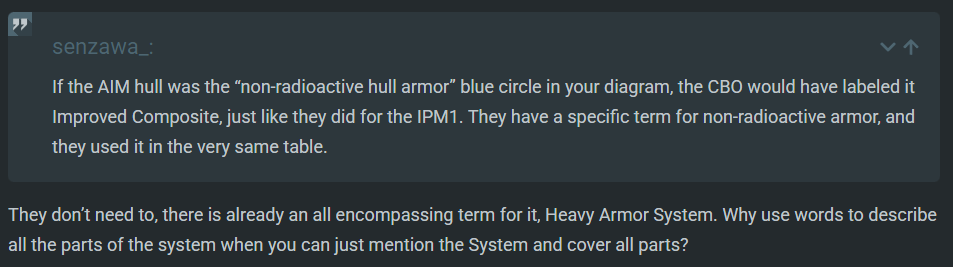
We know the CBO has a specific vocabulary for non-DU hull upgrades: Improved Composite. They used it in the very same table.
If the AIM hull upgrade was just a non-DU composite improvement as you claim, why did the CBO switch terms to Heavy Armor?
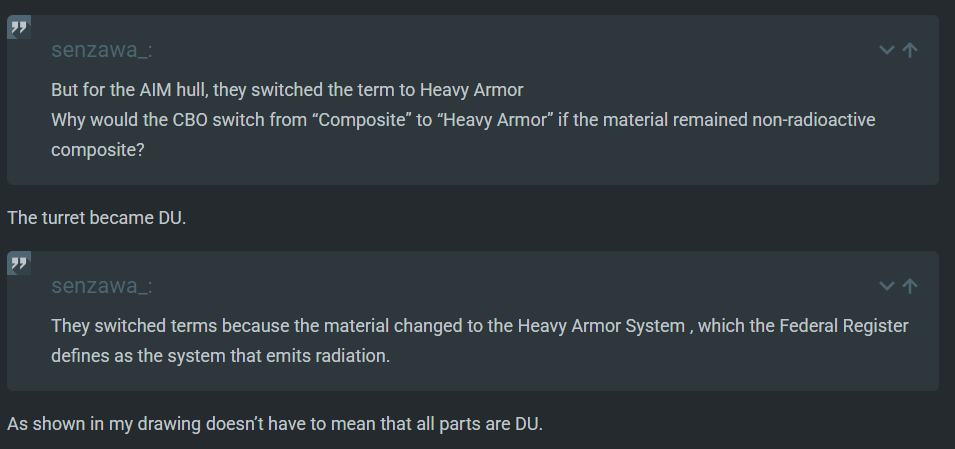
They switched because the material changed. Heavy Armor is the Army’s term for the radioactive package.
You are admitting the armor should be better than the 1980 model, but you are refusing to accept the specific material named in the budget audit because it contradicts a 20 year old note about school tanks. The CBO named the improvement. It is Heavy Armor.
It doesn’t say the hulls change either. both can be true, thus it’s inconclusive.
If the turrets change it is.
I haven’t ignored it, please stop lying that i ignore things.
Still conjecture, nowhere is it explicitly stated that Heavy Armor = DU.
THE. TURRETS. How many times do i have to repeat THE TURRETS for it to stick ?
Here, ill help:
→ THE TURRETS! ←
For every thing your read, in all your documents, the turrets being the only component with DU will still logically cover EVERYTHING. Its not the only way to read it, but you very easily can so all your documents are inconclusive.
→ THE TURRETS! ←
Heavy Armor → SYSTEM ← It’s not defined as a material.
The CBO wrote: Heavy armor added to hull and turret.
If Heavy Armor refers only to the DU in the turret as you claim, then the sentence would read: DU-in-Turret added to hull and turret.
That is linguistically impossible. You cannot add a turret-exclusive feature to a hull.
When a sentence says Subject X added to Object A and Object B, it means Subject X is present in both objects.
You claim Heavy Armor is a System and not a material.
The Federal Register Section 2 explicitly calls it: the depleted uranium (DU) armor package.
A package is a physical item. The CBO says that package was added to the hull.
Screaming THE TURRETS does not change the fact that the CBO explicitly listed the Hull as a recipient of the Heavy Armor upgrade. If the hull just got composite, they would have written Composite added to hull. They didn’t. They wrote Heavy Armor because the material matches the definition.
I have no idea what you’re even trying to say at this point.
Yes, if Subject X is a multi part SYSTEM with several components of different materials the Object A can be a different material than Object B and the sentence still semantically works.
No, they do not equate the system to the package, the system might as well just contain the package among other things and the sentences semantically still work. CBO doesn’t mention the word “package” .
Which can be non-DU for the hull and DU for the turrets and all your sources would not be false or contradict each other in the slightest.
Speculation.
It’s enough for the turrets to be DU for that to hold true.
You keep saying it is a multi-part system where the hull is non-radioactive, but that ignores how the CBO actually wrote the table.
Look at the column for the IPM1. They explicitly wrote Improved composite armor. They have a specific vocabulary for non-DU upgrades and they used it right there.
But for the AIM, they switched the term to Heavy armor.
If the AIM hull was just the non-radioactive composite part of the system like you claim, why did they switch terms? Why not just write Improved Composite again? They changed the name because the material changed to the radioactive package defined in the Federal Register. Using the radioactive system name to describe a non-radioactive composite hull would be bad auditing.
And regarding the license, look at the specific grammar in Item 9. It authorizes DU material utilized as Armor in tank turrets and hulls.
It does not say DU is utilized in the Heavy Armor System. It says the material is utilized in the Hull. If the hull was just a steel bracket for a DU turret, the NRC would not list the hull as a utilization point for the uranium. They listed it because the uranium is physically integrated into it.
You already admitted that for the 5 prototypes, the Heavy Armor hull contains DU. The CBO states that the AIM fleet received Heavy Armor hulls. It makes zero sense for the Army to use the exact same specific name for the 5 real DU hulls and the 1,000 fake composite hulls in the same budget era. The simplest answer is that the fleet matches the prototypes.
Yeah, nothing i say seems to be landing anywhere near your memories. I have already answered every point you make here. Re-read my previous answers. You’re not countering anything i say and just keep repeating your statements that have been disproven.
I could quite literally answer this and all of your coming answers by just quoting myself.
You actually haven’t answered the specific contradiction in the CBO table. You keep claiming Heavy Armor is just a generic system name, but you completely ignored the fact that the CBO used the specific term Improved Composite for the IPM1 in the exact same table.
If the AIM hull was just non-radioactive composite like you claim, the CBO would have used the composite label again. They didn’t. They switched to Heavy Armor. You never explained why a federal auditor would change terminology if the material stayed the same.
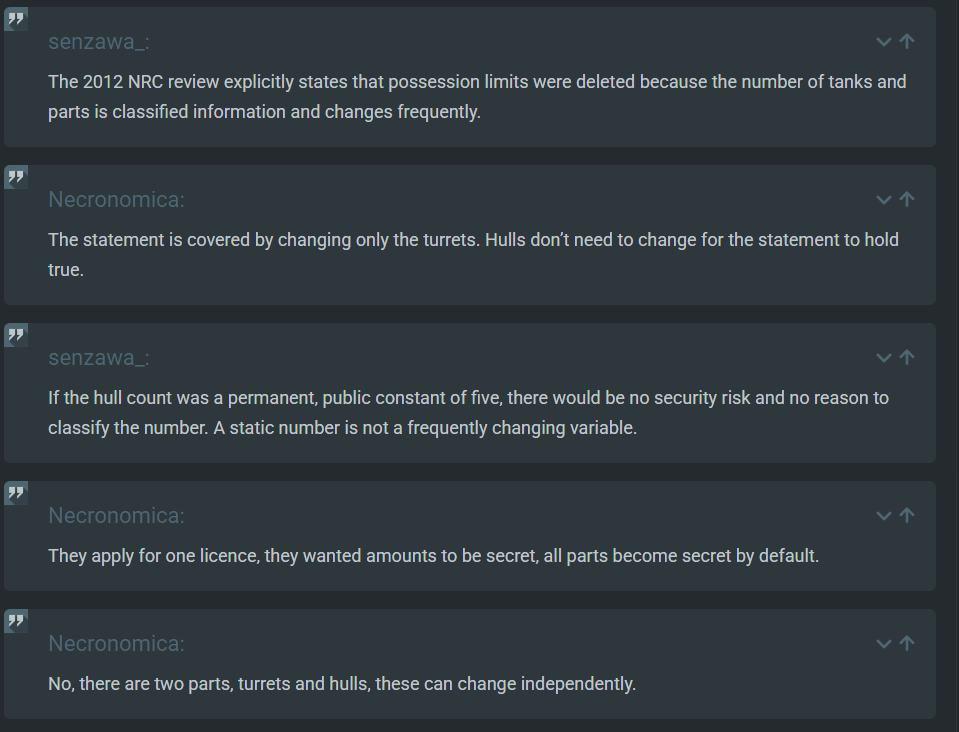
You also didn’t explain why the NRC would remove a specific 5-tank limit if the inventory never changed. A static number of 5 isn’t a security risk or a frequently changing variable.
Waving these contradictions away by saying it is just a system isn’t an answer. It is ignoring the specific vocabulary used by the federal auditors to distinguish between materials. But if you are done discussing the actual text of the documents, then we can leave it there. The CBO distinction stands on its own.
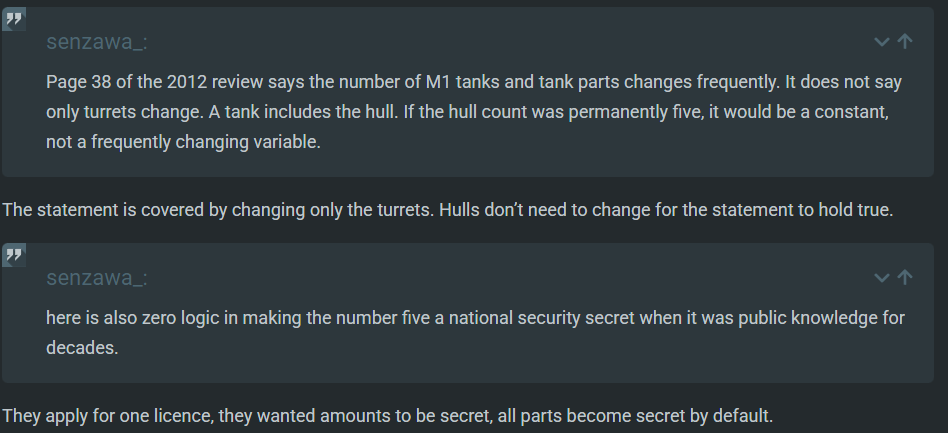
Screenshots of just the answers in the past 50 out of 240 messages in this thread
There is no contradiction.
Already answered.
Screenshots of just the answers in the past 50 out of 240 messages in this thread
It is, it absolutely is, it covers all bases.
They don’t. That is YOUR conclusion.
It can’t. It quite literally can’t. By definition it can’t. It doesn’t explicitly say “There is DU armor in the hull” all by itself.
Without your applied logic and outside documents with more applied logic to them nothing in your arguments and sources hold any weight on their own. All of your conclusions, all of your logical steps. ALL OF IT! Is conjecture, assumptions and speculation. Nowhere does it EXPLICITLY state EXACTLY: “DU is in the hull of all abrams tanks”.
You claim you answered it, but you actually just sidestepped the specific contradiction in the text.
You said the CBO switched to the term Heavy Armor just because the turret has DU.
But you failed to explain why they didn’t do the same thing for the IPM1.
The IPM1 was also part of a system upgrade. Yet the CBO explicitly labeled its hull Improved composite armor.
When they got to the AIM, they stopped using the word Composite and switched to Heavy Armor.
If the AIM hull was just part of a system where the hull remained composite, the CBO would have written Heavy Armor Turret and Composite Hull. Or they would have stuck with the term they already established in the previous column.
Switching the terminology for the hull specifically implies a change in the hull material. Simply saying “It’s a system” doesn’t explain why the auditors stopped using the accurate word for composite.
And regarding the NRC review:
You admitted the document says the inventory changes frequently.
A static inventory of 5 museum pieces does not change frequently.
You haven’t explained why the NRC would describe a permanent number of 5 as a frequently changing variable. Saying “Security” explains why it is secret, but it doesn’t explain why the NRC claims the number fluctuates if it is actually constant.
The only scenario where the inventory changes frequently and is classified is if it covers the active fleet moving through depots. Your 5-tank theory makes the NRC’s description of their own inventory physically impossible.
Because it doesn’t have DU in any of it’s armor parts. How is that so hard to see?
Speculation. the way they write still works.
The turrets changed, terminology changed.
No. that’s your assumption but not the only conclusion.
Yes it does, just because you fail to understand that doesn’t change that fact.
The turrets are included, they change, they make the numbers fluctuate even when the number of hulls remain the same. Is that really so hard to understand?
It really doesn’t. You are just failing to understand the logic.
You guys have been at this for a while can you both concede that there were hull improvements just maybe not with DU. Even if it had DU it’s still clear the original M1’s values shouldn’t be on the LFPs of the M1A2, AIM, SEP, etc. Sure it’ll take some educated guesses to determine what those improvements would theoretically equate to in RHA equivalent protection but I’m sure it could be figured out.
Even if there’s 100% concrete evidence that the hulls have DU, Gaijin will most likely not add it considering their current stance on the matter.
You still haven’t answered the specific text. The 2012 NRC review states the number of M1 Tanks changes frequently. It does not say only turrets change.
If the Army only has 5 DU hulls, then they can never possess more than 5 DU Tanks. A hard limit of 5 is not a frequently changing variable. It is a static ceiling. The only way the number of Tanks fluctuates and requires classification is if the hull inventory isn’t capped at 5.
And you still can’t explain the CBO grammar. The CBO wrote Heavy armor added to hull. They applied the specific radioactive term to the specific location of the hull. If the hull was composite, that sentence would be factually false. You are claiming the CBO wrote a wrong sentence just to avoid admitting the hull changed.
Except it doesn’t explain anything? The “report” clearly talks about PHYSICAL THICKNESS and not EFFECTIVE THICKNESS of the armor, in fact it’s even wrong about that, as 960mm is the physical thickness of the turret’s armorz the hull is only 700mm…
So your conclusion is based on a bad and wrong sourcez and it too is wrong.
I already dismissed that source earlier in the thread. I agreed it had errors regarding the Bradley and BMP values, so I stopped using it. You are attacking a point I conceded hours ago. My argument stands on the Federal Register, CBO Report, and NRC License.
I’m addressing that part because thats what I saw after logging in after a work day, so deal with it cus i frankly dont havr the energy to read 250 comments to see if someone already talked about it.
I have answered that multiple times. Changing the turrets to DU is enough for that statement to be true.
You are reading it as if the hulls limit the implementation of DU turrets. this is not the case. They can add DU turrets without adding DU hulls and all documents still work and hold true.
I have, multiple times. My information goes in one ear and out the other ear on you.
You keep saying you answered the CBO grammar, but you didn’t. You just shouted “Turrets.”
You never explained why the CBO used the specific term Improved Composite for the IPM1 hull but switched to Heavy Armor for the AIM hull.
If the AIM hull was just non-DU composite, they would have used the composite label again. They switched terms because the material changed. Saying “it’s a system” doesn’t explain why the auditors stopped using the accurate word for composite in the very same table.
Also, a static limit of 5 is not “Classified Information.” The number 5 was public for years. The inventory count is only classified now because it expanded to the mass fleet.