Documentation of M1A2 / M1A1 HC Hull Armor Composition (1996–2016)

You keep saying you answered the CBO grammar, but you didn’t. You just shouted “Turrets.”

You never explained why the CBO used the specific term Improved Composite for the IPM1 hull but switched to Heavy Armor for the AIM hull.

If the AIM hull was just non-DU composite, they would have used the composite label again. They switched terms because the material changed. Saying “it’s a system” doesn’t explain why the auditors stopped using the accurate word for composite in the very same table.

Also, a static limit of 5 is not “Classified Information.” The number 5 was public for years. The inventory count is only classified now because it expanded to the mass fleet.

Because that answers it, what part of that do you not understand as an answer?

I did, several times, if there is some part you did not understand then point that out and ask me to clarify instead of claiming i never said something i said multiple times.

The turrets and hulls are part of the same licence, making it secret makes both secret by default. That doesn’t mean that both need to change in amount after that. Not automatically. They can, but don’t have to for the logic to work.

“Turrets” answers nothing about the hull label.

The CBO used “Improved Composite” for the IPM1. They switched to “Heavy Armor” for the AIM.
If the AIM hull was still composite, they would have used the composite label again. They didn’t. They changed the name because the material changed.

And you don’t classify a number that has been public for two decades unless it changes. “Secret by default” is an excuse. The NRC explicitly said the count changes frequently. A static 5 is not a frequently changing variable.

And as I mentioned before in that same CBO report.

They also changed terms from HA to DU Gen 2 and DU Gen 3 when they mention the M1A2 and M1A2 SEP but also dont specify Hull or Turret.

So if you want to argue the IPM1 and AIM changing then why are you ignoring the clear distinction between the AIM/M1A2/M1A2 SEP.

Why would the AIM which is 9 years after the M1A2 list HA but they clearly defined the M1A2 using DU Gen 2, its either because there interpretation of HA = DU is incorrect, they either didnt understand the AIM did in fact get an armour change just not DU hence HA being mentioned and defined separately to DU or the report is incorrect.

The label Heavy Armor, can refer to a system of many parts of different materials. Saying “Heavy Armor added to turret and hull” can mean that the turret got one material and the hull got another material while both are still part of the Heavy Armor System.

The IPM1 being called composite means only composite was used for all parts of that change.

The New Heavy Armor denotation can mean DU in turret and new better composites in hull without it breaking any logic.

The next A2 gets changes only to the DU turret part of the armor. and so on.

This is a guess on your part, there is nothing forcing them to do so, there is nothing in any law that says they have to do that. Is it logical? Yes. Is that the ONLY solution? NO!

If the material changed in only the turret that also justifies a name change for the generation of armor as a whole. It doesn’t have to be changed in all parts to get a new name.

They haven’t said the hulls change, there is no specifics. changing just the turrets justifies everything. There is no explicit statement that they have to change the hulls. there is no explicit statement that all hull have changed. there is nothing but your assumptions that things are a certain way and can only be that certain way when there are in fact multiple viable options (yours included).

If you are so set in your way that you fail to see other options as even a slight possibility then i don’t think anyone will be able to help you understand this in any way.

You are confusing Generational distinctions with Material distinctions.

Heavy Armor is the specific Army program name for the First Generation Depleted Uranium package introduced on the M1A1 HA.

The CBO table lists them separately because they are different generations of the same material technology:

  1. IPM1: Improved Composite (Non-DU)

  2. AIM: Heavy Armor (Gen 1 DU standard)

  3. M1A2: Gen 2 DU

  4. SEP: Gen 3 DU

The distinction between the AIM and the M1A2 is generational (Gen 1 vs Gen 2).
The distinction between the IPM1 and the AIM is material (Composite vs DU).

If the AIM hull was just non-radioactive composite, the CBO would have labeled it Improved Composite like the IPM1. They didn’t. They used the term Heavy Armor, which defines the start of the DU lineage. Listing the generations separately doesn’t mean the first one isn’t DU; it just means it’s the older version of DU.

thats an assumption and even if that was the case that doesnt add up with the timelines.

Ill explain it again. the AIM can 9 years AFTER DU Gen 2 was already in active use and 1 year after DU Gen 3 was in use… so why is the AIM a newer variant (just rebuilt M1A1s) listing an armour that isnt DU.

AIM cannot be using Gen 1 DU if Gen 2 and Gen 3 are already in use, unless they somehow are magically producing 3 generations worth of DU but then sadly you would need a source to validify that and im sorry but im not convinced they were producing 3 generations worth of DU armour when the entire purpose of AIM was rebuild M1A1s like new, not to bring them up to parity with M1A2/M1A2 SEPs thats why these were built before the AIM program even started

Page 38 of the 2012 review says the number of M1 Tanks changes frequently. It does not just say parts. An M1 Tank is a complete vehicle. If the hull count is legally locked at 5, the Army can never possess more than 5 DU Tanks. The number would be a constant, not a frequently changing variable.

You also admitted that my reading of the CBO report is logical, but you prefer an interpretation where federal auditors decided to be vague for no reason. Auditors use precise language. They used Improved Composite for the IPM1. They switched to Heavy Armor for the AIM. If the material stayed the same, the name would have stayed the same.

Item 9 explicitly says DU is utilized in the hull. If the hull was just a steel mount for a DU turret, the DU would be utilized in the turret, not the hull. Listing the hull as a utilization point confirms the material is inside it.

The timeline argument relies on the false assumption that the Army upgrades every single tank to the absolute newest armor generation during a reset. The M1A1 AIM program was designed to standardize the M1A1 fleet, not convert them into M1A2 SEPs. The M1A2 fleet received Gen 2 and Gen 3. The M1A1 fleet operated with the standard Heavy Armor DU package. Maintaining different protection standards for different fleet tiers is standard military logistics, not magic.

If the AIM hull was just non-DU composite as suggested, the CBO would have labeled it Improved Composite, just like they did for the IPM1 in the same table. The auditors explicitly switched terminology from Composite to Heavy Armor. That switch indicates a change in material to the DU standard defined in the Federal Register. Arguments about production lines do not override the specific technical designation recorded in the federal budget audit.

If you have a newly built Abrams tank with DU in only the turret then the number of Abrams containing DU has changed. It doesn’t have to be in the hull for that statement to be true. If you take an Abrams tank with no DU at all in it and add DU only in the turret then the number of Abrams tanks containing DU has changed.

I haven’t said prefer. i said it’s a logically valid interpretation. This menas that there is more than one valid interpretation and thus the source is inconclusive and cannot be used as proof.

They have to list it like that to include the 5 prototypes. Without that inclusion having the 5 prototypes would have been illegal. It became “as needed” for secrecy reasons, the post contained both turrets and hulls both became secret at the same time by default. This means that they are allowed to have as many DU hulls as they want. It DOES NOT mean that all hulls suddenly become DU. If you are saying that the Heavy Armor package is DU in the hull and the CBO states that half the tanks in service already have DU in the hull (by your definition) by 1993:

image
( https://www.cbo.gov/sites/default/files/103rd-congress-1993-1994/reports/93doc04_0.pdf )

Then why would the army say that only 5 hulls have DU in 2006?

1 Like

except your CBO report contradicts that because they list no armour changes from IPM1 to the M1A1, that change only happened with the AIM program with the introduction of HA.

Its not though, the AIM was purely there to bring the aging M1A1 fleet back to life, not to parity so why would they bother giving them DU armour if the entire purpose of the AIM program is simply to get then back to “like new”

like I said before its cheaper for them to use a non DU array over DU for such a program because those programs typically are brought into the fold to cut costs vs rebuilding entire fleets from scratch but its also to help the US transition without wiping an entire 5000+ tank fleet in one go knowing production of the M1A2s wouldnt reach the same levels for years.

No they wouldnt, they would have listed it as “n/a” just like they did from the IPM1 to the M1A1 in that same document, they clearly made the distinction from the M1A1 to the M1A1 AIM and then made that dinstinction further with the M1A2 and M1A2 SEP.

Im sorry but the timelines just do not add up realistically, your not going to from a production POV introduce a new Abrams variant with inferior armour vs what you currently have in production, that only happens if budget is a problem or something during the rebuild prevents them from doing so like weight or effective protection being reduced or the licencing restrictions.

HA cannot mean Gen 1 DU when its 9 years post Gen 2 DU production and 1 year post Gen 3 DU production, just makes no sense. what makes logical sense is what I alluded to prior, they used a new armour type to save on using DU that was being used for the M1A2s and whatever they had lined up in there R&D for the SEP and SEPv2s etc.

Thats the equivalent of apple launching an Iphone 16++ model with a gen 1 chip but labelled “new” when they have an iphone 18 from 4 years prior using a gen 4 chip labelled “new+” that just wouldnt happen, what would happen is they introduce an “upgrade” with changes to the hardware, not use older hardware that they might not even have production lines for given the timelines involved

Let me add to this, if what you say is correct and that HA = Gen 1 DU then your also admitting that in reality that Gen 1 would be inferior in protection to the M1A2 and M1A2 SEP because these are using newer armour, so your own report here could in reality get some tanks nerfed on the premise its using weaker armour in relation to the M1A2s and M1A2 SEPs in game
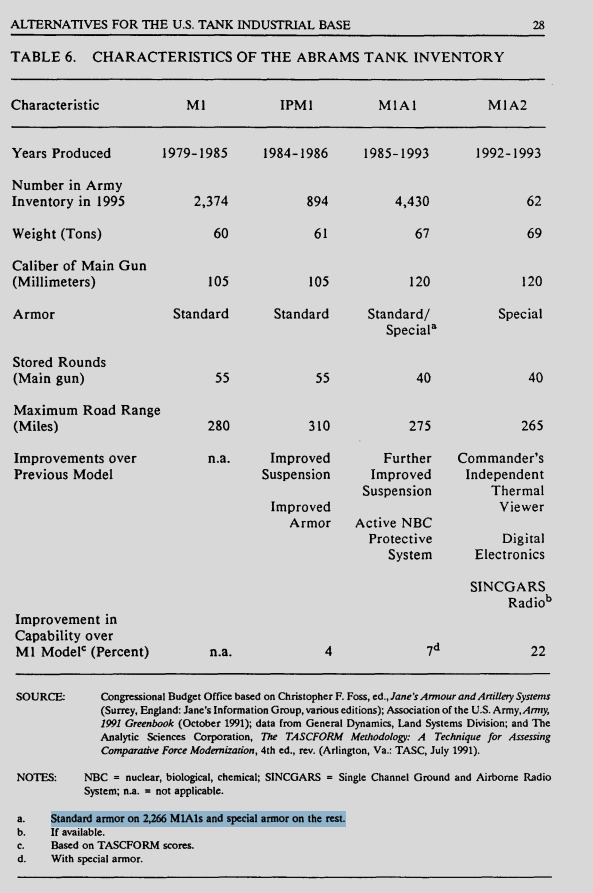
The assertion that the AIM program was purely maintenance contradicts the CBO table which explicitly lists the armor as an improvement. If the goal was just to return to 1985 specs, the armor column would read n/a like it did for the M1A1. Instead, it reads Heavy Armor added. That confirms a capability upgrade, not just a repair.

Tiered fleet management explains the generation gap perfectly. The M1A2 SEP received Gen 3 DU because it was the priority unit. The M1A1 AIM, serving as the bulk force, was upgraded to the standard Heavy Armor DU package. This provided a massive protection increase over the base M1A1 composite without consuming the newer Gen 3 packages reserved for the SEPs. Militaries frequently cascade older but effective tech to the main force while reserving the newest tech for elite units.

If the AIM hull was actually a brand new, advanced non-DU composite developed in 2000, the CBO would have labeled it Advanced Composite or similar. Using the specific term Heavy Armor, which the Army defined in 1988 as the DU package, to describe a non-DU composite would be a classification error by the auditors. It makes far more sense that they used the term Heavy Armor because they installed the Heavy Armor DU package.

The cost theory also fails on the industrial level. Developing a unique non-DU array that matches DU performance for the AIM fleet is far more expensive than using the existing DU industrial base and material stockpiles. The CBO audit confirms the money was spent on Heavy Armor. The NRC license confirms the hulls are DU components. The Federal Register confirms the system emits radiation. The documents align on DU.

Claiming the 1993 report states DU in the hull is incorrect. The 1993 table lists Special Armor for the M1A1. It does not explicitly say Hull.

The 2006 CBO report is the one that added the specific qualifier: Heavy armor added to hull and turret for the AIM.

The CBO updated the description in 2006 because the configuration changed with the AIM program. You cannot use a 1993 report to disprove a 2006 audit of a tank that didn’t exist in 1993. The auditors updated the table to reflect the new reality of the AIM fleet.

Regarding the license, a static number of 5 is not a national security secret. It was public information for years. The NRC review states the quantity is now classified and changes frequently. A hard cap of 5 does not change frequently. The only reason to classify the inventory count is if it represents the active fleet size, which is sensitive operational information.

You admitted that reading the documents my way is logically valid. You are rejecting it only because you prefer a theory where the CBO wrote a vague sentence and the NRC classified a public number for no reason. My interpretation just accepts the text of the audit and the license as written. The fleet got the armor, and the license covers the fleet.

I’m not saying the AIM didnt get an up armour as part of its rebuild, im saying it just wasnt Gen 1 DU like you claim, the timeline doesnt match, but you have to remember DU is significantly more dense than a composite array so simply slapping DU into a rebuild when it didnt get any suspension upgrades but got other weight adds on will mean more than likely that up armour wasnt in the form of DU inserts or it was significantly limited (how would one limit that) well one good way would be to not use DU in the hull food for thought. speculation at best.

Which is why the timeline I keep mentioning matters, if lets say hypothetically Gen 1, Gen 2 and Gen 3 were simple weight improvements with no impact to protection then do you not think they would have used something newer in the AIM rebuild of M1A1s? if Gen 2 and Gen 3 were already out at the time. I sure as hell wouldnt expect them to use older armour type unless they planned to either not use it in the hull OR had a prototype/new armour type in development.

Your assuming they had access to that information to make that assessment to begin with, the CBO references other sources that dont define that information further so for all we know it was either a lose term used or they simply put 1+1 together and decided HA must mean DU.

Not entirely, thats assuming they built and designed it from scratch the moment the AIM program started but for all we know it could have simply been add ons to existing composite arrays or some hybrid array where the cost could have been substantially cheaper.

But you didnt touch on my last point:

if what you say is correct and that HA = Gen 1 DU then your also admitting that in reality that Gen 1 would be inferior in protection to the M1A2 and M1A2 SEP because these are using newer armour, so your own report here could in reality get some tanks nerfed on the premise its using weaker armour in relation to the M1A2s and M1A2 SEPs in game

If you want HA to mean DU Gen 1 then you have to concede the fact that means a turret protection nerf to the AIM and M1A1HC in game because its using an older armour design and because we dont know the exact values between generation, that would be debated by gaijin, so in reality you COULD get a hull improvement but then lose it in the turret which would then in reality imo render at least the M1A1HC/AIM worthless if they lost lets say 100mm of KE protection.

You are inventing a scenario where the CBO auditors just put 1+1 together and guessed about the Heavy Armor definition. That is not how federal auditing works. The CBO reviews the actual procurement contracts. If the contract says Heavy Armor, they write Heavy Armor. If the Army defines Heavy Armor as DU, the CBO uses that definition. Auditors do not make wild guesses about classified armor compositions; they report the line items paid for by the budget.

Regarding the weight, the M1A1 AIM is heavier than the M1A1. The weight increase is consistent with the addition of the DU package to the hull. The suspension upgrades for the AIM program were specifically included to handle this weight increase. The idea that they couldn’t add weight because of the suspension ignores the fact that suspension refurbishment was a core part of the AIM overhaul.

As for your concern about nerfing the turret: Yes, Gen 1 DU is older than Gen 2/3. But Gen 1 DU is vastly superior to the non-DU composite currently modeled on the hull in-game. The current in-game M1A1 AIM has a hull protection level from 1980. Even if the upgrade is “only” Gen 1 DU, that is a massive buff to the hull compared to what is currently there. The trade-off of acknowledging the turret is Gen 1 is worth it to fix the hull which is currently modeled as if it has no upgrade at all.

You are arguing that the AIM shouldn’t have DU because it would make the M1A2 look better. That is exactly the point. The M1A2 should be better. But the AIM should still be better than a base M1A1. Right now, the game treats the AIM hull as if it never received the upgrade the CBO says it did. Fixing that historical error is the priority.

Thats not the issue I am on about.

Let me break it down better. lets say hypothetically you have all the source confirming HA = DU Gen 1 and as such confirms DU in the hull for Abrams beyond the AIM variant.

What do youexpect gaijin would do with that information when other sources in that CBO report also confirm Gen 2 and Gen 3 DU.

Gaijin wouldnt simply just add extra protection to the hull and be done with it, no more than likely they will use that attempt to say “Gen 1 is inferior to Gen 2 and Gen 2 is inferior to Gen 3” which could snowball into a change where the M1A1HC/AIM/M1A2 all take a protection value hit on the turret because gaijin are assuming Gen 1 through to Gen 3 means less protection.

Thats why your report claiming HA = DU could in reality backfire to a point its a monkey paw effect basically, you get the hull improvement in one hand but lose it in the other hand with turret and you know full well gaijin wont just add to the hull and thats the end of it.

1 Like

Your monkey paw theory relies on the assumption that the current in-game turret is massively overperforming compared to Gen 1 DU standards. It really isn’t. The turret cheeks are strong, but they aren’t magic.

The math is overwhelmingly in favor of the upgrade. Right now, the in-game hull is modeled as non-DU export composite from 1980. It has roughly 400mm of effective protection against kinetics. It gets penetrated by almost every round at its tier.

If they update the hull to Heavy Armor (Gen 1 DU), that protection jumps significantly, likely to the 600mm range. That is a 50 percent increase in hull survivability.

I would gladly trade a theoretical minor adjustment to the turret values to gain a hull that can actually stop a dart. Right now, the tank is an auto-kill if you hit the lower plate. Upgrading that to Gen 1 DU makes the tank viable. If that means the M1A2 gets Gen 2 and is technically stronger than the AIM, that is fine. That is historically accurate. The M1A2 should be better. But the AIM shouldn’t have a hull made of paper. Fixing the hull is worth the risk.

thats not an assumption I would have to make, its an assumption gaijin would make with your information and you know 100% they would make it half assed.

potentially yeah but again gaijin would still look at the information and go “well hold on a second how does the M1A1 AIM/M1A2/M1A2 SEP all have the same protection if they all use 3 different generations worth of armour”

Gaijin will use that information to decide that there “should” be difference in those values so what that means is as follows.

Gen 1 for the hull could be 600mm, Gen 2 could be 650mm and Gen 3 could be 690mm+ but the issue here is the turrets all match in terms of protection from gen 1 to gen 3 (if we assume the AIM is using gen 1)

That would mean gen 1 for the turret would be 680mm+ gen 2 be 720mm+ and gen 3 be 760mm+ (these are just hypothetical to explain my point) but we know gaijin wont suddenly up armour the turrets but they also wouldnt keep them the same if they know gen 1 through to gen 3 has protection differences meaning they would work there way from top to bottom.

So M1A2 SEPv2 would be the highest protected with subsequent variants below getting reduced all because they got a hull buff which as much as I would like the hull to be buffed, ide rather they not touch the turrets because they misinterpreted a report (which they have done multiple times)

The fear that fixing the hull will ruin the turret relies on the assumption that Gaijin balances based on a linear tier list rather than material density values. Currently, the M1A1 AIM hull is modeled with non-DU composite values from the 1980s. That is a confirmed error based on the CBO report.

If they implement Gen 1 DU for the AIM, the hull protection jumps massively. Even if they decide Gen 1 is slightly weaker than Gen 2, the baseline performance of Depleted Uranium is still far superior to the current export composite. A slight adjustment to the turret to match historical Gen 1 values is a worthy trade for a hull that can actually stop a kinetic round.

Right now, the tank dies to any hull hit. Trading a theoretical small turret reduction for a massive hull increase is the only way to make the vehicle competitive. Keeping a broken hull just to protect a turret value that might not even change is prioritizing fear over the actual documents. The CBO says Heavy Armor is in the hull. That needs to be reflected in the model.

Its not a fear but an objective POV from there end or really anyones perspective.

If they suddenly see the AIM/M1A2/M1A2 SEP all have the same armour protection when these could have different values calls into question how they look at the fact they used 3 different armour types.

There method would be to assume whatever source they used to get guestimates of protection would be deemed the “upper limit” so Gen 3 and work there way down in values.

The inverse wouuld also have to happen for the Hull if said sources were enough to claim the hull had DU and it would be this change between the 3 vehicles that would make gaijin objectively or subjectively realise they cannot be the same across all 3.

Meaning whatever they decide on the reduction for the turret and differences between the Hull if such a report got passed and they made changes well I fear such a change could make some top tier shells pen the turret entirely depending on how much they reduced it by.

Better yet let me explain it this way, if gaijin took your report and pushed the changes they would at minimum conclude the hull on the AIM/M1A2/M1A2 SEP could not be identical in protection values, it would be that realisation that makes them look at the turret and go “these cannot be the same too” and I doubt they up armour the current values on the turret and I doubt they would be kept the same either