Of all days to post this.
1 Like
Citing the Australian export contract proves the opposite of what is being argued. It is a matter of federal law under ITAR that the U.S. cannot export Special Armor (DU). The U.S. is legally required to maintain a separate armor configuration for export customers. Australia’s public confirmation that their tanks lack DU is a result of those export restrictions, not a reflection of the U.S. domestic inventory.
Speculating that the U.S. would cut costs by skipping DU on its own tanks is also factually wrong. DU is a waste byproduct of the enrichment process. The U.S. has a massive surplus of it that is essentially free to use, making it cheaper than developing and sourcing high-performance non-DU ceramic composites for thousands of tanks.
The distinction in the CBO table remains the key evidence. The CBO labeled the IPM1 as having Improved Composite. They labeled the AIM as having Heavy Armor added to the hull. If the AIM upgrade was just a non-DU composite improvement, the CBO would have used the term they already established for the IPM1. They switched terminology because the domestic AIM fleet received the Heavy Armor package, which the Federal Register defines by its radiation emission.
Exporting a downgraded version to Australia doesn’t change the budget audit or the NRC possession license for the domestic U.S. fleet. One is a restricted export model; the other is the domestic standard documented by the CBO and licensed by the NRC.
Yes im aware of this but like I said the AIM program was just a refresh of M1A1s in service, again to retrofit every M1A1 in service which was the plan (never happened) to AIMs to basically refresh the fleet would have cost astronomical amounts of money and an astronomical amount of DU even if we exclude the hull entirely.
So if they had plans to export the AIMs then they would have simply created a more simpler production method for the AIMs, knowing the fleet was already being phased out because the production of the M1A2 and M1A2 SEPs were in full production years ago.
So why siphon DU production to an already phased out vehicle fleet and why waste more money doing it when they could cut costs and put that cost saved to the M1A2s
It very is relevant, if they can’t install it into the hull. Then who does?
There is no other installer mentioned. There is no place at that time that holds a licence to install into the hulls.
5 of them.
I didn’t, the army only list 5.
It does, it means that no other hulls were created than the 5 they already had.
2 Likes
The M1A1 fleet was not phased out in 2000. It was the backbone of the armored force during the Iraq war, as the M1A2 was only available in much smaller numbers at the time. The AIM program was specifically designed to bring that massive fleet up to a modern standard so it could remain viable on the frontline.
DU is not a scarce resource that needs to be siphoned. It is a waste byproduct of nuclear fuel enrichment that the Department of Energy has in massive, hundred-thousand-ton stockpiles. It is actually cheaper for the military to use DU than it is to buy and manufacture the high-performance non-radioactive composites required for export versions. Using DU is effectively a cost-saving measure for the US government.
The idea that they would secretly cut costs by skipping a documented armor upgrade while telling the Congressional Budget Office they installed it is an assumption of massive budget fraud. The CBO audited the AIM program and recorded that Heavy Armor was added to the hull. These audits are based on actual procurement contracts and production work, not on guesses about supply chains.
Simplified production for Australia exists because ITAR and the Atomic Energy Act make exporting DU armor a criminal offense. US domestic production does not have that legal restriction. Using a legally mandated export downgrade to claim the US domestic fleet is also downgraded is ignoring how military export laws work. The budget audit says the armor was added, and the federal definition says that armor emits radiation. No amount of speculation about costs overrides the actual financial record of the work performed.
The General Dynamics license is a manufacturing and handling permit for a factory, while the Army license is the master record of what the government actually owns. General Dynamics doesn’t make the armor; the Federal Register explicitly says a Department of Energy contractor makes the packages and ships them to the plant. General Dynamics just installs those pre-made modules into the tanks.
The question of “who installs it” is simple: the workers at the Lima plant do. Just because their specific factory license focuses on turret work doesn’t mean they aren’t bolting pre-sealed armor packages into hulls.
The Army’s possession license is the final word on what is inside the vehicle. If the hulls were just steel or composite, they would be radiologically “cold” and the NRC would have no jurisdiction over them. But Item 9 of the Army license explicitly defines the hulls as depleted uranium armor components.
The budget audit from the CBO confirms the AIM fleet received the hull upgrade. The Federal Register confirms that the “Heavy Armor” upgrade emits radiation. The Army’s own license confirms the hull is a uranium component. Trying to use a contractor’s handling permit to ignore the legal inventory record of the tank’s owner doesn’t work. The Army wouldn’t subject themselves to nuclear regulations for a hull if the material wasn’t in there.
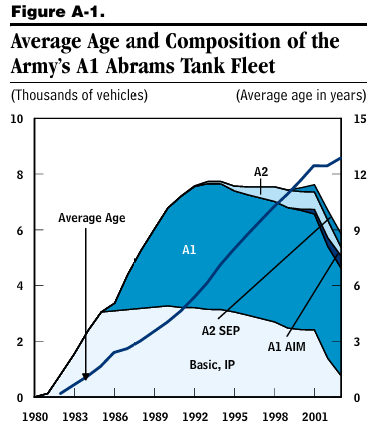
Didnt say the M1A1 fleet was phased out, I said the AIMs were being phased out because M1A2s were in full production, that much is clear from your own CBO report when they list vehicle numbers of the fleet.
Phased out is probs the wrong term here, but they had little intention of eventually upgrading every M1A1 to AIMs when M1A2s were more than likely taking up most of that production headroom, thats the M1A2 in terms of numbers out does the AIMs on this grapgh.
Spoiler
Not entirely, it costs them money to store DU, it costs money to maintain the areas that store DU, it costs money from organizations that handle it through contracts and licencing fees. the cost actually adds up overtime because of maintenance and handling and transportation costs. which a lot of can be reduced through non DU arrays being produced or using existing lines for existing arrays
All correct.
That is EXACTLY what it means.
The 5 yes.
Yes, a non-DU one.
Yes, the turret part.
5
It’s not ignored. the inventory is 5, they didn’t make more.
it’s in 5.
Find me any licence that authorizes installation in hulls and i shall happily concede.
The graph provided actually shows the M1A1 AIM expanding in the fleet from 2000 onwards. It was not being phased out; it was the primary modernization path for the thousands of existing M1A1 hulls that the Army could not afford to replace with brand-new M1A2s. The AIM program was specifically meant to keep the bulk of the fleet relevant for decades.
Regarding the cost of DU, the Department of Energy already pays to store and secure hundreds of thousands of tons of this material as a waste byproduct. Using it for armor is not a massive new expense; it is a way to utilize a raw metal that the US government already has in massive stockpiles. Developing and manufacturing the high-end ceramics needed for a non-DU export array is actually more expensive than using the DU surplus.
Speculating on why the Army might want to cut costs does not change what the Congressional Budget Office actually reported. The CBO audited the program and recorded that Heavy Armor was added to the hull. These are financial and inventory records based on real contracts. Claiming the Army skipped the upgrade to save money on a metal they have in surplus, while the documents state the work was done, is just a guess that contradicts the official record.
Item 9 in this 2016 NRC license is the exact authorization for installation. It permits the Use and storage of hulls as depleted uranium armor components. In NRC regulatory terms, Use refers to the operational employment of the material for its licensed purpose. A hull cannot be used as a DU armor component if the DU has not been installed.
The 5 tank limit you keep citing is not true. It does not exist on this license or the 2006 amendment that preceded it. The maximum amount is officially listed in Item 8 as As needed. The NRC would not authorize the unlimited use of hulls as radioactive components if they were just empty steel boxes.
The contractor handling license you posted covers factory tasks at Lima. This Army license covers the physical inventory of the fleet. Item 9 legally identifies the hull as a component that contains the uranium. That is the literal definition of installation for an armor package. The paperwork confirms the material is in the hulls and the limit on the number of those hulls has been gone for two decades.
Item 9 of license SUB-1536 is that authorization. It explicitly permits the Use and storage of hulls as depleted uranium armor components. In federal licensing, the term Use is the specific legal authorization for the material to be operational in its final assembled form. You cannot use a hull as a DU armor component if the material hasn’t been installed.
The contractor license you found for General Dynamics describes their specific shop floor handling tasks. The Army possession license defines the physical configuration of the fleet once the government takes delivery. By authorizing the Use of hulls as DU components in Item 9, the NRC is authorizing their integration into the vehicle.
The 5 tank limit was legally deleted from this license in 2006. Item 8 now authorizes possession As needed. There is no reason for a federal agency to remove a specific numeric limit and switch to unlimited authorization if the production was stopped at 5 tanks. The NRC removed the limit to cover the mass production fleet confirmed by the CBO audit. The documents show the limit is gone, the use is authorized for hulls, and the material is being utilized in the fleet. If you are waiting for a license that uses the word installation instead of the legal term Use, you are ignoring how federal possession and use statutes are actually written.
expanding? when the A2 portion is about 3x bigger than the AIM portion of the graph but notice how all productions basically dwindled around 2000-2003, I cannot get up to date figures but reality is, they clearly were reducing costs hence production across the A1/AIM/A2/A2SEP reduced significantly post 2000.
Who pays the DoE? government does. who issues budget changes? government does, just because the DoE pay the cost doesnt mean the cost is coming from elsewhere, do you think the DoE just produce there own money… no it comes from subsidies and government budget changes with each administration that comes along and wants to either increase or decrease it.
You also realise DU isnt purely used for armour or weapons right? just because they have a huge stockpile doesnt mean its all available for armour or weapons, a lot of it is also used to dilute enriched uranium from weapon programs and is also used in civil nuclear reactors because they dont use pure high enriched uranium, they use a mixed oxide or MOX fuel which to make that they need DU
The production graph dwindles after 2000 because the US stopped building brand-new hulls, not because they were cutting corners on the upgrades. Every AIM and SEP is a remanufactured tank. The AIM program was the only way to keep the thousands of M1A1s relevant during the Iraq war because they couldn’t afford to replace every single one with a brand-new M1A2.
Speculating about DU being used for MOX fuel or civil reactors is a reach. The MOX program in the US was a total failure and got cancelled years ago. The Department of Energy is currently sitting on over 700,000 metric tons of depleted uranium. It isn’t a rare or expensive material that needs to be siphoned; it is a waste byproduct they have to pay to store anyway. Using it for armor is literally the most cost-effective way to get high-density protection compared to buying expensive specialized ceramics for an export array.
The CBO audit from 2006 isn’t a theoretical plan. It is a record of what the government actually paid for and installed during that rebuild process. If the CBO says Heavy Armor was added to the hull, then the government signed the contracts and the work was done. Guessing about production headroom or handling costs 20 years later doesn’t change the official financial record of the fleet’s configuration.
Right and do you honestly think they would spend the money needed to convert all of these to DU hulls/turrets when they clearly needed to cut costs, hell if the main use for these was during Iraq they sure as hell knew adding DU to these would be redundant because they wouldn’t be facing anything of major concern in terms of firepower.
Do you see the picture now in why adding DU to what is basically a refresh fleet makes no sense.
No its not a reach, this was lifted in 2005 and the Nuclear Energy Association confirm that with public documents.
What you also dont see to grasp is the stockpile of DU the US have isnt all in the form needed to produce armour, the majority of there stockpile is in the form of DU Hexaflouride (DUHF) which costs money to deconvert, as of 2024 the Nuclear Energy Association claim the US have roughly 765000 tonnes of Hexaflouride stockpiled and this has to be converted if you want to use in other areas like armour and ammo
No.
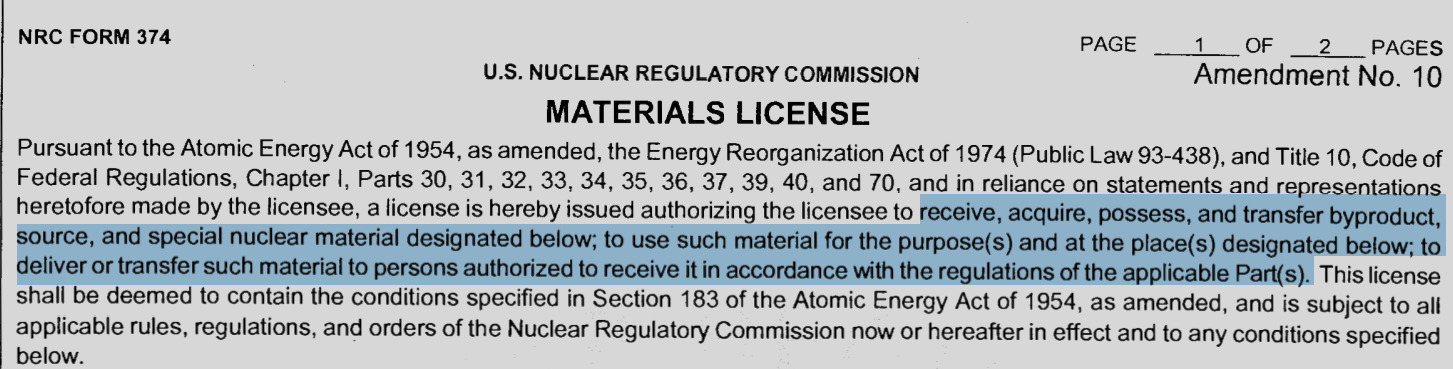
Yes, but not installation of the packages into them.
Correct, and they have 5.
The licence back references the application letter in point 13 and 17. the 5 are mentioned in the application.
They need 5 hulls.
They did it for security reasons.
( https://www.nrc.gov/docs/ML1229/ML12297A211.pdf )
No, use and storage. Excluding repair and maintenance.

No it isn’t. It does not mention installation. it doesn’t even mention that they are allowed to possess the packages outside of the turrets and the 5 hulls. Only as part of them.
Correct, so who installs them?
correct.
No, they have not given authorization for handling the packages outside of the turrets and the 5 hulls. They have not authorized transport and storage of the packages. only as part of turrets and the 5 hulls.
No, point 13 and 17.
for security reasons.
No, absolutely not. Not even a little. You are completely impossible.
Condition 17 actually disproves your point. Read the very first sentence: Except as specifically provided otherwise in this license.

That is a legal override clause. It means that if a specific box in the license header says something different than the old letters, the license header wins.
Item 8 on the first page specifically provides the maximum amount as As Needed. Because the license itself provides this specific As Needed authorization, it legally overrides the 5 tank limit mentioned in the 2006 letter.
You are trying to use the fine print to ignore the primary authorization of the document. If the NRC wanted a 5-tank limit, they would have typed the number 5 in the Maximum Amount box. Instead, they deleted the number and wrote As Needed to account for a mass-produced fleet.
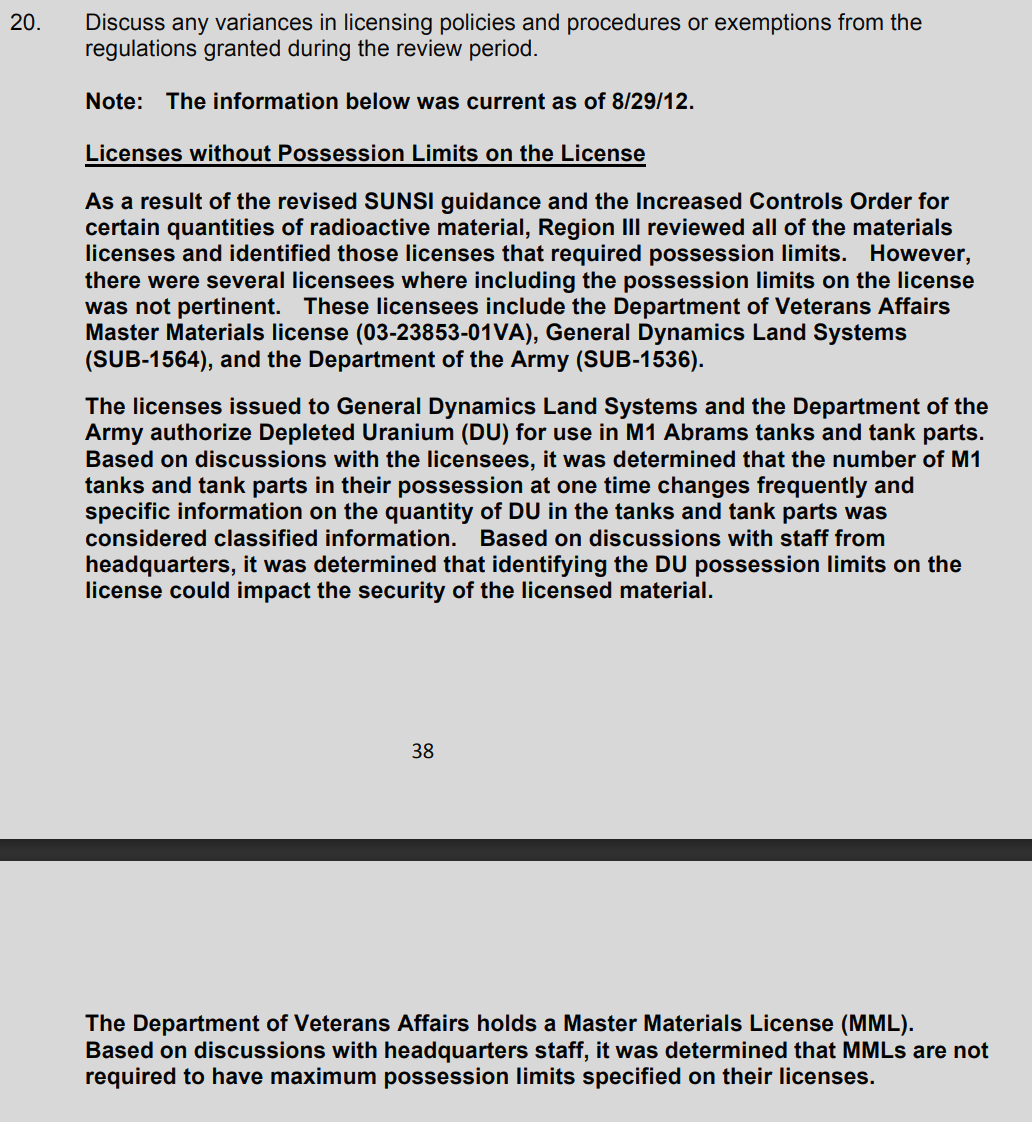
This matches exactly what your other source, the 2012 review, said on page 38: that the possession limits were removed because the number of tanks changes frequently and is now classified.
The number 5 is not a secret and it does not change frequently. You are using a 20-year-old note from a schoolhouse application to ignore the current legal reality. The Army is licensed for an unlimited, classified number of hulls. The CBO audit confirms they paid for those hulls. The 5 prototypes argument is over.
You are clearly getting emotional and resorting to one-word denials because the literal text of these documents contradicts your theory. I am not going to keep arguing with analogies about bikes and nails while you ignore federal law. I won’t respond again until you can explain why your own source says the inventory is a classified, frequently changing number if you honestly believe only 5 tanks exist. If you can’t explain that contradiction, you are just ignoring the evidence to protect an old decision.
1 Like
No, for security reasons as previously proved.
No.
DU in turret.
no.
yes.
No.
No.
No. I resort to one word answers as to not sound like a broken record and just repeat previous answers that have already since long disproved you singular logic track.
I’m not ignoring anything.
Turrets. They have frequent changes of DU in turrets. hulls stay 5.
No contradiction, i have said turrets 100 + times at this point.
Page 38 of the 2012 review says the number of M1 tanks and tank parts changes frequently. It does not say only turrets change. A tank includes the hull. If the hull count was permanently five, it would be a constant, not a frequently changing variable. There is also zero logic in making the number five a national security secret when it was public knowledge for decades. The quantity only became classified information because it shifted from five prototypes to the mass produced fleet.
Claiming the inventory is a secret frequently changing number while also claiming it is a public constant of five is a total contradiction. The CBO audit confirms the AIM fleet got the armor, the NRC says the quantity is now classified, and the 5 tank note hasn’t been the legal reality for twenty years. Since there is no explanation for why your own source calls the count a classified secret if you think it is still five, we really are done here. The documents are clear.
The statement is covered by changing only the turrets. Hulls don’t need to change for the statement to hold true.
They apply for one licence, they wanted amounts to be secret, all parts become secret by default.
Conjecture.
No, there are two parts, turrets and hulls, these can change independently.
Conjecture.
They really really really really aren’t. Gaijin have dismissed them repeatedly.
I strongly recommend reading through these threads:
Gaijin dismissing these sources previously does not change the literal text of the documents. Those older developer responses rely almost entirely on the 2006 letter note about 5 hulls while ignoring the actual legal reason the NRC removed that limit. The 2012 NRC review explicitly states that possession limits were deleted because the number of tanks and parts is classified information and changes frequently.
If the hull count was a permanent, public constant of five, there would be no security risk and no reason to classify the number. A static number is not a frequently changing variable.
The CBO audit confirms the mass-produced M1A1 AIM fleet received Heavy Armor in the hull. That is a financial record of what the government actually paid for during the refurbishment of hundreds of tanks. Claiming the documents are inconclusive just because the developers chose to ignore them in the past is a circular argument.
The documents are consistent: the NRC license is unlimited and the quantity is classified because it is significant, and the CBO budget audit confirms the fleet-wide upgrade was performed. Past developer decisions based on older, more restrictive versions of the license do not override the current legal and financial records.
correct.
Security reasons.
Does not prove that DU is in those hulls.
The answers still hold. None of the information you have provided are new things, read the THREADS and not just the top post. You have impossibly in this time read through thousands of responses and linked documents.