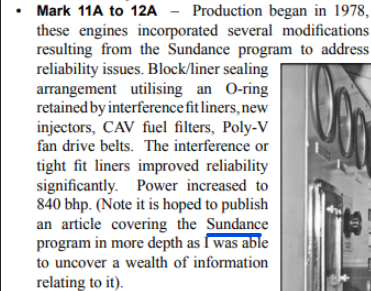
Please refer to the parliament archieve below, as of 1978 the engine improvement program (almost certainly sundance) was said to be “going well”, I doubt it was cancelled.
Just because the program ended in 1978, that does not mean that a significant number of Cheiftains were upgraded to that standard by then.
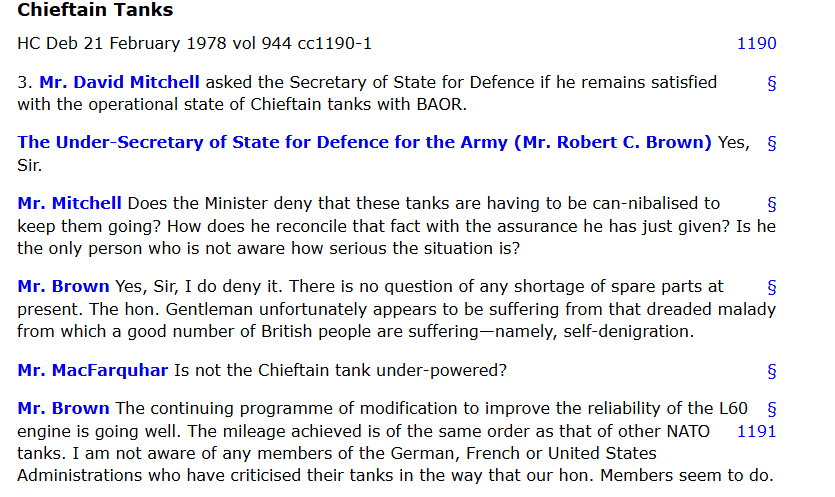
Archieves from parliament indicate that by Feburary 1978 the engine improvement (likely Sundance) program was still “continuing”. You can either read this as the actual program of upgrading tanks was continuing, or that the program of designing / developing improvement modifcations was still ongoing.
We don’t know how many Chieftains were actually upgraded, it could have only been a select few, therefore the CV12 replacement made sense due to the fact that many of Cheiftains were still running the old engine by 1982.
Even with Sundance upgrades, the L60 still had a lower maximum horsepower than the CV12 which could go up to 1000hp (as per your document), it made no sense to use the L60 instead of the CV12. The CV12 had more power potential and was more reliable.
I’d like to point out the word current isn’t used, it says “existing L60”, it never refers to it as the current variant as in the most modern variant rather just saying the L60 is the engine fitted to the Chieftain.

This is pretty vague, it dosen’t mention which variant of L60, and assuming it includes the sundance upgraded L60s is not unreasonable, but we don’t have direct proof.
Personally, I believe we should go with the Leyland society’s numbers as they are very specific about the engine variants and their horsepowers. A lot of the other sources talk generally about the L60, or about the marks of tanks themselves rather than the engine marks. The Leylands Society’s information is very precise and in detail, it also comes from Archives, so it’s reliable information.